MOFFIE is a powerful film about a young gay man who is conscripted into the South African Defence Forces (SADF) during the scourge of Apartheid, which is a secondary subject. To give you a frame of reference, during this period, the punishment for being a homosexual, considered by the army to be subversive, was medical torture.
The “cure” was administered by Dr. Aubrey Levin’s* Aversion Project. Despite being warned by the Truth and Reconciliation Commission that what they were doing was a violation of human rights, the “treatment” for homosexual soldiers was administered at Ward 22 on a military base. When the aversion “treatment,” didn’t work, surgical procedures were performed to alter their genitals, many of which were botched and sometimes resulted in death.
MOFFIE, a derogatory Afrikaans term for gay, is masterfully helmed by South African director Oliver Hermanus from the screenplay he wrote with Jack Sidey, adapted from an autobiographical book by André Carl van der. The protagonist is 18-year-old white South African Nicholas van der Swart, compellingly brought to life by Kai Luke Brummer, who gives a quiet, spellbinding performance.
He, along with other boys his age, have been conscripted to serve in the army for two years to train to fight the border war between South West Africa and Angola. He is a beautiful, soft-spoken young man, with delicately etched features, and he knows he must be constantly vigilant to guard against being found out. As a farewell gift, his father, Peet, sympathetically played by Remano De Beer, gives his son a girlie magazine as a good-bye gift.
Although he has never discussed his son’s sexual preference, perhaps he thinks it will camouflage his son’s real sexual identity and serve to have him pass as one of the boys.
Riding on a train with a bunch of young recruits, Nicholas witnesses them shouting at a black man sitting on a bench. They throw garbage at him and call him the “N” word. The horrifying scene is captured by Director of Photography Jamie D Ramsay, whose camera moves in and lingers on the man’s face, splattered with debris.
Hauntingly played by Israel Ngqawuza, without a single word of dialogue, everything you need to know about Apartheid is finely etched on that gentleman’s face. When this rowdy bunch arrive at the training center, they are greeted with a chaotic scene, with army personnel screaming orders at them.
Vicious Sergeant Brand, played with maximum meanness by Hilton Pelser, calls them scabs along with derogatory parts of the female anatomy. The training period that ensues is brutal and designed to strip these young recruits of any shred of humanity. Those harrowing moments are documented by Ramsay’s finely tuned cinematography, especially in his close-up shots. In the barracks, perhaps because of Nicholas’ delicate look, a boy begins to pick on him which he diffuses by showing him the girlie magazine.
There’s always one recruit that rubs the sergeant the wrong way and in this case it’s Michael Sachs. Well played by Matthew Vey, his character is given a series of repetitive tasks that are exhausting and pointless. The training exercises are brutal and sadistic. One recruit throws up and the sergeant makes him redigest the regurgitated contents of his stomach. Gossip spreads about two “faggots” and the young soldiers agree that they deserved to be punished with severe beatings and sent to Ward 22, where they will face the unthinkable. One of the recruits, Dylan Stassen, sensitively played by Ryan de Villiers, senses a mutual attraction between he and Nicholas and in a surprising moment, gives him a hurried, but dangerous kiss on the lips.
While showering one evening, Nicholas has a flashback to when he was a young boy of nine or ten at a summer resort with his family. He makes his way into the men’s showers where he stares at the naked bodies. He is caught by a bully of a man who drags him back to his parents shouting that there is something wrong with their son. His dad defends him but the issue is never discussed and we realize that even at that young age, Nicholas knew who he really was and perhaps his father did as well. There is a tender scene during a heavy downpour between Nicholas and Dylan, another recruit nicely played by Ryan de Villiers. They are in a trench together.
They’re cold and wet and they look at each other and slowly move closer and closer to keep warm. Nicholas notices that he has not seen Stassen recently. He finds out that what befell him is every gay soldier’s nightmare –that he had been sent to Ward 22. The future relationship between them is left with a giant question mark.
Eight months into training, the young soldiers, many of whom transitioned from playful young men to potential killers, are allowed to go on leave before shipping out. At home, wearing his uniform, Nicholas’ parents drink a toast to him with his dad saying ,“Now you’re a man.”
Director Oliver Hermanus assembled an excellent supporting cast including, Stefan Vermaak, Wynand Ferreira, Rikus Terblanche, Shaun Chad Smit, and Hendrik Nieuwoudt. In addition, he surrounded himself with a top-notch production team including, Editors Alain Dessauvage and George Hanmer, Costume Designer Reza Levy, and Composer Braam du Toit, whose lively musical score ranges from Bach to Rock with a fun scene of the boys singing “Summer Breeze.”
It’s unlikely that any director starts out to make a masterpiece. However, this work merits that description as MOFFIE is truly unforgettable, finely-crafted filmmaking.
Distributor: IFC Films
Release Date: Current
Where: Select Theaters & on Digital and VOD Platforms
Language: Afrikaans and English
Running Time: 106 Minutes
Rating: R
Orange County Supervisor Katrina Foley has provided Rossmoor Community Services District with clarification that the City of Los Alamitos sales tax rate does not apply to Rossmoor.
Recently, the District informed Supervisor Foley of a problem some Rossmoor residents were having with being charged the increased City of Los Alamitos sales tax rate. The Rossmoor Community Services District inquired about the sales tax charges for the unincorporated area of Rossmoor now that the City of Los Alamitos approved a new 1.5 percent local sales tax. This new sales tax is imposed on top of the base 7.75 percent County rate. The County of Orange has now issued and received guidance from county counsel. The short answer to Rossmoor residents is that they are not subject to the Los Alamitos Tax.
While Rossmoor shares the same zip code with the City of Los Alamitos, Rossmoor keeps the same base 7.75 percent tax rate since the City of Los Alamitos’ new sales tax should only be imposed in the City’s jurisdictional boundaries and should not be charged on sales made in unincorporated areas. The California Department of Tax and Fee Administration has a website that allows users to look up a tax rate by address: https://gis.cdtfa.ca.gov/public/maps/TaxRates/
Using this website, you will see that 12081 Chaucer Rd, Los Alamitos, CA 90720, which is in unincorporated Rossmoor, lists a 7.75 percent total sales tax rate. However, 11122 Los Alamitos Blvd, Los Alamitos, CA 90720, which is in the City of Los Alamitos, lists a 9.25 percent total sales tax rate.
Retailers sometimes charge the wrong sales tax rate, particularly where a zip code contains multiple taxing districts as noted in the attached article. In the attached Publication 452, the California Department of Tax and Fee Administration states:
What happens if you are charged too much tax? Contact the business where you believe the incorrect rate was charged and request a refund. If you are unable to resolve the issue, call the CDTFA at 1-800-400-7115 (TTY:711), and staff will work with that company to resolve the problem.
Orange County Supervisor Katrina Foley has stated that she, “looks forward to continue working with the Rossmoor community to help solve community concerns.”
Although Joshua Kreitzer leads one of the region’s fastest growing companies, his own rough and rocky road to the summit of success has left him determined to instill values of leadership among his rapidly expanding workforce.
Channel Bakers CEO Josh Kreitzer
“Our brand is about focusing on new ways to help people,” said Kreitzer, as he hints at what really drives him as a leader.
Kreitzer is the founder and CEO of Channel Bakers, a global ecommerce agency based in Anaheim. During the pandemic, the company grew its worldwide workforce over 50% in 2020, bringing 61 new employees onboard.
Despite worldwide economic impacts from the pandemic, the agency achieved year-over-year growth in each of its key markets and accomplished regional expansion goals, said Kreitzer.
Kreitzer uses strength forged by his own life experience to inform a unique brand of leadership that has led to stratospheric growth.
Although he sits atop a skyrocketing business, Kreitzer’s vision of success seems centered now around attracting the brightest young talent and giving them whatever they need to grow the company, and themselves, to a better future.
“At Channel Bakers, we grow the dough,” he jokes, but deeper, Kreitzer grows the self-esteem of his employees and it seems to be working spectacularly well.
Kreitzer’s digital metamorphosis began way back at the birth of the internet, with Ingram Micro. As a sales manager, he worked with big accounts like Apple, and he was compelled to keep pace with their technologies, if for no other reason than to sell them products as the internet grew.
Learning from the lessons of Apple
His stop-and-go digital career has rocked back and forth as companies imploded, so he moved around. Another key step was when Kreitzer landed a job at Buy.com, where he focused on helping brands leverage their digital platforms to build retail channels.
He could not have known it then, but his day-to-day encounters were providing him with enormously valuable knowledge precisely at the dawn of the internet age.
He took notice when Apple, then just an upstart, published 10 posters entitled “think different.” Kreitzer collected nine of the 10 originals, which hang in his home today, but more importantly, these posters apparently made him begin to think differently as well.
During his days at Buy.com, Amazon, too, was merely an upstart. If fact, “Amazon was the enemy,” he said, yet keeping up with their progress was part of his job.
Eventually, Kreitzer moved to GoPro, where he focused on building retail channels for brands using data and large media ecosystems.
When he lost his job at GoPro, the bottom fell out, literally, for Kreitzer, and his family. His wife, Katie, a mortgage industry executive, was also affected and the young couple lost their home after the financial crisis of 2008.
“Things got pretty rough,” he said.
By then, however, Amazon had begun their ascent to the top of the ecommerce world and was building an incredible digital platform that few noticed.
Kreitzer’s internal guidance system, however, was already locked on as he studied their every move.
Apparently, the inner strength and knowledge that resulted from his family’s crisis and his deep knowledge of the internet, slowly began to power Kreitzer’s stunning comeback.
By 2013, Amazon was not only a behemoth retailer but had also built a staggering digital platform that few understood. Kreitzer, meanwhile, had been ever-present and believed he had decoded Amazon’s data platform.
Kreitzer began to speak to brands about utilizing what he saw as an untapped resource as his ideas began to stir.
Falling back on his friends, many of whom managed big brand digital advertising, Kreitzer said he approached them at the 2015 Consumer Electronics show in Vegas.
“Don’t look at Amazon just as a retailer,” Kreitzer advised them. Instead, Kreitzer felt like the big brands should look at Amazon’s platform as a credible alternative to rivals Google and Facebook.
“I can utilize Amazon’s own data to grow your brand,” Kreitzer said he told them, promising to target Amazon shoppers and send them directly to big brand websites.
As they began to buy into the idea, Kreitzer said they began to ask whether or not he had a company.
“I said no,” said Kreitzer. “Well you need to start one,” Kreitzer said they told him.
So, he did, forming Channel Bakers in 2015. This time, there would be no looking back for Kreitzer.
Not only was he properly positioned for growth, but his particular brand of retail channel management quickly captured the attention of his big brand friends.
His tiny upstart in Anaheim began to grow as big brands grew along with him.
Kreitzer’s was the first agency purely focused on Amazon Advertising, but Channel Bakers today has evolved into a full-service, global agency founded upon a core tenet to help innovative brands find the right audience at the right time.
Kreitzer’s team shown in pre-pandemic setting in their collaborative office environment.
He attracted young, creative talent to tell the big brands’ story and eventually, their specialty work drove their sales through the roof.
Hitching his company’s fortunes onto Jeff Bezos’ Amazon platform, for sure, was a stroke of genius that has since put his own company on a stratospheric trajectory. Channel Bakers is now fully accredited and certified by Amazon as an advertising partner, says Kreitzer.
“Last year we saw more than 145 million consumers shopping online for the first time ever in response to social distancing measures. The shift to shopping online has accelerated the need for brands to transform their go-to-market strategy and overall brand experience into measurable digital platforms,”he said.
According to Kreitzer, the agency saw a return of more than $700 million in ad-attributed client sales performance from more than $100 million in Amazon ad spend last year. Just on the Amazon platform alone, Channel Bakers built and managed more than 84,500 advertising campaigns across their 220 clients around the globe in 2020.
Channel Bakers also celebrated the launch and accelerated scaling of its first UK office, joining its existing U.S. and Asia office locations. The agency now has full-service representation on three continents, which it credits to enhancing overall speed-to-execution of its client campaigns.
Kreitzer’s Anaheim office suite now reflects many of his own lessons on life. He inspires his employees, mostly young, tech-savvy creatives, to write “notes of gratitude to each other.”
He inspired them to paint creative slogans on the wall of their massive suite. Located in Anaheim Hills, Kreitzer has also carved out inspirational rooms where employees can retreat to create.
One has a Disney theme (Kreitzer is a big fan of Disney’s ‘happiness for all’ philosophy), another has Einstein’s face and words. Then, there is the George Lucas Star Wars suite, etc. “Every one of them were people of value as much as success,” he notes.
“We genuinely respect the people we work for, not just their brands,” said Kreitzer, “and we use these rooms to brainstorm. My goal is to make the entire office conducive to creation,” he said. Sort of like an ideation incubator of value creation.
“Teamwork makes the dream work,” he says.
Not only does Kreitzer urge collaboration among his team, he also promotes being out of the office and “in the community.” “There’s more to life than work,” he claims, and Channel Bakers employees often collaborate on charitable and community projects outside the office.
So far, this philosophy seems to be working for Kreitzer.
The Channel Bakers creative team doubled creative department revenue in 2020. The team also accomplished major business objectives, including development of a full-service, in-house video production department capable of producing video to scale with an emphasis on Amazon OTT (over-the-top), Sponsored Brands Video, and DSP online video ads.
eMarketer recently reported that digital marketing spend in 2020 grew by $3.59 billion to reach online consumers, who spent more than ever streaming programming by Amazon, Disney, Hulu and other content providers.
Digital video streaming platforms such as TikTok and Twitch have drawn a fast-growing audience, which resulted in brands shifting dollars away from traditional television advertising and into products such as Amazon’s OTT advertising.
Kreitzer said Channel Bakers’ clients are seeing increased performance at multiple stages of the sales funnel by employing campaign strategies involving OTT as well as introducing high-quality video into Amazon’s Search platform. The agency has differentiated itself by combining traditional storytelling with technological innovation.
Kreitzer promotes caring as much about the community as employees do about themselves.
“Channel Bakers has continued to grow because we are data-driven and maintain a level of creative execution meeting the expectations of the world’s largest brands,” Kreitzer added.
In October of 2020, Kreitzer was awarded “Internet Marketer of the Year” by the Internet Marketing Association at its annual IMPACT 20, which set a Guinness World Records achievement for largest attendance for a virtual marketing conference in one week.
Channel Bakers offers turnkey ecommerce solutions and advertising strategies fueled by analytics. Its campaigns help elevate brands such as Samsung and Honeywell, and range from apparel, consumer packaged goods, over-the-counter drugs, automotive, and electronics to financial, insurance, education and more.
Amazon, the eCommerce, cloud computing, digital streaming, and artificial intelligence giant with a market capitalization of more than $1 trillion, not only lists Channel Bakers in their Partner Directory of Amazon advertisers but has also posted their own case studies featuring Channel Bakers’ creative and advertising work with Samsung.
Like other tech CEO’s, Kreitzer knows the real value lies within the hearts of his employees, not simply the work they create every day. “They must care more about the end result than themselves,” he insists.
“I wake up in the morning to create tomorrow’s leadership,” says Kreitzer, acknowledging what compels him forward every day. “My job is creating new leaders,” said Kreitzer. “Amazon is just a platform to get us there.”
The curriculum for the first-ever ethnic studies elective at Los Alamitos High School is now available for public viewing.
For months, supporters and opponents have spoken at Los Alamitos Unified School District Board of Education meetings debating the merits of the optional ethnic studies class without knowing exactly what it would offer.
On April 27, Deputy Superintendent Ondrea Reed briefly presented the course work at a Board meeting that drew hundreds of people. More than 90 people signed up for a chance to address the Board.
The curriculum has been on public preview since the meeting. The Board will vote on it June 1.
The overview of the ethnic studies course and its curriculum can be viewed on LosAl.org by typing “ethnic studies” into the search bar. Hard copies of the items are also available at the District’s office in Los Alamitos.
The optional course, named “Ethnic Studies: Cultural Experiences in the United States,” is expected to be offered in the Fall of 2021 as an elective for LAHS 11th and 12th graders.
“The intent of this course is to expand students’ awareness of the role of ethnic groups in a diverse American society in order to build community and solidarity across various groups and differences,” reads part of the course overview.
The curriculum spans eight units starting with the first unit on the origins and history of Ethnic Studies. Another unit’s title is: Labels vs. Identity: Where Do Stereotypes Come From and How Do They Affect Society? Another unit focuses on community-based social movements in the 1950s and 1960s.
According to the course overview, students will take part in a number of projects including conducting an oral history interview with a family member or another adult in their lives “focusing on the concepts of race, ethnicity, nationality, and culture.” During a unit studying community organizing, students will be asked to create an art project. Students’ final assignment is to “design and implement a service learning project with a community organization in their neighborhood.”
The Board unanimously approved the concept for the ethnic studies course in February.
After Reed’s presentation last Tuesday, Board President Marlys Davidson praised her and the team, thanking them for how they developed the curriculum.
“I look forward to going over every piece of it because I know that you thoughtfully developed it in conjunction with other districts and every resource rather than just buying something that is mass produced and doesn’t reflect our community,” Davidson said.
Reed’s presentation on the curriculum came after more than two hours of public comments. That included statements from at least twenty LAUSD students speaking in favor of ethnic studies.
Students and other speakers also addressed a related effort from LAUSD; the adoption of social justice standards described as a resource for K-12 teachers to guide conversations about bullying, intolerance and racism.
Board members will consider the social justice standards, developed by LearningforJustice.org, a project of the Southern Poverty Law Center, at their May 11 meeting.
Both efforts were targeted by opponents at a Town Hall held at a church in Long Beach on April 20. One speaker at the event argued LAUSD’s ethnic studies class and social justice standards are guided by “critical race theory,” an academic discipline studying systemic racism.
Critical race theory has been attacked by some high-profile conservatives who say it is “anti-American.” A website promoting the Town Hall accuses LAUSD of introducing courses that “are filled with hate for America and all America stands for.”
“I don’t know how to be more clear,” he said before spelling it out: “Critical race theory is not a foundation of this ethnic studies course.”
At the end of the meeting, LAUSD Board Vice President Diana Hill also addressed what has been said about district efforts, noting the ethnic studies elective is being developed at the request of students and families and is not politically driven.
“The idea that we are indoctrinating our students with any political agenda is absurd. It’s absurd. And that might happen in other places but that doesn’t happen here in Los Al,” Hill said.
Ethnic Studies Elective Curriculum Now on Public Preview
On June 1, the Los Alamitos Unified School District Board of Education will vote on the proposed curriculum for its first-ever ethnic studies elective to be offered at Los Alamitos High School. The following texts are what will be included in the course. The optional class for 11th and 12th graders has spurred passionate debate from speakers at recent LAUSD Board of Education meetings.
On Saturday, April 24th the streets of Seal Beach were filled with sights and sounds from days gone by. Nearly 200 gorgeous, painstakingly maintained vintage cars and trucks cruised the streets of The Hill and Old Town, thrilling spectators with their throaty roars and flashy paint jobs. Leading the pack was Seal Beach realtor, Wyatt Hill in his 1962 Plymouth Valiant Signet 200, chosen as a symbol of the valiant perseverance of our local businesses over the past year.
The cruise featured nearly 200 vintage cars from 1980 or earlier. Seal Beach residents and spectators watched, socially distanced, from their yards, balconies, green belts, parks and businesses along the 3 ½ mile route, expertly manned by volunteers of the Seal Beach Lions Club, led by Nikki Muller.
The event was entirely volunteer run, by members of the Seal Beach Chamber of Commerce, the Seal Beach Lions Club and other members of the community.
“I am very pleased with the event and deeply touched by all of the community support around it. It was fun to see people out socially distanced, watching from their yards, front porches and on the greenbelts,” said Tim Way, Chair of the Car Cruise. “So many participants mentioned how great it was to cruise past everyone waving and cheering them on. It made them feel like they were in a parade,” he exclaimed.
Trophies were awarded in 8 classes, as follows:
Best Truck was a 1950 Studebaker pickup, owned by Brian Bateman and sponsored by Ferguson Realty.
Best Convertible was a 1967 Pontiac Convertible Grand Prix, owned by Richard Scandaliato and sponsored by G & M Oil.
Best Coupe/Sedan was a 1967 Chevrolet Chevelle, owned by Jimmy Mercurio and sponsored by OPGI.
Most Unique was a 1936 Great Racer BeerSter, owned by Milt Thomas and sponsored by Republic Services.
Best Car for Mom was a 1961 Nash Metropolitan, owned by Patrick Halbert and sponsored by the Seal Beach Lions.
Best Car for Dad was a 1957 Chevrolet Nomad, owned by Don Kammerer and sponsored by Baytown Realty.
Best Paint Color was a 1963 Chevrolet Nova, owned by Robert Raices and sponsored by 16th Street Garage.
Seal Beach Chamber of Commerce Choice was a 1932 Ford Roadster, owned by Randy Palmer and sponsored by the Seal Beach Chamber of Commerce.
The first 7 classes were judged via online voting, by spectators.
The First Annual Vintage Car Cruise is an official event of the Seal Beach Chamber of Commerce and could not be produced without the support of event partner, the City of Seal Beach, the Seal Beach Lion’s Club, Boeing, Seal Beach and generous event sponsors, G & M Oil, Republic Services, Baytown Realty, 16th Street Garage, The Sun News, Original Parts Group and Ferguson Realty.
During the April 19 meeting of the Los Alamitos City Council, Mayor Mark Chirco announced the “very sad news” that former Mayor Kenneth C. Parker had passed away at the age of 65.
Parker served two terms as the Mayor of the City of Los Alamitos. He was elected to the City Council in November 2000 and was re-elected in December 2004. Parker had a strong background in corporate finance.
He owned and operated Ken C. Parker and Associates Inc., an independent financial management company based in Los Al, and served as Finance Director on many boards and commissions.
During his career in public service, Parker served on the Board of Directors of: WestComm JPA as Chairman, Orange County Sanitation District Finance Committee and as Chairman of the Operations Committee, Southern California Association of Governments, Orange County Fire Authority Board of Directors, Orange County Transportation Authority WOCPDS Policy Committee, Joint Forces Training Base Master Plan Committee, Orange County Growth Management Area Board, North Orange County ROP Virtual Enterprises (Advisor), and the Orange County Senior Citizens Advisory Council Transportation Committee and other regional boards.
Within the community, Mayor Parker had served as Auditor, Treasurer, and Parliamentarian of the LAE PTA, part of the LAUSD Drug and Alcohol Prevention Coalition, and was the City Working Group Representative, according to his bio.
In addition, Mayor Parker has serviced the community as an employee of the Los Alamitos Parks and Recreation Department. He has 29 years of community involvement, including participation as: Los Alamitos Elementary PTA board member, Founder of Los Alamitos Tennis Club, Los Alamitos High School Varsity Tennis Coach, Manager Los Alamitos Junior Baseball, and AYSO soccer coach.
A native Californian, Mayor Parker graduated from Los Alamitos High School in 1973.
“He was very involved in our community,” said Chirco, who noted the city had been honored by his service. “He gave very dedicated service to this community,” said Chirco.
Local delivery companies are charging significant fees to deliver food from restaurants to consumers at home as governments may soon attempt to step in to help mom and pop restaurants.
The April 19 meeting marked the first time the Los Al city council had met in person since the onset of the pandemic. Rather than meet in the standard city hall meeting room, the city has instead renovated its community center to include a makeshift city meeting room where council members can be socially distanced.
The council discussed an “urgency ordinance” that would sharply limit the fees that delivery service companies could charge local restaurants to deliver prepared dishes to residents.
According to the staff report, third-party food delivery services charges have risen significantly over the past few years. “These increases are impacting local businesses, as restaurant owners and theircustomers are struggling to combat the economic strain caused by the COVID-19 pandemic,” it said.
Third-party food delivery companies, such as Grubhub, Uber Eats, DoorDash, and Postmates have stepped in to fulfill this service by providing residents with delivery from local restaurants, the report said.
“However, these companies charge restaurants commissions that can reach 30% or more, potentially wiping out any profit that a local business might make from a delivery order. With an increasing amount of food delivery business being performed through online third-party services, restaurants must comply with these companies’ fees or risk losing customers,” it concluded.
In fact, Mayor Mark Chirco said other cities in West Orange County, like Buena Park, have already adopted such local ordinances and the state is considering a bill in the Assembly that would limit fees statewide, he said.
Therefore, Chirco said while he has not yet decided to support the ordinance, he thought it was time for the council to at least have a chance to discuss the issue.
“We need to think about it,” said Chirco, saying many consumers have expressed concern over “a lack of transparency” about the fees and commissions among food delivery services.
Mayor Pro-Tem Shelley Hasslebrink said while she liked the idea of the ordinance, it is “just not necessary.”
She said the delivery companies took advantage of an opportunity during the pandemic and simply “took what the market allowed.” Nevertheless, Hasslebrink said the city should do whatever possible to help restaurants in the city.
After Council member Ron Bates suggested the regulation should be facilitated on a business level, fellow Council member Tanya Doby agreed with his idea. She suggested a couple of alternative ideas but said, for now, she kind of has a “small issue” with the ordinance.
Jordan Nefulda said he was reluctant to get involved until he knew more.
Among other provisions, the draft ordinance would restrict fees they could charge. “It shall be unlawful for a third-party delivery service to charge a retail food establishment a delivery fee that totals no more than 15 percent,” was one of the proposed ordinance provisions.
With a similar bill in the state Assembly, however, Chirco said he thought it would be best for the city to table the proposed ordinance to wait and see if the issue is not first addressed by the state. This would give the council more time to explore the issue, he added.
In other action, the council voted unanimously to approve a hike in its master fee schedule. In doing so, Bates suggested the city seriously investigate giving homeowners some relief on fees related to some replacement do-it-youself projects.
Eric R. Nuñez, the Police Chief in the city of Los Alamitos, and the immediate past president of the California Police Chiefs Association, has announced his retirement effective June 4.
The announcement came at a meeting of the Los Alamitos City Council last week. Nuñez, who recently returned to the office after a bout with COVID-19, said the experience had “refocused” his priorities.
Nuñez has served as Police Chief since 2016 after serving for 25 years at the La Palma Police Department.
“It’s kind of difficult,” Nuñez told the Council at its April 19 meeting. “I sent out an email, it was a save the date kind of thing more than an official resignation,” he said.
Yet, Chief Nuñez said the email informed the city and his department that June 4 would be his last day on the job, having made the decision to retire.
“Throughout the five years I’ve been here, I’ve grown and learned a lot,” said Nuñez, noting that some his “best years” in law enforcement had been spent in Los Alamitos. said Nuñez as he thanked the council for the opportunity to serve in the position.
“It feels strange,” he said, “because I’ve never quit anything.” But, said the police chief, Los Al city manager Chet Simmons had reminded him that he was “not quitting, simply retiring.”
Nuñez said will that on May 30, he will have 30 given thirty years of service to law enforcement. Given the circumstances, therefore the Los Al Police Chief thought it was a perfect time to retire.
“Thank you for your service to the city,” said Mayor Mark Chirco, “and congratulations on your well-deserved retirement.”
“Chief Nuñez has served and represented the City of Los Alamitos well,” the mayor said. “We appreciate his many years of dedicated service to the city, community, and police department and we will certainly miss him. We wish him a wonderful and well-deserved retirement after 30 successful years in law enforcement.
Nuñez said he would stay around to help the city “find the right leadership” in law enforcement before he “physically separates” from the city.
Nuñez served as the 55th President of the California Police Chiefs Association (CPCA 2020-2021) representing 332 police chiefs and their respective agencies as a leader in California law enforcement.
According to the association, Nuñez was “a skilled and staunch public safety legislative advocate focused on improving community and officer safety, securing funding for local mandates.”
In addition, Nuñez worked to provide effective officer training, develop best practices for police executives and managers, and to increase community trust by practicing fair and impartial policing with increased levels of transparency and ensuring accountability.”
Nuñez also serves on the Board of Directors for California Police Chiefs Association (CPCA) and serves on the Finance, Legislative and Political Action Committees for CPCA. Chief Nuñez has also served as the President of the Orange County Chiefs of Police and Sheriffs Association (OCCPSA).
Nuñez has been active in local law enforcement, serving as the Chair on the Integrated Law and Justice Agency of Orange County (ILJAOC), Vice-Chair of the Orange County Remote Access Network (OCRAN) Board, a 10-year member of the International Association of Chiefs of Po (IACP) and he shas been a California Peace Officer Association (CPOA) member for 20 years.
What has been a tumultuous couple of weeks for the Los Alamitos Unified School District resulted in students themselves stepping to the forefront to express their support for a proposed ethnic studies high school elective course and social justice standards, a K-12 framework for teachers.
More than 200 people showed up at the LAUSD Board of Education meeting on Tuesday, April 27, with more than 90 of them signing up for a chance to speak for or against the measures, one week after opponents staged their own town hall.
At least twenty students spoke in favor of LAUSD’s efforts.
A supporter of LAUSD’s ethnic studies curriculum attends the April 27 Board of Education meeting. More than 200 people showed up for the meeting and 90 people signed up to speak to the Board. Photo by Jeannette Andruss
“I believe this ethnic studies class is a very important class because it tells us stories that help us belong,” said Los Al sophomore Nico Muench-Casanova.
“In order for students to learn about the countless figures and events that our current curriculum overlooks, we must include ethnic studies as an elective course at Los Alamitos High School,” said Jack Chang, a junior at LAHS.
“We should acknowledge our differences, embrace them, and be able to learn from them,” said Los Al high school senior Jackie Bond.
While the board took no action, the textbook and other coursework that the district planned to use for its ethnic studies course were introduced, including the book A Different Mirror: A History of Multicultural America by Ronald Takaki.
The public will now have 30 days to inspect the proposed coursework and a vote is expected June 1.
On Monday, LAUSD emailed district families a statement and a five-page document entitled “Ethnic Studies & Social Justice Standards FAQ” seeking to clarify many of the competing claims circulating throughout the community about what the district was actually proposing to do.
This action came after critics of these measures took part in a Town Hall at a church in Long Beach last week that attracted more than 200 people, with roughly 30 of them identifying as LAUSD parents.
Giant screens at the April 20 meeting at Cornerstone Church displayed a slide warning “Critical Race Theory is coming to Los Alamitos Schools. Are these your values?” One presenter criticized LAUSD efforts and accused the District of trying to turn students into “social justice warriors.”
That speaker discussed LAUSD for 25 minutes and the rest of the two-and-half-hour Town Hall featured school choice supporters and conservative activists, including one who encouraged parents to be confrontational with elected officials.
An LAUSD Board Member who attended the event was not asked to speak but did have an exchange offstage with one of the presenters.
In the statement, LAUSD Superintendent Dr. Andrew Pulver slammed the “non-District sponsored” Town Hall saying it was put on by “special interest groups” that tried to connect the “controversial concept of Critical Race Theory to our course.”
Critical Race Theory, or CRT, is an intellectual and academic discipline examining the intersection of race and laws and systemic racism. CRT has become a target of conservatives, including former President Donald Trump who called it “toxic propaganda.”
The District’s new FAQ document states its efforts are not aligned with Critical Race Theory and the focus is instead on “Culturally Responsive Instruction” or CRI. LAUSD described it as “both an asset and research-based approach that makes meaningful connections between what students learn in their schools and their cultures, languages and life experiences.”
In his statement, Dr. Pulver wrote: “It is shameful and deceitful to imply that Los Al Unified is attempting to pit students of differing ethnicities and racial backgrounds against one another. Our intent is to bring students and communities with diverse backgrounds together by affirming their identities, stories, and contributions.”
The course, entitled Cultural Experiences in America, was developed by LAUSD staff, was first approved in February and is slated to be offered to juniors and seniors who had already taken another history course at LAHS in the Fall of 2021.
The Social Justice Standards — a framework for teachers to use to address topics like racism, bullying and intolerance — is up for discussion by the Board on May 11.
The framework was developed by TeachingTolerance, now known as LearningforJustice.org, a project of the Southern Poverty Law Center and includes “anti-bias scenarios” tailored to different grade levels.
For example, one scenario in the K-2 grade group depicts a boy being taunted for playing with a baby doll. Another student intervenes and says, “It’s OK that he likes different things than you or the other boys.” A teacher supports the intervening student and says, “As long as no one is being hurt, you shouldn’t judge someone for what they like.”
Speaker calls for Confrontation; School Choice Ballot Measure Pitched
At the April 20 Town Hall, Harriette Reid, a retiree who lives in Long Beach and says she has a godson in LAUSD, made a 25-minute presentation arguing the District is being guided by Critical Race Theory.
“Our goal is to give you facts. It’s to let you know what we think is wrong and … where we do need to step up and push back a bit against the school district,” Reid told the crowd.
In her presentation, Reid used some slides that represented information from LAUSD, including slides screenshotted from District workshops. But she also had original slides, including a flow chart showing Critical Race Theory as the umbrella over District goals.
Two slides from Reid’s presentation showed the introduction and anchor standards and domains from the Social Justice Standards framework. Another slide showed blurbs taken out of context from TeachingTolerance.org including one that said: “Gender identity is based on how someone feels inside.”
“Wow,” said one person in the audience. “Oh my God,” gasped another as the slide went up.
Reid was also critical of Christine Sleeter, one of the authors cited in the district’s ethnic studies presentation saying a quote attributed to Sleeter sounded more like CRT than ethnic Studies.
“This is where that theory that this is going to be a Critical Race Theory course came from. We’re not saying it’s all gonna be Critical Race Theory.”
(Sleeter’s work is not part of LAUSD’s ethnic studies course supplemental materials which was presented April 27.)
Reid warned the goal of the District’s effort was to make students become “social justice warriors.”
“If you take nothing else, understand that they plan to make your child active in whatever causes they think are important,” Reid said.
“If you listen carefully to what the opponents are saying, there is a strong misconception [about ethnic studies and social justice standards] out there,” claims Dr. Cathery Yeh, an LAUSD parent and Chapman University Professor who has been involved in LAUSD’s Human Relations Advisory Council which has guided the efforts.
In a phone interview on April 23, Reid said, “I don’t think that everything in TeachingTolerance.org is bad.” But she said there’s “enough bad there.” “You have no idea where that teacher is on the scale of I agree with CRT or whether they are going to use the benign examples.”
In the District’s FAQ document, it assures parents that the optional ethnic studies class is not aligned with CRT and that care will be taken to ensure that teachers “present topics from multiple points of view” and have students examine materials from “multiple perspectives to come to their own conclusions.”
Reid said she was asked to speak out by parents who were afraid of being called racists. “I feel that I’ve been called out, called on to speak out because of my background and because of who I am,” Reid said.
Reid is Black. She said her parents lived in Alabama in the Jim Crow-era before moving to California in 1959 where Reid said she attended private schools and her family found success. Reid, who has spoken at Board meetings, said that white parents feel her “voice will carry more [weight] than theirs.”
She said she is impacted by District policies because she has “to live next door to the people you are educating.”
In the phone interview, Reid said she is concerned about Critical Race Theory and is also interested in promoting school choice and has been helping gather signatures for a school choice ballot measure.
After Reid’s presentation, the Town Hall’s next two hours featured speakers pushing for school choice and political activism.
That included Arthur Schaper, the Organization Director for Mass Resistance. Schaper, who lives in Torrance, said Mass Resistance is a “pro-family,” “in-your-face confrontational group” that “doesn’t shy away from speaking about the destructive aspects of homosexuality, transgenderism and the whole Black Lives Matter Critical Race Theory garbage.”
He spoke about his group’s success getting Downey schools to drop a sex education course by using confrontational tactics with elected officials.
“We don’t ask politely,” Schaper said, noting in Downey, activists confronted board members at church and at their homes.
“We need angry parents and relentless troublesome citizens who won’t settle for concession,” he said, encouraging parents to confront school board members outside of meetings. “You have to make these elected officials’ lives miserable.”
The evening’s final speaker, Larry Shoaf, the OC Chairman of the California School Choice movement, an organization seeking to push a statewide ballot initiative to allow residents to create “Educational Savings Accounts.”
Shoaf told the group he’s collecting signatures to get an initiative on the 2022 ballot that would allow citizens to utilize funding from Prop 98, a measure that requires 40% of California’s budget be spent on K-14 education.
If approved, said Shoaf, parents would then control the educational savings accounts, and use the stipends to send their children to the school of their choice, including charter schools and private institutions.
Despite Los Al Unified’s reputation as a top public-school system in the state, Shoaf said generally, California schools are “failing on multiple levels.”
A panel discussion that followed the speakers took written questions from the crowd. The panel included Jeff Barke, a former LAUSD Board member who lost his re-election bid in 2018. He also runs a charter school in Orange; Logan Zeppieri, an associate at the Charles Koch Institute; Marc Ang, an activist who worked to defeat Proposition 16, the affirmative action measure on California’s 2020 ballot; Dr. Jacob Daniel of the Heritage Council; Peggy Hall, founder of the Healthy American; Reid, Schaper, and Shoaf.
Town Hall ‘Hijacked’ by Activists
Some LAUSD parents who expressed concern about the course and standards and wanted more information said they helped organize the Town Hall when they felt the District was not providing enough details.
One of those parents is David Ryst. He has three kids in LAUSD schools. Ryst has spoken out about the ethnic studies course and Social Justice Standards at Board meetings and has also met with LAUSD officials to voice his concerns and ask questions.
In an interview prior to the Town Hall, he said he hoped parents would “get some information they need.”
Right after the speaker portion of the meeting, however, Ryst said, “they (organizers) had some bigger goals and agendas with school choice.” He also criticized Schaper’s tactics.
According to Ryst, other political agendas had “hijacked” what had been, in his eyes, a well-meaning attempt to provide better information to parents.
Another LAUSD parent that attended the event wrote in an email that she found it “eye-opening” and feared tax dollars were being spent on programs to fund “a curriculum that teaches kids to choose their gender and encourages them to be activists at such a young age.”
But she said she was surprised to see more than 200 people when she expected it to be “a small group of concerned parents.”
No LAUSD parents spoke at the event. The only person with a connection to LAUSD that spoke at the meeting was Barke during the panel discussion. That’s when Barke pushed back on Schaper’s efforts to encourage confronting school board members.
“Activism helps, but please do so politely and articulate your position at a school board meeting,” Barke said.
LAUSD VP Not Recognized; Calls Presentation ‘very incorrect’
LAUSD Board of Education Vice President Diana Hill attended the Town Hall but was not asked to speak. She said she let organizers know she was available to answer questions by writing it on an index card attendees were given to submit questions.
Ryst said he was not aware that Hill submitted the card but said, “It would have been awesome if she would have been able to speak.”
Hill said LAUSD parents should be checking with the District if they encounter information they find questionable.
As the Town Hall ended and people were leaving, Hill and Reid had a spontaneous and civil discussion where Hill called Reid’s presentation “inaccurate” and “very incorrect.” Two reporters witnessed the exchange.
Hill specifically disputed the slide in Reid’s presentation that showed Critical Race Theory being the umbrella guiding LAUSD’s approach.
“That’s not us,” Hill said, asserting that CRT is not the focus of their efforts.
One apparent point of contention, or confusion, is the actual Social Justice Standards framework considered by the Board members versus the group and website that created it.
Hill held up a photocopy of the framework for Reid and said: “This is what we’re voting on.”
“How would you know that they aren’t planning to use TeachingTolerance.org when the materials point you to that?” Reid said in a phone interview on Friday. “How do you know they are just going to use the ‘good part’? How do you negotiate that?”
The District’s FAQ document issued Monday states: “The Board is not adopting all materials provided by Teaching Tolerance.”
At the April 27 Board meeting, Dr. Pulver explained that just because the standards are coming from Teaching Tolerance does not mean the District will utilize the entire website. He compared it to purchasing one algebra textbook from a publisher did not mean all math books from that publisher’s website would be used.
Pulver also stressed that in the diverse district, teachers had been asking for these tools, which he said would be one of many in their toolkit, to address a variety of student-driven questions.
At the April 20 meeting, Hill said LAUSD reached out to school education officials in Anaheim and the Teaching Tolerance framework was being used there.
Supporters and Opponents of Ethnic Studies Plan Next Steps
Los Alamitos High School students have responded to the emergent ethnic studies controversy by organizing themselves into a visible show of support, claiming opponents are simply trying to create division for their own purposes.
Calling itself the “Griffin Coalition,” the group announced itself in an email this month saying, “we are pro-ethnic studies, pro-social justice standards, and pro-culturally responsive instruction.”
Hunter Dunn, a senior, is part of the Griffin Coalition along with other students, including Bond. They were among the more than twenty students that spoke at Tuesday’s meeting.
Dunn and Bond both said they faced heckling after speaking at a previous meeting.
“The Us vs. Them narrative is an incredibly reductive philosophy,” he said in an interview this week, adding that the coalition’s mission is to support the school board to “create a better community, not a more divided one.”
Dunn said the LAUSD board is simply responding to “what the students want.”
Last summer, Dunn notes, Los Al students organized three peaceful protests, including standing in solidarity for Black and brown lives, asking the district to explicitly address the hateful rhetoric and discrimination that have occurred at school.
The reckoning resulted in a marathon board meeting last June wherein students, teachers and parents who claimed to have been victimized by hate or bullying with LAUSD during the past decade, also asked the district to consider making changes to enhance diversity.
“They are listening to their students,” Cathery Yeh said of the Board of Education. “That’s what they should do.”
Over the past year, the district has made multiple presentations on the ethnic studies course and Social Justice Standards, and heard plenty of comments at its meetings, but had yet to issue a statement or FAQ until Monday.
Ryst said he only recently received a response from some Board members after reaching out repeatedly. He said he did learn that some of the programs are already being tested out in the schools. (Vice President Hill confirmed pilot programs were underway which she said is customary with any curriculum.) He thinks the Board will approve the Social Justice Standards and he is exploring options for allowing his children to opt-out of it.
In an email to Board members this week Ryst wrote: “I am convinced my participation as a parent is unwanted. I have spent countless hours trying to get insight to what’s being planned for our schools and continue to be left in the dark. Sadly other groups have done a better job at trying to inform the community than our own district.”
Dunn said what was presented at the Town Hall “couldn’t have been further from the truth.” But he stops short of painting everyone against, or seeking more information, with a broad brush. “Not everyone against ethnic studies is a hateful person,” he said, but the current dialog is “not healthy for the community.”
Ryst said he’s heartened seeing people engaged and his message to fellow LAUSD parents who may think differently from him is for them to explain why they like these standards. “I haven’t seen anyone say, ‘I believe TeachingTolerance.org is the best way to do it.’ …
Please if you support it, please make sure and show what you support. Maybe I’ll have my eyes opened.”
Editor’s Note: This is an updated version of the story that appeared in the April 28 print edition of The Event-News Enterprise. It was updated to include events from the April 27 LAUSD Board of Education meeting which happened after the ENE print publication deadline.
The growing battle over ethnic studies prompted the Los Alamitos Unified School District superintendent to express support for his staff at Tuesday’s board meeting, following a week of information being distributed, some of which questioned the district’s top administrators.
Although the district has been working on an ethnic studies elective course for the past year, the process of adopting it has grown intense of late, with strong emotions being expressed along battling lines between opposing sides.
The public drama playing out in Los Alamitos comes amid the intersection of a state ethnic studies effort and as a handful of other OC districts having already adopted courses similar to the one elective LAUSD is currently attempting to add to its curriculum.
During the superintendent’s report, District Superintendent Dr. Andrew Pulver noted that while opponents have every right to express their opinion on the course, he suggested calling for removal of some top administrators has perhaps exceeded the bounds of reasoned argument.
“I speak only for myself,” said Pulver, noting however, that “I am sure that I have the complete support of the board, but I won’t speak on their behalf.”
Nevertheless, the superintendent commended Deputy Supt. Ondrea Reed and Teacher on Special Assignment Nadia Williams, both of whom have worked on the framework for the new ethnic studies course.
“They have my complete support,” said Pulver. “They (Reed and Williams) do their work with grace and dignity,” said Pulver, saying the work was assigned to them by the board and is important work, “even if it does not align with everyone, it is the work the board has asked them to do.”
Like some of the speakers later in the meeting, Pulver said the tactics of the course are puzzling and expressed concern about the level of “misinformation” being disseminated.
“I don’t believe in cancel culture,” said Pulver, yet “it is often some of the same individuals who say that they don’t believe in cancel culture who are trying to write petitions to remove individuals who are doing work, not from their political agenda, but work directed to them by the staff and reflects values we hear from all our individuals.”
“I really do appreciate hearing dissenting voices,” said Pulver, as well as those who are in support, but at the same time we have to make decisions that are in the best interest of the system. That’s the goal,” he said.
The board’s meerting turned into a marathon session, sometimes rollicking with outbursts, prompting board members to plead for a “civil discourse.” Since more than 50 speakers registered to speak at the open mic portion of the meeting, board members limited speakers in the workshop to two minutes but allowed speakers in the regular meeting the full three minutes.
Many opponents attacked similar targets, including a loosely defined term called critical race theory, potential “indoctrination” and turning whites into “evil oppressors.” They also attacked the Southern Poverty Law Center, one of the sources from which social justice standards are being considered and many of them cited specific constitutional references that the board purportedly would be violating.
Supporters of the ethnic studies course self-identified themselves as parents or students, giving specific reasons as to why an ethnic studies course would be helpful. Some of the opponents did acknowledge having children or grandchildren attending, or passing through the system.
Matt Simmong said he was against critical race theory, calling it “terrible and poisonous,” making students, depending on their race, either “oppressors or victims.”
Denise Inouye also criticized critical race theory. She said it “paints all whites as evil oppressors,” calling it “nothing less than child abuse,” making students, in her view, “ashamed of their skin color.”
“I don’t see truth as a misconception,” said Harriet Reid, another opponent. She called Christen Sleeter, one of the proponents, and author of some ethnic study resources a racist and said her work promotes “indoctrination” based on “Marxist” ideology. “Truth is a defense,” she said.
Kim Franke, calling herself a “Christian patriot,” also said critical race theory is based on a “Marxist agenda,” a “socially constructed category” that ultimately teaches students “to hate their classmates and themselves.”
Barbara Kipinosz, said she spent more than eight hours doing a “deep dive” into the critical race theory curriculum. “I dissected the curriculum,” said Kipinosz, but “there’s a difference between criticizing an unfair system and criticizing those who can do well within the system,” she said.
She also said critical race theory also promoted binary notions of gender but said “trust me folks, there are two genders, it’s a scientific fact, but people are diverse.”
One student at McAuliffe Middle questioned why “white privilege” would be taught in schools and that it he thought it would be “moving backwards,” saying he was called terms like ‘homophobe’ and ‘idiot’ “for no other reason than wearing my MAGA hat.”
Another McAuliffe student asked the board “why add something else when school is hard enough?” He questioned the implementation of social justice standards while also saying he’s heard fellow students saying things like “pick my cotton” and “don’t whip me master” while walking down the hall.
Larry Cramer said he did not want critical race theory being “taught in our schools.” He said the theory teaches children “exactly the opposite” of what Martin Luther King preached and, in his view, “promotes hate in our country.”
Melissa Austin pleaded with the board to “just let the dust settle from the past year.” Austin nonetheless said she has collected more than 400 signatures on a petition asking the board to reject the ethnic studies curriculum and stick to teaching “reading, writing and arithmetic.”
“I guess I’m about the lowest form of human being there is on earth according to the critical race theory,” asserted Charles Williams. “I’m an old white man who grew up in the South,” he said.
Williams said his parents nevertheless taught him to “respect everybody” and that now with two grandsons, “I hate the thought that this curriculum could teach them they are flawed human beings.”
“I am here representing a nation, a state that I don’t want to see become another statistic due to pressure and intimidation,” said Julie Kizzlar. “Parents should be teaching this at home,” she said, “to have respect for another regardless of color and ethnicity.”
Belen Herrera Smith asked the board to reject this “trojan horse called social equality. God’s watching y’all,” she said.
Amid the steady drumbeat of opponents, however, those favoring the curriculum expressed their full throated support. Some were exasperated, expressing frustration at the “highly organized” opponents, the repetition of their argument and that only a few self-identified as having a vested interest in LAUSD.
For instance, Jacqueline Asbury, a mother of two children in the district, suggested the opponents were “highly organized” noting that many did not “identify themselves as a parent in the district.” Asbury said it appeared as though many were reading from messages received from a “Facebook group” that promoted them to “come down here and speak up.”
“Where does this organization come from,” she asked? “It sounds like fear to me.” Asbury said “you are fighting an elective, don’t you understand that?” If you don’t like it, your child doesn’t have to take the course,” she said, turning toward the large group of opponents. Asbury predicted all students would eventually get some version of ethnic studies in college.
The administration has proposed is a course that will only be available to high school students as an elective, meaning if students choose not to take it, it is not required for graduation.
The coursework for the ethnic studies elective has yet to be introduced and there has been no discussion of any “curriculum” changes. Once coursework is approved, only students who want to take the course can register.
“My mom is a staunch Republican, my dad is very liberal and I’m a Christian Catholic,” said Los Al senior Jackie Bond. “I’ve never been tested but I’ve seen every day people bullied for their skin color,” she said, “and this is not acceptable.”
Moreover, Bond said the circus atmosphere in the meeting room is “really indicative of the ignorance that this class (course) is trying to alleviate. “I believe we are not an ignorant community but a community of inclusion,” she added.
Nichole Horton, with two children at Weaver Elementary, described very touching examples of why her own children, she thought, would benefit from such an ethnic studies course when they were able to take it.
Barbara Farrell said all her children and grandchildren attended Los Al Unified, said “I know you are not looking at critical race theory, I support your decision.”
Nathan Searles, whose daughter attends middle school, thanked the board for being “brave and honest,” saying their action is “robust and meaningful. Do not let harassment stop you from delivering core values of this district,” said Searles.
“The time has come for an ethnic studies course,” said Denise Miller. “This is not to be feared but celebrated,” she said, suggesting that studies by Stanford University have indicated students who take ethnic studies courses show gains in math, science and other subjects.
Cathery Yeh, a Los Al parent, complained about the “misconceptions that need clarification” being spread, saying she and her family received some of the misinformation. “Can you imagine getting this at your door,” she asked, describing some of the info, “if you are a person of color?”
Yeh said she has been to all of the meetings and reviewed decades years of research on the topic.“It’s not just about race, it’s about biased education with components to address prejudice,” she said. “It’s about collective action and how to build community,” she argued.
Hunter Dunn, another Los Al High School senior, said “I think we can all agree that we want to create the best environment to produce smarter healthier and more successful individuals regardless of race class or creed.”
“Please stop saying that this class is going to divide us into oppressors,” Dunn asked the opponents. Also, he urged them to stop trying to create a “liberal boogeyman that’s going to take away our rights.” This tactic is mere political theatre, he suggested, saying the board was simply trying to create “better education for everyone.”
Amber Steeves thanked the board for voting for ethnic studies. Steeves said she would “have loved to have the opportunity as a young person to learn” more about ethnicity. “Our duty to empower them (students) with information,” she said. Opponents “soley trying to deny the option to learn” demonstrates fear, she suggested, and said “the more opposition makes a clearer picture that this needs to happen.”
President Maryls Davidson said once the coursework for the ethinc studies elective is introduced, the community will have 30 days to examine before it is voted on by the board.
Two of the community speakers actually spoke about other items.
Shaun Shuck, who said he served as student body president 21 year ago, was critical of the board for their decision to remain in hybrid until the end of the school year. He criticized LAUSD for “lack of consistent decision making” and for using metrics “that only matter when it suits your agenda.”
Finally, Claire Kurkjian, a student at Weaver Elementary, whose dad is a U.S. Navy reservist, reminded the board that many kids within Los Al Unified are “military kids” who make sacrifices because of parents leaving for long periods of duty. She asked the board to “purple up for military kids’ at their next meeting.
Purple is the color you get when you mix all of the colors of the U.S. flag, she said, so she asked the board and the staff to wear something purple at the next meeting to show solidarity with military kids and support for their parents serving in the military.
It seems now that Rossmoor Community Service District Directors see the wisdom in the community stepping in to slow down the process of legislation to enhance the overall powers of the district.
The board, at its April meeting, agreed to seek a latent powers consultant to help them figure out the process and to move forward to set up an inclusive process to discuss real change in governance.
The District backed off an attempt last month to work with Assembly representative Janet Nguyen to introduce legislation that purportedly would have granted the special service district additional powers of governance. Now the district doesn’t quite know who understands a very complicated law.
Rossmoor is not an incorporated city or town, yet they do have some powers, those granted to it under its status as a “special service district.” It provides some powers, but not nearly the powers afforded villages, towns and cities to govern the municipal affairs within their community.
The Rossmoor community includes about 3,500 homes and approximately 10,000 residents.
According to the California Service Districts Association (CSDA), there are approximately 2,300 independent special districts in California, meaning they are governed by an independent board of directors elected by the districts’ voters or appointed to a fixed term of office.
While the Rossmoor Board of Directors does enjoy some powers, even then they pay taxes to Orange County for various provisioned services such as trash collection, public safety and public works, yet OC keeps all the fees while the district has little, or no control.
Regarding an upcoming waste management agreement, General Manager Joe Mendoza explained to the directors what he’s been able to accomplish by way of changes in the agreement, but said it sometimes takes extraordinary effort just to get simple things added to agreements negotiated by the county.
Mendoza also introduced Chris Palmer via Zoom, Senior Public Affairs Director for CSDA, who said while cities and towns had been authorized to receive stimulus funds in the latest federal stimulus bill, the service district lobbyists were not able to get service districts included in the bill.
Even in the absence of authorizing language in the bill, Palmer said they’ve managed to build a coalition of special district allies and have fired off a letter to Gov. Gavin Newsom seeking inclusion in the distribution of funds.
Palmer said special districts around the state collectively lost more than $2.4 billion because of the pandemic. “We need those funds,” he said.
While Cypress will get $9 million, Seal Beach $5 million and Los Al $2.3 million (estimates) in new COVID stimulus funds, service districts can attempt to make direct appeals to the state, simply based on community organization status. It was not exactly clear what the path for stimulus funds for service districts will be.
When discussing governance later in the meeting, directors began to discuss a process of change and how to keep citizens better informed.
Nevertheless, Director Tony Dimarco said somehow, some changes should be made in the status.
He complained that Rossmoor earns an annual franchise fee of $23,000, but it is paid to Orange County Sanitation or the agency responsible for the contract. “I guess it’s okay,” he said, but noted how easily Rossmoor CSD could administer the contract and keep the administrative fee.
He suggested Rossmoor residents contact Mendoza and his staff with any concerns or problems, who would then relay them to OC Sanitation, yet the administering agency would keep the entire fee. It adds up.
For example, on a five-year agreement, Rossmoor could receive approximately $1.5 million in fees, but under the current law that governs RCSD status, such contracting is not allowed so the franchise fees are kept by the agency that administers the contract (in this example, OC Sanitation).
In fact, said DeMarco, “we could manage several contracts.”
“Why can’t we get these franchise fees for ourselves,” he asked? “I know it’s complicated and, speaking with legislative staff, I’m not sure they understand it.”
“If we’re going to do that, we need to understand how it is done successfully” said Board President Jeffrey Barke.
“It’s not a question of whether we want to do this, it’s about the process,” argued Director Jeffrey Rips.
Many residents agree with the idea of seeking better control, he suggested, but they too want to know the process.
“This could be a great first step,” said Rips, adding to Barke’s suggestion the RCSD leadership readdress the community with a process of how this can happen, seeking their input. “We will share during that process why we think this is the right thing to do,” said Rips.
“So I agree, I think we do need a process,” said Barke, but he said the board may need outside expertise. While “the legislative person in our assembly, and our state senator, may have insights (on service districts) they’re both relatively new too, so we may even want to look for somebody else with the level of expertise to guide us.”
DeMarco suggested Chris Palmer, an official with the California Service District Association, who perhaps understands the legal instrastructure of latent powers, which are the type of power that would have to be changed to allow Rossmoor Community Service District governing authority.
“We need to move quickly and in an open manner,” said Director Mark Nitikman, suggesting that the board’s legislative committee move quickly on a process framework for the change and for the Rossmoor Advisory Committee.
He suggested expanding the Rossmoor Advisory committee but surely want to let them know that the RSCD is “there to listen as much as talk.”
Director Nathan Searles, an attorney, suggested the Board get going. “We’re going to have to be quick on this,” he said, because a year is going to pass quickly and if residents approve, directors want to have the legislation introduced as early as 2022. “We can’t be passing this down the road too much.”
Barke revealed the district met with new Second District Supervisor Katrina Foley and would keep her appraised as well so that if and when legislation does appear, the district would want her support as well.
The Directors voted unanimously to move forward with a plan to have Mendoza reach out to Palmer as the legislative committee begins to create a process and framework for expanding RCSD powers to discuss with the Rossmoor Advisory Committee and ultimately, the residents of Rossmoor. It seems now that Rossmoor Community Service District Directors see the wisdom in the community stepping in to slow down the process of legislation to enhance the overall powers of the district.
The board, at its April meeting, agreed to seek a latent powers consultant to help them figure out the process and to move forward to set up an inclusive process to discuss real change in governance.
The District backed off an attempt last month to work with Assembly representative Janet Nguyen to introduce legislation that purportedly would have granted the special service district additional powers of governance. Now the district doesn’t quite know who understands a very complicated law.
Rossmoor is not an incorporated city or town, yet they do have some powers, those granted to it under its status as a “special service district.” It provides some powers, but not nearly the powers afforded villages, towns and cities to govern the municipal affairs within their community.
The Rossmoor community includes about 3,500 homes and approximately 10,000 residents.
According to the California Service Districts Association (CSDA), there are approximately 2,300 independent special districts in California, meaning they are governed by an independent board of directors elected by the districts’ voters or appointed to a fixed term of office.
While the Rossmoor Board of Directors does enjoy some powers, even then they pay taxes to Orange County for various provisioned services such as trash collection, public safety and public works, yet OC keeps all the fees while the district has little, or no control.
Regarding an upcoming waste management agreement, General Manager Joe Mendoza explained to the directors what he’s been able to accomplish by way of changes in the agreement, but said it sometimes takes extraordinary effort just to get simple things added to agreements negotiated by the county.
Mendoza also introduced Chris Palmer via Zoom, Senior Public Affairs Director for CSDA, who said while cities and towns had been authorized to receive stimulus funds in the latest federal stimulus bill, the service district lobbyists were not able to get service districts included in the bill.
Even in the absence of authorizing language in the bill, Palmer said they’ve managed to build a coalition of special district allies and have fired off a letter to Gov. Gavin Newsom seeking inclusion in the distribution of funds.
Palmer said special districts around the state collectively lost more than $2.4 billion because of the pandemic. “We need those funds,” he said.
While Cypress will get $9 million, Seal Beach $5 million and Los Al $2.3 million (estimates) in new COVID stimulus funds, service districts can attempt to make direct appeals to the state, simply based on community organization status. It was not exactly clear what the path for stimulus funds for service districts will be.
When discussing governance later in the meeting, directors began to discuss a process of change and how to keep citizens better informed.
Nevertheless, Director Tony Dimarco said somehow, some changes should be made in the status.
He complained that Rossmoor earns an annual franchise fee of $23,000, but it is paid to Orange County Sanitation or the agency responsible for the contract. “I guess it’s okay,” he said, but noted how easily Rossmoor CSD could administer the contract and keep the administrative fee.
He suggested Rossmoor residents contact Mendoza and his staff with any concerns or problems, who would then relay them to OC Sanitation, yet the administering agency would keep the entire fee. It adds up.
For example, on a five-year agreement, Rossmoor could receive approximately $1.5 million in fees, but under the current law that governs RCSD status, such contracting is not allowed so the franchise fees are kept by the agency that administers the contract (in this example, OC Sanitation).
In fact, said DeMarco, “we could manage several contracts.”
“Why can’t we get these franchise fees for ourselves,” he asked? “I know it’s complicated and, speaking with legislative staff, I’m not sure they understand it.”
“If we’re going to do that, we need to understand how it is done successfully” said Board President Jeffrey Barke.
“It’s not a question of whether we want to do this, it’s about the process,” argued Director Jeffrey Rips.
Many residents agree with the idea of seeking better control, he suggested, but they too want to know the process.
“This could be a great first step,” said Rips, adding to Barke’s suggestion the RCSD leadership readdress the community with a process of how this can happen, seeking their input. “We will share during that process why we think this is the right thing to do,” said Rips.
“So I agree, I think we do need a process,” said Barke, but he said the board may need outside expertise. While “the legislative person in our assembly, and our state senator, may have insights (on service districts) they’re both relatively new too, so we may even want to look for somebody else with the level of expertise to guide us.”
DeMarco suggested Chris Palmer, an official with the California Service District Association, who perhaps understands the legal instrastructure of latent powers, which are the type of power that would have to be changed to allow Rossmoor Community Service District governing authority.
“We need to move quickly and in an open manner,” said Director Mark Nitikman, suggesting that the board’s legislative committee move quickly on a process framework for the change and for the Rossmoor Advisory Committee.
He suggested expanding the Rossmoor Advisory committee but surely want to let them know that the RSCD is “there to listen as much as talk.”
Director Nathan Searles, an attorney, suggested the Board get going. “We’re going to have to be quick on this,” he said, because a year is going to pass quickly and if residents approve, directors want to have the legislation introduced as early as 2022. “We can’t be passing this down the road too much.”
Barke revealed the district met with new Second District Supervisor Katrina Foley and would keep her appraised as well so that if and when legislation does appear, the district would want her support as well.
The Directors voted unanimously to move forward with a plan to have Mendoza reach out to Palmer as the legislative committee begins to create a process and framework for expanding RCSD powers to discuss with the Rossmoor Advisory Committee and ultimately, the residents of Rossmoor.
As Printmasters, a local print shop in Los Alamitos, wraps up the final rounds of their Student Art Contest, today they are proud to announce the winners of the 3rd topic, “What Does Community Mean To You?” This topic is particularly fitting in this 4-part competition, the purpose of which has been to help local students through creativity and philanthropy. The contest has brought uplifting stories of motivation from participants and will ultimately lead to the publishing of a book called “The Artists of Los Al.” Printmasters will be selling the book in order to donate proceeds to Casa Youth Shelter, The Youth Center, and LAEF (Los Alamitos Education Foundation). As you read the comments from the winners this round, we think you’ll agree that Printmasters’ goal of uplifting our local student community has truly worked.
Elementary Ages 6-8 Division
First Place: Aashna Patel
Aashna says “Our community is very beautiful and I love everyone in it. My teacher is my hero in my community. Mrs. Moushon is a fun teacher, I love to learn math, science and art from her.”
Second Place: Anya Nieblas
Anya says “I love art because it helps me show how I feel. I can be creative and draw new things. This is me jump-roping, that is my favorite thing to do at school.”
Elementary Ages 9-11 Division
First Place: Alistair Wu
Alistair, who has now won 3 First Place awards in this competition, says “I can’t believe I can win more than one prize in the art contest. I have enjoyed learning and experimenting in different styles of drawing and painting using various materials. The process is fun and challenging. I hope I can serve my community and raise social awareness of important issues through my artworks in the future.”
Second Place: Ellie Oh
Ellie says “I am very glad to be able to share what I love about my community and how I am grateful for the community members that encourage me and make me a better person. I hope everyone learns to be thankful for our everyday surroundings and to be grateful. I think it is really thoughtful of Printmasters to come up with these amazing art topics to really influence kids like me to think about the great things in life to be thankful for, and to have a chance to share with the public. I think art is a beautiful form of sending a message with creativity. “
Middle School Division
First Place: Alene Washington
Alene says “Painting has always been my favorite hobby to do in my free time because it is very relaxing and peaceful. I enjoy painting on the beach; with my watercolors next to me and listening to waves crash, which inspired this cool piece. By sharing my art with you all, I was hoping that it would spark joyful memories and remind us to continue to create these memories in spite of these times. I’m looking forward to all of us having a safe and awesome summer!”
new doc 2021-03-09 16.04.38
Second Place: Emma Jimenez
Emma says “Since I was 4 years old, art has always been a passion of mine. Unfortunately, I never cared or knew how to improve my art skills, I just did it for fun. Art is my happy place. My aunt and uncle have really amazing drawing skills. I really love to draw as well, but wasn’t able to draw people as well as they did. That was until middle school came around and I chose Art as an elective. I almost didn’t enter the art contest because I wanted to draw a picture of myself but didn’t like how it turned out. After a few projects in my Art class, we were going to learn how to make self-portraits. I WAS TERRIFIED!!! The first drawing I made looked so weird, but then my teacher taught us the basics and I was able to make what you see today. My point is, art will always have a special place in my heart, but drawing portraits will always be more special to me. I wanted to say THANK YOU to my Art teacher and Printmasters for building my confidence!”
High School Division
First Place: Breanna Segura
Breanna says “Art is very important to me, it distracts me from the negative things going on in the world and allows me to express my feelings. You’re able to create anything your mind wants and I love the sense of freedom art provides. This art contest was super fun to me and I’m happy I got to participate, it allowed me to have fun despite the current circumstances going on with the pandemic!”
Second Place: Jeya Suwanwanitch
Jeya says “Before creating my piece, “March 17 Wednesday 4:15 AM,” I was faced with a massive artistic burnout. My right hand had just recovered from overuse pain, but drawing never felt the same since. I didn’t stop drawing, but every moment felt like I was on autopilot mode. I kept drawing because it was for other people and not me. It made me sad to see all my creative drive had left. All my concepts seemed bland, and I started feeling pessimistic about my artistic dream. Then on one morning, my teacher, Mr. Long, announced the Print Masters contest on google classroom. At first, I thought, “It’s futile, I shouldn’t bother,” but I checked it out anyway. The prompt, “Community,” was so vague and personal that it allowed me to draw something therapeutic for myself and still turn in the piece as an extra opportunity. The thought of creating without many constraints made me the happiest in months. I may have won a place in this contest, but more importantly, the joy of creating art unpressured returned to my conscience.”
Everyone at Printmasters congratulates this round of winners! If you are interested in more information about the upcoming “Artists Of Los Al” book and the Non-Profit Charity donations, please contact us at 562-493-4547 or de****@**************al.com. Thank You!
Los Alamitos wrapped up a perfect 6-0 record and the outright Sunset League championship with a 41-3 win over Newport Harbor on Friday at Los Alamitos High. Malachi Nelson threw for three touchdowns, connecting with Brian Jurado, Makai Lemon and Shain Allen. Jurado also ran for two touchdowns and Gavin Porch added another touchdown run for the Griffins. The Griffins finished the season ranked No. 3 in the Orange County poll. Two other Sunset League teams also finished in the top 10 (Edison at No. 5 and Corona del Mar at No. 9) Pictured above is Gavin Porch, breaking through the line for a big gain.
Cypress High’s football team closed out its season with a 31-8 win over Kennedy High on Thursday at Handel Stadium. The win secured an Empire League Championship for the Centurions for the second year in a row.
The Cypress defense was able to keep the Fighting Irish off the scoreboard until the final minutes of the game. Kennedy threatened at times, including a drive inside the 10 yard line, but ended with a turnover on downs when the Centurion defense held.
Other promising drives also stalled, sometimes with Kennedy penalties assisting, but also on several sacks that pushed Kennedy into long yardage holes. Cypress coach Rick Feldman praised he defense, which had a lot of young players after graduating a host of seniors from last year. He noted that defensive coordinator Jeff Crooks did a great job bringing the young group along.
“They just picked up where we left off last year, they played fast all year long, made plays all year long,” Feldman said.
The Cypress offense was also led by a host of underclassmen, including junior quarterback Dylan Eldridge and sophomore receiver Matthew Morrell, who made for a dangerous combo this season. Against Kennedy Eldridge threw for 246 yards and three touchdowns, with two of those touchdowns going to Morrell. Morrell finished the night with 207 yards in receptions.
Cypress began to pull away in the second quarter. Kennedy had moved the ball to midfield, but a false start penalty and a sack by the Cypress defense shut down the drive.
After a short punt, the Centurions struck quickly. They ran flea-flicker play that had Morrell alone behind the defense, Eldridge connected with him for a 58-yard touchdown that pushed the Centurions lead to 21-0. Prior to the Kennedy possession, Eldridge and Morrell connected on a pass that put the ball at the 10 yard line. Tomas Ramirez followed that with a sweep to the end zone for a 14-0 lead.
Cypress shares the league title with Pacifica and Tustin, as all three finished 4-1 on the shortened season. Cypress won the league outright last year. They were 3-0 before getting tripped up by Pacifica, 26-21, on April 8. But the Centurions are happy with the way the season played out.
“It feels great to win league for the second year in a row,” Feldman said.
Feldman admitted that with all the changes and interruptions, he was unsure how sharp his players would be. Teams originally were cleared to begin practice in late 2020, with the idea of starting a season in January. That was scrapped as the lockdown returned for another two months. Given all that, Feldman was impressed with how well the team did. He credited his staff with putting the players in a position to succeed.
“They just really stepped up and played hard all year, it was exciting to see,” Feldman said.
Kennedy was able to get on the scoreboard late in the fourth quarter on a pass from Kaos Devinney to AJ Frieson for a touchdown. Starting quarterback Alex Herrera left the game after, what appeared to be a shoulder injury after a hard collision on a run. The fighting Irish went 1-4 this season with their win coming on a 39-36 victory over Crean Lutheran.
Tickets are on sale now for the Rossmoor Woman’s Club’s annual Spring Garden Tour and Outdoor Marketplace. The event was cancelled in 2020 due to Covid-19, but it returns this year from 10 a.m. to 4 p.m. on Sunday, May 16, with masks and social distancing required.
This will be the 17th year for the self-guided tour, which features landscaping, pools, outdoor kitchens and more in five Rossmoor yards. In addition, shoppers can browse the pop-up Outdoor Marketplace for plants and outdoor decor, refreshments and other wares sold by a variety of vendors. Several gift baskets will be raffled off, too.
Tickets may be purchased in advance for $15 from any Rossmoor Woman’s Club member
or the participating merchants listed below. You can also buy tickets the day of the tour at the Outdoor Marketplace, which will be in the parking lot behind Farmers & Merchants Bank, at St. Cloud Drive and West Road in Rossmoor Center, next to the Los Alamitos-Rossmoor Library.
A third option is to purchase tickets online at rossmoorwomansclub.com and pick them up the day of the tour at the Outdoor Marketplace. This option costs $16, which includes a $1 handling fee.
The tickets include the addresses of homes on the tour and a map.
All net proceeds from the Garden Tour go to support the Rossmoor Woman’s Club’s charitable work with a variety of organizations throughout north Orange County and Long Beach. The club provides scholarships for Los Alamitos High School students and money, in-kind donations or hands-on-work to help fill the needs at organizations including Precious Life Shelter, Bethune Transitional Center, Ronald McDonald House, Food Finders, Long Beach Veterans Hospital, the Joint Forces Training Base, We Care, Fix Long Beach and many more.
Check rossmoorwomansclub.com for more information.
Merchants selling tickets are:
Antica Olive Oil, Vinegars and Spices, 11110 Los Alamitos Blvd., Los Alamitos
Brita’s Old Town Gardens, 225 Main St. A, Seal Beach
Cinnamon Stik, 10641 Los Alamitos Blvd, Los Alamitos
McNally Electric & Lighting, 10792 Los Alamitos Blvd., Los Alamitos
Prep Kitchen Essentials, The Shops at Rossmoor, 12207 Seal Beach Blvd.
Although he’s not yet on major record label, a 2017 Los Alamitos graduate has taken matters into his own hands, literally, and just released his first album “Conversations.”
Robbie Lyons said this week creating his own music is what he’s wanted to do since third grade. “I’ve always wanted to make and release my own music,” said Lyons.
A veteran of many years under Los Al’s director of orchestra and jazz Justin Padilla, Lyons said his musical odyssey began on the saxophone in 3rd grade. “I played sax, then found trumpet and then fell in love with drums,” said Lyon.
Currently, Lyons attends Fullerton College but hopes to get a ticket into CalArts as soon as possible.
His recently released album is self-published, but Lyons believes that is merely a first step to getting the attention of a major label. “My goal is to one day be on a major record label,” he said.
Lyons said he had hoped to have the album complete by 2019, doing “a lot of trial and error,” tweaking the songs, etc., “but it kept being delayed.”
When the pandemic set in, this young songwriter said his “conversations” with a love interest gave him both the time and inspiration to finish it.
“I played everything on the album,” said Lyons, including guitar, bass, drums, and keyboard, he said, admitting that much of it “was trial and error.” Lyons said he also did the vocals and learned to “mix” the tracks using software.
The album includes six songs; Gone with the Wind, Pressed, Flirt, Mute, Ninety-one and Same Home, his favorite.
“I remember all the time I spent on it and it was a reminder of the investment, of what I’m capable of.”
It wasn’t always that way, he candidly admits, thinking for a long time “I can’t do anything. I can never make music. I had a lot of doubts.”
Yet, after experimenting with variations of the theme, song names and other concepts, Lyons said he eventually got everything recorded and mix. Then, friends stepped in to help him with graphics for the album, publicity photos, etc.
“I’m pretty proud of it,” said Lyons this week.
Lyons album is available on Spotify, Apple Music, YouTube and all other major platforms.
The local Jewish community held a community free kosher falafel drive-thru on April 15 to celebrate Israel’s 73rd Birthday, known as Yom HaAtzmaut. The event was sponsored by Jewish Long Beach, Alpert Jewish Community Center, The Hebrew Academy, Hillel, and the Jewish Family and Children Services (JFCS).
The U.S. military has opened up a 30-day comment period for an Environmental Assessment that found “less than significant impacts” to a plan by the U.S. Army Reserve that is expected to bring new activity to Joint Forces Training Base in Los Alamitos.
According to a document released by the U.S. Army Corps of Engineers this week, the proposed action will relocate a contingent of 18 personnel and a fleet of four Cessna Citation Ultra jets from Fort Hood, Texas to JFTB.
The local military base already hosts elements of the U.S. Army Reserve (USAR) 63rd Readiness Division (RD), and the fleet of four Citations are expected to participate in more than 200 landings and take-offs (LTOs) annually, the document contends.
“The purpose of the action is to relocate Detachment 1, Company B, 6th Battalion, 52nd Aviation Unit personnel and UC-35A aircraft near major transportation hubs that service the southwest region,” according to the Environmental Assessment.
“There is a need to enhance crew readiness, improve mission command of Company B, and provide increased support of Joint Operational Support Airlift Center (JOSAC) mission requests in the southwest region,” it concludes.
Further in the document, the military concludes that Fort Hood, a base that now houses the air transportation unit, is perhaps too remote. Since most of the pilots that fly the jets that ferry military officials around the continental U.S. are airline captains for major carriers, military officials believe JFTB offers them access near a major transportation hub.
“Most of the UC-35A pilots fly for commercial airlines and commute to perform their USAR duties. The pilots live across the country and commute via commercial flights. Many of the pilots have USAR duties more frequently than one weekend a month. The Unit is currently located at Fort Hood, TX, which is near (8 miles) a small regional airport offering limited flights with major airports further away in Austin (80 miles), San Antonio (140 miles), Dallas (170 miles), and Houston (201 miles),” said the study.
“Relocating personnel and UC-35A aircraft near multiple large travel hubs will provide multiple commuter options and more frequent commercial flights, enabling pilots to efficiently commute to perform their USAR duties,” the study concludes.
Major airports near JFTB Los Alamitos include Long Beach (8 miles), Santa Ana (18 miles), Los Angeles (26 miles), Burbank (38 miles), Ontario (45 miles), and San Diego (105 miles). “These travel hubs and major airports offer more flight options for commuting pilots and would make scheduling pilots for USAR duties more efficient and manageable,” it said.
The need for the Proposed Action is to “enhance crew readiness, improve mission command of Company B, and provide increased support of Joint Operational Support Airlift Center (JOSAC) mission requests in the southwest region. The number of UC-35A pilots is extremely limited.”
These pilots must first be proficient C-12 pilots before they can become UC-35A pilots,” it said.
The Corps study also concludes that the relocation will involve minimal disruption, since hangers at the base that already house similar jets have ample space for the four new Citations. “The aircraft would move into the existing CA023 facility which has ample space inside and on the airport apron,” said the study, noting that “the proposed action does not require construction, renovation, demolition, or land-disturbing activities.”
The Army Corps’ environmental review found the additional 200 annual flights would contribute to increased emissions, but impacts would be minor, and no mitigation measures are required. The future flight operations would increase noise levels at and around the Los Alamitos base, but the noise levels would be within existing parameters. California National Guard policy already requires minimum flight altitudes and designated no-fly areas to minimize the effects of aircraft noise.
The study also notes that military officials have already reached out to city managers in Los Alamitos, Seal Beach, Cypress and to the General manager of the Rossmoor Community Services District to discuss the pending relocation.
“The Army invites public participation in the NEPA process. Consideration of the views and information of all interested persons and entities promotes open communication and enables better decision-making. All agencies, organizations, and members of the public having a potential interest in the Proposed Action, including minority, low-income, disadvantaged, and Native American groups, are urged to participate in the decision-making process.”
Citizens have until May 3 to comment on the plan, which can be downloaded at http://www.LosAlamitosEA.com.
Residents within the city of Cypress learned at the city council’s meeting in March that Valley Vista Services has withdrawn all interest in projects that could result in either a strategic partnership or a rate increase for waste customers.
A few months ago, Cypress was discussing a strategic partnership with Valley Vista Services (VVS), its current trash hauler. Now, after a change in the committee’s makeup, the company has apparently withdrawn all interest in their own proposal.
Mayor Jon Peat announced at the meeting the news that VVS had abandoned its plans for any projects that could justify rate increases, contract extensions, even divorcing itself from it’s own prospect of a CNG facility at the city’s public works yard.
Late last year, city officials were discussing allowing VVS to utilize the city’s public works yard for a direct tip transfer facility, then when that fizzled the partners considered a compressed natural gas facility with either a contract extension or rate increase to pay for it.
In 2020, Peat and Council member Paulo Morales, acting as an ad-hoc subcommittee, had explored the VVS proposal. Following a heated meeting before last year’s election, the council agreed to wait to act on any of the proposals until new council members could be seated.
One of the new council members elected last fall included Frances Marquez, who exchanged words with Mayor Jon Peat during their first council meeting after being sworn in over the issue.
During the first meeting of the new council, while discussing Valley Vista, Marquez asked for the financial “justification” for any extension or rate increase. “We didn’t discuss costs,” said Peat.
Nevertheless, after some political wrangling, Marquez ended up on a new adhoc subcommittee with Peat to continue exploring the VVS proposal, the results of which were not discussed until the meeting two weeks ago.
“We met (with VVS) approximately three times,” said Peat. “Recently, Valley Vista has said, and confirmed, that it is not going to seek the rate adjustments,” the mayor said, “and also it is not going to pursue a natural gas CNG fueling station of the public works yard.”
He announced that the company instead had decided to focus on developing local guidelines for a state mandated requirement for the collection of organic wastes. Peat did not elaborate.
Marquez, however, had a message for the public, expressing concern about the company “lack of timeliness,” noting the company failed to reply promptly and did not comply fully with its request for documents before deciding to abandon their plans.
“We asked for financial statements for the 12 months prior to the pandemic from February 2019 through February 2020,” said Marquez, and “we asked for financial statements during the pandemic beginning March 2020.”
Marquez reinterated key financial information that was requested by the adhoc subcommittee, including “when adjustments for pandemic related losses would end. We also asked for a description of the consequences and viability of the franchise, if the rate adjustment was not permitted,” said Marquez.
Instead of receiving the documents, the city received an email that informed the city they were withdrawing their proposal and any other request, said Peat. Marquez even suggested the city should begin looking elsewhere for waste hauling services, if for any reason they would be needed.
“I hope that in the coming months they’ll come up with a good plan for organics,” said Marquz, “but I also want to recommend that we think about considering going out to bid in the future to see what other options we will have.”
Mayor Pro-tem Stacy Berry congratulated Peat and Marquez, saying “I am delighted with the news they’re (Valley Vista) not moving forward.”
In a more subtle skirmish later in the meeting, Marquez and Berry proverbially slapped the hand of city manager Peter Grant for a word in the strategic planning report that would seemingly fast track a long-term employment agreement.
Cypress city council members expressed satisfaction, and, in fact, praised Grant and city staff following their recent strategic planning session, except for one small, troubling detail.
A document emanating from the planning session that included a strategic objective included an item that said “negotiate a long term agreement with the city manager,” which prompted Marquez to ask that it be changed.
“It would be good to adjust the language on discussing the long term contract extension,” said Marquez, saying it would be appropriate to have “discuss” or “consider” said extension, rather than jump all the way to “negotiate.”
Mayor Pro-Tem Stacy Berry then agreed with Marquez, noticing that under the category of “maintain high quality and high value services for the community,” there was a priority for the city manager’s contract negotiation.
“I realize that we’ll be talking about this at a future closed session,” said Berry, “but I’m just not comfortable with that current wording as it sounds like it’s already been decided and pre-determined.”
Berry also suggested changing “negotiate” to “discuss or consider.”
After an awkward pause, Mayor Jon Peat attempted to remind the council had declared before the election to negotiate Grant’s long-term contract. In essence, Peat said the only reason Grant did not already have a long-term agreement was the the previous council decided to wait for the new council members to be elected, then consider the item.
“I guess I don’t know what words you would want to want to put in here,” said Peat.
City attorney Fred Galante stepped in and informed Peat he saw the words only as “a placeholder,” but said if the council wanted to change the word, it was “their prerogative” to do so.
The Council indeed changed the wording to say “discuss” a long-term contract extension for the city manager and a motion by Berry, seconded by Council member Paulo Morales passed unanimously.
In other action at its most recent meeting in March, the Cypress Council;
• Accepted the 2020 General Plan Annual Progress Report on the implementation of the Housing Element prepared by city planning director Alicia Velasco.
• Accepted the Sewer Relining, Project 265, in the amount of $115,400.51 and approved the final retention payment of $5,770.02 to Sancon Engineering.
• Approved plans and specifications and awarded contracts for the annual Slurry Seal project to Roy Allan Slurry Seal, Santa Fe Springs, CA for $483,027.13, and authorized a contingency of $72,500.
• Approved a Task Order for Construction Inspection Services to TRC (Vali Cooper and Associates, Inc.), for $68,462, and authorize a contingency of $10,300.
• Approved plans and specifications for the Katella Avenue Median Restoration.
• Approved an $83,100 task order with LSA for an Environmental Initial Study/Mitigated Declaration for a proposed residential development at 9470 Moody Street (Cypress School District Headquarters)
• Confirmed the Emergency Services Director’s six-month time extension of the temporary outdoor storage permit for Earth-Friendly Products; and the City Manager/Emergency Services Director right to approve additional extension for up to 12 months after the City Council’s COVID-19 Proclamation of Local Emergency is rescinded.
• Proclaimed the month of April 2021 as Sexual Assault Awareness Month.
The Los Alamitos Planning and Zoning Commission approved two business permits this past week and defied the staff’s recommendation for a third as new businesses seek to open in the city.
While still meeting on Zoom, the Commission’s agenda was filled with proposals for new and expanded business permits as commissioners, in some cases, defied key recommendations to give businesses the green light to proceed.
First, they approved a conditional use permit for a popular Los Al business that wants to expand to an area zoned as light industrial to accommodate their sustained growth.
Elizabeth Gomez, the owner of of Onstage Dance Center, said the existing business needs a new, larger location to grow into. Their chosen location is situated next to Mr. C’s towing in a light industrial zone, but Gomez said it is best suited to accommodate the many students, teens and children that want to join their growing community.
“Dance is an amazing vehicle for self-expression and developing social skills,” Gomez told the commissioners. “I’m seeking approval to move my business into a larger facility,” she said.
She said the new 22,040 square foot location is centrally located, has ample parking, more secure drop off zones and “provides a safe environment” for everyone involved. Gomez said Onstage teaches jazz, ballet and a variety of current and traditional dance to boys and girls.
Associate city planner Tom Oliver said the staff recommends the permit, but the city’s police department recommended the business not be allowed to remain open past 8:30 p.m., due to safety concerns.
“After reviewing the proposal for consistency with the general plan, staff believes that affirmative recommendations can be made for the permit,” said Oliver, given the security provisions.
Also, he said, there was a need for additional parking lot lighting because of the proposed use.
The commission did express concern about large vehicles currently parked in front of the proposed business, but Gomez said the owner of the towing company has assured her that all of the vehicles parked there now will be moved to the back because they are only there because of COVID.
Also, she said, he planned to facilitate the additional lighting requirement.
Several community members asked to speak on behalf of Onstage Dance’s proposal.
Jo Shade, of Rossmoor, said the current studio is “overgrown” and asked the commission to approve the permit so that the dance studio would not have to move out of the city.
“It is of utmost importance to parents and staff,” said Shade, who said her daughter is actively engaged with the dance program.
Ondrea Reed, Deputy Supt. of the Los Alamitos Unified School District, spoke in favor of the permit both as a parent and as a school administrator. “Positive things happen,” said Reed, “when our city works together.”
Reed said Onstage is “a beacon of hope” for many young people involved in the program, which she said includes her freshman daughter. “This is a second home to her and her friends,” said Reed, asking the commission to approve the studio’s move to a larger location.
Moreover, she said, Onstage is deeply intertwined and with and has a positive impact on the Los Al High School dance program. Reed said there was one trusted adult for every kid and said the physical and social effect of the overall community “is an amazing thing to see.”
Los Al high school teachers Jeff and Tina Heeren also spoke in favor of the proposal. Heeren said he was clueless when his daughter first expressed a desire to get involved with dancing, yet “before long, we were there every night.”
Heeren said his daughter was “welcomed with open arms, learned to work with others and found the community she wanted.” For his daughter, said Heeren, Onstage was “the happy place we all look for.”
“To say that this program has enriched her (daughter’s) life is an absolute understatement,” said his wife, Tina Heeren, calling it a place where “every student fits in” and “no one is ever cut from a team.”
Jennifer Stewart said the business is part of the reason Los Alamitos Dance is recognized “around the country” as a top program. She said, for her daughter, “it is a safe place to go” that provides her daughter with a profound “sense of belonging.”
By the time Chairwoman Wendy Grose was able to ask Commissioners for input, the proposal had demonstrated significant community support. In fact, commissioner Guy Loe and Vice Chair Art DeBolt wondered why the Police Department had asked for earlier closing times than 9 p.m., citing security concerns.
DeBolt said the business, and its supporters, had demonstrated there are “enough good business people” attached to operation to know whether or not they need to close early. He recommended adding Saturday operating hours to the permit.
Loe said the commission “should be more liberal” with the hours for the business, given the testimony.
Ultimately, the board voted unanimously to approve the conditional use permit, without adjusting their hours of operation recommended by the city and the police department. Though approved by the Commission, the measure must now be approved by the city council, which can override any action by the panel.
City attorney Michael Daudt said commissioners did have significant authority to utilize their own judgement.
The panel also went a bit rogue on a recommendation to deny a permit for a proposed new, two-story medical office building. The 5,200 square foot building would replace homes at 4562 Katella and 11002 Saratoga was not a good fit, said city officials.
Local resident Alex Keller, who applied for the permit, was assisted during the online presentation by officials of Procon Development and others, including Keller’s daughter, now an attorney.
Following a long debate, Commissioner Victor Sofelkanik said he “kind of liked the project” and other commissioners expressed similar sentiments, as they refused make a motion to invoke the prepared resolution to reject the permit.
They instead dictated new questions for staff to research and asked the staff to re-evaluate the proposal to be discussed at the next meeting. Grose agreed to continue the public hearing until then.
Finally, the board approved a permit for The Crane Guys, currently located in La Mirada, to move into a 50,000 square foot structure in the city. Company spokesman Joe Schactano said they were eager for growth and the Los Al location took them two years to find.
The commission voted unanimously to grant their permit.
All of the recommendations, except the medical office building, now move to the city council for final adoption.






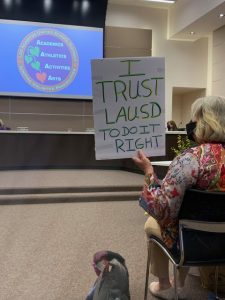


 First Place: Breanna Segura


 This will be the 17th year for the self-guided tour, which features landscaping, pools, outdoor kitchens and more in five Rossmoor yards. In addition, shoppers can browse the pop-up Outdoor Marketplace for plants and outdoor decor, refreshments and other wares sold by a variety of vendors. Several gift baskets will be raffled off, too.


