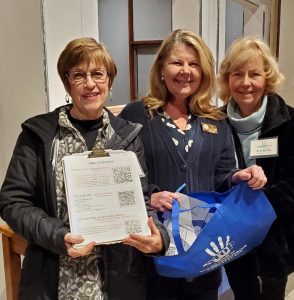
During the Los Alamitos Chamber of Commerce’s March Breakfast meeting, members listened to Small Business Development Center (SBDC) representatives Mike Daniel and Manal Richa on how to grow their business.
Daniels is the Regional Director of the Orange County Inland Empire SBDC OCIE Network, which assists current businesses and aspiring entrepreneurs throughout Orange County in providing one-on-one consulting and training.
OCIE SBDE is hosted by the California State University of Fullerton through the College of Business and Economics.
“You don’t need to do it on your own; we’re here to help,” said Richa. If your business needs to grow and expand or you need extra capital, SBDC can help you get there.”
Richa explained that they use college students to do marketing research. “We can help you put your marketing plan together; a way to tell people what your business does with an online presence – an exposure beyond local and we can match you with a lender – we are here to help you through the journey.”
Daniels shared that as a business owner and entrepreneur himself, he started his career as owner of a Rocky Mountain Chocolate Factory, currently owning stores in Huntington Beach and Long Beach. He also owns a Sugar Pop Sweet Shoppe in Long Beach that is an old-time candy store with “fill-it-yourself” containers.
Manal Richa, director of the California State University Fullerton OCIE SBDC said the Network offers no-cost one-on-one assistance and training to business owners and entrepreneurs in Orange County.
“The CSUF SBDC helps entrepreneurs and business owners launch and expand through growthplanning, startup assistance, marketing strategies, access to capital and building teams,” she said.
Manal founded the MarCom Network, which is a marketing and creative consulting firm that helps small businesses build not only exposure but offers a way to increase sales. She also started BreakThrough Networking Inc. where she helps clients build relationships, leverage connections and offers how to use different social media platforms in order to take their business to the next level.
Daniel is a graduate of California State University; he and his wife have two children that he says he is, “Grooming to take over his business,” when he retires.
Richa is also a graduate of California State University, Fullerton where she earned her BA in Communications and Advertising; she earned her MBA in Organizational Leadership from Brandman University.
Presentations and certificates of recognition were made by California Assemblyman Tri Ta, with the 70th District; Congress woman Michelle Steel’s office; Cypress City Mayor Tanya Doby’s office, and the Los Alamitos Area Chamber of Commerce.
For Los Alamitos Chamber information visit in**@**********er.org or call 1-562-598-6659.
Senator Thomas J. Umberg (D-Santa Ana) announced today that he is prioritizing California’s fentanyl crisis in 2023 and has introduced 4 measures to help stem the explosion of fentanyl poisonings.
“As lawmakers, we have a moral, ethical, and legal obligation to protect lives in California,” said Senator Umberg. “The scourge of synthetic opioids like fentanyl is unlike anything we have ever seen,” he continued. “We have lost more people to opioid overdose in the last year alone than the number of U.S. military personnel killed during the Korean, Vietnam, Iraq and Afghanistan wars combined – we cannot continue to throw up our hands in confusion while an entire generation of Americans perishes.”
Approximately 107,477 people died from drug overdoses overall in the U.S. in the 12-month period ending in August 2022, making it the leading cause of injury-related deaths. California accounts for approximately 20% of that statistic. This represents a nearly 750% increase from 2015 to 2021 and the largest amount ever recorded in a calendar year. Most of these deaths (~66%) are caused by illicit synthetic drugs like clandestinely manufactured fentanyl and methamphetamine, often in combination with other drugs, including cocaine and heroin.
To make matters worse, youth under 24 account for the fastest rise in drug deaths. In California where fentanyl deaths were rare just five years ago, a young person under 24 is now dying every 12 hours. The biggest factor attributing to this danger is the undisclosed addition of fentanyl to other drugs which can, and does, often lend itself to fentanyl poisoning and death. Among teenagers, overdose deaths linked to synthetic opioids like fentanyl tripled in the past two years, yet 73% have never heard of fake prescription pills being made with fentanyl.
In fact, fentanyl poisoning has been attributed to several high profile deaths in the last few years including rappers Mac Miller, Lil’ Peep, and Shock G (Digital Underground), singers Prince, Tom Petty, and Luke Bell, actor Michael K. Williams, author Michelle McNamara, and comedians Fuquon Johnson and Rico Angeli. None were known fentanyl users but had been known to use other drugs for recreation, pain relief, or depression. Singer Demi Lovato almost died from a fentanyl poisoning, as well.
To put these numbers into perspective:
• Fentanyl now kills more people ages 18-45 than automobile accidents, gunshots, suicides, and even COVID-19 in 2021.
• All told, more people have now died of synthetic-opioid overdoses than the number of U.S. military personnel killed during the Korean, Vietnam, Iraq and Afghanistan wars combined.
• Roughly 194 people die every day from overdoses related to synthetic opioids like fentanyl.
• On average, one person dies of a fentanyl overdose in the United States every seven minutes.
When Driving Under the Influence (DUI) deaths peaked in the 1990s, the public demanded swift and comprehensive action by lawmakers. The Legislature rose to this occasion by passing a series of measures exemplifying a holistic and multi-pronged approach as a response. By addressing DUI deaths in a comprehensive manner through education, law enforcement, and harm reduction angles, California was able to turn the escalation of DUI-deaths around and preserve public safety.
As the former Deputy Drug Czar (Deputy Director of the White House’s Office of National Drug Control Policy) under President Bill Clinton, a former United States attorney and career prosecutor, Senator Umberg is uniquely positioned to lead a similar effort to address our fentanyl crisis.
Senator Umberg’s 2023 legislation pertaining to fentanyl consists of:
SB 44 – Alexandra’s Law/Fentanyl Admonishment: Jointly authored with Senator Rosilicie Ochoa Bogh, the measure requires that a written advisory or admonishment be issued to a person convicted of a fentanyl-related drug offense notifying the person of the danger of manufacturing and distributing controlled substances and of potential future criminal liability if another person dies as a result of that person’s actions. SB 44 is sponsored by San Diego Mayor, Todd Gloria, co-authored by over 1/3 of the Legislature (to date), and supported by victims’ families, law enforcement agencies, and local governments, among others.
SB 60 – Drug Content on Social Media Platforms: Allows for private legal action to be taken against social media companies who fail to timely and immediately remove drug content from their platforms.
SB 250 – Fentanyl Self-Reporting and Immunity: Expands California’s 911 Good Samaritan law to include self-reporting of fentanyl poisonings and opioid overdoses to law enforcement and medical assistance through fentanyl testing strips and other medical devices such as smart watches.
Pending Senate Resolution – National Fentanyl Awareness Day: Declares the second Tuesday of May every year as Fentanyl Awareness Day in California.
“Drug addiction, treatment, and rehabilitation will always be a focus for lawmakers as a consequence of drug use and addiction,” said Senator Umberg. “In the meantime, we must do everything we can to prevent fentanyl poisonings and deaths in an effort to save the lives of Californians.”
Through the introduction of measures to educate the public (a pending Senate Resolution), ensure responsibility by social media companies (SB 60), provide harm reduction strategies with accountability (SB 250), and give law enforcement additional tools (SB 44), Senator Umberg is making the fentanyl crisis and the saving of lives his top priority in 2023.
For questions about any of these measures included, please feel free to contact his Capitol Office at (916) 651-4034.
Branford Marsalis touched the top of the music world and still found a better place to thrive.
He was a bandleader on one of the most vaulted American music platforms and decided to walk away.
Though this humble saxophonist shies away from the brightest spotlights, his talent always seems to bring it back.
Over four decades, Marsalis has “evolved” into somewhat of a hidden American musical gem. Even so, Marsalis believes the very act of moving on, or “evolving,” as he puts it, has been the hidden secret of his success.
He inherited musical mastery from his pop and a nurtured soul from his mother, an educator.
He speaks clearly, and slowly, with the methodic ease of a French Quarter afternoon.
Three time Grammy Award winning bandleader and saxophonist Brandford Marsalis. Courtesy photo
Born in Breaux Bridge, Louisiana, the bandleader is the son of New Orleans music legend, Ellis Marsalis.
“The reality is, as my dad used to say this all the time. ‘The thing you do most of the time is the thing you do best,’” said Marsalis in an extensive interview this week.
“Growing up, I played in rhythm and blues bands, rock and roll bands, and a lot of diverse music,” he said.
Yet, when introduced to classical music, he saw the future. “I just took to classical music at a young age,” he said, “just took to it.”
Branford’s childhood home was always filled with music and Branford was drawn to it along with siblings Wynton, Delfeayo, and Jason.
His dad, a music professor, grew close to the other royal New Orleanian music family in New Orleans, the Neville Brothers. The cosmic music explosion produced by this arrangement produced many music stars, of which Branford is perhaps the most enduring.
Marsalis began playing the clarinet at a young age but eventually switched to the saxophone. He studied at the Berklee College of Music in Boston before moving to New York City in the early 1980s.
In what has become one of his hallmarks, in New York, Marsalis found a way to create his own scene, as he began performing with jazz legends like Art Blakey and his Jazz Messengers, Miles Davis, and Dizzy Gillespie.
His musical evolution called him to launch his own career in mid-1980s. He formed the Branford Marsalis Quartet and they released their first album, “Scenes in the City,” in 1984, and went on to release a number of critically acclaimed recordings over the years.
This Sunday, March 12, the bandleader rolls into Orange County with the same Branford Marsalis Quartet he formed way back then. They are scheduled for two performances, at 4 p.m. and 7 p.m., at the Segerstrom Center for the Arts.
After so many years, Marsalis said that though the quartet has four members (Marsalis on saxophone, Joey Calderazzo on piano, Eric Revis on bass and Justin Faulkner on drums), Marsalis said “we think with one brain.”
He said this allows for instantaneous improvisation on stage. “It keeps it interesting when everybody is engaged,” he said.
“We play like a modern song and then we follow it with a song from the 30s. And then we’ll play a ballad and we just try to switch it up all the time. It keeps it interesting for us and for the audience,” he said.
Though he never ventured away from his quartet, the arc of his evolution has taken him around the world and his talent, for a time, allowed him to perform for millions of Americans each night.
Named bandleader for “The Tonight Show with Jay Leno” when the broadcast was at its zenith in the 1990s, he walked away after three years.
Essentially, Marsalis said he began to feel the job was way more about management and celebrity, while at heart, Marsalis said he simply wanted to continue “evolving” as a musician.
Marsalis said he knew it was time to go when he performed a concerto outside the show and thought his musical mastery had slipped a bit.
“I played a concerto on the side, and I noticed how much my technical ability had dropped off,” he said. “So, I had a decision to make.”
“It wasn’t that hard to walk away,” said Marsalis, “because I’ve never been motivated by that kind of commercial success or fame,” he said.
“That [Tonight Show] gig was not about a musician’s evolutions,” said Marsalis, “it was just a gig. It’s hard to be an evolving musician when you’re professionally not required to evolve to succeed,” he said.
While Marsalis does not shy away from notoriety, he is just as comfortable being a player in his own band.
“You know, when you play in a horn section, you’re essentially invisible. And if you want to be noticed, then you better start singing, because it ain’t in the cards (for a horn player),” said Marsalis.
“I love playing as part of the group. I’m like a reluctant soloist, because I don’t feel like I need to be up front,” the band leader said.
“I like playing in the group. And then when I’m finished with my solo, I always move to a place in the back of the stage so that everybody can notice the piano player,” the modest Marsalis said.
Despite his modest personality, his enormous musical talent has always been in high demand.
Over his career, Marsalis has gigged with great bands like the Grateful Dead and toured with Sting.
Branford has also shared his knowledge as an educator, forming extended teaching relationships at Michigan State, San Francisco State and North Carolina Central Universities and conducting workshops at sites throughout the United States and the world.
According to his bio, Marsalis’ work on Broadway has garnered a Drama Desk Award and Tony nominations for the acclaimed revivals of Children of a Lesser God, Fences, and A Raisin in the Sun.
His screen credits include original music composed for: Spike Lee’s Mo’ Better Blues, The Immortal Life of Henrietta Lacks starring Oprah Winfrey and Ma Rainey’s Black Bottom starring Viola Davis and Chadwick Boseman.
Ma Rainey is the Netflix film adaptation of two-time Pulitzer Prize winner August Wilson’s play, produced by Denzel Washington and released in December 2020.
Throughout his career, Marsalis has received numerous awards and accolades, including three Grammy Awards for Best Jazz Instrumental Performance, Individual or Group. He has also served as a cultural ambassador for the United States, promoting American jazz music around the world.
He has received a citation by the National Endowment for the Arts as a Jazz Master and an avatar of contemporary artistic excellence.
Now living in North Carolina, Marsalis, ever the ambassador, returned to New Orleans after the devastation wrought by Hurricane Katrina. He and a friend, Harry Connick, Jr., conceived of “Musicians’ Village,” a residential community in the Upper Ninth Ward of New Orleans.
The centerpiece of the Village is the Ellis Marsalis Center for Music, honoring Branford’s father. The Center uses music as the focal point of a holistic strategy to build a community designed to deliver a broad range of services to underserved children, youth and musicians from neighborhoods battling poverty and social injustice.
Despite his meteoric rise, Marsalis orbits the music world at an altitude all his own.
Marsalis knows from experience how fleeting the limelight can be.
“When I go back to New Orleans, the people that loved me, they still love me, the ones that didn’t, still don’t. I love that about the city. Let’s keep it real.”
In its virtually uninterrupted three-plus decades of existence, the Quartet has established a rare breadth of stylistic range as demonstrated on the band’s latest release, “The Secret between the Shadow and the Soul.”
Soul is something Branford Marsalis seems to know a lot about, having learned the lessons of humility from his mother.
“Somebody interviewed my mother once,” recalls Marsalis, “say, your son is on the Tonight Show, you must be really proud.” The band leader said, “her eyes narrowed to about the size of two nickels sideways,” and this was her reply.
“I have six boys. I am proud of all of my children. You don’t have to be on TV to be proud of your children. There you go,” he said.
Little wonder, then, why Branford Marsalis considers himself a “reluctant soloist.” Being a big deal was “never a part of it.”
“In our country, we are constantly obsessed of impressing outside people, even those that don’t matter. The whole thing is bizarre to me. I just want to do my thing.”
“For me,” said Marsalis, “it’s all about the music.”
Tickets are available at online at SCFTA.org, at the Box Office at 600 Town Center Drive in Costa Mesa, or by calling (714) 556-2787.
Let’s face it, Tina Fey was on to something when she wrote “Mean Girls.”
Fey’s genius in writing “Mean Girls” lies in her ability to accurately capture and satirize the social dynamics of high school life.
Moreover, “Mean Girls” tackled important issues such as bullying, cliques, and peer pressure, issues not typical to teen comedy in the early 2000’s. Artfully capturing the early wave of the digital teen meets social pressure, Fey’s script managed to balance humor with a deeper message.
Two decades later, Nadina Hassan says society may have advanced, but pressures are the same.
The “Mean Girls” cast has folled into the Segerstrom Center for the Arts in Costa Mesa. Photo by Jenny Anderson
Hassan, 22, was practically straight out of college when she won the prestigious role of Regina George in the current touring live production of “Mean Girls,” which opens at the Segerstrom Center for the Arts in Costa Mesa on Tuesday.
Hassan graduated from Baldwin Wallace’s Musical Theater program in 2020. Previously, she’s landed roles in “Tick, Tick,… BOOM!” (Susan), “West Side Story” (Maria), and “Be More Chill” (Brooke).
“I mean, the story is the same, but there is a lot to accommodate for, like modern-day technology and social media,” said Hassan. “Obviously, that’s a big thing that the girls in the movie didn’t have back then,” she said in a phone interview.
“Mean Girls,” the musical features a book by nine-time Emmy Award® winner Tina Fey, based on her screenplay for the film, music by three-time Emmy Award® winner Jeff Richmond, and lyrics by two-time Tony Award® nominee Nell Benjamin. Tony Award® winner Casey Nicholaw directs and choreographs.
In addition to Hassan, the tour cast will feature English Bernhardt as Cady Heron, Jasmine Rogers as Gretchen Wieners, Morgan Ashley Bryant as Karen Smith, Lindsay Heather Pearce as Janis Sarkisian, Eric Huffman as Damian Hubbard, Adante Carter as Aaron Samuels, Caleb Mathura as Kevin G., Heather Ayers as Mrs. Heron/Ms. Norbury/Mrs. George., Lawrence E. Street as Mr. Duvall and Adriana Scalice as Standby for Cady, Regina, and Janis.
The producers of “Mean Girls,” the record-breaking new musical comedy produced by Lorne Michaels, Stuart Thompson, Sonia Friedman, and Paramount Pictures based on the hit film are excited to announce the First National Tour coming to Orange County at Segerstrom Center for the Arts. The show will be playing in Segerstrom Hall from March 7 – 19, 2023.
“We’ve updated all that and it’s in the musical,” said Hassan. “I think it’s really important because that is how people in high school communicate these days.”
Though it has been adapted for modern life, “Mean Girls” still nag at the same old issues revolving around social pressures.
“Cliques are kind of formed through social media,” she said, “and things like that.”
“I still think the “Mean Girls” story is so prevalent,” said Hassan. “I think that there are cliques like that do exist in a lot of high schools and even in a lot of workplaces,” she said, “so even if you’re an adult, you can kind of empathize with these characters and see where they’re coming from.”
Hassan, already an emerging musical theater star, started performing as a child.
“I started performing when I was about 10,” she said. “I really wanted to copy my sister, she was in voice lessons so I wanted to do voice lessons.”
“Then I just completely fell in love with that and I wanted to continue to do more shows and basically never stopped,” said Hassan. What began as roles in middle school, then regular roles in high school productions before landing at Baldwin Wallace (one of the nation’s oldest liberal arts colleges),” said Hassan.
Even though the tour production has now completed more than 400 shows, Hassan says she still wakes up surprised to find herself already on such a big stage. And, she said, she loves all her “Mean Girls” friends.
“I love them,” she said, adding that “we are so lucky.”
“It’s my first big job ever, so I really have nothing to compare it to but I do say that Mean Girls cultivates a true family aspect on tour,” she said, “and this [is] very, very special. We [castmates] genuinely all really love each other.” While on tour, she said, the cast and colleagues are like family, “You are traveling with these people and you’re not going home every day to your actual family. So these people become your family. It’s really cool.”
Hassan’s reviews along with the entire cast have been upbeat since the tour began.
New York Magazine calls Mean Girls “HILARIOUS! A smart, splashy new musical that delivers with immense energy, a wicked sense of humor and joyful inside-jokery.” Chicago Tribune says “Tina Fey writes FUNNIER, SMARTER, SHARPER satire than anyone else in the business.” People Magazine declares the show is “FRESH, FUN AND INFECTIOUS – Jeff Richmond and Nell Benjamin’s songs keep the laughs coming!” The New York Daily News raves Mean Girls “TICKLES THE EARS, EYES AND FUNNY BONE – the direction by Casey Nicholaw packs style, invention and red bull-force energy.” And Entertainment Weekly proclaims it “A MARVEL: DAZZLING & HILARIOUS!”
The creative team includes Scott Pask (Set Design), Gregg Barnes (Costume Design), Kenneth Posner (Lighting Design), Brian Ronan (Sound Design), Finn Ross & Adam Young (Video Design), Josh Marquette (Hair Design), Milagros Medina-Cerdeira (Make-Up Design), Mary-Mitchell Campbell (Music Supervisor), Chris Kong (Music Director), John Clancy (Orchestrations), Glen Kelly (Dance and Incidental Music Arrangements), Mary-Mitchell Campbell, Jeff Richmond, and Natalie Tenenbaum (Vocal Arrangements), Howard Joines (Music Coordinator), and The Telsey Office / Bethany Knox, CSA (Casting).
Tickets are available at online at SCFTA.org, at the Box Office at 600 Town Center Drive in Costa Mesa, or by calling (714) 556-2787.
Joe and Margo Lazzari start their days by reading the Wall Street Journal alongside the L.A. Times. They point to this morning ritual as their education on the Seal Beach National Wildlife Refuge, on which they volunteer with the local chapter of the
Friends volunteer Joe Lazzari shares the trash he picks up across the Refuge.
Friends organization. Margo says their volunteer choices are guided by the question of whether their work is somehow supported by what’s happening in our world today.
Since Oct. 2013, Joe has walked to the tidal marshes across the street from his home nearly every day, volunteering over 15 hours a week to restoring the ecosystem.
Margo invests her time more often in the Friends’ meetings and monthly tours.
They both share an appreciation for the opportunity to care for the environment, however local and simple their contribution may be, because all the world is connected.
Current Friends President and CSULB researcher Chloe Van Grootheest speaks about the green sea turtle population at the Refuge. She partners with local university professors to track the trends of endangered species and the health of the ecosystem at large.
Few people generally, let alone those living in Seal Beach, know about the protected wetlands within the Naval Weapons Station off Seal Beach Boulevard.
Initially declared a Navy Preserve in 1969 (to prevent the expansion of the 605 freeway through a precious coastal habitat), the 963-acre parcel was formally declared a National Wildlife Refuge in 1972.
From the start, its mission has prioritized the conservation and restoration of migratory waterbirds, fish, and plants.
The wildlife refuge continues to rely on the unique partnership between the US Fish & Wildlife Service and the Navy (under the San Diego National Wildlife Complex) to oversee the recovery of the endangered species that depend on this tidal marsh.
In addition, partnership promotes the longevity of the habitat itself, and encourages public engagement.
The Navy provides personnel and some financial support for annual breeding surveys and predator management for four endangered species – the light-footed Ridgway’s rail, California least tern, green sea turtle, and Western snowy plover.
The natural beauty of the Seal Beach National Wildlife Refuge is within a short drive for most area families.
The Navy’s Environmental team also manages invasive species around the base and alongside the US Fish & Wildlife Service, is currently overseeing a sediment augmentation project intended to add a supplemental nesting habitat for endangered birds, replenish eel grass beds, and generally protect the saltwater marsh habitat against sea level rise.
In 2019, they started an ongoing project using radio trackers to monitor sea turtle migration.
The volunteer group – Friends of Seal Beach National Wildlife Refuge – consists of about 15 members, though just four who show up daily are responsible for the heavy lifting.
Volunteers comprise 20% of the national Refuge System’s workforce, according to the National Wildlife Refuge Association.
Refuge Manager Mac Purvin wrote, “They are an incredible group of folks, and it is only through their dedicated volunteering efforts that we are able to give our endangered species the best chance of possibly thriving.”
Van Grootheest shares invertebrates and plants essential to the health of the ecosystem. Echinoderms are like small sea stars; gastropods are small snails; Amphipods are like aquatic insects; isopods are marine roly-polies; bryozoans are a coral-like species; polychaetes are like worms with little feet.
With limited funds from donations, the US Fish & Wildlife Service, a small federal subsidy, and grants, volunteers partake in various efforts across the Refuge. Among the programs the Friends group leads are Adopt-a-Highway, National Public Lands Day, maintenance of the native plant garden (Shirley’s Garden), and Eyes on the Colony.
The Eyes on the Colony program involves volunteers shaking cans of rocks at predators approaching the least tern nests on NASA island, hopefully deterring them from eating the eggs.
Volunteers also help conduct biological surveys to determine the population trends of the four endangered species under its purview and various mammals throughout the Refuge; they assist researchers in the sediment augmentation project, surveying the Pacific flyway shorebirds; and they generally support areas of the Refuge needing maintenance.
When funds are low, volunteers invest from their own pockets. One volunteer even funded and built the rafts supporting the Ridgeway’s rail nests. Mac describes them as “nest platforms” that offer the birds cover from predators.
Another strategic partnership within the Refuge is one that includes researchers from CSULB, Chapman, USGS, UCLA, and CSUF.
Bird expert and former Friends President Carolyn Vance speaks about the birds she surveys throughout the fall and winter. She surveys shorebirds at one high tide and one low tide every month, counting by bill length, size, and shape.
With the ever-ready help of the Friends, the military’s biologist Bob Schallmann, and a cooperative agreement with the Huntington Beach Wetlands Conservancy, these research partners pursue the refuge’s additional effort of preserving the health of tidal marshes themselves.
They use Secchi disks to measure the water’s turbidity or clarity and trolls to collect sediment with which they’ll document invertebrates. The quantity of pollution-tolerant invertebrates helps indicate the wellness of the habitat.
Tidal marshes critically sequester carbon from the atmosphere, buffer inland communities to wave erosion and flooding and provide recreational spaces to the public. The Seal Beach marshes are uniquely important because they provide a nursery habitat to the California halibut and offer a feeding habitat for the green sea turtle.
They are also more intact than most surrounding wetlands. Just about 20% of California’s historic wetland extent remains, according to the California Water Quality Monitoring Council, and our local tidal marshes offer a landscape for piloting projects potentially applicable to tidal marshes at large.
US Fish & Wildlife Refuge Manager Mac Purvin leads his first tour on January 28.
The Refuge research partners have been assessing the benefits of sediment augmentation, particularly in an environment of severe subsidence due largely to area oil drilling.
Over five years of monitoring, CSULB Professor Christine Whitcraft acknowledges the benefit of introducing invertebrates and plants to the dredged sediment. She says it expedites the ecosystem’s diversification and rehabilitation.
Still unclear, however, is the efficacy of the solution on every tidal marsh due to the five- to ten-year timeframe rehabilitation would likely take. Researchers also have not yet concluded the Ridgeway’s rails’ population trend in response to the initiative.
These birds attach their nests to the base of plants that rise and fall with the tide. Without sediment to offer stability, nests are vulnerable to floating away. Whitcraft and her colleagues are hopeful for further funding to continue annual monitoring.
Meanwhile, Joe narrates the joy of chasing down a least tern chick after weeks of watching over a nest of unhatched eggs. He can’t deny the satisfaction of bringing that chick to the researcher responsible for registering it, but he’s not disillusioned.
“Why do we have to do that? … It’s a way of measuring and it’s a statistic. Understood. [But] why are we worrying about individual birds when we should be caring about the habitat in general,” claimed Joe.
Ted Nowell tends Shirley’s Garden (after Shirley Batey) and shares about our native plant life. He graciously hands out California poppies to those who ask.
With continued community outreach, including monthly tours, the Friends of the Seal Beach National Wildlife Refuge hope to raise awareness and funds to invest in more projects throughout the Refuge and the community at large.
Purvin looks forward to implementing a living shoreline project in the future to mitigate the hazards of erosion due to sea level rise, while Joe anticipates implementing pollinator shelters throughout all of Seal Beach.
“There [are] so many ways to get involved. If you are interested in birds or plants, data and research, or just getting the chance to work with your hands, I encourage folks to get in touch with me or the Friends group [via sealbeachnwrfriends.org],” wrote Purvin.
“Taking a monthly tour on the Refuge is a great way to get to know about all the amazing things our volunteers work on every day,” added Purvin.
After a lively marathon meeting that lasted more than four hours, the Los Alamitos City Council voted to approve a planning commission recommendation to rezone parts of the city to facilitate a housing element that meets state guidelines.
Despite an impassioned plea from an overflow crowd of concerned local homeowners to delay the vote for 90 days, the Council voted to approve the measure that will rezone parts of the city they have identified where housing can be built to meet state housing mandates.
City officials tried to emphasize that the vote they were taking, in essence, simply approved general zoning changes that facilitated the city’s housing element.
“I’d like to just point out before we start that this item is specifically about the housing element and not about any particular projects that may be proposed throughout the city, I think that’s just an important distinction,” said City Manager Chet Simmons as the discussion began.
Simmons asked Development Director Ron Noda to give the overcrowded room of concerned residents a briefing on the city’s housing element.
Noda explained, in detail, how the city came to develop its current housing element, saying the city and its consultants began developing the plan years ago.
At issue, currently, is not the Lampson Project, per se.
City officials acknowledge that no final applications have been recived, and, in fact, studies required for the Lampson Project’s permitting process have yet to be completed or submitted for that specific project.
However, what concerned residents was the provision embedded in the city’s ordinance that was passed by the Los Al Council last week that rezoned the 12-acre tract of land located on Lampson Ave. that has been proposed for a multi-use, 246-residence project from commercial to residential, in essence providing to developers the zoning designation required for the project.
That is what triggered residents’ concern, as dozens of local residents paraded to the microphone to make any number of cases for why the city should not vote for the rezoning ordinance, mostly asking for a simple 90-day delay.
Residents said that despite the city claiming to have used multiple forms of outreach, including ads in the Event News Enterprise, they were caught off guard by the project. They claimed a delay of 90 days to the vote would be in order and give everyone time to do more research.
“We’re asking for a 90-day continuance,” said Brian Kiebler, one of the residents against the project. “The risk is low,” he said, noting that “not one city has been fined for not having an approved housing element. “Nobody is against low-income housing,” said Kiebler, but approving the delay would make residents “feel like we’ve been a part of he process that has been fair and transparent.”
Hold on, said Council member Shelley Hasselbrink, explaining that in the city of La Habra, city officials lost control of a housing development of more than 700 homes that will consume a local golf course because, in the absence of an approved housing element, developers took advantage of a “builder’s remedy” that got the project approved.
“Keep in mind the La Habra City Council denied that application in 2020 for 530 homes and the developer wanted to do it anyway. They found the state remedy loophole now they’re building more than 530 homes and the city can’t do anything about it other than sit on the sidelines and watch it being overdeveloped more than what they already declined,” she warned the council.
Not having a housing element is a risk, said Simmons, “and part of my job is risk mitigation so I am going to ask you to do this as plainly as I can,” said Simmons.
“If somebody were to submit a development application to the city, you would not be able to legally disprove it on the grounds that it conflicts with our zoning or our general plan policies or standards, meaning a multifamily high-density project, for example, could go into a zone where that type of use is not otherwise permitted,” said city attorney Michael Daudt.
Carol Churchill, a Rossmoor attorney, provided to the Council part of the extensive research she has done on the project, saying, “your risk under the builder’s remedy is really low and the $10,000 fine rule, according to government code, is imposed only by a court.”
The city is nowhere near any of that, she suggested, explaining the complicated legal framework.
Mayor Tanya Doby seemed to somewhat change the mood and tenor of the resident’s anger, at least momentarily, with an impassioned statement about how much the city had more local control.
“Since I’ve been in the mayor’s seat, right, I take that very seriously, I have been talking to everybody that I can get my hands on to find out what can we do,” said Doby, “even in Sacramento.”
“I hear what you’re saying, and you are not wrong,” the mayor said. “Until I started sitting in rooms, and on calls with people who made it abundantly clear that there is no one in our hierarchy that will get this changed for us,” she said.
“It comes from the governor now and he’s not changing it,” she said.
In addition, residents were appreciative that city officials went above and beyond the norm of many local governments, actually providing answers within legal limits to questions posed during oral communications.
Moreover, the two newest members of the Council, Trisha Murphy and Emily Hibard, made their presence known as they peppered the city manager and staff with questions, sometimes pointed.
For instance, Murphy was upset that staff had not included a letter in their packets that actually proved that there had been a recommendation by airport regulators that the housing project might violate rules governing the Joint Forces Training Base airfield that was not shared with the Council, even if for technical reasons.
Near the end of the meeting, Hibard asked the staff to provide answers to each and every question they had posed in the meeting.
“If there’s anything that I can do or if there’s anything that this council can do if there’s anything that this staff can do to earn your trust, we’re asking you to earn your trust,” she said.
In fact, Hibard made a motion to grant residents the 90-day variance for more time, a motion seconded by Murphy, the Council’s other new member.
“I have received several emails from residents and community members asking us to honor the continuance of 90 days,” said Murphy.
The motion to delay the vote on the housing element ordinance failed 3-2, with Hasselbrink, Doby and Mayor Pro-tem Jordan Nefulda voted again.
Hasselbrink then made the motion, seconded by Nefulda, to approve staff’s recommendation to approve the resolution approving the housing element ordinance, which then passed 3-2.
Hasselbrink, Nefulda and Doby voted to approve the resolution while Hibard and Murphy voted against.
Los Alamitos Medical Center has appointed Heather Crawford as Chief Nursing Officer (CNO) at Los Alamitos Medical Center, effective February 6, 2023. In this role, Heather will oversee all nursing units, nursing supervisors, and the quality and infection control departments at Los Alamitos Medical Center, the hospital announced in a press release. Additionally, Heather will serve as Group Chief Nursing Officer (GCNO) for Tenet Health Pacific Coast and provide strategic guidance to our nurse leaders across the market, the hospital said.
Crawford began her nursing career at California Pacific Medical Center in San Francisco where she advanced in several clinical and quality roles before becoming Associate Vice-President of Nursing. She comes to us from SCION HEALTH in Louisville, Kentucky where she has served as Chief Clinical Officer & Senior Vice President of Clinical Operations for the past twelve years.
She continually strives to promote a work culture that champions four key pillars: Safety, Quality, Experience, and Values. She is well-versed in leading teams to meet the demands of a quickly evolving clinical care landscape to keep a competitive edge and has advanced knowledge of applying Lean & Agile methodologies to embrace operational efficiency, the statement said.
Crawford earned her Master of Business Administration in Leadership from the University of Phoenix and her Bachelor of Science in Nursing from Sonoma State University, and she is currently working toward earning her Doctor of Business Administration in Leadership at Liberty University.
“Heather is a wonderful addition to our executive team,” said Kent Clayton, Chief Executive Officer of Los Alamitos Medical Center. “She has proven her ability to develop strong teams that provide superior patient care and service excellence. Her leadership will help us continue to deliver on our vision of being a community built on care.”
The City of Los Alamitos paid tribute to long-serving Fire Chief Ron Roberts, a popular fixture at council meetings for many years, who passed away unexpectedly while vacationing in Costa Rica.
Council member Shelley Hasselbrink, who serves as the city’s representative on the Orange County Fire Authority, said that although Roberts served in many capacities, he is perhaps best known for his role as OCFA Division 1 Fire Chief, which services the City of Los Alamitos.
“Our former division chief Ron Roberts,” said Hasselbrink, “who sat right over there [pointing to his seat], “passed away on Feb. 9th, just 125 days after he retired.”
She said Roberts was vacationing in Costa Costa Rica with his wife and another couple when he and his wife were unexpectedly taken out to sea by a riptide.
Hasselbrink said the couple was eventually rescued, “but unfortunately, Ron did not survive.”
“He was a terrific man who gave 42 years of his life to fire service and was starting to enjoy the prime of his life,” said Hasselbrink, asking everyone to keep Roberts in their prayers.
At his retirement ceremony in October, 2022, OCFA posted a thank you to Facebook for his 42 years of service.
“We thank Division Chief Ron Roberts for his 42 years of fire service as he retires today from the OCFA. Chief Roberts began his career as a Reserve Firefighter for Santa Ana Fire Department in 1980 before becoming a firefighter for the City of Westminster in 1981. In 1995, the City of Westminster joined the OCFA as the 19th member city, and he continued to proudly serve Orange County,” said the statement.
Chief Roberts has held a variety of specialty positions in the emergency service, including paramedic, fire investigator, helicopter crew chief, assistant fire training officer, division administrative captain, emergency command center battalion chief, and chief fire investigator. Chief Roberts retired from Division 1, which serves Los Alamitos, Los Alamitos Joint Forces Training Base, Midway City, Rossmoor, Seal Beach, Westminster, and Garden Grove.
Chief Roberts has served on multiple incident management teams, including in positions such as Incident Commander for our Covid response and Incident Commander for the Bond Fire. One of his most impactful memories was being at the 2001 Darby Fire in Northern California when the news of the 9/11 attacks arrived during their morning briefing. He remembers the morning briefing pausing for several minutes before they continued on with their firefighting mission while still processing what had occurred.
According to the OCFA, Roberts lived in Orange with his wife Stacy. They have two grown sons and three grandchildren that they enjoyed spoiling.
Roberts, according to the retirement ceremony account, told his OCFA fire family, “I will miss you all, you are good people doing great work. Take care of one another.”
In announcing the news, Fire Chief Brian Fennessy issued a statement.
“Chief Ron Roberts built a career and lived his life in service of others,” said OCFA Fire Chief Brian Fennessy. “Our hearts are broken, but we take solace in knowing that the legacy of his service will live on in the communities he protected and the lives he saved in his more than 40 years of service.”
“Ron was a natural leader and mentor to many firefighters and chief officers. His kind heart and strong character made him a trusted and loved leader in Orange County and throughout the fire service community,” said the statement.
Plans for funeral services are pending, Hasselbrink said.
The city closed out its February meeting with a tribute to Roberts and the mother of Laura Herzog, Vicki, who died in a head-on car collision in Westminster earlier this month. Herzog is the Executive Director of the nonprofit “Honoring our Fallen.”
Jim Salchak, our demonstrator, has been captivated by the medium of watercolor for over thirty years. His paintings have been shown in numerous local and national juried exhibitions, including the American Watercolor Society, National Watercolor Society and Watercolor West. Jim is a signature member and past president of both the National Watercolor Society and Watercolor West and has also achieved signature membership in the Nevada and San Diego Watercolor Societies.
His paintings have been published in the Best of Watercolor, People in Watercolor and Watercolor Expressions. He has served as a juror for both national and local exhibitions. His workshops emphasize the importance of selective vision through simplification and focus and using design principles to create strong compositions. Jim encourages direct painting, getting the right value and color with the first wash to achieve good clean color and prevent overworking. Jim’s paintings can be seen at The Schroeder Gallery in Orange, California and on his website www.johnsalchak.com.
Our meeting will be on March 12th. Remember that is Daylight Savings Time. Clocks go ahead that morning. Don’t be late for the meeting.
The Pencil Painting Show is scheduled for take-in on March 4th with that show up until we get ready for the Spring Show. Invitations are being prepared.
We wish you and yours the best for this coming year. Remember that dues are now payable for the year. Looking forward to seeing you at the meetings and shows.
The public is welcome and encouraged to attend our meetings held at the Cypress Community Center, 5700 Orange Avenue, Cypress. We start the meetings at 2:00 pm and conclude between 4:00 & 5:00 pm. Refreshments are provided, and we ask for a donation minimum of $2.00 to replenish supplies.
The Youth Center announced today it has been named a Nonprofit of the Month by the United States Congress House of Representatives.
For 71 years, the Youth Center has been providing programs for kids and their families, including music education, after school care, tutoring, summer programs, therapy for kids, programs for teens and scholarships for families in need in the local community.
“We are honored to be named a Nonprofit of the Month,” says Lina Lumme, Executive Director and CEO. “We are proud of our accomplishments this year, including brand new programs like View U, Girls in STEM, and Workshops for Success,” she concluded.
The Nonprofit of the Month Award was given in honor of The Youth Center’s commitment to the youth and equipping them with the tools for future success. “Thank you for your service and dedication to our community,” said Michelle Steel, Member of Congress. “Congratulations on this achievement!”
“The Youth Center is a great example of a nonprofit making a real difference in their community,” said Zechariah Jauregui, Representative of Michelle Steel’s Office, “Their award is well-deserved recognition not only of their work, but the tremendous support they receive from people who have direct experience working with The Youth Center.” Children at The Youth Center enjoyed playing political trivia with Mr. Jauregui.
The Youth Center is a non-profit organization whose mission is to transform children’s lives one family at a time through collaborative social, educational and recreational programs. If you are interested in the Youth Center, join the upcoming One Grand Project or attend the Annual Casino Night on March 31. For additional information on The Youth Center or to purchase tickets, visit www.TheYouthCenter.org.
With self-described pride of having the largest tree canopy of any inhabited area in Orange County, the Rossmoor Board of Directors suggested erecting signs to tout it and even suggested more funding if needed as the community’s resident arborist presented her annual tree report to the community.
Once a year, the Rossmoor Community Services District requires its full-time arborist, currently Mary Kingman, to present an annual report on its trees.
“Mary is very popular in the city,” said General Manager Joe Mendoza. “I want to commend Mary,” he said in introducing her, “we’re constantly trimming trees and we’re jumping forward and doing additional trims throughout the year, making sure it’s safe.”
Kingman said overall, the RCSD tree department planted 146 new trees in Rossmoor while only 89 trees were removed.
She said the trees were removed “for various reasons, which include fungal or bacterial disease.” Trees die for a host of reasons, she said, which include decay, drought, stress, and structural or hazardous issues.
There was one complete tree failure that was the result of the roots family below the soil level, she said, which did not result in personal injury or property damage.
During the year, there were a total of 424 resident service requests and inquiries regarding trees and the majority of those were for tree planting, trimming or removal of tree-health concerns and reports of limb failures.
Kingman said the staff constantly maintains a vigilant policy and “we will continue to plant trees and we want to promote an age and species-diverse urban forest.”
Further, Kingman said they will encourage residents to take part in the tree selection process, and “I believe that that helps and promotes the residents to care more for the trees when they’ve been able to select the tree in their Parkway.”
The arborist presented dramatic images taken from space of Rossmoor’s dense canopy, comparing it to virtually barren communities of Midway City and Stanton, noting that Rossmoor could boast of perhaps the densest urban forest in Orange County.
Kingman said the community was planning an Arbor Day tree-planting event in April, again working with The Youth Center and perhaps also with local Girl Scout troops.
“Hopefully,” she said, “some of the school districts can also get involved,” said Kingman.
Director Jo Shade said she had contacts with local Girl Scout troops and offered to work with Kingman on the event. In addition, she suggested Rossmoor erect signs around the community, including at its entrances, to reflect its pride in its urban forest.
“It’s fantastic,” said Shade, noting that Rossmoor is “a great tree community. You know, it’s I guess, in Orange County, we really don’t have anything out there that stipulates that, I mean, can we get some signage out?”
She said signage could only instill more pride in the community and let visitors know as they enter. Shade also thanked Kingman for recently planting an “Australian Willow” in her yard.
“It’s true that Mary has a passion,” said First Vice President Michael Maynard. He asked to discuss “the concept of artificial grass hurting our trees.”
Kingman said the district has already had a limb failure on a small tree this year, in part caused by “root cooking.” Never a big fan of artificial lawns, Kingman said even though most synthetic laws are supposed to be made of a permeable material, “it’s plastic and it also heats up, so it could be cooking the roots.”
“It’s killing anything beneficial in the soil. If you want to kill anything in your soil you could just cover it with plastic,” said Kingman, “so it’s killing anything beneficial and there are a lot of beneficial organisms and soil that trees need.”
“Most people believe synthetic turf is such a good thing because it’s saving water,” she said, “so they are shocked that I even had issues with synthetic turf.”
Questioned by Board President Tony DeMarco, Kingman said Rossmoor has developed its own policy for synthetic turf installation.
Kingman said there are strict rules to follow when planting artificial grass that is designed to allow the trees to breathe and drink. Although some of the artificial lawns are ‘permeable,’” she said residents who make the transition must follow specific permitted guidelines.
When residents do improperly install synthetic turf, she said it is up to the county to enforce the guidelines.
Orange County is the enforcement arm for violations of synthetic turf, said Kingman, noting the county’s agency tasked with enforcement seems to be a bit slow.
“I think they are a little bit behind in that type of enforcement,” she said.
Maynard also questioned whether or not the district should accelerate its current four-year grid coverage policy to three, suggesting that even if the district has to invest a little more in the program to better maintain its trees, most residents would approve.
Kingman said they are looking at various options.
Director Nathan Searles congratulated Kingman for the district planting nearly twice the number of trees that were lost in 2022.
“It’s awesome,” he said, “I mean, you know, I want to begin by acknowledging it looks like we’ve planted way more trees than we had to remove this past year.” Also, he asked Kingman about working with OC public works to figure out something to help residents with concrete poured almost to the base of their trees.
Kingman said she has approached OC code enforcement and public works about the issue but it is basically the same story.
“They are a little behind,” she said, “I believe because they’ve had some position changes and with the pandemic, so we need to explore that more this year and try to figure something out.”
The suspect in a violent hit-and-run crash in Seal Beach that left five people injured, including three teenage girls, has surrendered to police, Chief Michael Henderson has confirmed.
Jahson Imgrund, a 23-year-old from Lake Forest, turned himself in to the Seal Beach Police Department Sunday afternoon, according to a press release.
Police said he was taken into custody and booked for felony hit and run with serious bodily injury.
The crash occurred on Feb. 11 just after 7 p.m. on Pacific Coast Highway at Main Street.
The Huntington Beach Police Department had transferred a call to Seal Beach police of a reckless driver speeding northbound on PCH from the area of Warner Boulevard, authorities said.
Five young girls were seriously injured in a horrific crash in Seal Beach Saturday that was allegedly caused by a man who was fleeing from police, according to a witness.
The driver and four passengers from the vehicle that was struck were rushed to local trauma centers with serious injuries. Two of them, women in their early to mid 20s, have since been discharged. The other three, all 17-year-old girls from Orange County, were also seriously injured.
Kevin O’Rourke, a witness who saw the aftermath of the crash, told Eyewitness News the night of the crash Imgrund was reportedly fleeing from police at a high rate of speed when he ran a red light and crashed into the girls’ car.
“I commend the STAR team, the traffic unit and the detective bureau for their diligence in this investigation and persistence in pursuing this suspect to keep the community safe,” said Henderson in the statement.
“We want to thank the community for their support and assistance during this investigation. The assistance of volunteers canvassing the neighborhood, residents searching for additional video evidence, and the ongoing concern for the victims and their families illustrates how tight knit the Seal Beach community is,” he added. The crash remains under investigation. Anyone with information is urged to contact Traffic Investigator Officer James Dowdell at (562) 799-4100 ext. 1627.
pressed frustration at its monthly February meeting when the Orange County Sheriff’s Department refused to provide details regarding their deputies responding to the community.
Rossmoor, an unincorporated community, has no police force of its own and therefore must rely on a complicated arrangement. The Orange County Sheriff’s Office provides crime enforcement while the California Highway Patrol provides for traffic enforcement within Rossmoor, a community of approximately 10,000 people.
Slow response times have nagged the community during several incidents in the past couple of years, and directors seemed equally frustrated at their February meeting following Capt. Gary Knutson’s regularly scheduled crime report.
Knutson told the directors no crime stats were available because the Department of Justice was transitioning to a new computer system entitled the National Incident Reporting System.
“The whole purpose is to get better information reported nationally,” he told the Directors, noting that the new system “allows for a little more finite reporting so it breaks things down into smaller categories.”
He continued to explain “the DOJ has not validated our statistics, so we are not releasing any statistics until that happens.”
Nevertheless, Knutson did provide some data to the Directors based on calls for service and, in doing so, acknowledged that residential break-ins had ticked up significantly in the fourth quarter of 2022.
Knutson said, however, that residential break-ins had increased across the board, blaming the rise in a flawed justice system that releases offenders almost as fast as their law enforcement officers could bring them in.
Moreover, he said catalytic converter thefts account for most of the thefts reported in the community.
During the discussion, the board brought up an incident on Feb. 13, the night before the meeting, when a Rossmoor homeowner apparently came home to find someone in their house. The intruder fled when the homeowner returned, yet the discussion sparked a series of questions.
The Directors thanked Knutson for the strong response to the incident, including a helicopter, but were befuddled when Knutson said he had no way of knowing whether a deputy was in the community or nearby when the call for service went out.
“Could you query like 911 calls to see how many come out of Rossmoor,” asked DeMarco?
“That’s kind of hard to do,” said Knutson, “without finalized stats, all I can say is, anecdotally, again, the same trends and things we’re seeing here are happening in not only this area. All of our contract cities in south Orange County are experiencing the same issues.”
DeMarco persisted.
“In that incident last night, was there a deputy in Rossmoor,” he asked Knutson?
“You know, I don’t know,” said Knutson.
“On December 15, when all those catalytic converters were stolen, did we have a deputy in Rossmoor?” he further asked Knutson.
“I don’t know if we had one,” again answered Knutson.
“Again, to go back to what we’ve talked about before, Rossmoor is only one of the patrol beats staffed by a deputy. Whether or not they were in Rossmoor, at any given moment in time, or on another call for service somewhere else, I don’t know off the top of my head,” said Knutson.
The Directors then asked Knutson why the department’s computer system was not able to do basic sorting of calls to determine who was where when calls for service are logged.
Director Dr. Jeffrey Barke asked Knutson whether or not there was a specific reason that maybe the information is not being disclosed.
“Is there a reason specifically, maybe because we don’t want to get that granular for the public to know how long it takes for a deputy to get to a particular area in a particular city,” he asked. “Maybe that’s not publicly disclosed or is it just statistically it’s all in one so we can break it down,” Barke wondered.
“I don’t know the answer your question,” he told Barke.
“Specifically,” said Knutson, “I know that we break these down by contract city and then by the unincorporated division,” volunteered Knutson, “so you have a southeast unincorporated in South Orange County. So, anything that’s unincorporated falls in that district, for lack of a better term, and then the north. It’s just the way the system was designed,” he said. “It is just the way it is.”
Barke said “we love our police and the department,” but again asked about the data.
Again pressed about the data, Knutson said “you’d probably have to go through each record by hand in order to do that.”
“Could that be done?” asked Barke, a reserve deputy sheriff, who offered to go into the department and personally pull the data.
“I suppose anything’s possible,” said Knutson, but then said “It sounds like a public records request, what you’re asking for.”
DeMarco thanked Knutson for providing law enforcement service to the community and for coming to the meeting with an update on calls for service.
He also reminded Knutson that Rossmoor has set up a mini substation at Rush Park for patrolling deputies, all of whom now have keys and can stop in for coffee or to refresh themselves while on duty in the community.
General Manager Joe Mendoza had earlier set up the mini substation hoping to attract more deputies to patrol the Rossmoor neighborhoods.
Still frustrated by the end of the meeting, however, DeMarco and Barke both again expressed their frustration about not being able to retrieve what seems to be very simple data from the Sheriff’s Department.
During their individual Director reports, Demarco and Barke again commented on the Rossmoor law enforcement predicament in their closing remarks.
“If the Los Al Police Department was patrolling Rossmoor,” said Barke, “we would know where they (deputies) were and when they were here.”
As an unincorporated area, Rossmoor is not allowed to utilize the department next door, rather must depend on the Orange County Sheriff’s Office for law enforcement. Knutson has explained many times in the past that the department has only a certain number of deputies to patrol all of the county’s unincorporated areas.
DeMarco incredulously expressed frustration about not being able to get the simple data.
“We should be able to gather that information as a board, and as a general manager,” he said. “It’s not me asking them (OCSD),” said DeMarco, “but I feel like I’m representing the community when I read this stuff on NextDoor and other social media.”
DeMarco said he is alarmed when he reads messages from Rossmoor residents saying that ‘I just got broken into and there’s someone in my house’ and he believes the community has a right to the information they seek on the community’s security.
“We just want to feel safe,” said DeMarco.
A former Westminster attorney and co-founder of the Hessian Motorcycle Club who has been incarcerated for nearly 40 years for the killings of a fellow Hessian and his bodyguard will be released within 48 hours due to California’s compassionate release laws after he was diagnosed with terminal cancer, the office of Orange County District Attorney’s Office has announced.
Thomas F. Maniscalco, 78, was serving a 46-year to life sentence after he was convicted in 1994 of three counts of second-degree murder for the shooting deaths of Hessian Richard “Rabbit” Rizzone, 36, and Thomas Monahan, 28, who served as Rizzone’s bodyguard, Spitzer’s office said in a published statement.
Maniscalco was also convicted of raping and torturing Rena Miley, who was murdered in Rizzone’s Westminster home. Miley was Rizzone’s girlfriend and the 19-year-old daughter of a Los Alamitos Police Department officer, the District Attorney’s office noted in the release.
Orange County District Attorney Todd Spitzer criticized the anticipated release of Maniscalco, who has been incarcerated for 39 years.
“Where is the compassion for the victims?” Spitzer said in a statement. “He has taken no responsibility for the lives he destroyed, and soon he will be a free man with nothing to lose. At every turn, the California state Legislature and Department of Corrections and Rehabilitation has continued to show sympathy and concern for the murderer but turned a blind eye to the murdered and their loved ones,” said Spitzer.
“Maniscalco didn’t care about the pain and suffering of his victims as they took their last breaths and yet we are supposed to unleash a violent sociopath back into society so he can live out his final days out of custody,” he added. “State law handcuffs judges from exercising their discretion to keep sadistic murders like him behind bars where he belongs and that has to change.”
The compassionate release law prohibits judges from considering the heinousness of the crime for which the prisoner is serving time and limits judges to considering only the prisoner’s current mental and physical condition.
In order to prevent the prisoner’s compassionate release, prosecutors are required to persuade a judge that the prisoner will likely commit a super strike, the most serious strikes under California law, including murder, mayhem and any sexually violent offense.
At Maniscalco’s 1994 sentencing, then-Orange County Superior Court Judge Kathleen O’Leary stated Maniscalco “is an extremely dangerous sociopath.”
“Since he is successful in getting others to do his dirty work, I do not believe he will ever cease to present a danger to society if he is released at an advance age,” the judge said.
Another Hessian, Daniel “Shame” Duffy of Long Beach, was convicted of special circumstances murders in 1992 and sentenced to life in prison without parole. Another biker, Phil Warren, would have also been charged with the three murders, but he was killed by Oklahoma police in 1982 while the case was still being investigated.
Duffy and Maniscalco shot the three victims multiple times at close range. Miley was found naked, laying on her back and there was evidence she had been raped.
Prosecutors said Maniscalco and Duffy carried out the killings because Maniscalco believed Rizzone was stealing from him in his counterfeiting and methamphetamines distribution ring. Miley and Monahan’s murders occurred because Maniscalco did not want to leave any witnesses to Rizzone’s murder.
Maniscalco’s first trial began in 1990 and ended a year later with a hung jury. A second trial lasted nearly one year and a half and resulted in his conviction.
The California Department of Corrections and Rehabilitation did not inform the family of the victims of the upcoming hearing and potential release of their loved ones’ killer, according to Kimberly Edds, Spitzer’s spokeswoman. Family members did participate in the hearing this week after they were contacted by Spitzer’s office.
Prosecutors had less than 10 days to prepare an argument against Maniscalco’s release after an innocuous letter informing the Orange County District Attorney’s Office of the upcoming compassionate release was mailed to its office, Edds said.
There was no follow-up from the California Department of Corrections and Rehabilitation to convey any sense of urgency of the looming release of a convicted triple-murderer who had been previously denied parole twice, including in 2020, because he posed a public safety risk, Edds said.
After considerable debate, the Cypress City Council has decided to keep salary suspension as a penalty for city employees’ perceived misconduct after a split vote to revise the city’s Civility, Conduct, and Governance policy.
The item was placed on the agenda by City Manager Peter Grant for what officials called a one-year update.
Soon, however, many old political fault lines emerged as they discussed whether the city had the right to withhold the salary of an official legitimately elected by the people.
At issue, of course, was the salary of Council member Frances Marquez, which has been withheld since the previous council issued her a verbal censure.
The city has no legal right to withhold her salary, argued Council member David Burke, himself an attorney, citing cases where courts have, in fact, seemingly suggested the contrary.
Keeping the salary penalty clause puts the city at risk for a lawsuit, Burke suggested.
Not so, argued city attorney Fred Galante, who acknowledged the case cited by Burke, but said the courts have not ruled specifically on the issue so there is no prohibition for withholding a salary.
And, said Galante, if for any reason the city council were to vote to lift the salary provision, it would not be retroactive, meaning Marquez would not receive any salary she has not been paid before the vote.
At best, said Burke, the issue is not settled law, so he wondered aloud why the city would take a chance on being sued by leaving the provision in the policy.
Marquez suggested the actions were overly punitive and created legal liabilities for the city.
“When a member (of the Council) is elected, they are elected by the people,” said Marquez.
“I have never had a job where somebody took away my salary, not during my entire life. I’m a college professor. My colleagues never had the right to do that,” she added.
Marquez’s passionate plea to remove salary suspension as an authorized punishment comes after the councilmember had been the subject of the censure clause twice in the previous year.
Using personal experience to cite her defense, Marquez claims that the 90-day salary and stipend suspension her colleagues saddled her with was “painful” and “damaging.” Moving forward, Marquez believes that it is “really important that this doesn’t happen to anyone in the future.”
According to public salary records, the salary for Cypress council members is $832 a month.
Burke said when he tried to research the commonality of this instance, “our city was the only instance I could find of a council member voting to suspend another council member’s salary.”
Based on his legal research, he said the issue is seemingly exclusive to Cypress.
“It’s not customary in government or the private sector for one’s co-workers to be able to vote to take away their salary while they continue working,” said Burke, who finds the provision “odd” at the very least.
The censure clause in question falls on page 11 of the city’s Civility, Conduct, and Governance Policy under “Revocation of Special Privileges.”
The policy states that shall any member of the council be found in violation of the code or engage in other misconduct, the city council may discipline them accordingly using either an individual or combination of sanction options listed on the agreement.
In addition to the options to “warn, direct, and reprimand,” the current civility policy allows for the revocation of special privileges.
According to the policy, it authorizes the revocation of a Council Member’s committee assignments, regional board and commission assignments, and community-generated board/committee appointments, suspension of official travel, conference participation, access to a City credit card, City Council salary, stipends and benefits, and ceremonial titles.
The Council debate included a motion to strike the ability to take a person’s benefits and salary.
“If necessary, I would hope that it would be a very much a last-ditch effort,” said the mayor.
However, in addition to the fact that no city has been found to have enacted a censure to this extent, Burke points to the legal implications the financial penalty may pose to Cypress.
“So one of my concerns with this is, no court has ever said this is okay, no court has ever said it’s not okay. But it’s never reached the level where a court has decided that it’s permissible as a part of censure to take away an elected official salary and stipend.”
“We should not risk getting the city into a legal battle over a provision that simply isn’t necessary,” Burke said.
In regard to the illegality of the sanction item, Cypress City Attorney, Fred Galante, agreed with Burke that the law does indeed prohibit salary change from occurring during a council member’s tenure.
Nonetheless, Galante said censure is temporary and therefore, the law as currently anticipated does legally allow the city to withhold a salary.
Unlike a censure, said Galante, “that’s a permanent change and the law is very clear on that.”
Since the sanctions are temporary by nature, the council is authorized to impose varying conditions upon a censure, including those that have a financial penalty, the city attorney told the Council.
Ultimately, the Council voted 3-2 to keep the salary provision in place.
Councilmember Bonnie Peat, Mayor Pro-tem Scott Minikus, and Mayor Anne Hertz-Mallari, stood by their decision to keep salary and stipends on the policy as Burke and Marquez voted against.
“The revocation of special privileges comes pretty far down the process. And I hesitate to eliminate the council’s ability to implement these at their discretion,” said Mayor Hertz-Mallari.
“There has to be consequences for actions,” said Mayor Pro-tem Scott Minikus, especially when “progressive disciplinary” actions have already been enacted.
The history Minikus appears to be referring to is in response to Marquez’s defense regarding her experience with the punitive sanction last October.
Censured for leading a controversial high school campaign alongside prospective candidates, the incident yielded a slew of parental complaints for the city to shoulder. As a result, the incident came as the “final straw” for her colleagues to take punitive action.
With her punishment being backed by the verbiage written in the policy of question, Marquez says she was “quite stunned” to learn that her colleagues would utilize this to justify taking away her salary and stipend.
Moved to final discussion after the motion failed to be passed by all five members of council, Marquez and Burke both gave their final remarks on the matter.
“And I would just ask us to consider, especially given Councilmember Marquez’s clearly negative experience with this happening to her, is it so important for us to be able to take away each other’s salary that we risk sowing division and ending up in court over it,” asked Burke, “versus what is really the great benefit of leaving this here?”
Despite the plea, the discussion ended with the decision to override the two opposing councilmember’s recommendations.
Nonetheless, the remaining members of the council stand by the belief that the policy, including its newly adopted revisions and continuances, are what best suits the city of Cypress—which can even mean salary suspension delegated by their own colleagues.
Love was indeed in the air and classical music was on the menu Saturday at Old Ranch Country Club in Seal Beach.
It was a night of big songs and bright stars as the Seal Beach Symphony presented its annual “Love Songs” Valentine’s Day event.
Since the pandemic pause, the local classic music event has come roaring back, this year in spectacular fashion. Two Grammy® winners, a two-time Grammy® nominee, and several local classical musicians were on stage to perform for a packed house.
Pictured (L-R ) Grammy®winning soprano Sangeeta Kaur, two-time Grammy®nominee baritone Rod Gilfry, soprano Katie Dixon and far-right tenor Chad Berlinghieri, who is also the artistic director of the Seal Beach Symphony. Photo by Jim “Woody” Woods
The powerhouse musical lineup included the Seal Beach Symphony Artist-in-Residence Teresa Mai, who performs under the name of Sangeeta Kaur. Kaur became the first Vietnamese artist to ever win a Grammy® in 2022 in the Best Classical Solo Vocal Album category. Kaur is also a composer and multi-media artist with her own recording studio (Studio Hill) in Austin.
Also on stage and in the string section was Grammy-winning composer and violinist Nathalie Bonin, a Canadian musician who performed for the first time with the Seal Beach Symphony.
The Seal Beach Symphony had another special guest, two-time Grammy® nominee Rod Gilfry, a baritone, whose voice is known around the world, having played with symphony orchestras in most world capitals.
SBS Director Chad Berlinghieri, himself a tenor, also performed along with soprano Katie Dixon, rounding out the cast of singers who were the featured voices for the evening. They performed with a string ensemble that also featured Seal Beach’s Jennifer Corday on cello.
The evening’s entertainment appeared in three sets, interspersed with the evening’s meal.
Gilfry, a baritone, opened the show with “If I Would Ever Leave You,” from Camelot, followed by Dixon singing “My White Knight” from Music Man, Berlinghieri singing “Stand by Me,” and Sangeeta Kaur closed the set with “I Dreamed a Dream” from Les Miserable.
The second set mixed things up with Dixon opening with “Wishing You Were Somehow Here Again” from Phantom of the Opera, Gilfry singing “My Funny Valentine” from Babes in Arms, followed by Berlinghieri performing a Four Tops’ classic, “I Can’t Help Myself.”
The second set closed out with a sonic stunner from the two Grammy® winners, Kaur and Bonin. They performed a mesmerizing duet of voice and violin on “Lo Ti Penso Amore,” (I Think I Love You). With Kaur’s soaring voice answered harmonically by Bonin’s violin, it was a musical tour de force that created an iconic moment for the upstart symphony.
“The crowd favorite was performed by two Grammy-winning artists,” said Berlinghieri after the show, naming Kaur and Bonin. “This was the first time I had ever heard this particular piece,” he said, “so I know it was new to the audience.”
“The combination of soprano harmonizing with violin is really hard to beat,” he noted, saying Kaur’s searing soprano vocals mixed with Bonin’s violin were “so incredibly complimentary of each other.”
In the final set, Dixon got the music going again with “Goodnight My Someone,” from the Music Man, Gilfry followed with “Some Enchanted Evening,” from South Pacific (a song for which he is known around the world), as Berlinghieri and Kaur closed out with their own inspirational duet featuring “People Will Say We’re in Love,” from Oklahoma.
The entire ensemble reassembled on stage to close out the evening with a rousing “I Could Have Danced All Night” from My Fair Lady.
Toward the end of the evening, thoughts moved to the future of the Seal Beach Symphony.
Gilfry, after his final performance, asked the audience to continue supporting the Seal Beach Symphony.
“I sing with a lot of symphonies,” he said, “and this is how they all start, just like this. A bunch of people getting together, attending some fun, cool, events to raise some money.”
“You’re going to be very excited by what this organization can accomplish in the future,” said Gilfry, thanking Berlinghieri, whom he said “has the vision and the passion to make this thing really work.”
During the event, Berlinghieri suggested the Seal Beach Symphony is growing, yet needs more donors and corporate support to eventually begin to reach its full potential. Even so, he said the quality of music delivered this year “is second to none.”
“We need major sponsors now to underwrite the entire season, from start to finish, on an annual basis. It’s time, we’re ready now,” he said.
“I believe I’ve created a beautiful monster,” he added. “From what I’ve seen and experienced in over thirty years of performing, everything that I’m seeing is truly first class.”
“That being said, it’s also grown beyond my ability to do everything alone. We simply need more volunteers and more resources to continue putting forth this caliber of artistry,” said Berlinghieri.
Berlinghieri said the Seal Beach Symphony will also promote a Mother’s Day Recital on May 14, also at Old Ranch, and again sponsor the “Patriots in the Park” event in Eisenhower Park on September 17 to raise funds for the Symphony.
Reactions from sponsors and attendees were equally upbeat.
Corday, a Seal Beach musician who played cello during the concert and also played guitar and sang for the after-party, said the event was a hoot.
“Wow,” she said, “what a brilliant evening. It’s a rare opportunity to experience top-notch talent right here in Seal Beach. The singers blew the roof off, and the string ensemble was amazing. A truly classy evening,” said Corday.
Scott Weir, President of the Seal Beach Lions Club, who sponsored part of the event, said, “The Seal Beach Symphony gathered the most remarkable performers and the Lions were delighted to participate.”
“Who knew such an incredibly talented group of people were in Seal Beach? My friends were all so impressed and happy we came,” Wendi DeBie of the Original Fish Co. said.
“What a surprise and such a lovely evening,” said Gabby Bierman, of Long Beach, who said she and her husband bought tickets at the last minute and were happy they did.
“This was the finest evening that David has ever dragged me out to,” said Sherry Barnes, the wife of David Barnes, who is President of the Los Alamitos/Seal Beach Rotary Club.
“What a great event for Seal Beach,” said Jim Klisanin, the honorary Mayor of Main Street.
Publisher Steven Remery, of Sun Newspapers, said the event is an opportunity “to bring top talent to the area while also featuring many of the best local musicians.”
Sister Eymard Flood, who gave the invocation, suggested the evening’s music touched the heavens and perhaps even hit a divine note.
“Music enlivens the soul and great music reaches the heavens,” she said. “Love Songs 2023,” as an event, she continued, “gave those gathered a taste of the divine.”
Newly elected California Assemblymember Josh Lowenthal returned to his old high school thirty-five years after attending to be ceremoniously sworn in to his seat Saturday.
With his father, former Congressman Alan Lowenthal and his mother Bonnie, looking on, Lowenthal, who represents areas of Long Beach near Los Alamitos and Seal Beach, was introduced by his brother, Superior Court Judge Daniel Lowenthal.
Lowenthal won the seat in the Nov. 8 general election.
Many state and local elected officials attended the event, area Congressman Robert Garcia, Long Beach Mayor Rex Richardson, Sen. Lena Gonzales, and about 20 other area officials, including a dozen members of the California Assembly.
Judge Lowenthal said his younger brother showed leadership qualities as far back as grade school, taking an interest in debating issues and representing student interests. Lowenthal said his brother became student body President at Cornell University and studied Latin American studies in grad school at UC San Diego.
The younger Lowenthal became a teacher, then traveled to more than 100 countries after becoming an entrepreneur.
He is now uniquely qualified to represent the constituents in his Long Beach district.
“Josh is truly the political trailblazer in this family,” the Superior Court judge said. “He was always drawn to public service.”
In his address to the group, Josh Lowenthal pledged to use his experience to work for the district during what he called “transformative” times.
“We are in the midst of a revolution that requires us to hold on to those values across our great state,” he said.
“We are undergoing a once-in-a-century transformation in technology and artificial intelligence,” he said, “and automation that has upended social norms.” He said that combination makes the public “susceptible to disinformation and propaganda.”
Lowenthal said entire sectors of the economy are being uprooted, creating “well-founded concerns about the emotional development of our children.”
We’re in the midst of an environmental transformation, he said, “facing the painful process of migrating away from energy and systems that can threaten our very existence.” He also pledged adjustments in the criminal justice system and to work on other needed reforms, like creating more opportunities for women.
“We handicap our own achievement with our complete and total inability to provide equal opportunity for women,” said Lowenthal.
Lowenthal said he takes the constitutional oath seriously and would represent everyone equally, “not just those with the same experiences, the same perspective, the same political party, the same interests everywhere because we all need government to work for everyone.”
Shocking human trafficking statistics were posted on easels near the altar of St. Irenaeus Catholic Church. These posters revealed that 98% of human trafficking victims are never rescued; human trafficking generates an estimated $150 billion dollars each year; human trafficking is the fastest growing crime in the world; and sextortion is a hidden pandemic threatening our teenagers. About 80 people attended this prayerful and informative community event hosted by St. Irenaeus Health Ministry’s Bridge of Light: Human
Anthony Kocal, Music Director, playing piano. Courtesy photo
Trafficking to Human Triumph Ministry on the evening of February 7th.
A meditative Taize chant began the program. Music was provided by singers, Belinda Gonzalez, MiMi DiRosa, and Rosalie Valles, accompanied by Anthony Kocal, Music Director. Then, Rick Tkach spoke about the goal to increase awareness of human trafficking — to be a light shining in the darkness.
Next, Fr. Aaron Galvizo shared a gospel reading. Highlights of the evening included the candlelit procession and prayers led by Fr. Aaron; reading letters of appreciation written to an investigator by a rescued survivor of human trafficking and by her mother; information about the labor trafficking on seafaring vessels; a letter written by the mother of a teenage boy who committed suicide as a result of sextortion; the film, “False Imprisonment,” about the exploitation and abuse of disabled adults in Georgia; and a film about the Orangewood Foundation.
Monica Kovach, Cypress Mayor Anne Hertz-Mallari & Carol Reed with Call to Action flyer. Courtesy photo
The Mayor of Cypress, Anne Hertz-Mallari, the Cypress Police Chief, Mark Lauderback, and Hannah Adkison, Resource Home Recruiter/Trainer for the Youth Connected Program at Orangewood Foundation, attended this event. They each gave speeches later in the evening. Police Chief Lauderback said that he takes a victim-centered approach to human trafficking cases.
Since 71% of human trafficking victims were previously in foster care, it is vital to be proactive by supporting The Orangewood Foundation that provides services to vulnerable youth. This organization, a 501c3 nonprofit, provides services to Orange County youth to prepare them to become independent adults, thus preventing human trafficking. Orangewood’s “Project Choice” is the only program in Southern California that provides Drop-In services for kids who have been or are being trafficked.
Call to Action suggestions were many: Call 911 if someone is in immediate danger; Call the National Human Trafficking Hotline at 800-373-7888 if you suspect human trafficking; Pray and Discern — consider becoming a mentor to youth through the Orangewood Foundation’s Youth Connected Program at www.youthconnectedprogram.org/about; join St. Irenaeus’ CarePortal Response Team to help stabilize families, reducing the risk of human trafficking; and support Global Hope 365 & CA Coalition to end child marriage. Advocacy letters to our local representatives were available in the vestibule to facilitate distribution. For more information, please contact Monica Kovach at 310-490-6113.
Southland Credit Union remains a top sponsor of Los Alamitos Education Foundation’s (LAEF) 2023 “Fundraising February for Los Al Kids” campaign at the Archduke level, donating $15,000 to this year’s campaign. Southland Credit Union has strong ties to LAEF, with two of its very own holding the title of King of Hearts; Matthew Herrick, Sr. Vice President of Marketing & Financial Services was crowned King in 2016, and President/CEO, Thomas Lent was crowned King in 2015. Lent also served as the LAEF Board Chair.
“Over our 86-year history, we have adopted the philosophy of ‘people helping people’ as a guiding principle for giving back to our local communities,” said Lent. “Southland is proud to support education in Los Alamitos through the exceptional impact of LAEF’s scholarships and programs.”
Southland Credit Union is a $1.1 billion credit union that serves 63,000 Members in Orange and Los Angeles Counties. Branch locations are in Long Beach, Los Alamitos, Downey, Carson, Santa Monica, St. John’s Health Center, the Los Angeles Federal Building in downtown Los Angeles, and on campus at Cal State Long Beach. Operating as a not-for-profit financial cooperative, Southland is dedicated to providing Members with exceptional, comprehensive and innovative financial solutions, delivered with uniquely personal Southland service.
Headquartered in Los Alamitos, Southland supports many local charities and city initiatives, including the Los Alamitos Race on the Base, the Los Alamitos Winter Wonderland at the Plaza and the State of the District. Membership to Southland Credit Union is open to anyone who lives, works, worships, or attends school in all of Orange County and Los Angeles County. For more information on Southland Credit Union, visit their Los Alamitos Branch at 10701 Los Alamitos Blvd. or www.SouthlandCU.org.
Proceeds from the campaign will help to maximize Well Spaces district wide. All nine district campuses are now equipped with designated spaces that provide a calm, comfortable space for students to reset and get support from counselors. In addition, donations will support STEAM grants and school fairs, free elementary school World Language classes and scholarships for families in need.
LAEF is the non-profit partner of Los Alamitos Unified School District. LAEF enhances educational excellence in our community by providing after-school and summer enrichment programs to Pre-K to 12th grade students. For additional information on LAEF, please call (562) 799-4700 x80424 or visit www.LAEF4kids.org. To learn more about the Fundraising February campaign, visit https://laef4kids.org/fundfeb/.
The Cypress Chamber of Commerce will host Dr. JoAnna Schilling, President of Cypress College as our guest speaker at the March Networking Breakfast. Our event will be held Tuesday, March 14th at the Residence Inn by Marriott at 4931 Katella Avenue, Cypress/Los Alamitos starting at 7:30 a.m.
Dr. Shilling has served as the President at Cypress College since 2017. Late last year she announced her retirement, which takes effect at the end of the current academic term.
According to the Chamber, Dr. Schilling will be sharing highlights from her State of Cypress College Address featuring the future of higher education in a post-pandemic world and how this paradigm shift has changed how they serve students and employees. She will also recap of some of the major projects and initiatives she completed during her 6-year tenure at Cypress College.
Cypress College is one of three campuses in the North Orange County Community College District and a member of the 116-campus California Community College system. Dr. Schilling began her career in community colleges as Dean of Arts and Cultural Programs at Rio Hondo College and went on to serve as Vice President of Academic Affairs at both Cerritos and Rio Hondo Colleges.
Her doctorate in education came from Oregon State University, an MFA in playwriting from Carnegie Mellon University, and a BA in English from Smith College. Under Dr. Schilling’s leadership, Cypress College was ranked as the #1 community college in California in 2018 and 2020 by Niche.com and was named a national Top 150 community college by the Aspen Institute in 2022.
Each Chamber breakfast attendee will also have an opportunity to stand to introduce themselves and share a little about their business before the program begins.
Reservations are highly recommended to secure your spot for the monthly breakfasts and can be made online. Cost of the breakfast is $25.00. Early Bird Registration is $20.00. Attendees are also welcome to bring along a door prize to promote their product or service. The program will include time for live networking, self-introductions, a breakfast buffet, our guest speaker and a question and answer session if time permits.
The Chamber networking breakfasts, which are open to the public, are held on the second Tuesday of every month. Space will be limited. To assure your seat, pre-register on the chamber website: https://www.cypresschamber.org/events/details/march-networking-breakfast-2023-2661

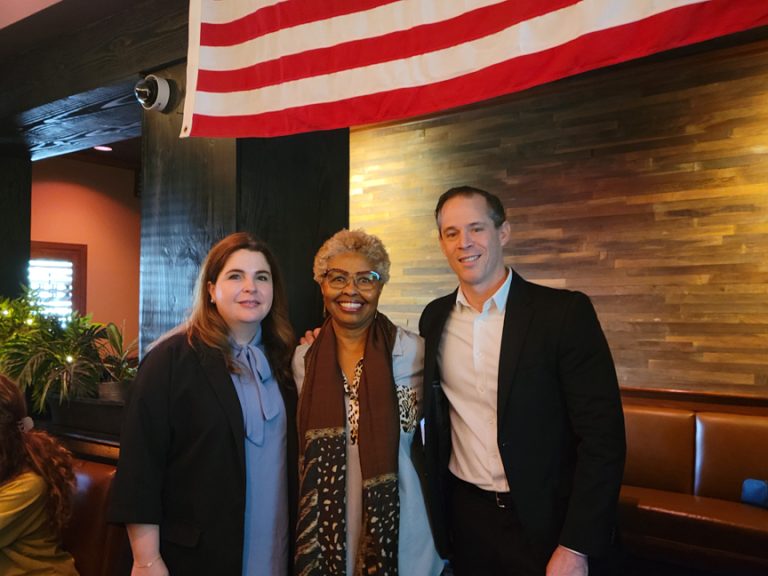
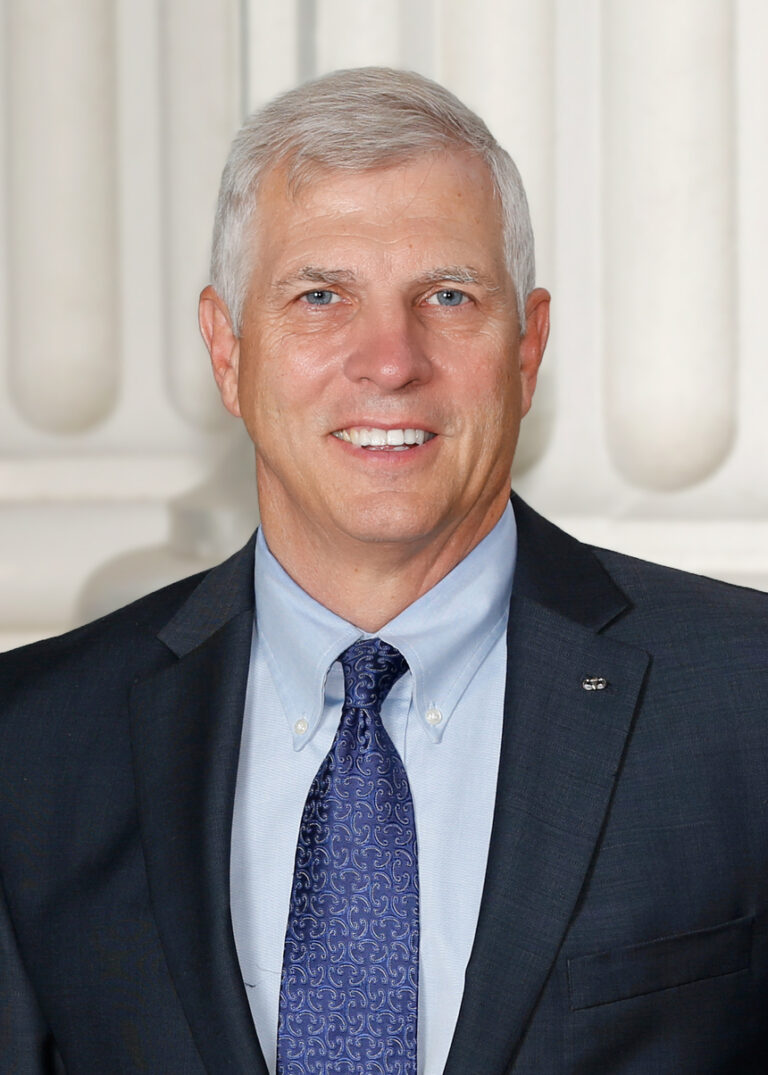





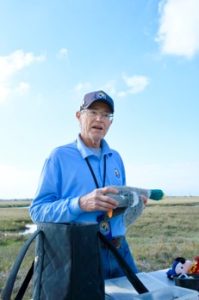



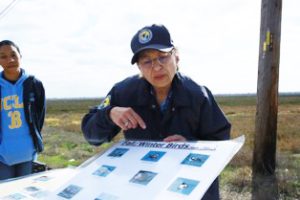


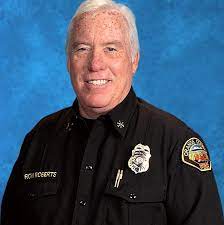

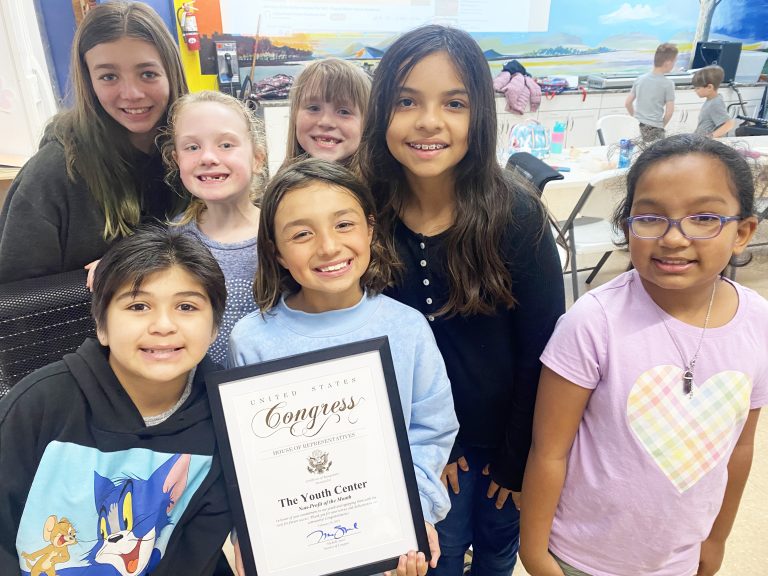

 With self-described pride of having the largest tree canopy of any inhabited area in Orange County, the Rossmoor Board of Directors suggested erecting signs to tout it and even suggested more funding if needed as the community’s resident arborist presented her annual tree report to the community.