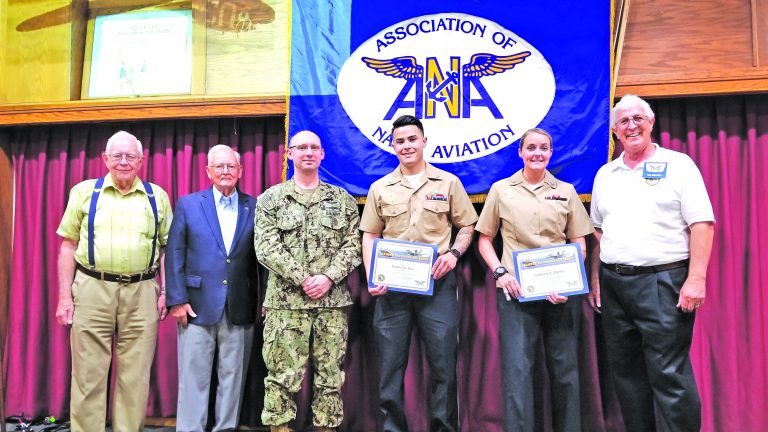
At the recent regular monthly meeting of the Grampaw Pettibone Squadron at the Elks Lodge in Garden there were some very special guests present from the Seal Beach Naval Weapons station, they were the Sailors of the Quarter for April thru June.
Present were the Junior Sailor of the Quarter–MA 2 Matthew Pace and the Bluejacket of the Quarter–MA 3 Katherine Parsley. Certificates of Appreciation were presented to them by the Commander of the Grampaw Pettibone Squadron–Tim Brown.
The sailors were introduced by CMDCS Paul Ellis, the Command Senior Chief for the Weapons Station. Some other Sailors of the Quarter were not able to attend because of duty responsibilities.
Attractive medallions from the USAA Insurance Company were presented and local restaurants sent coupons for the SOQ’s. The participating restaurants were: in Seal Beach (Main St)–Avila’s El Ranchito Mexican Restaurant, Bistro St. Germain, Crema Cafe, Hennessey’s Tavern, Old Town Cafe, O’Malleys on Main, and Taco Surf; on PCH (Seal Beach)–Coaches Sports Grill, Finbar’s Italian Kitchen, Glory Days Beachside Grill, and Yucatan Grill; on Seal Beach Blvd–California Pizza, Chick-Fil-A, Romano’s Macaroni Grill, and Santa Fe Importers; in Long Beach–Corner Bakery Cafe, Mimi’s, and Ruby’s. Restaurants in the Sunset Beach area included: Fish Camp, Harry’s Rooftop Patio and Grill, Olive Pit Grill, and Romano Cucina.
A popular horse racing announced, recently dismissed at Santa Anita, will be returning to California to announce races at Los Alamitos Race Track, officials have announced.
Wrona will be the full-time announcer for quarter horse and thoroughbreds in Los Alamitos, according to owner Ed (Doc) Allred.
Wrona will replace Ed Burgart, another legendary quarter-horse announcer who will continue to call races until Dec. 15, at which time Wrona will begin calling the races.
According to Wikipedia, Wrona began calling races in Australia at the age of 17 and his move to the United States was promoted by an invitation from another Aussie announcer, John Tapp.
Wrona, whose call of “Racing!” at the start of every race is his signature expression, also will reportedly call the three short thoroughbred meetings as long as they are held at Los Alamitos.
Wrona expressed surprise after Allfred offered him the job on the spot after a phone interview.
Los Alamitos currently has three short thoroughbred meets that go three to four days for two to three weeks. The nighttime quarter horse and thoroughbred meeting goes Friday through Sunday for almost the entire year.
The Los Alamitos Police Department took part in the nationally recognized public safety event, National Night Out last Tuesday, August 6, 2019 at Little Cottonwood Park in Los Alamitos. Hundreds of residents and community members enjoyed emergency service displays, food trucks and vendors. While kids enjoyed free face painting, and balloon twisting and bounce houses.
“I think the event came together very nicely,” Captain Chris Karrer of the Los Alamitos Police Department said. “Considering the short amount of time we had to put it all together, everyone showed up and looked like they had a great time,” he added.
The Police Department hopes to make next year’s National Night Out event even better so more people can experience this fun and community-oriented event.
Artillery fire will ring out across Joint Forces Training Base (JFTB) on Saturday, August 17th, commemorating the promotion of Col. Stuart E. Werner of the U.S. Army Reserve’s 79th Theater Support Command (TSC) to the rank of brigadier general.
The ceremony, which will be officiated by Maj. Gen. Mark W. Palzer, Commanding General of the 99th Readiness Division, is scheduled to get underway at 4 p.m. The Army Reserve’s Pacific Training Division Salute Battery will render the honors.
Following his promotion, Werner will assume the duties of Deputy Commanding
General of the 79th TSC. The unit is the Army Reserve’s second largest command and is headquartered at JFTB.
For further information, please contact Lt. Col. Brandon Kelley at (562) 936-7663 or via email at brandon.l.kelley2.mil@mail.mil.
Who knew that when the Aquarium of the Pacific opened its doors twenty years ago this summer, that it would eventually become one of the most visited, most innovative oceanic institutions in America?
Now ranked 4th in the USA with 1.7 million visitors per year, the aquarium has envisioned much more than a visit to see a Pacific ecosystem as part of its mission as it also becomes recognized for its innovative integration with marine science and oceanic knowledge.
And now, with its newly opened Pacific Visions extension (see related story), AOP takes the proactive climate experience to new heights as the Aquarium surges in popularity.
“With each passing year, the Aquarium of the Pacific builds on its position as an institution unlike any other,” President and CEO Jerry R. Schubel, Ph.D. noted in the nonprofit’s most recent annual report.
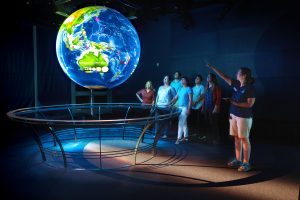
This year alone, the aquarium produced two new shows for NOAA’s popular “Science on a Sphere” series and is focused on “connecting the public with ocean science.” In addition, they offer scientific information on specific topics at its Ocean Science Center.
Let’s face it. Accurately replicating even a tiny portion of the Pacific Ocean has been a herculean task. The world’s oceans cover more than 70 percent of the earth’s surface and the Pacific itself covers more than 60 million square miles with an average depth of 13,000 feet, so figuring out what to showcase has not been easy.
So massive are the world’s oceans, in fact, that scientists estimate that under the surface of these winding canyons, mountain ranges, jagged edges and coral ecosystems, as much as 80 percent remain unexplored by man. Remote exploration devices are now able to go where man alone could not for generations, so with each passing day, more discoveries are being made and the excitement continues to build.
It is estimated that the Pacific Ocean alone contains enough water to cover all of the land surfaces. From the depths of the Pacific Ocean and its ecosystem, the Aquarium of the Pacific has assembled an incredible array of sea life and flora that now awaits its visitors.
With more than 100 exhibits, including 12,000 animals, 600 species and 50 unique displays, Schubel said in addition to being a top aquarium, AOP is also recognized as a leader in using its own technology network to make a huge contribution to oceanic knowledge around the world.
Even as they open the doors daily to an intricate network of overland and undersea exhibits that brings visitors face-to-face with the vast Pacific ecosystem, the aquarium is also “laying the groundwork for an entirely new platform for diverse marine sciences,” said Schubel.
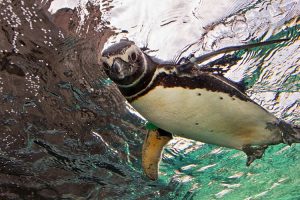
A penguin peers at the lens while swimming in the June Keyes Habitat. As the national conversation switches to climate, the institution has built an impressive network of scientists, oceanographers and others to play an expanded role in diverse marine science. Photo by Robin Riggs
Among the many innovations for the most recent year, he said, were “many new species” of sea animals that were being “exhibited for the first time,” including, among others, two grey reef sharks, a tufted puffin chick and three penguins (Cleo, Dee and Dolly).
Moreover, the AOP has developed a working partnership with the National Oceanic and Atmospheric Administration and has sponsored many forums and educational events with top marine scientists. This year alone, the aquarium produced two new shows for NOAA’s popular “Science on a Sphere” series and is focused on “connecting the public with ocean science.” In addition, they offer public classes on specific topics in its “aquatic academy.”
According to top websites, the Aquarium of the Pacific is considered a leader not only in overall visitation and scientific innovation.
As the national conversation switches to climate over the next few years, the institution has also built an impressive network of scientists, oceanographers and others to become a valuable oceanic authority in preservation of oceans, sea life and climate.
In just this short span of twenty years, the AOP has risen from an idea to a leading national aquarium.
Perhaps there are many reasons for the aquarium’s strong performance over two decades, but one of them may be the fact the Aquarium of the Pacific was actually built in an area that was once connected to the Pacific Ocean.
According to AOP’s website, the five-acre site on which the complex now operates, was not acreage at all but was part of the bay when the project was envisioned. With landfill and a plan, the Aquarium opened in the summer of 1998 across from the convention center and has been an anchor attraction ever since.
More than 1.7 million visitors make the Aquarium of the Pacific one of the leading American oceanic institutions.
Once inside the aquarium, visitors are greeted by a giant, mounted 88 foot-long blue whale, complete with calf, that hangs from the aquarium’s large lobby. In the sea, a whale of this size would eat 8,000 pounds of krill (small fish) at every feeding.
The aquarium offers more than 10,000 square feet of themed exhibits such as Explorer’s Cove and another exhibit called Shark Lagoon, supporting more than 150 sharks and sting rays. Then there is a 3,200 sq. ft walk through of Lorikeet Forest among many attractions, including southern, northern and tropical pacific galleries.
“The culture here is very unique,” says aquarium interpretation manager Staci Wong, who has been with AOP for 12 years. “There’s always something new,” she said, “and that keeps it exciting.”
Not only does she marvel at the public’s reactions to the exhibits, but she says it is also fun to hear the reactions as visitor’s learn how hard it is to keep this massive ocean ecosystem functioning every day.
Behind the scenes at the aquarium reveals the massive operation to keep up with the animals; their health, feeding them, etc. It takes 2,000 staff and volunteers to administrator all of the exhibits, tours, lectures and other activities that AOP now offers. And, of course, there is water quality, animal husbandry and more.
Tropical bird brings a smile to a visitor in the Aquarium’s Lorikeet Forest.
Yet, says Wong, it is “truly worth it.” With one and one-half million gallons of various underwater exhibits, the aquarium has managed to encase a multitude of regional highlights ot the Pacific, each tank properly planted or painted to highlight the region’s fish and marine ecosystems of the Pacific. They localize exhibits as well, as one tank presents a collection of coral and fish associated with Catalina Island, an Eco paradise located 22 miles off the California coast.
Says Wong, once visitors gaze into the tanks and “get a peek at the ocean, the questions begin.” Visitors ask about “almost anything,” but she says they most often wonder out loud, asking questions like “the size of a fish’s mouth, how long they live and how much do they eat,” said Wong.
After all, she said, in few other places can a human literally stand in comfort to witness the fantastical wonders of the sea, so questions are always welcomed, said Wong. “We learn too,” she added.
The scientific educator says she works with the AOP team with a goal of creating a “friendly and truly memorable experience” for the visiting public. She often interacts with visitors to learn from them what they enjoy most.
“They (visitors) always learn something new,” says Wong, adding that visitors are “very knowledgeable” and want to learn more.
That’s why Wong says the AOP association with NOAA is so valuable. It allows some aquarium staff to remotely participate on exciting research dives by the agency’s “Nautilus” exploration vessel so, they too, can learn and pass this exciting knowledge on to visitors through programs and tours.
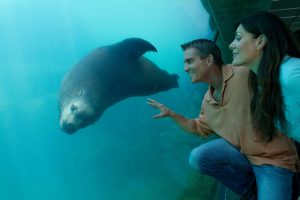
With more than 100 exhibits, Wong said people seem to enjoy all parts of the aquarium, though some more than others. Among the perennial favorites, she said, are the sea lions, seals and sea otters. “People love the mammals,” she added.
In just two decades, the AOP has managed to utilize dedication and technology to harness some of the amazing wonders of the Pacific. The institution has also created a top marine science educational platform and attracted hundreds of supportive donors who believe in the mission.
The nonprofit generates more than $60 million annually and is able to support itself with less than five percent of its income from other governmental sources, according to their annual report.
“Our 20th Anniversary highlighted the special place the aquarium holds in so many people’s lives,” said Schubel. He said the institution has collected many stories of young visitors or interns who have gone own to careers in the sciences and several staffers who have been there for the entire span of twenty years.
Schubel said the aquarium would “not be where it is today” without its dedicated staff as he looked forward to the next twenty years.
According to Schubel, the aquarium will continue to “challenge our visitors to examine human impact on our ocean planet and engage in choices to reduce that impact.”
Indeed, an institution unlike any other. For more info, visit www.aquariumofpacific.org.
$53 million expansion opened earlier this summer and is all about conservation
By Brooklynn Wong
Long Beach’s Aquarium of the Pacific has long been highly-regarded as a hub of underwater education and spectacle.
But a $53 million addition has taken it to the next level.
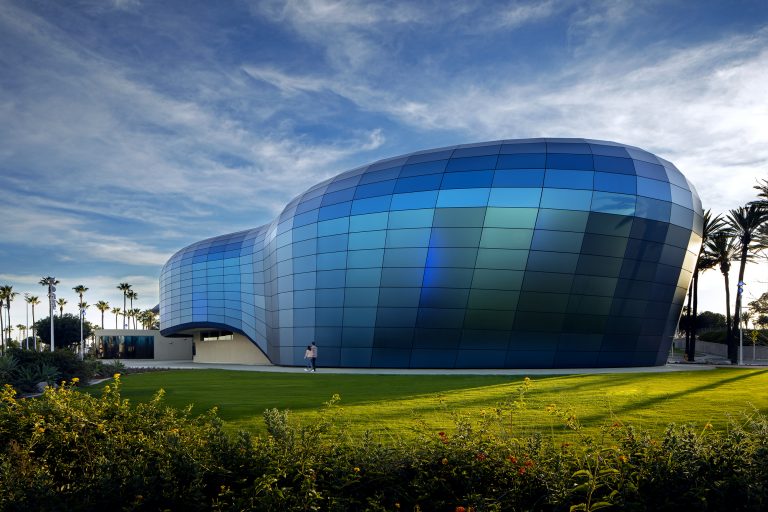
The Pacific Visions expansion is an addition that takes the Aquarium of the Pacific from aquatic zoo to all-encompassing educational center.
Not since the aquarium opened in 1998 had there been a major expansion until this one.
Ground was broken in February 2017 on Pacific Visions—a big blue add-on that contains a theater, an art gallery, game tables and live animal exhibits—and it opened to the public May 24 of this year.
The 29,000 square-foot two-story structure is a collaboration between the aquarium and several highly-regarded design and technology firms.
EHDD, a San Francisco architecture and design firm, brought to life the exterior of this big, reflective whale-esque addition.
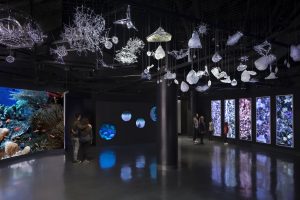
The Pacific Visions Art Gallery.
Aquarium visitors can still see all the fauna they always could, from penguins, and turtles and frogs, to harbor seals and sharks, but now they can round out their experience by learning about sustainability. This is at the center of Pacific Visions.
Some estimate that by the year 2050, there will be about 10 billion humans on the earth. The ocean plays a major role in providing oxygen, food and water to the earth’s inhabitants. The aquarium has taken on a new role of making people aware of the changing climate, and letting them know how they can make sustainable and environmentally-friendly lifestyle choices.
Said Aquarium President Dr. Jerry Schubel when asked about this, “Programs and exhibits at the Aquarium have always communicated messages about conservation and sustainability, but Pacific Visions takes on the urgent challenge we face in creating a sustainable future for a growing human population while conserving nature….We have a responsibility to serve as gathering places where people can collectively explore our relationship with our planet and alternative pathways to a sustainable future.”
When you enter the aquarium, veer right and you’ll find yourself in Pacific Visions.
The Honda Pacific Visions Theater. Photo by Howard Hall Productions
First comes “Reefs & Drifters.” This is the art gallery portion of Pacific Visions. Coral and plankton are the emphasis here. They are an often-overlooked but very important, and surprisingly beautiful, component of the world’s oceans. Hanging from the ceiling are ornate and delicate pieces of glass sculpted to look like plankton. On one wall is a touchable coral sculpture wall, with a 3D-printed rubbery material shaped like coral, with images of coral superimposed on it to amplify the effect. Another highlight of Reefs & Drifters is an Infinity Coral exhibit, in which people can look into portholes where artificial, but rather real-looking coral is mirrored, to create the effect of never-ending coral colonies.
Next up is the Orientation Gallery, where guests see a short pre-show that acts as a primer for the main event. There’s a virtual waterfall, that projects onto the wall and the ground, that reacts to movement. Children enjoyed splashing around in the virtual water, that rippled and chased away virtual fish when they walked in it.
Next up was the Honda Pacific Visions Theater, a beautiful, state-of-the-art indoor amphitheater that seats 300. And what ensues over the next eight minutes is the most impressive part of it all. A film plays, called “Designing Our Future.” It gives an outlook on the food, water and energy situation facing the earth, but what is impressive and makes the message impactful, is the multi sensory way in which it is presented. The film is a sight to behold in itself, as the screen wraps around 180 degrees, plus additional projections are made onto a 36-foot-wide disc on the floor that tilts.
Aquarium of the Pacific’s President and CEO Dr. Jerry Schubel gives a speech in the Honda Pacific Visions Theater during a press preview shortly before it opened to the public
With incredible sweeping ocean views and others, it feels like you’re on a rollercoaster, and creates such an effect that it might bother those prone to motion sickness.
There are immersive shots of dolphins, kelp forests, sharks and a breaching humpback whale.
Air is blown in for certain parts, fog is used, seat vibration and strobe lights are used in a lightning storm, and crop scents were blown throughout in one segment when agriculture was being discussed.
The film plays every 15 minutes.
The theater was developed by the aquarium in association with multimedia design firm Cortina Productions.
One thing the aquarium is particularly proud of is its ADA efforts in the theater and elsewhere in Pacific Visions. Those that are deaf or blind can use “virtual touch,” in which they are given an ultrasonic speaker that projects shapes, textures and effects directly onto their hands.
There is also braille on the informational signs next to the exhibits.
The Honda Pacific Visions Theater can also be rented out for a variety of purposes.
After the film, visitors go up and out of the theater and into what is called the Culmination Gallery. There they can test their knowledge of what they’ve just observed, with interactive touch-screen game tables about the water challenge, the food challenge and the energy challenge, and a touch-screen wall where they can pop virtual bubbles to reveal facts.
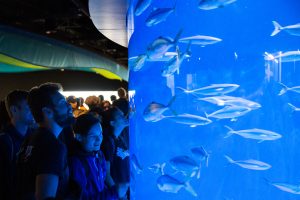
Aquarium visitors including more than 200 students from Lakewood High School view the new exhibits in the culmination gallery in the new Pacific Visions wing. An exhibit of nearly 100 California yellowtail fish demonstrate how offshore marine aquaculture, or farming of the sea, could help supplement our food supply.
There are a few live animals exhibited in the Culmination Gallery, but these animals are not the usual crowd pleasers. They’re ones that have a story to tell, of the impact people have on the environment.
A small fish called the delta smelt, the California yellowtail, and Pacific and Olympia oysters, are featured. The Aquarium of the Pacific is the first aquarium to exhibit delta smelt.
These fish are found only in the Sacramento-San Joaquin River Delta, and they are very endangered. In 2016, only one fish was found there, and last year, none were found. The aquarium’s population of the fish came from UC Davis. The delta smelt is heavily impacted by human infrastructure, they get trapped in water pumps, and they are sensitive to water contamination.
As far as general environmental tips, aquarium education staff urged visitors to abandon single-use plastics and to only buy seafood that is from the US, as our sea-life is protected from overfishing by regulations that are in place, that other countries tend not to have.
And this is where Pacific Visions ends—visitors are shown the grandeur of the sea and all it contains, and are then left with a wakeup call to be responsible consumers.
This $53 million project was funded completely by grants and donations from a variety of sources.
Staci Wong, Interpretation Manager at the Aquarium, said that Pacific Visions “allows us to focus on food, energy and water and to have a conversation about the future of our planet that we have not been able to have before.”
According to estimates, the Aquarium of the Pacific welcomes nearly two million visitors per year, making it the fourth-most-visited aquarium in the country. And with the addition of Pacific Visions, now those visitors can go beyond just looking at sea-life; they can learn how to protect it and the planet that supports it.
Admission to Pacific Visions is included with general aquarium admission.
And summer is the best time to go. On Fridays, Saturdays and Sundays for the next month, the aquarium will stay open later than usual and entry will cost less than usual. Admission after 5 p.m. those nights is $19.95, and the aquarium stays open until 9 p.m.
On July 20th through July 29th, McAuliffe and Oak students tested their musical abilities. These talented musicians competed at the 57th Southwestern Youth Music Festival (SYMF). This music competition took place over two weekends (five days) and was held at the Bob Cole Conservatory of Music at California State University of Long Beach.
Duet Photo (left to right) – LeAnn Lee and Kiera Wong
After months of preparation, the McAuliffe team comprised of LeAnn Lee and Kiera Wong placed 1st in their piano duet. Before receiving their trophies, the duet team delighted the audience at the Awards Recital with ‘In a Boat’ by Claude DeBussy.
Venturing on her own, Kiera Wong amazed the judges with ‘Sonatina 3rd movement – Allegro Mosso’ by Aram Khachaturian to earn 1st place in her piano solo. She also took the stage to perform at the Awards Recital.
McAuliffe and Oak musicians came together once again at SYMF. The chamber team of Katelyn Ngo, Karlie Nguyen and Kiera Wong took home 3rd place in the music ensemble category. A total of six trophies
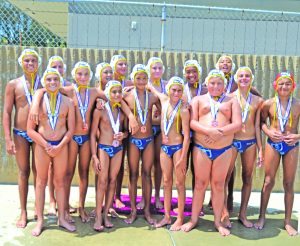
The United Water Polo Club 14U brings home two 3rd place finishes this past week down in Orange County.
United 14U Girls brought home bronze in the Championship Division placing 3 out of 78 teams while the 14U Boys placed 3rd in the Classic Division.
United’s 14U boys defeated number 1 seed Santa Barbara 11-9 to secure 3rd place in the classic division.
14U Boys – 3rd Place – Classic Division Kai Baker, Michael Sorenson, Lico Yuno, Josh Winn, Joe Stanbridge, Nick Leung, Isaiah Osorio, Zack Populus, Dusan Djorkevic, Felipe Castro, Kai Inoue, Cayden Harris,Otis McAdams and Nathan Tran. Courtesy photo
The road to the semi-finals was anything but easy. After an early round loss to South Bay, United was able to upset Irvine Back Bay to secure a spot in the semi-finals. In the Earlier rounds, United scored victories over Socal Gold and Costa Mesa Aquatics.
Offensively, United was lead by Nick Leung, Lico Yuno, Kai Inoue, Cayden Harris, and Kai Baker. Joe Stanbridge and Michael Sorenson played strong 2 meter defense.
United 14U Girls was led offensively from Isabel Valaika, Olivia Slavens, and Hayley Bergstrom. Tess Ravelo and Madelyn Nollan provided key stops on defense. Goalie Josephine Niz was outstanding all weekend long blocking multiple penalty shots and scoring two full court shots.
“These girls have been playing together since September. Before they go to polo practice, they go to swim practice twice a week. When not playing polo they share game tape with each other. These girls have an amazing work ethic,” according to Coach Sean Nollan.
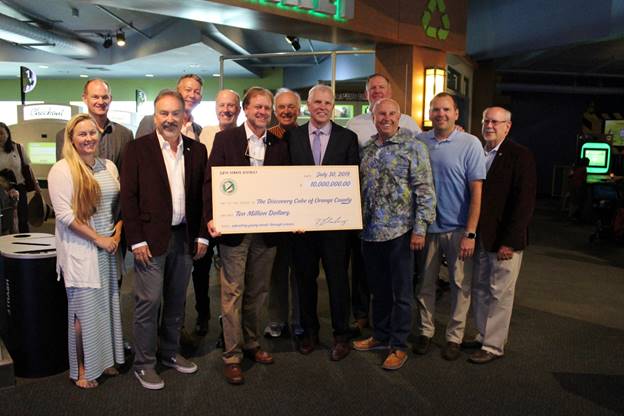
Senator Tom Umberg (D – Santa Ana) announced today that he has successfully secured $10 million in state budget funds to assist the Discovery Science Center of Orange County. The funds will be utilized to assist the Science Center with the recent expansion and addition of new science exhibits and educational services.
“The Discovery Science Center of Orange County has been a tremendous success story in our community, serving almost half a million local school children and teachers last year,” said Senator Umberg, a member of the State Senate Budget Committee. “The funding is an important investment by the State of California toward Orange County’s continued effort to provide the children of our community an important education in Science, Technology, Engineering and Mathematics. I am excited that we could be of assistance and provide them the opportunity to further enhance their effort to reach even more students.”
“The Discovery Science Center of Orange County’s recent expansion allowed us to add an additional 44,000 square feet to our museum facility, thus allowing us to successfully add new hands-on permanent exhibits, themed science adventures, incentive programs, and learning spaces,” said Joe Adams, CEO of the facility. “The important state funds will also assist us in our effort to accommodate the expansion. We are very grateful for Senator Umberg’s assistance.”
The Discovery Science Center now provides hands-on science learning centers in Orange County, Los Angeles, and Newport Beach, California. Established in 1989, their Discovery Cube facility in Santa Ana, presented by Taco Bell, has inspired and educated millions of young minds through engaging science-based programs and exhibits. In 2012, the Cube was named one of the 10 “Most Trusted Brands” in Orange County and in 2013 was awarded the National Medal of service from the Institute of Museum and Library Services at The White House.
Senator Thomas J. Umberg represents the 34th Senate District, which includes the cities of Anaheim, Costa Mesa, Fountain Valley, Huntington Beach, Garden Grove, Long Beach, Los Alamitos, Midway City, Orange, Santa Ana, Seal Beach, and Westminster. Umberg is a retired U.S. Army Colonel, former federal prosecutor, and small businessman. He and his wife, Brigadier General Robin Umberg, USA (ret.), live in Orange County.
The Los Alamitos Education Foundation (LAEF) is partnering with Los Alamitos Unified School District’s new Superintendent Dr. Andrew Pulver to host the 6th annual State of the District breakfast event on Friday, Sept. 13, at 8:30 a.m.
“LAEF is thrilled to continue this wonderful event with Dr. Pulver and help bring the community members together to celebrate the success of our district’s students and look ahead to what the future holds,” states LAEF Executive Director Carrie Logue.
The breakfast will take place at On the Greens at Navy Golf Course and all net proceeds will support LAEF. It is an opportunity to connect with community members and parents who are passionate about education and the district. The title sponsor will again be Alamitos Eye Care who has provided this level of support since the event inception. Tickets are available for $25 at www.LAEF4Kids.org/events.
LAEF is the non-profit partner of Los Alamitos Unified School District. LAEF enhances educational excellence by providing after-school and summer enrichment programs to children in grades Pre-K to 12. LAEF provides significant funding for STEAM teachers and instruction, as well as igniting new programs and providing valuable resources, to impact all students. For additional information on LAEF, please call 562-799-4700 Extension 80424 or visit www.LAEF4Kids.org.
St. Irenaeus’ Bridge of Light: Human Trafficking to Human Triumph Ministry had a booth at the Cypress Festival on July 27th that attracted a lot of people and spread community awareness of the heinous crime of human trafficking.
This ministry is part of Health Ministry at St. Irenaeus Catholic Church in Cypress. It is very active in helping foster community youth ages 18 – 24 throughout the year by providing and serving dinners regularly at the Orangewood Foundation, a center for Foster and Community Youth Services.
Because youth in Foster Care are most at risk for human trafficking, providing them with assistance and support helps to prevent them from becoming victims of human trafficking. This ministry also holds an annual Prayer Vigil and Solidarity Walk to honor and pray for victims of human trafficking.
Human trafficking is now the fastest growing illegal criminal enterprise in the United States. It has been called “modern-day slavery”. It is estimated that 100,000 kids under age 18 are victimized each year in the United States; 70% of victims are U.S. citizens and 82% involve sex trafficking.
The Orange County Human Trafficking Task Force Victim Report for 2015 identified 225 human trafficking victims in Orange County who had received service or assistance from them. According to Orangewood Foundation, “400 victims of sex trafficking in Orange County have been identified in the past 10 years. Nearly half of those victims were children.” If you see something that may be human trafficking, please call the National Human Trafficking Hotline at 1-888-373-7888 so that professionals can investigate the situation.
Janet Bica, Ministry Chair, extended her appreciation to Joe Tucciarrone for helping to set up and take down the booth, as well as her husband, Mario Bica, Carol Reed and her grandson, Monica Kovach, Sr. Gemma Pires, Donna Kriesel, Terry and Rolly Arenz, Rick and Mary Tkach and all volunteers who helped in manning this booth.
If you are interested in joining or assisting this ministry to combat human trafficking, please contact Janet Bica, Chair, at 714-743-0112. Monthly meetings are the 2nd Wednesday of the month at 7 p.m.
Rossmoor Woman’s Club donates backpacks to students of JFTB military personnel
Backpacks for School
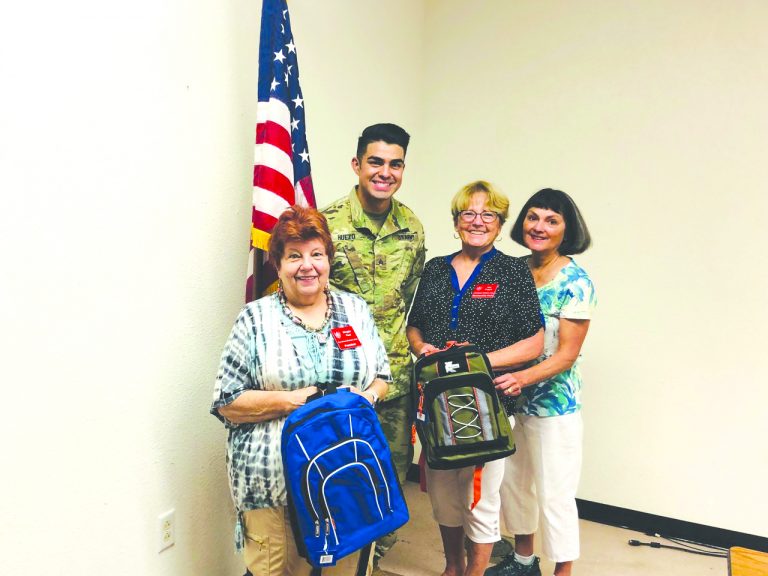
The Rossmoor Woman’s Club recently donated 120 school backpacks to the children of military personnel assigned to the Los Alamitos Joint Forces Base. The gifts are to be distributed to students in kindergarten through 12th grade by the Family Assistance Program at the base in conjunction with the Bob Hope USO of Orange County. The donation included the backpacks plus supplies including paper, pencils and rulers. Showing off two of the backpacks are RWC President Maggie Paul, left, U.S. Army Sgt. Felix Huezo, RWC Membership Chair Sue Pagett and RWC member Nina Millar, who spearheaded the project.
Saturday, August 17 is sure to be an action-packed and meaningful day, and you won’t want to miss it. At the Long Beach Airport, Special Olympics Southern California will host two incredible fundraisers that are estimated to raise a total of $450,000 total. Join us as we compete for bragging rights and pull a plane.
The 14th annual Plane Pull will test participant’s strength and endurance as teams of 25 pull a 124,000-pound UPS jet. Just up the runway, UCLA and USC fans will take to the streets to race for pride and Special Olympics in the 5K/10K rivalry run.
Last year’s Plane Pull raised more than $190,000 dollars for Special Olympics Southern California. To get involved you can create a team, sign-up individually, donate, or become a sponsor. Teams are made up of 25 people, but don’t worry if you can’t complete your team. Individual pullers will be added to teams of less than 25 people on the day of the event. The minimum amount of money for a team to fundraise is $1,500. As an individual, the fundraising commitment is $60. Sign up at www.sosc.org/lbplanepull.
“The Plane Pull is a very unique and fun way to support Special Olympics Southern California athletes,” said SOSC President and CEO Bill Shumard. “It is all about teams competing against each other to pull more than a plane – we’re also pulling for inclusion for people with and without intellectual disabilities. We are pulling for each other.”
To donate to the Plane Pull, you can support a team, a participant, or make a general donation. As a sponsor, you can raise awareness for athletes with intellectual disabilities, expand your customer reach, and build team morale. Sign up to conquer the Plane Pull at www.sosc.org/lbplanepull.
“The Plane Pull has grown to be more than just pulling a plane,” said Shumard. “It is a family-friendly event, offering something for everyone. It is such a great way to be a part of our movement of inclusion and acceptance, while helping us serve more athletes, changing their lives, the lives of their families, and of the community.”
We Run the City 5K/10K is an exciting event featuring USC and UCLA students, faculty, alumni and fans who compete for bragging rights and to take home the We Run the City Trophy. Each runner/walker must declare their allegiance at the time of registration and whether they are an alumnus, faculty, fan, staff, or student. They are then a part of Team USC or Team UCLA. Competition is broken into three categories: amount of runners/walkers, fundraising, and the school that has the first 100 runners to
cross the finish line. The school that wins at least two out of three, claims victory and their school has bragging rights and the trophy for the year!
Those interested in participating can walk/run in the 5K or 10K or participate in the kid’s race. If you can’t make it out to the event, you can register for the virtual race. Learn more at www.werunthecity.com.
Chamber members get primer on marketing to millennia
Consumers that belong to the so-called “Millennial’ generation and who mostly grew up around the internet are vastly different, the owner of a millennial based marketing firm told the Los Alamitos Chamber Friday.
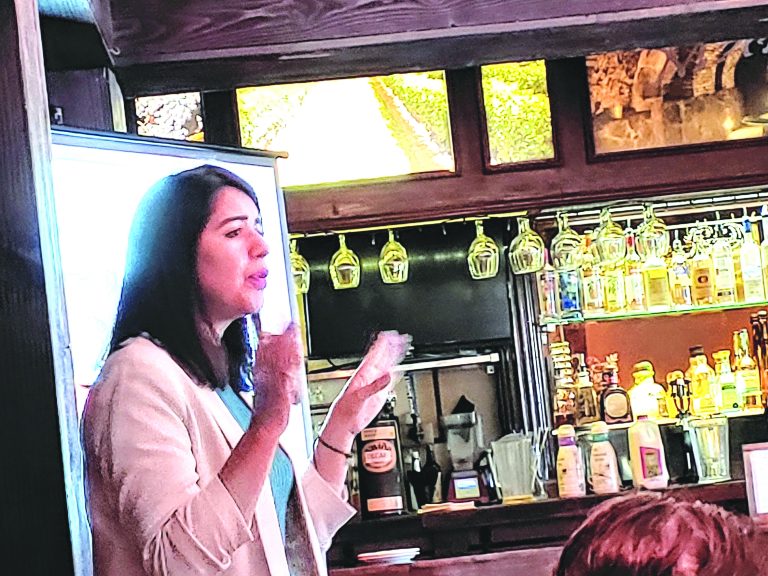
Speaker Ana Clara Otoni was introduced by Chamber Chairwoman Dawnette Palmore. Otoni is the founder and creative content strategist of Odara Digital and she gave Chamber members a marketing peek “Inside the Millennial Mind: The do’s, don’ts and best practices of marketing.”
Approximately 97 percent of millennials use social media, said Otoni, and this generation is predominately “experiential.” For millennials, she said they prefer doing business with companies that are authentic and those that “stand for something.”
Even if they perhaps disagree with a company’s stance, they will “respect” them for having the courage to exhibit who they really are. Millennials much prefer doing business with companies that work towards a “sustainable good.”
However, just being “on” social media is not enough to attract them, she said, adding “how” one engages will often determine the outcome.
For instance, during her “do’s” and “don’ts” of doing business with millennials, Otoni said do not make “repetitive” offers, especially those that do not offer value. The best approach, she said, is to create your own digital profile and find a way to get them interested in your service or product. “Let them come to you,” she said.
It is just a fact that millennials are married to their phones and thus, the internet, and the market is currently worth more than $600 billion nationwide. She said when they want to know something or find a product (or service), they will simply Google (search) for it. “They want it and they want it now,” she said.
It is then, she said, that “your business must show up,” giving business owners an idea of how to set up their digital profiles and search engine optimization to get themselves in front of millennial consumers.
Otoni called these incidences of internet searches as “micro moments,” adding that they were a “golden opportunity” for businesses to reach the millennial audience.
Likewise, she said, even millennial business owners will divorce their own customers if, for any reason they believe the relationship is not a good fit or inauthentic.
Otoni gave the business owners brief previews of how to create a target market and gave them social good project examples that could be used as a model in their own businesses.
Finally, she said, despite the digital reliance, retro analog items like vinyl records and “real, printed books” are making a popular comeback with millennials.
“Story telling is king,” she said, and then told the business owners to use the practices and engage with the millennial mind.
Dr. Fred Calhoun, a Buena Park resident, is president of the NAACP, Orange County Branch. He has previously served with and the National Association for Equal Justice in America.
Like a high-quality education, the internet has the promise to be the great equalizer. Whether rich or poor, black, brown or white, old or young, equal access to information and resources online can help bridge the gap between the haves and have-nots.
Unfortunately, equal access to the internet and its daily conveniences is in jeopardy. Action by Sacramento lawmakers is desperately needed this year to ensure the internet remains the great equalizer it has become. Specifically, a legislative fix is needed to ensure modern online advertising remains viable to support the free online services we enjoy and rely on today. Without this action, a flaw in the rushed privacy law passed last year threatens to create broad gaps in internet accessibility affecting those less fortunate.
Most of us currently take for granted our reliance on free online services such as driving directions, surfing the web, watching videos, accessing social media or using email. Much like we get free television programming because networks sell commercials, the free internet is made possible because internet sites serve us ads, many tailored to our interests. Importantly, the services and conveniences of the internet are significantly more critical than television programming to connecting underserved Californians with education, jobs and transportation.
The threat to free internet services and apps is one of the unintended casualties of last year’s well-meaning passage of the California Consumer Privacy Act (CCPA). The legislation is intended to give consumers more control over their personal data and information, but it was introduced and rushed through the legislative process in just one week with little opportunity for thorough vetting to identify possible flaws. Because of this rush, it was and is widely understood that clean up legislation would be necessary before the law goes into effect in June 2020.
One of those issues for clean-up is a flaw in the law’s drafting that would hinder tailored online advertising by prohibiting the sharing of technical information required to make online ads work. This was never the intent of CCPA and must be corrected this year.
This policy fix is needed to ensure the CCPA does not unintentionally prohibit the continued use of internet advertising tailored to the specific interests of consumers. Tailored ads are delivered using unique identifying numbers attached to computers, tablets and phones and do not rely on sensitive information such as an individual’s name, address, social security number or banking information.
The fix also would clarify that when a consumer opts-out of the “sale” of their personal information, it does not restrict the ability of companies to continue to show targeted ads to that consumer, so long as providing those ads only relies on sharing this technical data, not any sensitive personal information.
If ad targeting becomes more difficult or impossible, services we get for free today could start costing money. Imagine having to pay every time you search the internet, use an app to get directions, or check email or social media. These costs could quickly add up and create a growing gap of available education and employment opportunities between the haves and have-nots in California.
We can protect the privacy of consumers’ sensitive personal information without destroying all the progress made to close the digital divide.
We must ensure continued equal and free access to the internet for all Californians.
The members of Da’ Hawaii Seniors Club of Cerritos are known for their hospitality and interesting food that they share at their meetings. The club’s meeting on Tuesday, July 30, 2019, showcased the wide variety of international food that members prepared or purchased to share at their International Food Potluck Dinner. Prior to the start of the dinner, club members were first treated to seeing the video that Howard Koga had been working on for months with the assistance of many club members. Howard photographed himself and members singing the song, “White Sandy Beach” which he plans to put on You Tube. Members enjoyed the video and thanked Howard for all his hard work.
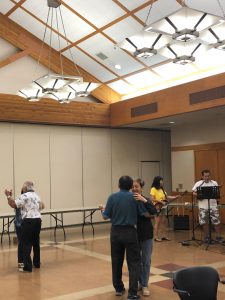
Members dancing Pictured at Da’ Hawaii Seniors Club’s International Food Potluck Dinner are dancers, Danny and Winona Chang, at left, and Frank and Gladys Yoshii, at right, dancing to the music played by Howard Koga, Carrie Kumabe and Roque Asistin. Roque is not pictured.
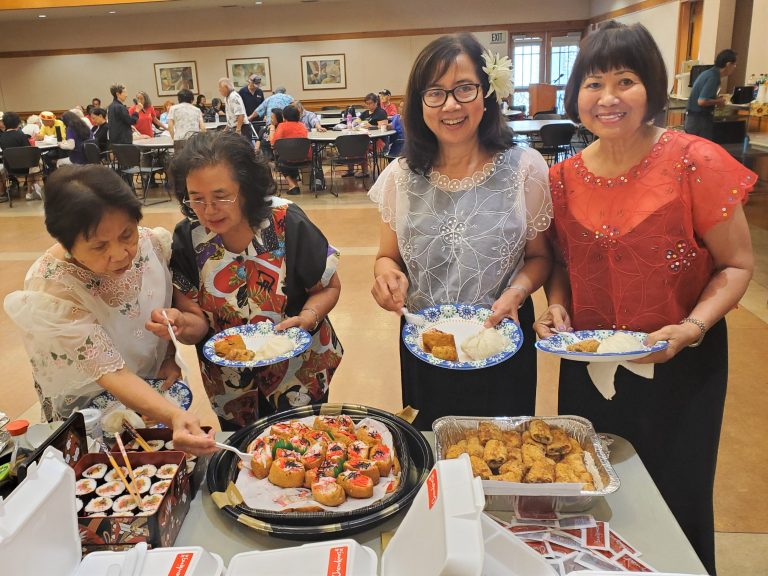
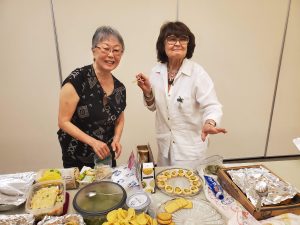
Approximately 70 members came to enjoy all the delicious food that included appetizers, salads, main dishes, side dishes and desserts with ethnic flavoring. There were so many items to try that a person could not try everything. Some of the food at the potluck included caviar from Sweden decorated with German style pickles, Japanese cucumber namasu, steamed Chinese pork bau buns, fried chicken from Chick-fil-A, Japanese makizushi wrapped in nori, tofu pouches with noodles, baked Italian Zita, Hawaiian style spam musubi, Chinese fried rice and noodles, Portuguese sausage stew, delicious Filipino desserts of fried banana lumpia and coconut balls, Japanese sweet mochi, decorated cookies, and a Hawaiian guava cake. There were also Ethel and Dennis Okada’s home-grown Hawaiian lilikoi (passion fruit) and rosy apples for people to taste, some for the first time. A special treat, to take home and cook with pork adobo, were bulbs of freshly picked bulbs of garlic from Gilroy, the garlic capital of California.
After everyone had eaten the items they selected for their dinner, everyone was en
Two members with Appetizers: Pictured at Da’ Hawaii Seniors Club’s International Food Potluck Dinner are Carol Yamaguichi, at left, and Helga Tanaka, at right. They prepared appetizers of Swedish caviar with German pickles.
tertained by the music and singing of Howard Koga, Roque Asistin, and Carrie Kumabe. Howard and Roque played their ukuleles, and Carrie played her guitar while they sang many mellow songs in Hawaiian and English. The music was so inviting that a few couples got up and danced while the trio sang and played one song after another for 30 minutes.
At the end of the evening, everyone gathered in a circle holding hands and sang their traditional closing songs of “Hawai’i Aloha” and “Aloha O’e,” and said their farewells until they met again. The next meeting of the Da’ Hawaii Seniors Club will be Thursday, August 8, 2019, at the Cerritos Senior Center, from 1:30 to 4:30 p.m. A guest speakers from Keiro, Healthy Living Programs will be discussing “Senior Scams” so that seniors will learn how to protect themselves against scams for a safer life. For more information about Da’ Hawaii Seniors Club, contact Membership Co-VP Myrna Matsuno at 310-538-2148.
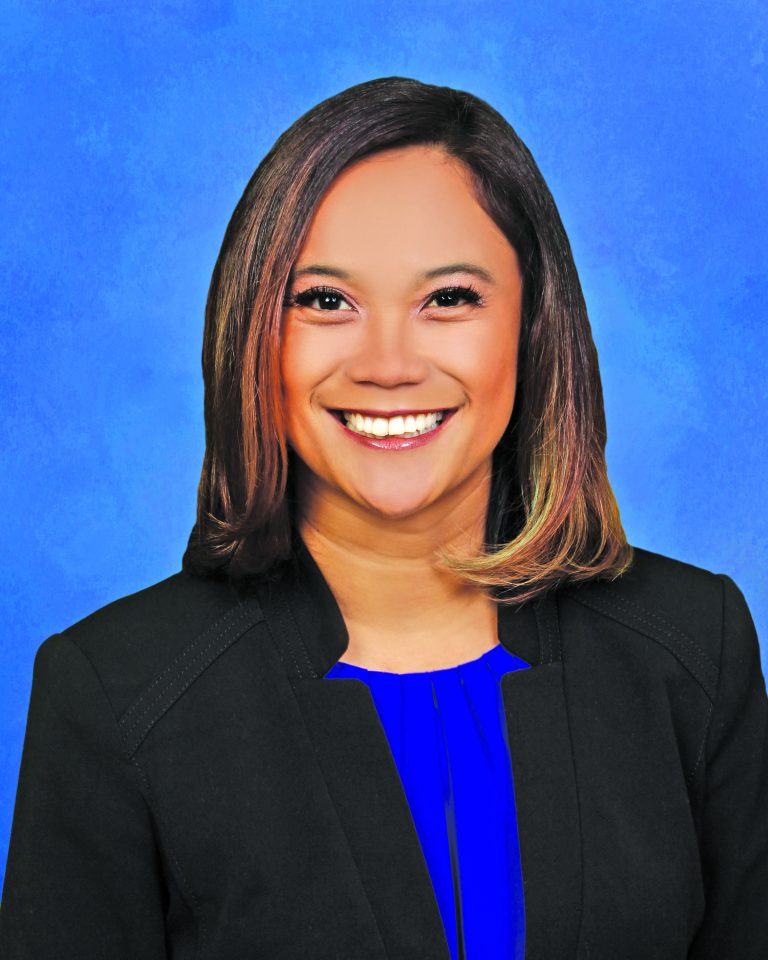
Following a rigorous selection process, the Cypress School District is pleased to welcome Mrs. Vanessa DeSantis as the new principal at A.E. Arnold Elementary School!
Mrs. DeSantis is a native of Northern California and began her elementary teaching career in her home school district of Elk Grove Unified. In 2010, she moved to Orange County and the following year began working in the Fountain Valley School District. Mrs. DeSantis has over 10 years of classroom experience and has taught nearly every level except kindergarten and first grade.
In addition to her vast classroom experience, Mrs. DeSantis has previous administrative experience in the Westminster School District, having served both as Principal and Assistant Principal. Her areas of professional expertise include multi-tiered systems of student support, restorative justice, trauma-informed practices, and working with students with special needs. Mrs. DeSantis earned a Bachelor of Arts in Liberal Studies from California State University, Sacramento; a multiple subject teaching credential from San Francisco State University; a Master of Arts in Education Administration and an administrative credential from Concordia University, Irvine; and is presently finishing her Educational Doctorate in P-12 Educational Leadership at California State University, Fullerton.
Mrs. DeSantis stated, “I am very excited to be a part of the Cypress School district family! I believe an effective educational program focuses on the development of the whole child. I look forward to working with the amazing staff at Arnold to provide a rich learning environment that encourages students to dream big and supports them in achieving their highest potential.”
“Mrs. DeSantis is an outstanding educational leader who is committed to fulfilling the district’s mission to inspire and empower every student, every moment, for every opportunity. She is a high-energy, dynamic leader, and we are thrilled to have her as the new principal at Arnold,” said Cypress School District Superintendent Anne Silavs.
Mrs. DeSantis lives locally in neighboring Los Alamitos with her husband Jeff and her three-month-old daughter Olivia-Rose. She looks forward to meeting students, working with parents, and partnering with the community when school begins on August 8, 2019.
Vanessa DeSantis began her elementary teaching career in her home school district of Elk Grove Unified.
Patty Barnett Mouton, the Vice-President of Alzheimer’s Orange County will be the guest speaker at the next Cypress Chamber of Commerce Networking Breakfast on Tuesday, August 13th at the Residence Inn by Marriott (4931 Katella Avenue, Los Alamitos) at 7:30 a.m.
Patty will be discussing a topic entitled “Your Brain is Our Business” and share some of the latest information about the disease and treatment of Alzheimer’s.
She manages community and clinical outreach, as well as the Advocacy and Public Policy activities at the local, state and federal levels. She has served as co-chair of the OC POLST Coalition, now known as the OC Advance Care Planning Partners, since 2010. She currently serves in leadership roles on both the CalOptima OneCare Connect and Member Advisory Committees.
Patty has also been a featured lecturer at many national meetings including: National POLST Paradigm Conference, California Council of Geriatrics and Gerontology, American Society on Aging National Conference and the California Association of Health Services at Home Conference.
Reservations are recommended for the monthly breakfasts and can be made directly on the Cypress Chamber website at cypresschamber.org. For more information call 714 484-6015. Cost of the breakfast is $20 in advance or $25 for nonmembers or those who do not register in advance. Attendees are also encouraged to bring door prizes to promote their product or service. The programs include a meet and greet time, self-introductions, breakfast, speaker and a question and answer session if time permits.
The Chamber breakfasts, which are open to the public, are held on the second Tuesday of every month.
By Dr. John Chang, senior medical director, UnitedHealthcare located in Cypres
August marks back-to-school season, an ideal time for parents in California to help improve their children’s health. Before schedules become packed with classes, homework and extracurricular activities, here’s a back-to-school “health checklist” to help give children a better chance to succeed inside and outside the classroom:
Get a Comprehensive Eye Exam
About 80 percent of what children learn is through their eyes. With that in mind, a child’s first comprehensive eye exam should occur before age 1, again at age 3 and before entering school. If no vision issues are detected, school-aged children should have an exam at least once every two years. Also, a school’s vision screening is not a substitute for a comprehensive eye exam, as screenings can miss conditions such as poor eye alignment, focusing issues and farsightedness.
The inability to see clearly can affect a child’s physical, emotional and social development, which in turn can affect academic and athletic performance. Children often don’t complain if their vision isn’t normal, so it’s important to look for possible signs such as squinting while reading or watching television, difficulty hitting or catching a ball, or headaches when watching 3D movies.
Also, be aware of digital eye strain, which is caused by prolonged use of computers or smartphones. Help your child practice healthy vision habits by keeping computer screens at least 30 inches from their eyes, resting their eyes every 20 minutes and blinking frequently to avoid dry eyes.
Get a Dental Cleaning
Maintaining proper oral health matters more than just keeping a sparkling smile – it’s also important for good overall health. This is especially true for children, as untreated dental problems may diminish attention, decrease self-esteem and limit a child’s ability to learn at school.
Tooth decay is largely preventable, yet it ranks as the most common chronic disease among children. About 33 percent of young kids (ages 2 to 8) have cavities in their baby teeth, and 20 percent of kids in the same age group have cavities in their adult teeth. With that in mind, parents should schedule regular dental exams every six months, especially at schools that require a back-to-school dental checkup.
For parents with teenagers, it is important to recognize the risks of opioid addiction, especially after wisdom teeth removal. If you or a loved one is prescribed an opioid following a dental or other medical procedure, ask your health care professional if there are alternatives, including over-the-counter pain relievers such as a combination of acetaminophen and ibuprofen.
Get Recommended Immunizations
Many schools in California require that children are properly immunized before they enter the classroom to help to avoid serious diseases and prevent other students from contracting them.
Children’s vaccines are 90% to 99% effective and may help protect kids from diseases such as mumps, tetanus and chicken pox. By helping reduce the risk of contracting potentially preventable diseases such as the flu, children may have fewer school absences.
Parents should check with their doctor to determine what immunizations are appropriate based on age. Most shots are given by the time children are 2 years old, but some are administered into the teen years. If your child runs a low-grade fever or has swelling in the shot location after the immunization, these minor side effects typically last a couple days. Apply a cool, wet washcloth on the sore area to help ease discomfort, but check with your doctor about the appropriateness of over-the-counter pain medications.
Back-to-school season is an exciting time for many children and their parents. Consider these guidelines to help encourage your child’s health and success throughout the school year.
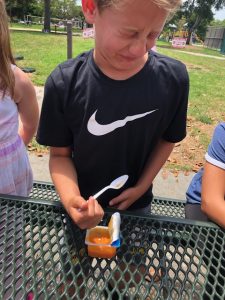
Pictured (before and after) is Youth Center camper Blake Naddler playing “Baby Food Roulette.” Kids recently did the at Camp S.H.A.R.K. at Rossmoor Park. There’s only the remainder of this week that the camp is open, then the kids get to get ready to go back to school, possibly another “sour” taste in their mouths.