A Los Alamitos High 10th-grader has been honored by the school board for his Eagle Scout project to benefit his old elementary school.
Alexander Bystrom was recognized by the Los Alamitos Unified School District board for creating a giant colored map of the United States in the center of the Los Alamitos Elementary campus. Bystrom also raised $237 in donations for the school, said Principal Gary Willems.
Bystrom said the project took several days to complete. He used a pressure washer to strip off the faded remnants of an old map on the concrete of the lunch area. He then taped down a 30-by-40-foot stencil and used chalk to outline the states. Finally, he said, “we started painting from the inside out.” Bystrom thanked “my parents and the people in my troop and my scoutmasters” for their assistance in the project.
The vividly-colored map has a powerful effect on students, Willems said. “We use it in all of our grade levels to teach about the 50 states, and our kids can go there and show their friends and parents how much they know.”
In presenting the certificate of recognition to Bystrom, Rick Larson, assistant principal at Los Alamitos Elementary, said, “We appreciate the hard work you’ve done, not only to become an Eagle Scout, but to represent our community with such poise and such class. We’ll be thinking about you for many, many years to come.”
Founder and Ambassador for Energy & Infrastructure of PTS Advance
Lawmakers in Sacramento have made no secret that one of their goals is to force Californians to stop using inexpensive and reliable natural gas and force the entire state onto an already overloaded electric grid pushing energy costs higher. Berkeley became the first city in America to ban natural gas hook-ups in new buildings with a landmark ordinance effective Jan 1, 2020, they signed up for far-reaching unintended consequences that will stymie growth and push people closer to poverty and homelessness. Now, cities across California are seriously looking at creating bans of their own. Could your city or even Cypress be next?
Its mind boggling that our California legislative leaders continuously fail to see the direct correlation between high energy costs and poverty and homelessness, a crisis already impacting the Golden State.
Prices for electricity are already fifty percent higher than the national average for residents, and double the national average for commercial, and are projected to go even higher.
The State’s efforts to ban natural gas use in homes and businesses will stymie future growth as companies decide to locate out of state taking their jobs with them as they choose to operate in places with lower energy costs. Higher energy costs from electricity only will make homes less affordable. According to Californians for Balanced Energy Solutions, it is estimated the cost of converting houses from natural gas to electricity is $7,500 and energy costs will go up by nearly $400 annually. This would dramatically impact California’s lowest income wage earners. It’s simple math: if people cannot afford their homes and apartments, more will be on the streets!
What’s worse is that a mandated shift away from natural gas use could cause potentially dire consequences for California’s aging and overburdened electric grid during peak load times in the summer.
On a 100-degree summer afternoon, just as we hit peak energy use with air conditioners, all 40 million of us would be forced to cook our dinners on electric skillets, ranges and ovens. Our mandated electric water heaters would draw energy at the same time we turn on TV’s, just as electric utility companies say they will cut power on high-risk fire days.
California is on a path toward 100% use of renewables and “zero-carbon” sources in electricity by 2045. But technology has not advanced to a point where California can generate that much electricity!
Last year alone, California imported up to 29 percent because it could not generate that much in-state, but imported electricity comes at higher costs which are being borne by residents and businesses alike. The need to import will escalate every year because land use is now being blocked for wind and solar energy sources, as in San Bernardino now. Wind and solar alone cannot replace the closure of facilities that continuously provide uninterruptible electricity from nuclear and natural gas.
The benefits of a carbon-free society are often discussed, but rarely are the high costs of achieving this technological breakthrough, or its impact on California’s economy.
Adding to the problem, California is phasing out nuclear reactors that have been generating continuously uninterruptible carbon-free electricity. In 2013, California already shutdown the continuous nuclear facility of SCE’s San Onofre Generating Station which generated 2,200 megawatts of power and will be closing PG&E’s Diablo Canyon’s 2,160 megawatts of power in 2024 getting ready for the renewable intermittent electricity from wind and solar. The Mayor must be oblivious to the fact that Natural Gas generating plants provide about 47 percent of the state’s electricity, and the state has no plans to replace that with renewables!
It gets bleaker in the coming years, as Mayor Garcetti recently announced that Los Angeles will shut down three gas powered power plants at Scattergood, Haynes, and Harbor, saying, “this is the beginning of the end of natural gas in Los Angeles.”
With the shuttering of nuclear and natural gas plants that have been generating continuously uninterruptible electricity, our elected officials seem to be oblivious to the fact that the State has no electricity generating capacity to replace what’s lost. Further, that “green” electricity from wind and solar is only intermittent, as neither generates when the wind is not blowing, and when the sun’s not shining.
With this path forward, it’s lights out for California’s future.
A longtime Lee Elementary School teacher has been named the new assistant principal of McGaugh Elementary in Seal Beach. Wendy Wood, who has taught at Lee for 27 years, was chosen after a rigorous selection process involving school staff, parents, school board members and district administrators, said Superintendent Dr. Andrew Pulver. She will work with McGaugh Principal Roni Ellis.
Wood, who has lived in Rossmoor for 20 years, has taught every grade level except 5th grade and has held many leadership roles for Los Alamitos Unified. She was a third-grade Language Arts mentor who wrote reading and writing curriculum and assessments for the district. She was also an English Learners Coordinator, conducting after school writing intervention classes and presenting at parent meetings. She was a Fellow of the Cotsen Foundation for the Art of Teaching and most recently served a special assignment with the district’s Educational Service department.
Wood grew up Lakewood and earned both her Bachelor’s and Master’s degrees from California State University Long Beach. She has two boys who attended Lee Elementary, Oak Middle School and Los Alamitos High School. Her older son is currently a junior at California Maritime Academy, and the other is a senior at LAHS.
Wood is “an extraordinary instructional leader, passionate about teaching and learning, and dedicated to the values of Los Al,” Pulver said.
The Los Alamitos Police Department has assigned Kevin Steinhauser to serve as school resource officer for Los Alamitos High. His duties include helping to maintain security and acting as a liaison between the police department and the school’s staff, students and families.
Steinhauser has more than four years of school-based law enforcement experience. He previously worked as school resource officer at Jordan High School in the Long Beach Unified School District where he was trained in campus law enforcement, event security and threat response.
Patti and Kit Kirby, Co-chairs of the St. Irenaeus Church 2019 Fall Fiesta, announced at all Masses on Saturday, August 10, and Sunday, August 11, that the Fiesta Committee will be collecting ticket sales returns and stubs for opportunities to win cash prizes the following week. Buena Park resident Hala Hana saw the Kirbys after the 9:45 Mass on August 11 and was ready to respond. She became the first person to turn her ticket sales money and stubs in for the chance to win the cash prizes. She said that she sold all her tickets to her family, friends and co-workers at her job. She said that even if she did not win any cash, she just wanted to help the church out in whatever way she could. The KIrbys hope that all St. Irenaeus parishioners will sell all their tickets just as Hana did to make the Fiesta a success.
There are still many volunteers needed to man the different game and food booths. Help is also needed to set up the booths before and after the Fiesta. Persons interested in volunteering to help at the Fiesta on September 20, 21 or 22, please contact Patti and Kit Kirby at 714-739-0463 for more information.
Photos and I.D. by Edna Ethington
Pictured at St. Irenaeus Church Patio area on Sunday, August 11, 2019, are left to right, Kit and Patti Kirby, Co-Chairs of the St. Irenaeus Fall Fiesta Committee, and Buena Park resident Hala Hana. Hala is the first person to sell all her opportunity tickets and turn in her money and stubs to the Kirbys.
The long and storied history of Los Alamitos High School was not lost on incoming principal Christopher Vlasic as he welcomed more than 3,200 students back to the campus this week.
“The first day went really well,” said Vlasic, who said he spent most of the first few days between the phone and his portable radio to make decisions and keep things running smoothly.
Making things even more complicated for Vlasic was the fact that much of the campus is under construction, as he said modifications are being made to the campus to prepare for extension renovations and new infrastructure.
“Things are really positive,” he said, admitting however that the construction equipment was seriously impacting the “flow of traffic.”
Vlasic said he brought in extra campus supervisors and relied heavily on the School Resource Officer but said both the students and the teachers seemed excited to be back on campus.
In making the announcement, Los Al Unified Superintendent Dr. Andrew Pulver said Vlasic started his educational career in Santa Ana Unified as a secondary math teacher and boys basketball coach at both Valley High School and Godinez Fundamental High School.
In 2010, he joined the Griffin family serving students and staff in a multitude of roles: math teacher, girls varsity basketball coach, athletic director, Teacher on Special Assignment (TOSA), and assistant principal.
For the past five years, Mr. Vlasic has served as a Director supporting a variety of areas including safety, student services, educational services and human resources.
“Mr. Vlasic is a collaborative leader with an immense amount of Griffin pride. He cares deeply about LAHS, the staff, families, and students and is committed to the success of every Griffin,” said Pulver.
Vlasic grew up in Garden Grove, graduating from Pacifica High School and earning All-State honors as a high school basketball player. He received his bachelor’s degree from the University of California, Davis and helped the university win a National Championship as a member of their basketball team. He later received his master’s degree in Cross-Cultural Education from National University.
School safety is always a consideration, said Vlasic, but having developed extensive school safety plans for the entire system in his previous role, he said protection of the students will remain paramount.
“I walked into a place that is not broken,” said Vlasic, understanding fully the amount of success the school has enjoyed in the past.
His role now, says Vlasic, is to pay careful attention to the staff and administration to “get them what they need to be successful” and retain the excellence.
With more than 300 teachers and administrative staff, Vlasic said more than half of them are former graduates or live nearby. “This is their community,” he said, adding that he would always keep “everyone’s best interest” in mind.
To the students, Vlasic said he will establish programs to ensure that students know they will all have equal chances to succeed. “Regardless of their background, ethnicity or interests, we are going to provide opportunities for them,” said Vlasic.
With more than 100 clubs already on campus, Vlasic said he will keep an eye out within the community for even more. Also, he said the school offers 27 sports and a very diverse offerings of other activities.
According to Vlasic, the largest single change and evolution in education is the continued integration of technology in learning. He said new data connections will be part of the school’s upgrade.
While it was great to see more than 3,200 fill the halls and classes of the school on the first day, said Vlasic, but added that, only then, “did the magnitude of his new assignment” really sink in.
But, after a very chaotic but successful first day, he was content and now ready to make his mark. “I am very humbled and gratified,” said Vlasic, and “I slept very good last night.”
Tucked away in a discreet part of the technical education building on the campus of Cypress College sits one of the few full simulators of the Boeing 737 MAX airliners in the USA, and with the recent addition of single and twin-engine planes, students are flocking to the skies without leaving the ground.
Cypress College recently announced the addition of a full-motion, Twin-Engine Reciprocating & Turbine Motion Simulator to its new Aviation Lab, according to a recent announcement.
The Twin-Engine Reciprocating & Turbine Motion Simulator enables Cypress College instructors to train aspiring pilots for their initial private pilot certificates. This on-the-ground training saves students between 30 and 60 hours of flight time, equating to a savings of $7,500 to $15,000.
“This new simulator will enhance the training we’re able to provide students,” said Cypress College President JoAnna Schilling, Ph.D. “It dramatically reduces FAA required flight training times, providing our students with an economical path to the completion of their flight program. We couldn’t have made this purchase without the donation we received from an anonymous donor last year.”
According to Capt. Ed Valdez, Chairman of the Travel and Aviation Department, the growing array of flight simulators will produce “better pilots” as technicians and flight instructors can now simulate a wide range of situations on a wider array of planes and engines.
The move comes as airlines are expected to replace as much as 40 percent of its airline pilots as many of those flying now are expected to age out.
Valdez, who flies 757 jets for United Airlines on weekends, keeps the center buzzing with fresh information taken directly from the cockpits of one of the world’s foremost airlines.
“It is very helpful to bring real world data and knowledge into the classroom,” he said.
In addition to the simulators, Valdez and department staff have worked out reciprocal agreements with many airlines and nearby airports.
Several small planes are under contract, with instructors, at John Wayne airport to allow students to take off in a real plane after their work in the simulators are complete.
Last October, Cypress College was the recipient of the largest individual gift in campus history when an anonymous donor provided a $1 million donation to the college’s aviation program. The donation was earmarked to transform Cypress’ state-of-the-art flight simulator lab into the region’s best public facility, support Cypress’ flying team, and be used toward the purchase of an airplane. In addition to the new Twin-Engine Reciprocating & Turbine Motion Simulator, four FAA certified simulators will soon be installed to better enhance the attainment of technical skills and increase student completion rates. The five simulators are part of the ultimate plan for the Aviation Lab to include eight flight simulators, with one slated as a full-motion multi-engine turbo-prop simulator. The college is home to a unique simulator that mirrors the recently released Boeing 737 Max commercial jet.
About Cypress College:
Cypress College offers students a pathway to their future in an environment in which employees commit to joining students on their educational journey. The college’s half-million-plus alumni include actors, athletes, doctors, executives, mechanics, nurses, and teachers. For some, Cypress College is the ticket into their university of choice, and for others, it provides essential training for a prosperous career. Just one Cypress College class is often all it takes to provide cutting-edge skills that lead to a promotion or a new job, according to the announcement.
Cypress College’s 16,000 students and the highly qualified teaching faculty are proud of the many excellent academic and vocational programs. Cypress College offers 56 university-transfer majors, 176 career-certificate programs, and degrees in 73 areas of study. The college’s traditional semesters begin in January and August, while short-term courses start throughout the year. A Cypress College education costs $46 per unit — $138 for a typical, full-credit class — California’s lowest tuition. Financial aid and scholarships are also available to qualifying students.
Cypress College is one of three campuses in the North Orange County Community College District and a member of the 115-campus California Community College system. The college primarily serves the cities of Anaheim, Buena Park, Cypress, Garden Grove, La Palma, Los Alamitos, Seal Beach, and Stanton.
“This is a huge opportunity for anyone looking to become a pilot. Becoming a pilot is expensive but Cypress College Aviation and Travel Careers in cutting the cost by thousands,” according to the college.
College is hosting a FREE informational meeting in its ATC department August 23 wherein “our programs within the ATC dept. include Piloting, Flight Attendant, UAS/Drone, Aviation Management, Airline Customer Service, Homeland Security, Travel & Tourism, and Administration of Justice,” will be discussed.
Students and their families are invited to our open house to learn about these programs, take part in an orientation, ask questions, meet faculty and students, and learn about the latest hiring data. The open house is August 23, 2019 from 4:30-5:30pm. No RSVP necessary. Located at Cypress College, Building Tech Ed 1, Room 200. Parking is in Lot 1 for this event.
Members of the Aquarium of the Pacific’s veterinary and animal husbandry staff plans to release a rehabilitated turtle they have been caring for, into the waters of Seal Beach.
A spokesman for the Aquarium said the release was slated for Thursday, Aug. 15.
Staff members of the Marine Mammal Center’s Morro Bay based operations rescued the 50-pound green sea turtle and brought it to the Aquarium of the Pacific for a medical evaluation and care because of the Aquarium’s expertise in treating and releasing stranded and injured sea turtles.
The release location—near the mouth of the San Gabriel River—was chosen for its warm water temperatures and because it is a common migratory habitat for this sea turtle species.
Aquarium volunteers conduct a monthly count of green sea turtles seen in the river through a citizen science program.
The Aquarium of the Pacific has rehabilitated and releases several sea turtles in recent years, including green sea turtles and loggerhead sea turtles. Some have been fitted with satellite tracking devices that allow scientists to gather data about their migration patters and habitats. The sea turtle being released on Thursday is fitted with a microchip ID. According to the U.S. Fish and Wildlife Service, breeding colony populations of green sea turtles in Florida and on the Pacific Coast of Mexico are listed as endangered; all others are listed as threatened.
To learn more, visit aquariumofpacific.org and click on Conservation
Major General Laura L. Yeager, commander of the 40th Infantry Division of the California National Guard, pins the star on the uniform of Col. Michael J. Leeney at a ceremony Saturday at the Joint Forces Training Base in Los Alamitos. According to sources, Leeney is a down-to-earth commander who enjoys wide support among the troops. Surrounded by his family and a host of old friends (many of whom travelled across the country to be present) and service members of the 40th I.D., Leeney was promoted to the rank of Brigadier General.
Who’s ready for Friday night lights? Summer is on its way out, and local schools are back in session, and with that comes the imminent start of fall prep sports. No area schools have football in the schedule yet this week—although Los Alamitos High has a scrimmage at Mater Dei in Santa Ana Thursday—but most do next week. Girls Volleyball gets underway this week, and the schedule gets fuller and fuller from there on out. Here is this week’s local prep sports schedule, along with some important dates to have in mind for later this month.
August 15, 6 p.m. Los Alamitos football scrimmage at Mater Dei (Santa Ana)
August 17, Cypress volleyball plays win Lakewood Molten Classic Tournament beginning at 11 a.m.
August 20, 4:20 p.m. Oxford Academy volleyball home vs. Cabrillo
August 20, 6:30 p.m. Kennedy volleyball home vs. Katella
August 22, first Cypress football game of the year, home vs. Peninsula
August 23, 7 p.m. first Los Alamitos football game of the year at Torrey Pines (San Diego)
August 23, 7 p.m. first Kennedy football game of the year, home vs. Jordan (Long Beach)
At the recent regular monthly meeting of the Grampaw Pettibone Squadron at the Elks Lodge in Garden there were some very special guests present from the Seal Beach Naval Weapons station, they were the Sailors of the Quarter for April thru June.
Present were the Junior Sailor of the Quarter–MA 2 Matthew Pace and the Bluejacket of the Quarter–MA 3 Katherine Parsley. Certificates of Appreciation were presented to them by the Commander of the Grampaw Pettibone Squadron–Tim Brown.
The sailors were introduced by CMDCS Paul Ellis, the Command Senior Chief for the Weapons Station. Some other Sailors of the Quarter were not able to attend because of duty responsibilities.
Attractive medallions from the USAA Insurance Company were presented and local restaurants sent coupons for the SOQ’s. The participating restaurants were: in Seal Beach (Main St)–Avila’s El Ranchito Mexican Restaurant, Bistro St. Germain, Crema Cafe, Hennessey’s Tavern, Old Town Cafe, O’Malleys on Main, and Taco Surf; on PCH (Seal Beach)–Coaches Sports Grill, Finbar’s Italian Kitchen, Glory Days Beachside Grill, and Yucatan Grill; on Seal Beach Blvd–California Pizza, Chick-Fil-A, Romano’s Macaroni Grill, and Santa Fe Importers; in Long Beach–Corner Bakery Cafe, Mimi’s, and Ruby’s. Restaurants in the Sunset Beach area included: Fish Camp, Harry’s Rooftop Patio and Grill, Olive Pit Grill, and Romano Cucina.
A popular horse racing announced, recently dismissed at Santa Anita, will be returning to California to announce races at Los Alamitos Race Track, officials have announced.
Wrona will be the full-time announcer for quarter horse and thoroughbreds in Los Alamitos, according to owner Ed (Doc) Allred.
Wrona will replace Ed Burgart, another legendary quarter-horse announcer who will continue to call races until Dec. 15, at which time Wrona will begin calling the races.
According to Wikipedia, Wrona began calling races in Australia at the age of 17 and his move to the United States was promoted by an invitation from another Aussie announcer, John Tapp.
Wrona, whose call of “Racing!” at the start of every race is his signature expression, also will reportedly call the three short thoroughbred meetings as long as they are held at Los Alamitos.
Wrona expressed surprise after Allfred offered him the job on the spot after a phone interview.
Los Alamitos currently has three short thoroughbred meets that go three to four days for two to three weeks. The nighttime quarter horse and thoroughbred meeting goes Friday through Sunday for almost the entire year.
The Los Alamitos Police Department took part in the nationally recognized public safety event, National Night Out last Tuesday, August 6, 2019 at Little Cottonwood Park in Los Alamitos. Hundreds of residents and community members enjoyed emergency service displays, food trucks and vendors. While kids enjoyed free face painting, and balloon twisting and bounce houses.
“I think the event came together very nicely,” Captain Chris Karrer of the Los Alamitos Police Department said. “Considering the short amount of time we had to put it all together, everyone showed up and looked like they had a great time,” he added.
The Police Department hopes to make next year’s National Night Out event even better so more people can experience this fun and community-oriented event.
Artillery fire will ring out across Joint Forces Training Base (JFTB) on Saturday, August 17th, commemorating the promotion of Col. Stuart E. Werner of the U.S. Army Reserve’s 79th Theater Support Command (TSC) to the rank of brigadier general.
The ceremony, which will be officiated by Maj. Gen. Mark W. Palzer, Commanding General of the 99th Readiness Division, is scheduled to get underway at 4 p.m. The Army Reserve’s Pacific Training Division Salute Battery will render the honors.
Following his promotion, Werner will assume the duties of Deputy Commanding
General of the 79th TSC. The unit is the Army Reserve’s second largest command and is headquartered at JFTB.
For further information, please contact Lt. Col. Brandon Kelley at (562) 936-7663 or via email at br*******************@**il.mil.
Who knew that when the Aquarium of the Pacific opened its doors twenty years ago this summer, that it would eventually become one of the most visited, most innovative oceanic institutions in America?
Now ranked 4th in the USA with 1.7 million visitors per year, the aquarium has envisioned much more than a visit to see a Pacific ecosystem as part of its mission as it also becomes recognized for its innovative integration with marine science and oceanic knowledge.
And now, with its newly opened Pacific Visions extension (see related story), AOP takes the proactive climate experience to new heights as the Aquarium surges in popularity.
“With each passing year, the Aquarium of the Pacific builds on its position as an institution unlike any other,” President and CEO Jerry R. Schubel, Ph.D. noted in the nonprofit’s most recent annual report.
This year alone, the aquarium produced two new shows for NOAA’s popular “Science on a Sphere” series and is focused on “connecting the public with ocean science.” In addition, they offer scientific information on specific topics at its Ocean Science Center.
Let’s face it. Accurately replicating even a tiny portion of the Pacific Ocean has been a herculean task. The world’s oceans cover more than 70 percent of the earth’s surface and the Pacific itself covers more than 60 million square miles with an average depth of 13,000 feet, so figuring out what to showcase has not been easy.
So massive are the world’s oceans, in fact, that scientists estimate that under the surface of these winding canyons, mountain ranges, jagged edges and coral ecosystems, as much as 80 percent remain unexplored by man. Remote exploration devices are now able to go where man alone could not for generations, so with each passing day, more discoveries are being made and the excitement continues to build.
It is estimated that the Pacific Ocean alone contains enough water to cover all of the land surfaces. From the depths of the Pacific Ocean and its ecosystem, the Aquarium of the Pacific has assembled an incredible array of sea life and flora that now awaits its visitors.
With more than 100 exhibits, including 12,000 animals, 600 species and 50 unique displays, Schubel said in addition to being a top aquarium, AOP is also recognized as a leader in using its own technology network to make a huge contribution to oceanic knowledge around the world.
Even as they open the doors daily to an intricate network of overland and undersea exhibits that brings visitors face-to-face with the vast Pacific ecosystem, the aquarium is also “laying the groundwork for an entirely new platform for diverse marine sciences,” said Schubel.
A penguin peers at the lens while swimming in the June Keyes Habitat. As the national conversation switches to climate, the institution has built an impressive network of scientists, oceanographers and others to play an expanded role in diverse marine science. Photo by Robin Riggs
Among the many innovations for the most recent year, he said, were “many new species” of sea animals that were being “exhibited for the first time,” including, among others, two grey reef sharks, a tufted puffin chick and three penguins (Cleo, Dee and Dolly).
Moreover, the AOP has developed a working partnership with the National Oceanic and Atmospheric Administration and has sponsored many forums and educational events with top marine scientists. This year alone, the aquarium produced two new shows for NOAA’s popular “Science on a Sphere” series and is focused on “connecting the public with ocean science.” In addition, they offer public classes on specific topics in its “aquatic academy.”
According to top websites, the Aquarium of the Pacific is considered a leader not only in overall visitation and scientific innovation.
As the national conversation switches to climate over the next few years, the institution has also built an impressive network of scientists, oceanographers and others to become a valuable oceanic authority in preservation of oceans, sea life and climate.
In just this short span of twenty years, the AOP has risen from an idea to a leading national aquarium.
Perhaps there are many reasons for the aquarium’s strong performance over two decades, but one of them may be the fact the Aquarium of the Pacific was actually built in an area that was once connected to the Pacific Ocean.
According to AOP’s website, the five-acre site on which the complex now operates, was not acreage at all but was part of the bay when the project was envisioned. With landfill and a plan, the Aquarium opened in the summer of 1998 across from the convention center and has been an anchor attraction ever since.
More than 1.7 million visitors make the Aquarium of the Pacific one of the leading American oceanic institutions.
Once inside the aquarium, visitors are greeted by a giant, mounted 88 foot-long blue whale, complete with calf, that hangs from the aquarium’s large lobby. In the sea, a whale of this size would eat 8,000 pounds of krill (small fish) at every feeding.
The aquarium offers more than 10,000 square feet of themed exhibits such as Explorer’s Cove and another exhibit called Shark Lagoon, supporting more than 150 sharks and sting rays. Then there is a 3,200 sq. ft walk through of Lorikeet Forest among many attractions, including southern, northern and tropical pacific galleries.
“The culture here is very unique,” says aquarium interpretation manager Staci Wong, who has been with AOP for 12 years. “There’s always something new,” she said, “and that keeps it exciting.”
Not only does she marvel at the public’s reactions to the exhibits, but she says it is also fun to hear the reactions as visitor’s learn how hard it is to keep this massive ocean ecosystem functioning every day.
Behind the scenes at the aquarium reveals the massive operation to keep up with the animals; their health, feeding them, etc. It takes 2,000 staff and volunteers to administrator all of the exhibits, tours, lectures and other activities that AOP now offers. And, of course, there is water quality, animal husbandry and more.
Tropical bird brings a smile to a visitor in the Aquarium’s Lorikeet Forest.
Yet, says Wong, it is “truly worth it.” With one and one-half million gallons of various underwater exhibits, the aquarium has managed to encase a multitude of regional highlights ot the Pacific, each tank properly planted or painted to highlight the region’s fish and marine ecosystems of the Pacific. They localize exhibits as well, as one tank presents a collection of coral and fish associated with Catalina Island, an Eco paradise located 22 miles off the California coast.
Says Wong, once visitors gaze into the tanks and “get a peek at the ocean, the questions begin.” Visitors ask about “almost anything,” but she says they most often wonder out loud, asking questions like “the size of a fish’s mouth, how long they live and how much do they eat,” said Wong.
After all, she said, in few other places can a human literally stand in comfort to witness the fantastical wonders of the sea, so questions are always welcomed, said Wong. “We learn too,” she added.
The scientific educator says she works with the AOP team with a goal of creating a “friendly and truly memorable experience” for the visiting public. She often interacts with visitors to learn from them what they enjoy most.
“They (visitors) always learn something new,” says Wong, adding that visitors are “very knowledgeable” and want to learn more.
That’s why Wong says the AOP association with NOAA is so valuable. It allows some aquarium staff to remotely participate on exciting research dives by the agency’s “Nautilus” exploration vessel so, they too, can learn and pass this exciting knowledge on to visitors through programs and tours.
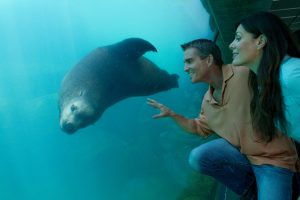
With more than 100 exhibits, Wong said people seem to enjoy all parts of the aquarium, though some more than others. Among the perennial favorites, she said, are the sea lions, seals and sea otters. “People love the mammals,” she added.
In just two decades, the AOP has managed to utilize dedication and technology to harness some of the amazing wonders of the Pacific. The institution has also created a top marine science educational platform and attracted hundreds of supportive donors who believe in the mission.
The nonprofit generates more than $60 million annually and is able to support itself with less than five percent of its income from other governmental sources, according to their annual report.
“Our 20th Anniversary highlighted the special place the aquarium holds in so many people’s lives,” said Schubel. He said the institution has collected many stories of young visitors or interns who have gone own to careers in the sciences and several staffers who have been there for the entire span of twenty years.
Schubel said the aquarium would “not be where it is today” without its dedicated staff as he looked forward to the next twenty years.
According to Schubel, the aquarium will continue to “challenge our visitors to examine human impact on our ocean planet and engage in choices to reduce that impact.”
Indeed, an institution unlike any other. For more info, visit www.aquariumofpacific.org.
$53 million expansion opened earlier this summer and is all about conservation
By Brooklynn Wong
Long Beach’s Aquarium of the Pacific has long been highly-regarded as a hub of underwater education and spectacle.
But a $53 million addition has taken it to the next level.
The Pacific Visions expansion is an addition that takes the Aquarium of the Pacific from aquatic zoo to all-encompassing educational center.
Not since the aquarium opened in 1998 had there been a major expansion until this one.
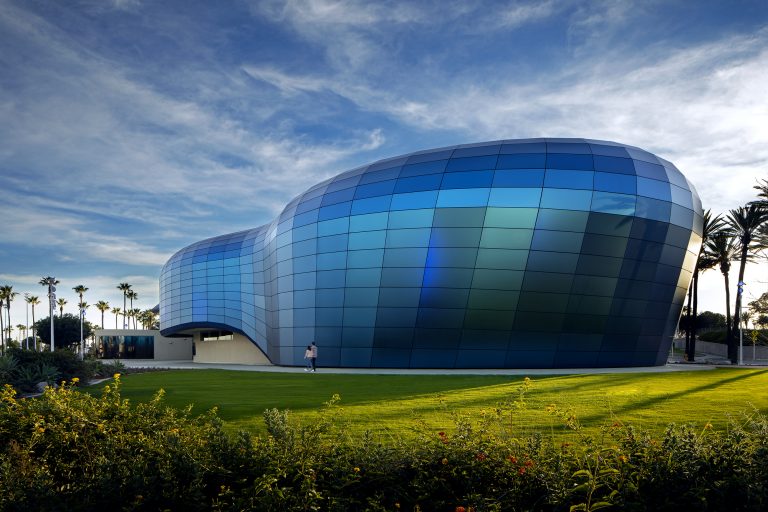
Ground was broken in February 2017 on Pacific Visions—a big blue add-on that contains a theater, an art gallery, game tables and live animal exhibits—and it opened to the public May 24 of this year.
The 29,000 square-foot two-story structure is a collaboration between the aquarium and several highly-regarded design and technology firms.
EHDD, a San Francisco architecture and design firm, brought to life the exterior of this big, reflective whale-esque addition.
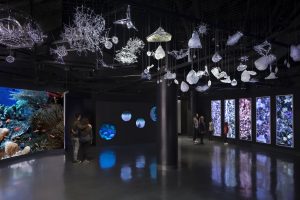
The Pacific Visions Art Gallery.
Aquarium visitors can still see all the fauna they always could, from penguins, and turtles and frogs, to harbor seals and sharks, but now they can round out their experience by learning about sustainability. This is at the center of Pacific Visions.
Some estimate that by the year 2050, there will be about 10 billion humans on the earth. The ocean plays a major role in providing oxygen, food and water to the earth’s inhabitants. The aquarium has taken on a new role of making people aware of the changing climate, and letting them know how they can make sustainable and environmentally-friendly lifestyle choices.
Said Aquarium President Dr. Jerry Schubel when asked about this, “Programs and exhibits at the Aquarium have always communicated messages about conservation and sustainability, but Pacific Visions takes on the urgent challenge we face in creating a sustainable future for a growing human population while conserving nature….We have a responsibility to serve as gathering places where people can collectively explore our relationship with our planet and alternative pathways to a sustainable future.”
When you enter the aquarium, veer right and you’ll find yourself in Pacific Visions.
The Honda Pacific Visions Theater. Photo by Howard Hall Productions
First comes “Reefs & Drifters.” This is the art gallery portion of Pacific Visions. Coral and plankton are the emphasis here. They are an often-overlooked but very important, and surprisingly beautiful, component of the world’s oceans. Hanging from the ceiling are ornate and delicate pieces of glass sculpted to look like plankton. On one wall is a touchable coral sculpture wall, with a 3D-printed rubbery material shaped like coral, with images of coral superimposed on it to amplify the effect. Another highlight of Reefs & Drifters is an Infinity Coral exhibit, in which people can look into portholes where artificial, but rather real-looking coral is mirrored, to create the effect of never-ending coral colonies.
Next up is the Orientation Gallery, where guests see a short pre-show that acts as a primer for the main event. There’s a virtual waterfall, that projects onto the wall and the ground, that reacts to movement. Children enjoyed splashing around in the virtual water, that rippled and chased away virtual fish when they walked in it.
Next up was the Honda Pacific Visions Theater, a beautiful, state-of-the-art indoor amphitheater that seats 300. And what ensues over the next eight minutes is the most impressive part of it all. A film plays, called “Designing Our Future.” It gives an outlook on the food, water and energy situation facing the earth, but what is impressive and makes the message impactful, is the multi sensory way in which it is presented. The film is a sight to behold in itself, as the screen wraps around 180 degrees, plus additional projections are made onto a 36-foot-wide disc on the floor that tilts.
Aquarium of the Pacific’s President and CEO Dr. Jerry Schubel gives a speech in the Honda Pacific Visions Theater during a press preview shortly before it opened to the public
With incredible sweeping ocean views and others, it feels like you’re on a rollercoaster, and creates such an effect that it might bother those prone to motion sickness.
There are immersive shots of dolphins, kelp forests, sharks and a breaching humpback whale.
Air is blown in for certain parts, fog is used, seat vibration and strobe lights are used in a lightning storm, and crop scents were blown throughout in one segment when agriculture was being discussed.
The film plays every 15 minutes.
The theater was developed by the aquarium in association with multimedia design firm Cortina Productions.
One thing the aquarium is particularly proud of is its ADA efforts in the theater and elsewhere in Pacific Visions. Those that are deaf or blind can use “virtual touch,” in which they are given an ultrasonic speaker that projects shapes, textures and effects directly onto their hands.
There is also braille on the informational signs next to the exhibits.
The Honda Pacific Visions Theater can also be rented out for a variety of purposes.
After the film, visitors go up and out of the theater and into what is called the Culmination Gallery. There they can test their knowledge of what they’ve just observed, with interactive touch-screen game tables about the water challenge, the food challenge and the energy challenge, and a touch-screen wall where they can pop virtual bubbles to reveal facts.
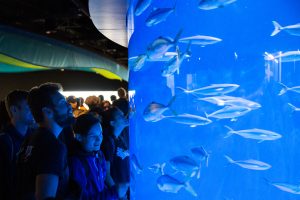
Aquarium visitors including more than 200 students from Lakewood High School view the new exhibits in the culmination gallery in the new Pacific Visions wing. An exhibit of nearly 100 California yellowtail fish demonstrate how offshore marine aquaculture, or farming of the sea, could help supplement our food supply.
There are a few live animals exhibited in the Culmination Gallery, but these animals are not the usual crowd pleasers. They’re ones that have a story to tell, of the impact people have on the environment.
A small fish called the delta smelt, the California yellowtail, and Pacific and Olympia oysters, are featured. The Aquarium of the Pacific is the first aquarium to exhibit delta smelt.
These fish are found only in the Sacramento-San Joaquin River Delta, and they are very endangered. In 2016, only one fish was found there, and last year, none were found. The aquarium’s population of the fish came from UC Davis. The delta smelt is heavily impacted by human infrastructure, they get trapped in water pumps, and they are sensitive to water contamination.
As far as general environmental tips, aquarium education staff urged visitors to abandon single-use plastics and to only buy seafood that is from the US, as our sea-life is protected from overfishing by regulations that are in place, that other countries tend not to have.
And this is where Pacific Visions ends—visitors are shown the grandeur of the sea and all it contains, and are then left with a wakeup call to be responsible consumers.
This $53 million project was funded completely by grants and donations from a variety of sources.
Staci Wong, Interpretation Manager at the Aquarium, said that Pacific Visions “allows us to focus on food, energy and water and to have a conversation about the future of our planet that we have not been able to have before.”
According to estimates, the Aquarium of the Pacific welcomes nearly two million visitors per year, making it the fourth-most-visited aquarium in the country. And with the addition of Pacific Visions, now those visitors can go beyond just looking at sea-life; they can learn how to protect it and the planet that supports it.
Admission to Pacific Visions is included with general aquarium admission.
And summer is the best time to go. On Fridays, Saturdays and Sundays for the next month, the aquarium will stay open later than usual and entry will cost less than usual. Admission after 5 p.m. those nights is $19.95, and the aquarium stays open until 9 p.m.
On July 20th through July 29th, McAuliffe and Oak students tested their musical abilities. These talented musicians competed at the 57th Southwestern Youth Music Festival (SYMF). This music competition took place over two weekends (five days) and was held at the Bob Cole Conservatory of Music at California State University of Long Beach.
Duet Photo (left to right) – LeAnn Lee and Kiera Wong
After months of preparation, the McAuliffe team comprised of LeAnn Lee and Kiera Wong placed 1st in their piano duet. Before receiving their trophies, the duet team delighted the audience at the Awards Recital with ‘In a Boat’ by Claude DeBussy.
Venturing on her own, Kiera Wong amazed the judges with ‘Sonatina 3rd movement – Allegro Mosso’ by Aram Khachaturian to earn 1st place in her piano solo. She also took the stage to perform at the Awards Recital.
McAuliffe and Oak musicians came together once again at SYMF. The chamber team of Katelyn Ngo, Karlie Nguyen and Kiera Wong took home 3rd place in the music ensemble category. A total of six trophies
The United Water Polo Club 14U brings home two 3rd place finishes this past week down in Orange County.
United 14U Girls brought home bronze in the Championship Division placing 3 out of 78 teams while the 14U Boys placed 3rd in the Classic Division.
United’s 14U boys defeated number 1 seed Santa Barbara 11-9 to secure 3rd place in the classic division.
14U Boys – 3rd Place – Classic Division Kai Baker, Michael Sorenson, Lico Yuno, Josh Winn, Joe Stanbridge, Nick Leung, Isaiah Osorio, Zack Populus, Dusan Djorkevic, Felipe Castro, Kai Inoue, Cayden Harris,Otis McAdams and Nathan Tran. Courtesy photo
The road to the semi-finals was anything but easy. After an early round loss to South Bay, United was able to upset Irvine Back Bay to secure a spot in the semi-finals. In the Earlier rounds, United scored victories over Socal Gold and Costa Mesa Aquatics.
Offensively, United was lead by Nick Leung, Lico Yuno, Kai Inoue, Cayden Harris, and Kai Baker. Joe Stanbridge and Michael Sorenson played strong 2 meter defense.
United 14U Girls was led offensively from Isabel Valaika, Olivia Slavens, and Hayley Bergstrom. Tess Ravelo and Madelyn Nollan provided key stops on defense. Goalie Josephine Niz was outstanding all weekend long blocking multiple penalty shots and scoring two full court shots.
“These girls have been playing together since September. Before they go to polo practice, they go to swim practice twice a week. When not playing polo they share game tape with each other. These girls have an amazing work ethic,” according to Coach Sean Nollan.
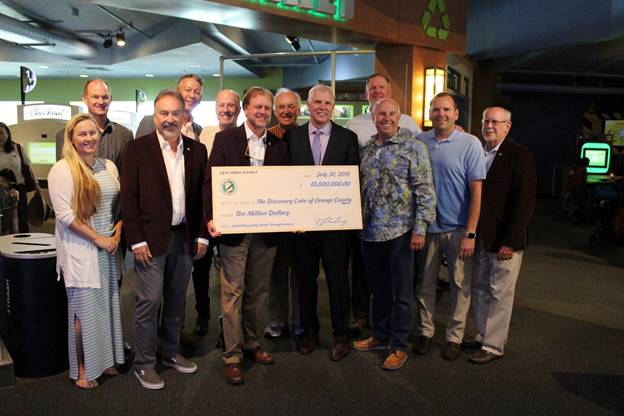
Senator Tom Umberg (D – Santa Ana) announced today that he has successfully secured $10 million in state budget funds to assist the Discovery Science Center of Orange County. The funds will be utilized to assist the Science Center with the recent expansion and addition of new science exhibits and educational services.
“The Discovery Science Center of Orange County has been a tremendous success story in our community, serving almost half a million local school children and teachers last year,” said Senator Umberg, a member of the State Senate Budget Committee. “The funding is an important investment by the State of California toward Orange County’s continued effort to provide the children of our community an important education in Science, Technology, Engineering and Mathematics. I am excited that we could be of assistance and provide them the opportunity to further enhance their effort to reach even more students.”
“The Discovery Science Center of Orange County’s recent expansion allowed us to add an additional 44,000 square feet to our museum facility, thus allowing us to successfully add new hands-on permanent exhibits, themed science adventures, incentive programs, and learning spaces,” said Joe Adams, CEO of the facility. “The important state funds will also assist us in our effort to accommodate the expansion. We are very grateful for Senator Umberg’s assistance.”
The Discovery Science Center now provides hands-on science learning centers in Orange County, Los Angeles, and Newport Beach, California. Established in 1989, their Discovery Cube facility in Santa Ana, presented by Taco Bell, has inspired and educated millions of young minds through engaging science-based programs and exhibits. In 2012, the Cube was named one of the 10 “Most Trusted Brands” in Orange County and in 2013 was awarded the National Medal of service from the Institute of Museum and Library Services at The White House.
Senator Thomas J. Umberg represents the 34th Senate District, which includes the cities of Anaheim, Costa Mesa, Fountain Valley, Huntington Beach, Garden Grove, Long Beach, Los Alamitos, Midway City, Orange, Santa Ana, Seal Beach, and Westminster. Umberg is a retired U.S. Army Colonel, former federal prosecutor, and small businessman. He and his wife, Brigadier General Robin Umberg, USA (ret.), live in Orange County.
The Los Alamitos Education Foundation (LAEF) is partnering with Los Alamitos Unified School District’s new Superintendent Dr. Andrew Pulver to host the 6th annual State of the District breakfast event on Friday, Sept. 13, at 8:30 a.m.
“LAEF is thrilled to continue this wonderful event with Dr. Pulver and help bring the community members together to celebrate the success of our district’s students and look ahead to what the future holds,” states LAEF Executive Director Carrie Logue.
The breakfast will take place at On the Greens at Navy Golf Course and all net proceeds will support LAEF. It is an opportunity to connect with community members and parents who are passionate about education and the district. The title sponsor will again be Alamitos Eye Care who has provided this level of support since the event inception. Tickets are available for $25 at www.LAEF4Kids.org/events.
LAEF is the non-profit partner of Los Alamitos Unified School District. LAEF enhances educational excellence by providing after-school and summer enrichment programs to children in grades Pre-K to 12. LAEF provides significant funding for STEAM teachers and instruction, as well as igniting new programs and providing valuable resources, to impact all students. For additional information on LAEF, please call 562-799-4700 Extension 80424 or visit www.LAEF4Kids.org.