

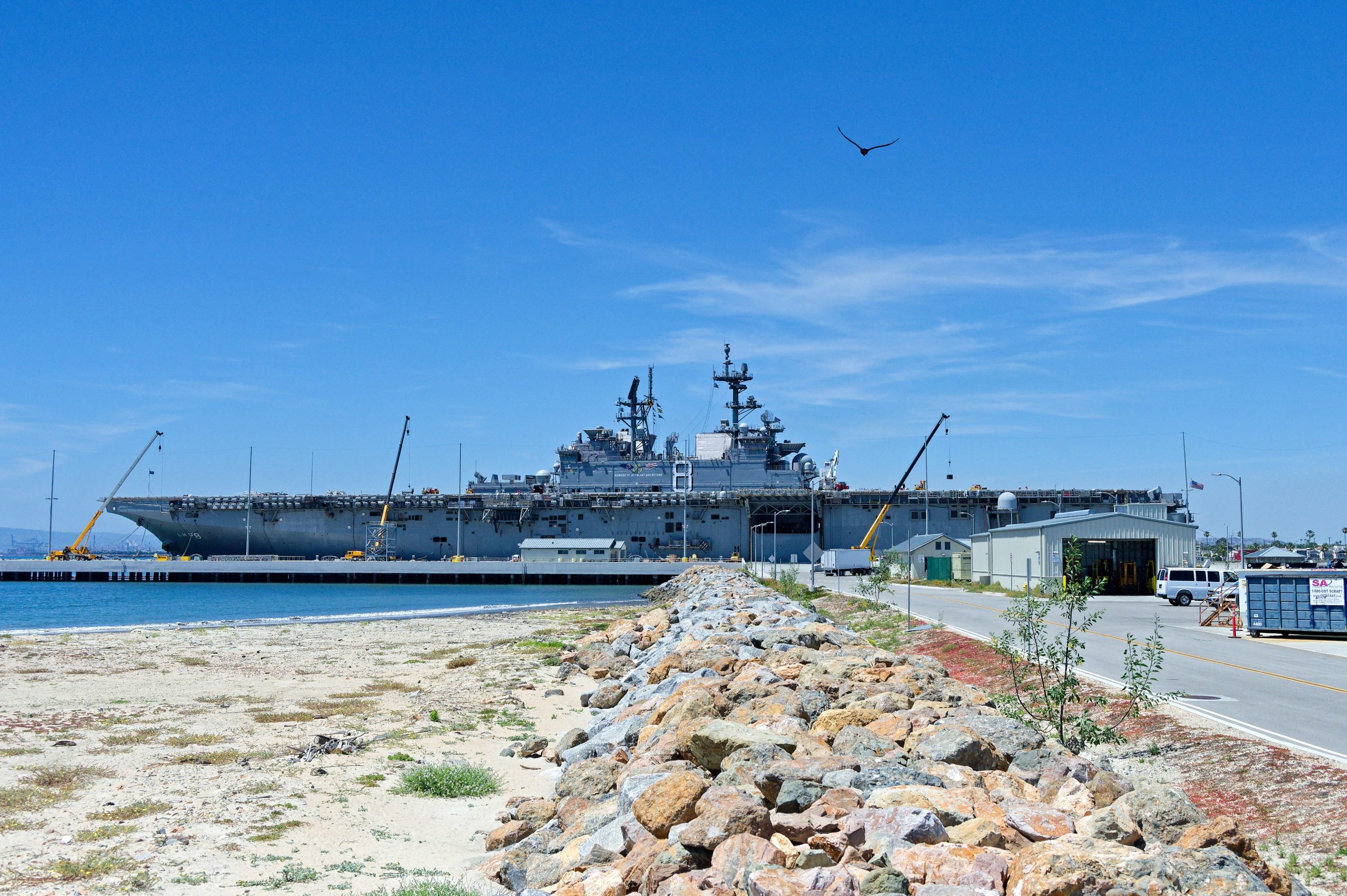
A large warship that docked at the Seal Beach Naval Weapons Station three weeks ago and drew quiet, yet significant interest from many around town, has sailed away, leaving only questions in its wake.
“This ship was a little different,” said Gregg Smith, Public Affairs Officer for the Naval Weapons Station, and perhaps it did “create some interest.”
Perhaps what made the ship so interesting, said Smith, is the sheer size of the vessel (nearly 1,000 feet).
“I think what was so interesting to people was the size of the ship,” he said. In fact, Smith said that before the Naval Weapons Station ammunition pier was enlarged, the massive aircraft landing ship would not have been able to dock at Seal Beach Naval Weapons Station.
As it turns out, the ship that departed the Naval Weapons Station three weeks ago had brought with it a legacy and a lineage of some renown.
The name of the ship is the USS Makin Island, and it was the final member of the Wasp Class LHD’s (Landing Helicopter Deck) to be manufactured.
The Makin Island had emerged from previous U.S. Navy Amphibious Forces and set the stage for the under-development successor to the Wasp Class, the LHA (R) Class of Amphibious Landing Ship, according to historical records from “America’s Navy” provided by the Weapons Station.
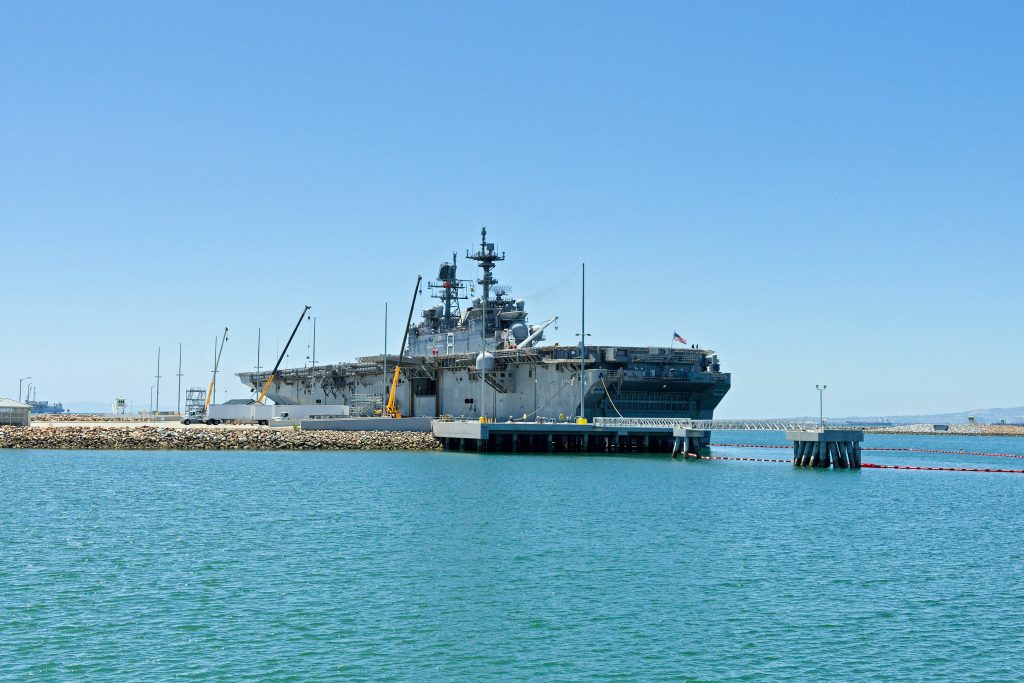
Also of interest is that the USS Makin Island (LHD 8) is the second ship to bear the name of a very brave raid during World War II.
The first USS Makin Island (CVE 93) was a Casablanca-class escort aircraft carrier that served during World War II from 1944 to 1946. Her aircraft provided air support and conducted tactical air strikes in support of amphibious landings at Luzon, Iwo Jima, and Okinawa during World War II.
In her period of service, she operated underway, deployed in the Pacific Theatre for nearly the entire time. CVE 93 was never damaged by enemy forces while earning five Battle Stars and the Navy Unit Commendation.
To understand the USS Makin Island, however, you must first understand the Makin Island Raid. In August 1942, just weeks after the catastrophic losses at Midway and amid the grinding hell of Guadalcanal, the United States needed a victory; something to show the American people that the Pacific could be won.
Lieutenant Colonel Evans Carlson led his 2nd Raider Battalion ashore on Butaritari Island in the Makin Atoll, deep in Japanese-held territory, according to the National Museum of the Marine Corps.
The Raiders overcame 90 Japanese soldiers, destroyed facilities, and gathered intelligence before withdrawing. The raid was imperfect — nine Marines were tragically left behind and later executed — but its psychological impact was enormous. America could strike back. America would strike back.
In fact, it is from this warship that the cultural slang, “Gung Ho,” was said to have emerged. “Gung Ho” was the Battle Cry of the Second Raider Battalion and the motto of USS Makin Island (CVE 93). “Gung Ho” translates to “work together,” military records confirm.
The current USS Makin Island (LHD 8) underwent construction at Northrop Grumman Shipbuilding in Pascagoula, MS.
She was the final ship built in the LHD-1 Wasp-class, but the first of them built with Gas Turbine Engines and Electric Drive. Steam is not used on board the ship for heating or water production as in previous LHD class ships, according to U.S. Carriers.net
At 844 feet long and displacing approximately 41,000 tons fully loaded, Makin Island is a floating city of war. She can carry more than 1,600 Marines and their equipment, serving as the centerpiece of an Expeditionary Strike Group capable of delivering and sustaining a Marine Expeditionary Unit anywhere in the world.
Her flight deck, stretching the full length of the ship, can operate AV-8B Harrier jets, F-35B Lightning IIs, MV-22 Osprey tiltrotors, CH-53E Super Stallion heavy lift helicopters, and UH-1Y Venom utility helicopters simultaneously. Below her waterline, a massive well deck floods to launch landing craft air cushion vehicles — the hovercraft that carry Marines and armored vehicles from ship to shore in the opening minutes of an amphibious assault.
She carries a crew of roughly 1,200 sailors working alongside her embarked Marines, operating around the clock to sustain combat operations that can range from full-scale amphibious assault to humanitarian disaster relief. Her medical facilities rival a small hospital. Her galleys serve thousands of meals daily. She is a sovereign piece of American territory capable of projecting decisive force to any coastline on earth.
But what truly separates Makin Island from every amphibious assault ship ever built — what makes her genuinely historic in the annals of naval engineering — is her propulsion system. Every Wasp-class ship before her ran on conventional steam turbines, powerful but fuel-hungry and mechanically complex.
On her maiden deployment alone, she saved millions of gallons of fuel compared to a conventionally propelled ship of her class. The Navy credited her technology as a direct forerunner of the design philosophy that would eventually inform the America-class amphibious assault ships that followed.
The Makin Island has served continuously from her San Diego homeport, deploying to the Western Pacific, the Persian Gulf, and the broader Indo-Pacific theater. She has participated in multinational exercises that reinforce American alliances across the region, stood watch during periods of tension in the South China Sea, and responded to humanitarian crises with the same speed she would when going on the offensive.
The flexibility that defines amphibious assault ships — the ability to pivot from combat to relief operations without reconfiguration — has made her an instrument of both hard and soft power.
In 2021 and beyond, as the United States reoriented its strategic focus toward great-power competition in the Pacific, Makin Island found herself at the center of that pivot. Her ability to operate F-35Bs gives her a fixed-wing air capability that blurs the line between amphibious assault ship and light aircraft carrier — a capability the Pentagon has increasingly leaned into as a distributed lethality concept takes hold in naval doctrine.
Something is fitting about naming America’s most technologically advanced amphibious ship after the raid that began the Pacific campaign, especially fitting around Memorial Day.
The Raiders who struck Makin Atoll in 1942 were outnumbered, operating far from support, relying on ingenuity and audacity to achieve what conventional thinking said was impossible. USS Makin Island carries that same spirit in her steel — a ship that refused to be ordinary, that rewrote the rules of what a warship could cost and consume and accomplish.
The atoll is quiet now. The ship that bears its name is not.
As the ships come and go from the Seal Beach Naval Weapons Station, you just never know the stories they can and should tell us all. On this solemn weekend, we pause to remember not only this one ship, but those brave Marines and all the service members in all branches of the U.S. military who have given “that last full measure of devotion.”