

The President and CEO of the Aquarium of the Pacific made it clear this week that he views the role of this internationally recognized center as not only a place to put the ocean on display, but also a forum for environmental knowledge to protect it for years to come.
“The Aquarium already does amazing education and conservation work,” CEO Jeff Flocken acknowledged at a major press conference this week, but said he wanted to expand the institution’s role in the knowledge economy.
“My goal is to have us double down on that while continuing to expand in those directions,” he said.
To that end, Flocken this week invited the nation’s top weather experts into the Honda Vision Center at the Aquarium to explain how hotter weather associated with a growing “El Niño” could have severe implications for the world’s oceans, especially for the oceans and the blue economy.”
“We’re (AofP) already known as a fantastic entertainment facility,” Flocken told ENE after the event, saying, “people come here with their families to be inspired,” he said, while noting that the Aquarium has expanded its existing conservation work and educational resources.

Courtesy photo
“I would like us to continue doing that and be a voice beyond Long Beach and Southern California,” said Flocken. “I want people to understand more about our oceans and what’s going on in them.”Earlier, inside the Vision Center, he introduced experts from the National Oceanic and Atmospheric Administration (NOAA), a scientist from NOAA’s Southwest Fisheries Science Center, and two Aquarium staff members to discuss a developing El Niño and the “anticipated effects of warming water on ocean life.”
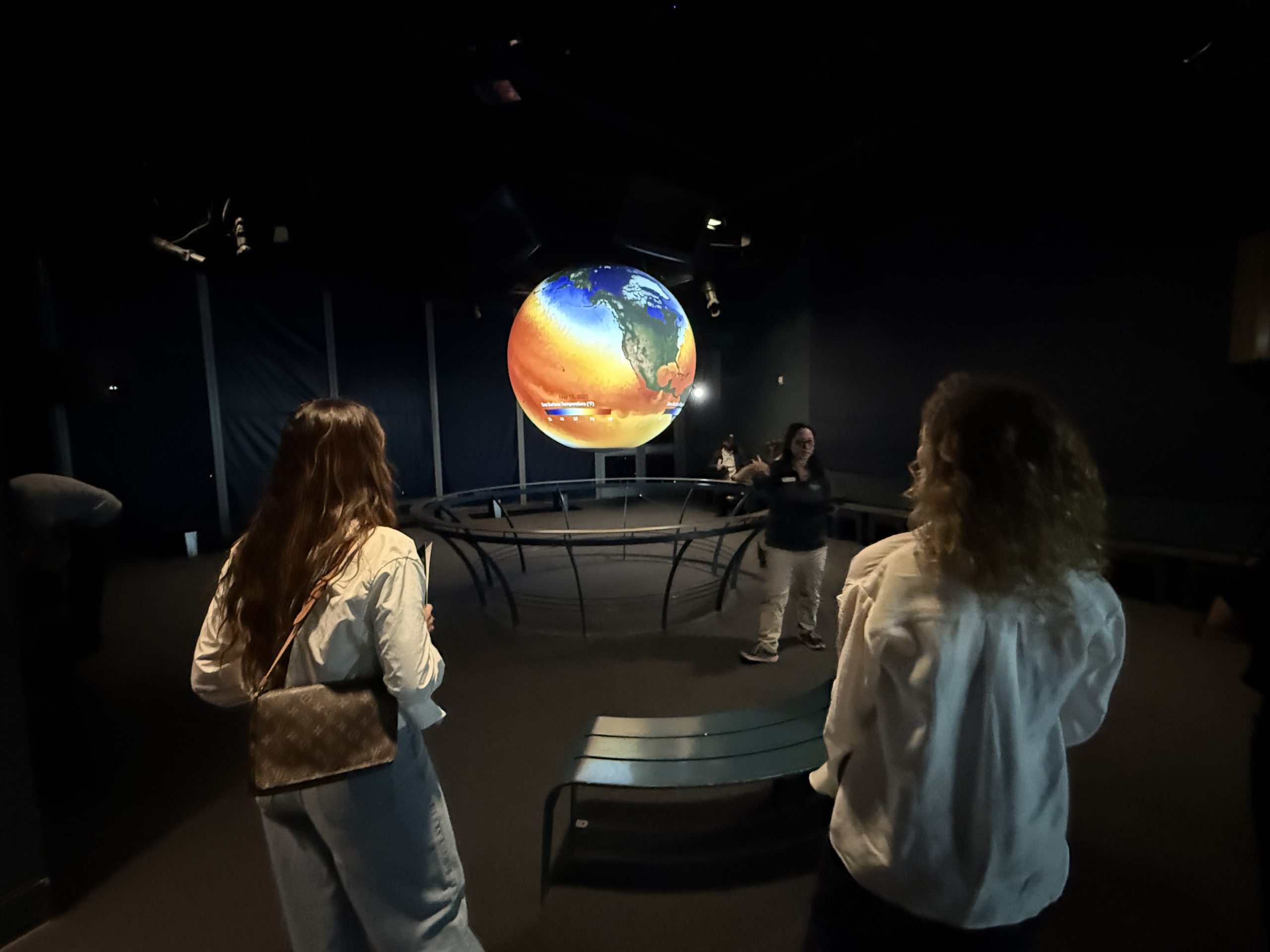
In addition, Flocken introduced the Ocean Science Center within the Aquarium, where satellite data from NOAA and the National Aeronautics and Space Administration are beamed directly into an elevated globe called Science on a Sphere® to reflect real-time warming of the earth’s oceans.Flocken also explained how the Aquarium is in training to study “the health impacts of marine animals” caused by the warming oceans.
“As a non-profit organization committed to ocean conservation and education, the Aquarium of the Pacific is focused on programs that help marine life as well as those that make science accessible to the public,” he said.
Flocken said as impacts of the heat ramp up, the Aquarium is preparing to “serve a pivotal role in directly responding to aid wildlife in need of rescue, as well as providing rehabilitation care and sanctuary for impacted animals when needed.”
“We have staff on the water each day recording sightings of marine life so we can track population calculations and anomalies,” the Aquarium CEO said.
Dr. Ariel Cohen, a meteorologist who runs the Los Angeles Bureau of the National Weather Service, explained what El Niño looked like, which is a giant red ‘ blob ‘ gathering over the Pacific Ocean.
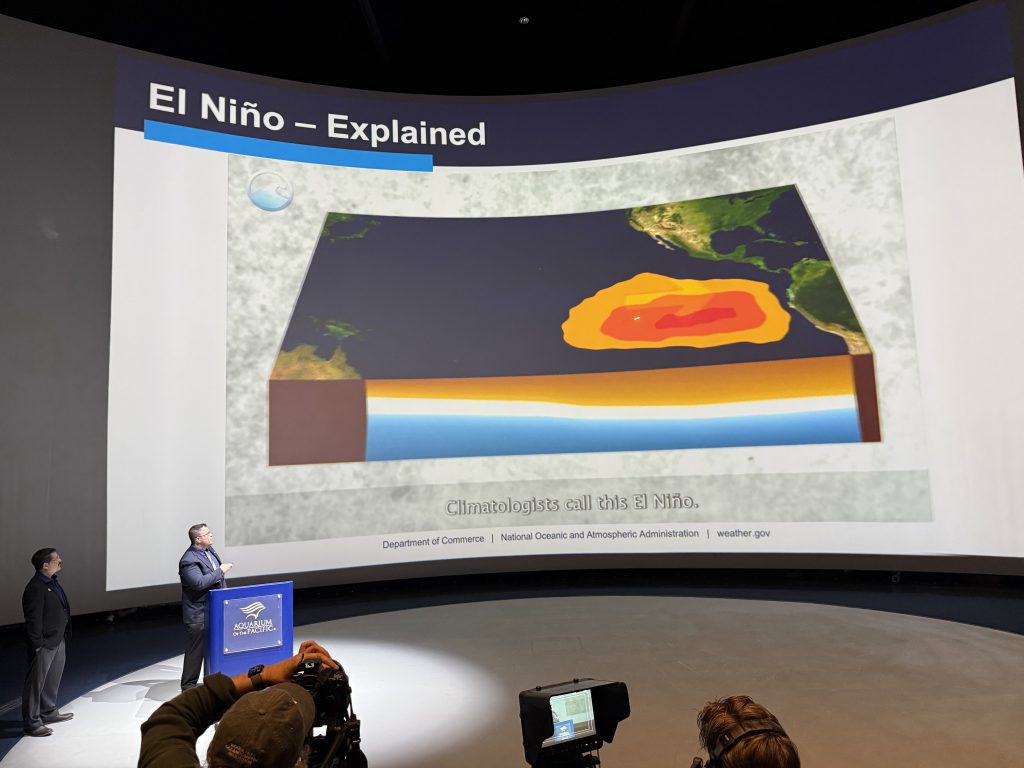
National Weather Service Meterologist Dr. Ariel Cohen points out a huge red blob gathering in the Pacific Ocean, warming the oceans and preparing for El Nino.
“I’m going to show how warm water temperatures over the equatorial Pacific can play a huge role in the types of weather patterns that we will see across California,” said Cohen.
Under normal conditions, an area of warm waters is blown westward by naturally occurring trade winds, followed by an area of cooler waters just off the coast of Central and South America.
Cohen used the Vision Center’s huge 130-foot video screen to show diagrams to illustrate the formation of El Niño weather patterns and how they indicate warming waters.
“We are already seeing the conditions favoring this El Niño pattern coming to light,” said Cohen.
He said El Niño forms when trade winds slacken, causing warm waters to extend farther east, right off the coast of Mexico and northern South America, which causes jet stream energy in the atmosphere to bring disturbed weather southward across the southern U.S.
“We are already seeing these warm temperatures lining up,” said Cohen, and when we look at the anomalies, or the departure from normal conditions, these reds and even darker colors are showing several degrees above normal in waters pooling over equatorial waters of the Pacific.”
Dr. Andrew Leising, a research oceanographer at the NOAA Southwest Fisheries Science Center, spoke directly about how the warming waters of El Nino affect the world’s oceans, specifically the Pacific Ocean.
Leising demonstrated government software modeling via satellite data, designed to predict ocean temperatures using external conditions. Scientists must take into consideration that some ocean heat waves “last for years,” he said.
El Niño, said Leising, “tends to cause green heat waves, indicating very warm conditions all along the coast. If indeed it continues to form, the conditions would be like the El Niño in 1998 and the one in 1978, which puts these conditions in spans of 20 to 30 years.
The researcher pointed out, however, that this year’s marine heat wave is mostly restricted to Southern California. In addition, he said it is located “far offshore,” and it is only about a third the size of the big one in 2015.
Nevertheless, the scientist said, the impacts are still hard to predict. “The impacts of El Niño are always different on different years,” said Leising.
Brett Long, Aquarium of the Pacific vice president of animal care, birds, and marine mammals, said the Aquarium supports disaster responses affecting birds and marine mammals using organized volunteers who monitor beaches and key ocean indicators.
“We work with local organizations to respond to crises, assist with wildlife surveys in search and recovery efforts, and collect impacted wildlife for them to receive the care they need,” said Long.
Nate Jaros, the Aquarium’s VP of animal care, fish, and invertebrates, said the warming waters could bring “an increase in tropical or warm subtropical species, which could include increased shark sightings.”
“We may see rare visitors like yellow-fin tuna, mahimahi, yellow-bellied sea snakes, seahorses, pelagic red crabs, and in very rare cases, even whale sharks,” said Jaros.
The group also heard from Dr. Felix G. Castro, from NOAA.Flocken thanked the experts for sharing their understanding of what’s happening to our oceans. “We understand there’s so much more we need to know about what’s currently there, and we will continue to grow in our knowledge of what we should know about.”