

By Sue Kaplan
RCSD Was Warned. Why Won’t It Revisit Pickleball at Rossmoor Park?
Three years after RCSD converted one tennis court into four permanent pickleball courts in a small neighborhood park, this is no longer a debate about whether pickleball belongs in Rossmoor. It is about whether RCSD is willing to acknowledge problems resulting from its decision and reconsider that decision when experience warrants it.
Residents raised concerns about cost, noise, traffic, parking, safety, overcrowding and enforcement. Since then, we have sent directors emails, photographs, videos and specific proposals. My own emails to RCSD directors have gone unanswered by the directors themselves. Repeated requests to place pickleball on the agenda for substantive public discussion have been deliberately disregarded, with the Board intentionally refusing to give the community any meaningful forum to address the issue.
Four Courts in the Space of One
Safety alone warrants reconsideration.
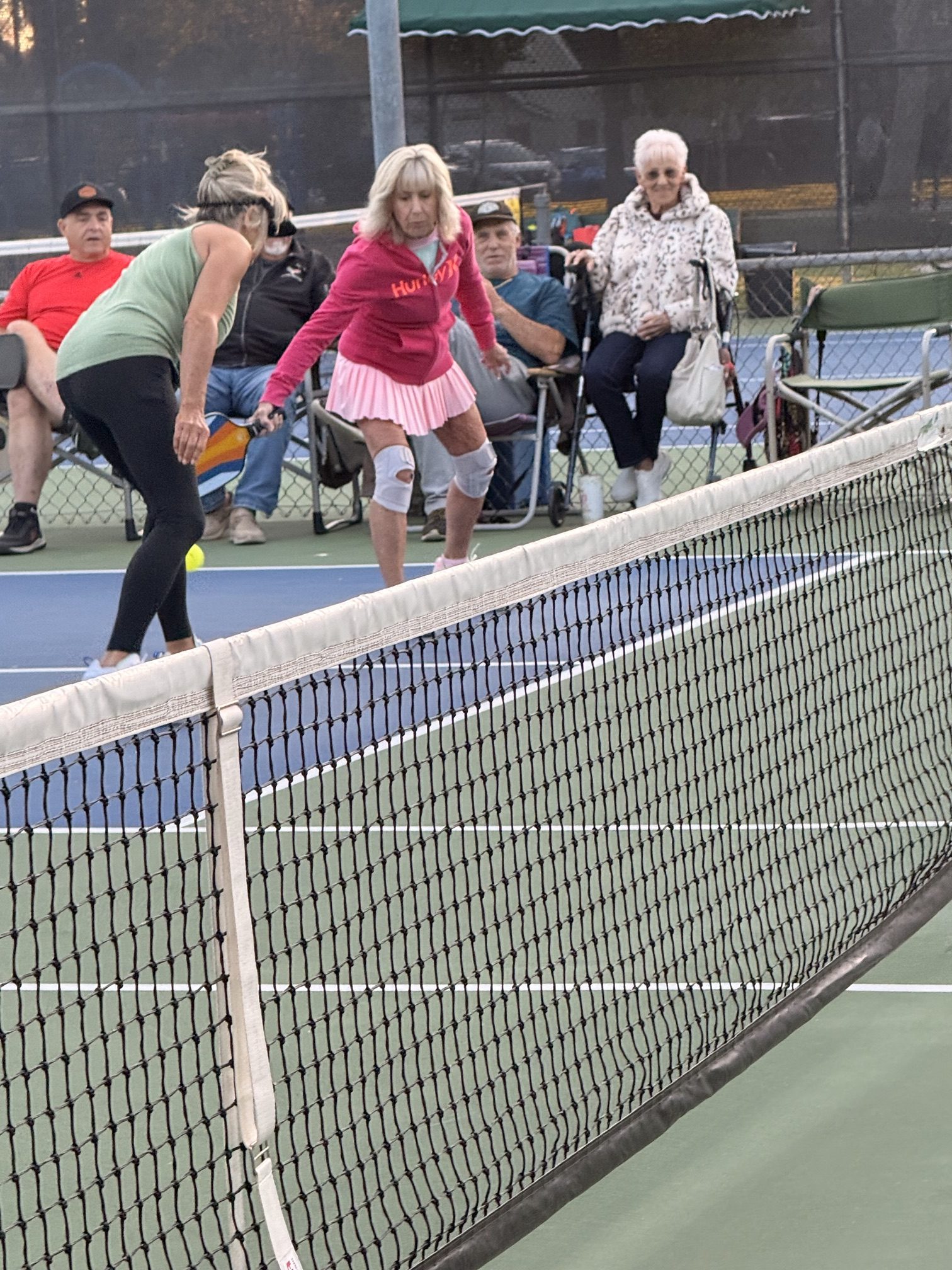
Four pickleball courts were squeezed into the footprint of one tennis court. I have sent RCSD photographs and videos showing spectators immediately alongside active courts and in areas players may need when pursuing balls. On at least one occasion, a baby was placed on the court beside her stroller while play continued in close proximity.
As a physician, I have repeatedly warned of the obvious injury risks. Players need room to pursue balls and decelerate, yet up to a dozen+ spectators can crowd inside the court perimeter. Those seated on walkers cannot readily evade errant balls, rackets or fast-moving players; neither can infants and small children. This overcrowded configuration creates a foreseeable safety hazard.
Three-minute public comments amount to speaking at the Board, not with it—remarks are met with silence, without acknowledgment or engagement. They are no substitute for an agendized discussion the Board has repeatedly refused to allow.
Rules Without Enforcement
General Manager Sharon Landers summarized RCSD’s enforcement philosophy in an email to me:
“The District does not have park enforcement staff or personnel assigned to monitor our parks or respond to active rule violations…. While we encourage visitors to follow those rules, the District is not staffed to provide real-time enforcement or immediate responses to reports of violations.”
That is an extraordinary position for the agency operating the park.
RCSD has repeatedly responded to problems with more rules and signs. But without meaningful enforcement, rules become suggestions. A part-time attendant 2 hours in the evening does not solve the problem during the remaining 12 hours the courts are open.
Equal Treatment Is Not Identical Treatment
Landers has also warned that if pickleball hours or operations are restricted, tennis will face comparable restrictions because the activities are treated as racket sports.
That confuses equality with identical treatment.
Four pickleball games can occupy the footprint of one tennis game, multiplying players, spectators and noise. Most distinctive is pickleball’s relentless, impulsive “pop-pop-pop”—often likened to a reversing vehicle’s deliberately attention-grabbing beep. The two sports create different impacts and should be addressed accordingly.
More troubling, I believe this position has silenced tennis players who were once vocal fearing retribution and has put a chill on reporting violations.
Where Was the Due Diligence?
Noise, traffic, parking, spectator space, court density and enforcement were foreseeable.
A professional planning process should have examined objective data, alternatives and operational consequences before making a permanent conversion. Instead, RCSD pushed ahead and left problems to be addressed later.
Three years later, “later” is still happening.
There have been acoustic blankets ineffectively placed, more signs, rules and talk of ambassadors and 2-hour attendants. But the measure of responsiveness isn’t how many remedies RCSD has attempted. It is whether they worked.
The continuing problems raise the more fundamental question: Was putting four permanent pickleball courts into this particular footprint a sound decision?
RCSD now has three years of actual experience. Measure the noise. Evaluate parking and utilization. Examine safety and spectator capacity. Determine whether rules are being followed. Then present the results publicly.
There is also a fiscal question. Taxpayers deserve a transparent accounting of what this project has cost, including conversion, resurfacing, acoustic mitigation, equipment, staffing and subsequent expenditures—and whether less expensive, more flexible alternatives such as portable nets, as many communities use, were adequately considered.
And Now an Election
These issues make the upcoming RCSD election especially relevant.
I listened closely when candidate Konya Vivanti was asked at the August Board meeting what she would do about pickleball noise and traffic. Her answer was striking because I had heard essentially the same response from her two years earlier.
When Vivanti was running for RCSD in 2024, I spoke with her personally about pickleball noise. My contemporaneous text messages document my account of that conversation: she told me that she regularly played mahjong near the courts and didn’t hear the pickleball noise, stating she heard basketball and tennis more.
Two years later, asked publicly about noise and traffic, Vivanti again began with mahjong. She had recently been at her “normal spot near the tennis courts, not far from the pickleball,” she said, and “I didn’t hear anything.”
I find the repetition—and the response itself—astonishing. Pickleball is not silent.
Whether one person notices pickleball while playing mahjong tells us little about what neighboring homeowners experience repeatedly in their homes and yards. Vivanti herself acknowledged that perhaps she was there at a different time and that she isn’t at the park “all day long listening.”
Exactly. If your exposure is admittedly limited, why begin an answer about residents’ noise complaints by saying you don’t hear the noise?
Vivanti then described residual noise and changing activities as “the downside of living near a park.” I found that dismissive. The question is not whether people near parks should expect ordinary park activity. It is what responsibility RCSD assumes when it introduces a substantially different use and neighboring homeowners subsequently report significant impacts.
Vivanti eventually said residents should be heard and that she would investigate what other jurisdictions are doing. Those are reasonable ideas. In my view, they should have been the beginning of her answer, not its coda.
She also raised “possible bias” in previous observations of pickleball noise while acknowledging, “I never saw the real meat of the results of that.”
If a candidate hasn’t sufficiently studied an issue, saying so is preferable to minimizing it. I would have welcomed an answer that began: I need to understand this better. I want to hear from affected residents, examine the evidence and investigate what has worked elsewhere.
Instead, two years later, I heard essentially the same mahjong anecdote. Pickleball noise is not a problem and if there is any noise, homeowners living near a park have to expect that.
Put It on the Agenda
Ultimately, this is larger than one candidate or one recreational activity. It is about governance.
RCSD was warned about many of these issues. It now has three years of experience with the results.
Put pickleball on the agenda. Present the evidence. Account for the money spent. Evaluate safety, noise, parking, enforcement and the four-court configuration itself. Listen to pickleball players, tennis players and neighboring homeowners.
If the evidence shows the configuration is working, demonstrate that publicly. If significant problems remain, be willing to change it.
None of this requires RCSD to be against pickleball.
It requires RCSD to govern.
As voters evaluate candidates for the RCSD Board, they should ask whether a candidate has already minimized or trivialized the very real impacts of pickleball on neighboring homeowners and tennis players—or more broadly to all governing issues whether that candidate is willing to examine objective data, listen to those affected and respond with empathy rather than dismissal. Rossmoor deserves directors who approach this issue with an open mind, not a predetermined conclusion.
Editor’s Note: Opinion pieces are welcomed. During the active campaign reason, anything related to elections are posted on the website.