Home Blog Page 84

JFTB officials gather to announce funding for fire suppression copters

Officials have announced that Southern California Edison funding will again this year bolster around-the-clock aerial assaults on wildfire with the world’s largest fire-suppression helicopters.

General Michael Leeney and Orange County Fire Authority Chief Brian Hennessy is scheduled to make an announcement at the Joint Forces Training Base this week regarding the housing of a new fleet of “quick responses” helitankers, according to a press release from Joint Forces Training Base.

It said the population of Los Angeles, Orange, and Ventura counties exceeds that of one-third of the state. Many of these communities live in or near the wildland/urban interface, putting them at risk of wildfire devastation in what has become a “year-round fire season.”

Now in its second year, the Quick Reaction Force (QRF) addresses these realities just as its name implies – quickly and with great force.
The QRF fleet, which is again funded by $18 million from Southern California Edison (SCE), is headlined by two CH-47 helitankers that can fill their 3,000-gallon tanks in less than 90 seconds and drop water or retardant (day or night) in surgically strategic lines.

The helitankers are supported by a Sikorsky 61 helicopter with a 1,000-gallon capacity; a Sikorsky 76 intelligence and recon helicopter; and a mobile retardant base that can actively mix up to 18,000 gallons of fire retardant per hour. Together, the fleet makes up the world’s first fully nocturnal wildfire aerial task force.

During the 2021 QRF program, the fleet deployed on more than 50 incidents, dropping nearly three million gallons of water and retardant that saved an untold number of homes, structures, and lives. For example, on last summer’s Tuna Fire, a single QRF helitanker dropped 37,000 gallons of water in under two hours in a narrow canyon at night – an unprecedented first that helped stop the fire in its tracks.

The QRF program, which is a partnership between the Orange County Fire Authority, Los Angeles County Fire Department, and Ventura County Fire Department, will be operational for 165 days and officially launched on June 24, 2022. A hover-filling and water-dropping demonstration will follow the press conference.

The announcement was scheduled for Tuesday, July 5 at 9:30 a.m.

Full text of Fortis LLP “expansive” Public Records Act request of Frances Marquez

For the record, the ENE is publishing the full text of the extraordinary public records request filed by Costa Mesa attorney Adam Harris of Fortis LLP asking for information from Cypress Council member Frances Marquez. No other Council member was subject to this “expansive request,” city officials said. Marquez was censured, in part, for allegedly taking too much time to comply with this and other measures. As yet, Fortis has not revealed the seeker of the information. The ENE has reached out to Fortis, LLP.

SCOPE OF THIS REQUEST
Please note this request for records includes, but is not limited to, all communications from and to and/or otherwise copied or provided to Dr. Frances Marquez as further defined hereinbelow, not only from or to her government issued email account, but also from or to her private phone, private email account, other private accounts, and personal devices and all other data required to be provided by law. City of San Jose v. Superior Court of Santa Clara County, Opinion No. S218066, March 2, 2017, Kleinberg.
In other words, without limiting the breath and scope of the City of San Jose case or any other applicable law, each and every request contained in this PUBLIC RECORDS REQUEST
includes, but is not limited to, any and all COMMUNICATIONS, whether involving Dr. Frances Marquez’ private or public email accounts, phone numbers, and/or personal devices, with any and all people and whether from third parties to her or vice versa, including but not limited to communications with George Pardon, Gary Segura, Sonny Waknin, University of California Los Angeles, Chad Dunn, Matt Barretto, Kevin Shenkman, Michelle Magur, Dr. Marquez’ family members and friends – especially those who live in the City of Cypress – Caroline Baladot, Britney Cook, Glen Morikawa, David Young, Event-News Enterprise, the Pasadena Star, any other media outlets and reporters, OC Young Democrats, Congressman Alan Lowenthal, Sharon Quirk – Silva, Katrina Foley, Katie Shapiro, Harry Pachon, California Aware, Emerge California Candidate Training, Sangee Tasangeeta (Swenson), Malini Nagpal, Sylvia Munoz, Orange County Fire Authority, Orange County Fire Authority Board Members or Staff, Southwest Voter Registration Education Project including but not limited to Board Members and Staff, Latino Policy Coalition, Gallaudet University as well as any agents, representatives, associates, employees or consultants of the aforementioned.
Similarly it includes documents in her possession or in the possession of other third parties who are holding them for her, whether created by her or any third parties, including but not limited to documents created by or being held for her by George Pardon, Gary Segura, Sonny Waknin, University of California Los Angeles, Chad Dunn, Matt Barretto, Kevin Shenkman, Michelle Magur, Dr. Marquez’ family members and friends – especially those who live in the City of Cypress – Caroline Baladot, Britney Cook, Glen Morikawa, David Young, Event-News Enterprise, the Pasadena Star, any other media outlets and reporters, OC Young Democrats, Congressman Alan Lowenthal, Sharon Quirk – Silva, Katrina Foley, Katie Shapiro, Harry Pachon, California Aware, Emerge California Candidate Training, Sangee Tasangeeta (Swenson), Malini Nagpal, Sylvia Munoz, Orange County Fire Authority, Orange County Fire Authority Board Members and Staff, Southwest Voter Registration Education Project including but not limited to Board Members and staff, Latino Policy Coalition, Gallaudet University as well as any agents, representatives, associates, employees, consultants, board members or staff of the aforementioned.

DEMAND TO PRESERVE EVIDENCE
Please also consider this email a demand to preserve any and all documents and evidence related to the requests made herein.

REQUEST FOR PRIVILEGE LOG IF ANY DOCUMENTS WITHHELD

We further request that if there are any documents not produced based on the ground of the attorney client privilege, work product doctrine, or any other privilege or doctrine, that you please prepare and provide a privilege log that identifies each document for which the privilege or doctrine is claimed, and which gives the following information:
(a) the names of the writer, sender, or initiator of each copy of the document; (b) the name of the recipient, addressee, or party to whom any copy of the document was sent; (c) the date of each copy of the document, if any, or an estimate of its date; (d) a non-privileged description of the contents of the document; and, (e) a statement of the basis for the claim of privilege.
DEFINITIONS
1. “COMMUNICATION” or “COMMUNICATIONS” includes but is not limited to the following: (a) any email, text message, written letter, memorandum, or other DOCUMENT of any kind transmitted from one PERSON to another PERSON by hand, mail, courier, other delivery service, telecopy, facsimile, telegraph, electronic mail, text message, WhatsApp message, voicemail, or any other means (including emails from non-government email addresses); (b) any telephone call, whether or not such call was by chance or prearranged, formal or informal; and (c) any conversation or meeting between two or more PERSONS, whether or not such contact was by chance or prearranged, formal or informal.
2. The term “DOCUMENT” has the same meaning as the definition of writings, recordings and photographs in Section 250 of the California Evidence Code and/or as defined by the California Public Records Act and includes all written and graphic matter, however produced or reproduced, of any kind or description, whether sent or received or neither, including originals, non-identical copies, and drafts, and both sides thereof, including but not limited to: emails, text messages, other electronic communications, books, journals, statements, bank statements, statements of accounts, bank records, deposit slips, payrolls, letters, correspondence, memoranda, contracts, agreements, books, journals, ledgers, statements, reports, billings, invoices, worksheets, jottings, notes, audits, charges, balance sheets, income statements, checks diagrams, diaries, calendar logs, facsimile transmissions, wires, computer files stored by any means, computer printouts, and electronic messages in any digital or electronic format, including emails, text messages, tweets, internet chatroom posts and all other informal or formal writing or tangible things on which any handwriting, typing, printing, video or sound is recorded or reproduced, and any and all amendments or supplements to all of the foregoing, whether prepared by YOU or another PERSON.

3. The term “DOCUMENT” also means originals and copies of all of the above upon which notations in writing, print, or otherwise have been made, which do not appear on the originals. This definition covers all documents in your or Dr. Frances Marquez’ possession, custody, or control, regardless of their location, including all copies of such documents, the contents of which differ in any respect from the original.

4. This definition further includes all DOCUMENTS that Dr. Frances Marquez has stored in and/or has access to or through any cloud-based internet application, including but not limited to email, Facebook, Dropbox, Twitter, or Google Docs, or other cloud-based applications.

5. The term DOCUMENT includes “Text Messages” sent using the Short Message Service (SMS) including alphanumeric texts, multimedia messages (known as MMS) containing digital images, videos, and sound content, as well as ideograms known as emoji (happy faces, sad faces, and other icons).

DOCUMENTS REQUESTED

We hereby request the following documents:
1. Councilmember Dr. Frances Marquez’ response and/or any COMMUNICATIONS with anyone, whether text, or emails or in any other form as set forth in the definition above, including from private accounts, emails, etc. and DOCUMENTS which in any way relate to Gary Segura’s communications, including but not limited to his November 15, 2021 email whereby he informed her that:
“Scaring white electeds is fun) Thoughts?” and “She’s hoping to cow them into districts.”

2. All DOCUMENTS and COMMUNICATIONS that Councilmember Dr. Frances Marquez had with her on the Dias or otherwise used for all city council meetings that she has attended or participated in, whether in-person, by zoom, telephone or by any other means from the time that she was elected through May 9, 2022, including but not limited to the April 11, 2022, and April 25, 2022 City Council meetings and including but not limited to her own notes and notes from third parties, advisors, colleagues, etc.

This request includes but is not limited to COMMUNICATIONS and DOCUMENTS related to all City of Cypress business, including but not limited to District Voting, The Amazon Last Mile Facility, The City of Cypress Sold Waste Franchise Agreement with Valley Vista and/or George Briggeman, and the Los Alamitos Race Course.District Voting
3. All COMMUNICATIONS by, from, to, with or otherwise copied to City Councilmember Dr. Frances Marquez – including but not limited to communications in her private accounts, private emails, private telephones – relating in any way to District Voting.

4. All DOCUMENTS created by City Councilmember Dr. Frances Marquez for her use by others who are not employees or representatives of the City of Cypress – relating in any way to District Voting. This requests includes, but is not limited to, journals, notes, ledgers, diagrams, speech drafts, speech notes, drafts of news articles, etc., created not only by Dr. Frances Marquez, but by any of her colleagues, consultants, advisors, reporters, third parties, including but not limited to George Pardon, Gary Segura, Sonny Waknin, University of California Los Angeles, Chad Dunn, Matt Barretto, Kevin Shenkman, Michelle Magur, Dr. Marquez’ family members and friends – especially those who live in the City of Cypress – Caroline Baladot, Britney Cook, Glen Morikawa, David Young, Event-News Enterprise, the Pasadena Star, any other media outlets and reporters, Southwest Voter Registration Education Project (any correspondence she has had), Latino Policy Coalition, Gallaudet University as well as any agents, representatives, associates, employees or consultants of the aforementioned, as well as any agents, representatives, associates, employees or consultants of any of the aforementioned.

The Amazon Last Mile Facility
5 All COMMUNICATIONS by, from, to, with or otherwise copied to City Councilmember Dr. Frances Marquez – including but not limited to COMMUNICATIONS in her private accounts, private emails, private telephones – relating in any way or referring to the Amazon Last Mile Facility.

6. All DOCUMENTS created by City Councilmember Dr. Frances Marquez or by third parties or others for her use and/or review – relating in any way to the Amazon Last Mile
Facility. This request includes, but is not limited to, journals, notes, ledgers, diagrams, speech drafts, speech notes, drafts of news articles, bank statements, deposit slips, etc., created not only by Dr. Frances Marquez, but by any of her Non-City of Cypress colleagues, consultants, advisors, reporters, third parties, including but not limited to George Pardon, Gary Segura, Sonny Waknin, University of California Los Angeles, Chad Dunn, Matt Barretto, Kevin Shenkman, Michelle Magur, Dr. Marquez’ family members and friends – especially those who live in the City of Cypress – Caroline Baladot, Britney Cook, Glen Morikawa, David Young, Event-News Enterprise, the Pasadena Star, any other media outlets and reporters, OC Young Democrats, Congressman Alan Lowenthal, Sharon Quirk – Silva, Katrina Foley, Katie Shapiro, Harry Pachon, California Aware, Emerge California Candidate Training, Sangee Tasangeeta (Swinson), Malini Nagpal, Sylvia Munoz, Orange County Fire Authority Southwest Voter Registration Education Project, Latino Policy Coalition, Gallaudet University as well as any agents, representatives, associates, employees or consultants of the aforementioned.
City of Cypress’ Solid Waste Franchise Agreement with Valley Vista

7. All COMMUNICATIONS by, from, to, with or otherwise copied to City Councilmember Dr. Frances Marquez – including but not limited to COMMUNICATIONS in her private accounts, private emails, private telephones – relating in any way or referring to Valley Vista Services, Inc. dba Valley Vista Services of Orange County and/or its Franchise Agreement with the City of Cypress and/or George Briggeman.

This request includes, but is not limited to, all COMMUNICATIONS relating to Dr. Marquez’ public statements that (1) “this company is corrupt”; (2) that there has “never been any audit of this company by the City”; (3) that this Franchise Agreement was not the result of a “fair, open and competitive bid process”; (4) that the resulting Franchise Agreement was not “fairly negotiated and (does not) protect the citizens of Cypress”; (5) that this Franchise Agreement was “written to protect Valley Vista’s bottom line not (Valley Vista’s) residents”; (6) that “no due diligence” was done when this contract was written; (7) that there is “no limit to how much Valley Vista can charge”; (8) that this Franchise Agreement is missing “standard termination language” found in other similarly classified government contracts; (9) that this Franchise Agreement was a “mistake”; (10) that this Franchise Agreement has 87-year old people worrying about paying their trash bill; (11) this Franchise Agreement is a “bail out” of Valley Vista; and, (12) that no one has compared the Valley Vista rates with the rates given surrounding cities. It also includes, but is not limited to, any communications from, to, with, or copying Dr. Frances Marquez relating to her April 11, 2022, request to “place an item on a Future Agenda to Take a Closer Look at the Termination Clauses in the Valley Vista Contract”.
This request includes all of the communications and documents as defined in the sections 1 through 5 of DEFINITIONS hereinabove which by definition includes all COMMUNICATIONS with any representatives, consultants, owners, employees, advisors, and liaisons of any and all solid waste management companies.

8. All DOCUMENTS created by City Councilmember Dr. Frances Marquez or by third parties or others for her use and/or review – relating in any way to Valley Vista Services, Inc. dba Valley Vista Services of Orange County and/or its Franchise Agreement with the City of Cypress and/or George Briggeman. This request includes, but is not limited to, journals, notes, ledgers, diagrams, speech drafts, speech notes, drafts of news articles, etc., created not only by Dr. Frances Marquez, but by any of her Non-City of Cypress colleagues, consultants, advisors, reporters, third parties, including but not limited to George Pardon, Gary Segura, Sonny Waknin, University of California Los Angeles, Chad Dunn, Matt Barretto, Kevin Shenkman, Michelle Magur, Dr. Marquez’ family members and friends – especially those who live in the City of Cypress – Caroline Baladot, Britney Cook, Glen Morikawa, David Young, Event-News Enterprise, the Pasadena Star, any other media outlets and reporters, OC Young Democrats, Congressman Alan Lowenthal, Sharon Quirk – Silva, Katrina Foley, Katie Shapiro, Harry Pachon, California Aware, Emerge California Candidate Training, Sangee Tasangeeta (Swinson), Malini Nagpal, Sylvia Munoz, Orange County Fire Authority Southwest Voter Registration Education Project, Latino Policy Coalition, Gallaudet University as well as any agents, representatives, associates, employees or consultants of the aforementioned.
This request includes all of the communications and documents as defined in the DEFINITIONS sections 1 through 5 hereinabove which includes all DOCUMENTS with any representatives, consultants, owners, employees, advisors, and liaisons of any and all solid waste management companies.

9. Any and all COMMUNICATIONS and DOCUMENTS between Dr. Frances Marquez and the attorneys that she claimed to have consulted with regarding the City of Cypress’ Franchise Agreement with Valley Vista.,Los Alamitos Race Course
10. All COMMUNICATIONS by, from, to, with or otherwise copied to City Councilmember Dr. Frances Marquez – including but not limited to COMMUNICATIONS in her private accounts, private emails, private telephones – relating in any way or referring to Los Alamitos Race Course.
11. This request includes all of the communications and documents as defined in the sections 1 through 5 of DEFINITIONS hereinabove which by definition includes all COMMUNICATIONS with any representatives, consultants, owners, employees, advisors, and liaisons of any and all solid waste management companies.
12. All DOCUMENTS created by City Councilmember Dr. Frances Marquez or by third parties or others for her use and/or review – relating in any way to Los Alamitos Race Course. This request includes, but is not limited to, journals, notes, ledgers, diagrams, speech drafts, speech notes, drafts of news articles, etc., created not only by Dr. Frances Marquez, but by any of her Non-City of Cypress colleagues, consultants, advisors, reporters, third parties, including but not limited to George Pardon, Gary Segura, Sonny Waknin, University of California Los Angeles, Chad Dunn, Matt Barretto, Kevin Shenkman, Michelle Magur, Dr. Marquez’ family members and friends – especially those who live in the City of Cypress – Caroline Baladot, Britney Cook, Glen Morikawa, David Young, Event-News Enterprise, the Pasadena Star, any other media outlets and reporters, OC Young Democrats, Congressman Alan Lowenthal, Sharon Quirk – Silva, Katrina Foley, Katie Shapiro, Harry Pachon, California ware, Emerge California Candidate Training, Sangee Tasangeeta (Swinson), Malini Nagpal, Sylvia Munoz, Orange County Fire Authority Southwest Voter Registration Education Project, Latino Policy Coalition, Gallaudet University as well as any agents, representatives, associates, employees or consultants of the aforementioned.
This request includes all of the communications and documents as defined in the DEFINITIONS sections 1 through 5 hereinabove which includes all DOCUMENTS with any representatives, consultants, owners, employees, advisors, and liaisons of any and all solid waste management companies.
ENDu


Breaking: Lawsuit filed against Cypress alleging Voting Rights Violations

Breaking News

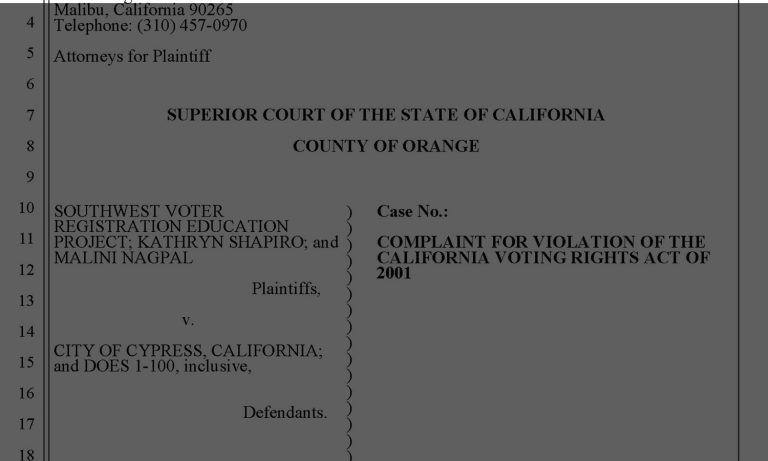
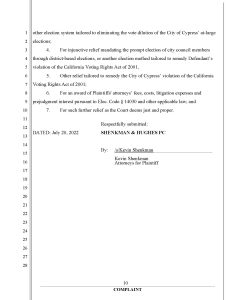
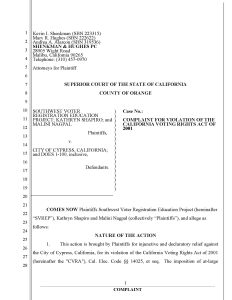
After the city council failed to discuss in public session the prospect of creating new voting districts throughout the city of Cypress for nine months, a lawsuit has been filed seeking “injunctive and declaratory” relief against the city for alleged violations of the California Voting Rights Act of 2001.

The lawsuit, if successful in court, could not only cost the city of Cypress millions of dollars, but would likely also prompt new elections once a verdict is reached in the case, according to Malibu attorney Kevin Shenkman.
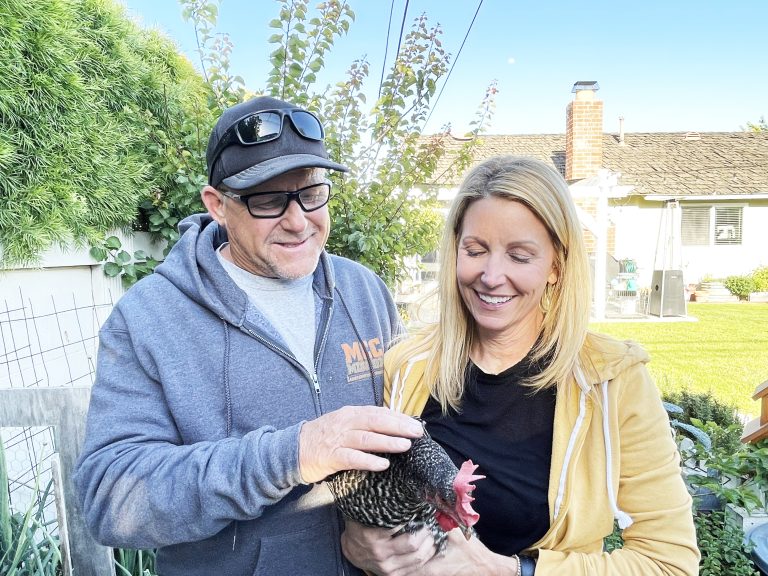
His firm, Shenkman and Hughes, filed the suit in Superior Court Wednesday, July 20.

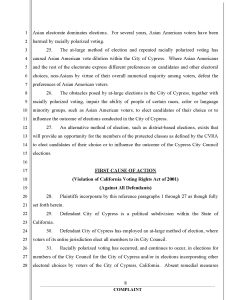
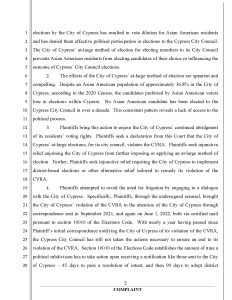
“The imposition of at-large elections by the City of Cypress has resulted in vote dilution for Asian American residents and has denied them effective political participation in elections to the Cypress City Council,” the lawsuit contends.

“The City of Cypress’ at-large method of election for electing members to its City Council prevents Asian American residents from electing candidates of their choice or influencing the outcome of Cypress’ City Council elections,” it said.

The lawsuit has been sent electronically to the Superior Court of the State of California. Shenkman said he expects court officials to review it and officially file it within 24 hours of its receipt.

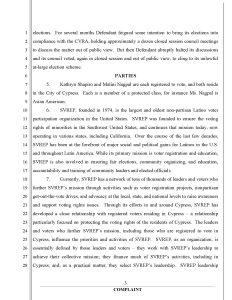
Shenkman’s firm filed the suit on behalf of the Southwest Voter Education Registration Project and two Cypress residents, Kathryn Shapiro and Malini Nagpal, both of whom reside in and are registered to vote in Cypress, the lawsuit contends.

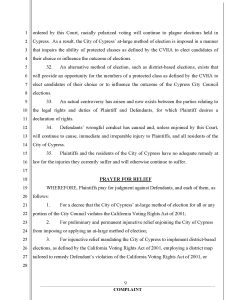
In general, the lawsuit seeks to force the city of Cypress to create voting districts within the city’s geographical boundaries rather than allowing the city’s current slate of five seats to be filled by qualified candidates able to run from anywhere in the city.

According to the lawsuit, more than 36 percent of the city’s residential population is of Asian American descent, yet the lawsuit alleges the city’s continued use of an at-large-based districting system violates the voting rights of citizens.

“The Asian American citizens of Cypress whose voting rights are immediately harmed by the City of Cypress’ adherence to an unlawful at-large system of electing its city council are hindered from protecting their own interests,” the lawsuit contends.

“Many of the Asian citizens of Cypress do not recognize that their voting rights are being violated by the City of Cypress’ adherence to an unlawful at-large system of electing its city council, and still others fear reprisal by the City of Cypress if they were to seek redress for the City of Cypress imposing its unlawful election system,” it claims.

Shenkman said he expects the entire process could take up to 18 months, saying the Superior Court generally sets trials about 12 months after the first status conference of the respective parties.

Moreover, Shenkman said, in cases like Cypress, when the Council makes no willful effort to comply, Superior Court judges have stepped in to force new elections within the respective new districts soon after the cases are settled.

He points to cases in places like Palmdale, and Highlands, where judges have taken action to force Council members to re-run within newly created districts soon after settling those cases.

“If I were running for Council this fall (in Cypress), I wouldn’t get too comfortable in the seat,” he said earlier. “I think it is just a question of when, not if,” Shenkman said today.

He expects whatever judge will hear the case to set a “Case Management Conference” within two months, and provide a given period of approximately six months for filings.

“That’s generally when they will set a date for trial,” said Shenkman.

The ENE has reached out to Fred Galante, legal counsel for the City of Cypress, and we will update the story when we receive a response.

Watch for comprehensive coverage in next week’s ENE.


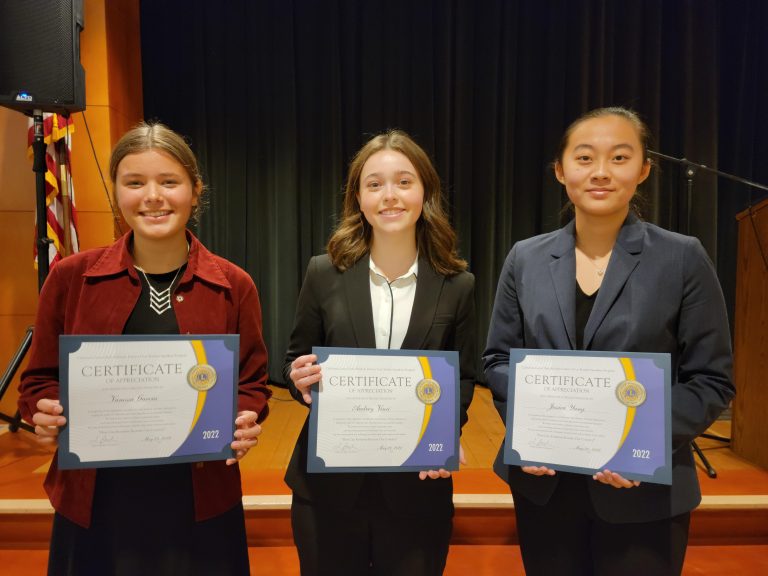
Can Kindness reunite America, Part III by Vanessa Garcia

Without question, one of the most impactful decisions we’ve made in 2022 is to publish this series of articles written by high school students about how kindness can reunite America.
I have heard from readers and even heard one of the articles quoted at a public meeting, so I again thank the three students who wrote them.

This week we run the third of the top three speeches written under the prompt “Can Kindness reunite America?” Interestingly, Vanessa Garcia has entitled her speech, “A House Divided,” after a phrase used by Abraham Lincoln.

With institutions and citizens now lining up on the left and the right, one can hope that somehow, we break the spell and heed the words of President Lincoln’s warning before it’s too late.

While the nation faces real enemies, we have seemingly been instead been directed to focus our political fire on our neighbors. People next door no longer have different views, they are portrayed, for political purposes, as “radicals,” left and right, out to destroy the country.

The worse they make it seem, the more money that flows into the coffers, both left and right. The vast majority of Americans, somewhere in the middle, stay out of the fight to avoid a political bullet they know is sure to come.
So the question remains, how long can this “House [be] divided” before it falls for good?

We already have red states and blue states, we have an assault on public institutions and institutions being stacked, one way or the other, to suit political purposes.
It seems that we ourselves, have allowed the destruction of public interest, the lost colony of the common good, leaving us on the a political divide from which there is no easy return.

While it is impossible to determine at what point the divide reaches the point of no return, for sure the threat is sufficient to beg the question of why can’t kindness be given a chance to reunite our widening political divide.

Creating a home where kindness can live

By Vanessa Garcia

“A house divided against itself cannot stand.” These are the words of Abraham Lincoln, spoken when the country was upended, split apart, engaged in a bloody war that drove apart families and cost the lives of thousands of Americans. Nowadays, thankfully, we’re no longer involved in a devastating civil war. But never has America been so divided on so many essential principles, many of which make up the foundation of what our country was intended to be. We may not be in a time of open warfare, like other parts of the world tragically are, but families are still driven apart by political ideologies and the blood of innocent Americans shed by senseless violence. But despite the severity of our situation, there is light at the end of the tunnel. This wave of conflict and disunity has a very simple solution: kindness.

What is kindness? Kindness is simple yet powerful, humble yet great. Kindness is civility, but more. Plainly put, kindness is love, but it also has many different, interrelated elements, and it is in this diversity where its power lies. Think of it as a house with many rooms, a place abounding in Southern-style hospitality and warmth. Imagine if I could transport you to a place like that, give you a chance to visit this Southern mansion and help you better understand the transformative and unifying power of kindness… [speaking with Southern accent] So come on in, let me take you on a little tour of the House of Kindness.

Kindness is the owner of this house, but he rents it out to his tenants, people like Acceptance, Gentleness, and Service. Starting with the Porch of Hospitality – this is Acceptance’s favorite part of the house, and as such, he fills it with an amiable, welcoming air and makes sure that visitors are loved and accepted no matter what their state in life might be. Here on your left as you enter is a trash can, where visitors are asked to dispose of their ego before coming in.

Moving on to the living room, there is always a hearty fire crackling in the hearth, the perfect place for you to sit down and pour out your worries and struggles to none other than Mrs. Compassionate Listening herself, who always listens to and carefully considers all sides of a story. (By the way, this living room is the very place where Stephen Covey got the inspiration for his 5 th habit of Highly Effective People, seek first to understand and then be understood.) Now on to the kitchen – we’ll only glance in here, because both Creativity and Courage are hard at work cooking up some fanciful new ideas and solutions to problems. We’ll stop briefly at the bathroom, I’m sure y’all are familiar… This is the place where you dispose of all your waste products like judgment, cynicism, and negativity. Now on to the Stairs of Discipline.

They may hurt, but you’ll come out stronger in the end! And finally, we arrive at the Balcony of Dreams. This Balcony provides you with a unique outlook on life, allows you to see the bigger picture (which reduces stress, by the way – take note, all you moms out there), renews hope, and allows you to dream freely and without inhibitions. This is also the place where Dr. Martin Luther King Jr. (also a Southerner) got the idea for his famous speech, which he then named after this balcony. Well, this concludes our quick tour of the House of Kindness!

Please feel free to drop by anytime, you know the door will always be open! Now you might be thinking, ‘Excuse me, but I don’t get how this relates to the topic you were supposed to be speaking about, you know, how can kindness reunite our country, you just faked a rather questionable Southern accent and led us on a tour of a house that doesn’t exist.’ And about the accent part, you are absolutely right, it was 100% questionable, but as for its relevance regarding the topic, here’s how it relates.

Here in America, we are famous for our cultural diversity and personal freedom. They're two aspects that help make America what it is. But without kindness to mediate, this diversity and freedom can cause major conflicts between people who don’t share the same opinions, as we can see happening in the world all around us. Unity, being a unified nation, does not mean that we all become the same. Unity does not mean we all have to agree on everything or link arms and sing ‘Kumbaya’ all day. Unity does mean that we listen to each other with love, respect each other’s opinions, and accept each other’s
differences. These things, which at their cores are compassionate listening and acceptance, also make up the basis of what kindness is. Therefore, if we restore kindness, we restore the very essence of our nation and heal the wounds that are driving it apart.

But revolutions must start somewhere, and this one in particular is very…shall we say…personal. You see, we each have our own spheres of influence, however small, comprised of people around us who are actively influenced by our actions. This can be anyone from friends to family to anyone we meet or interact with. And even though others may be annoying or hard to love, we must remember that each of the people in our spheres have their own spheres, and each of the people in their spheres have their own spheres, and so on – thus, each choice we make creates ripples that expand exponentially and spread throughout society. But just as people suffer if someone lashes out in anger or acts out of jealousy, each act of kindness also holds more power than we can ever imagine. It can be as small as a smile, a kind word, letting someone merge in front of you on the highway. Then there are bigger things like having compassion for a coworker’s situation or forgiving someone and giving them a second chance. As Catherine Ryan Hyde, author of the book Pay It Forward, says, “…It proves that you don't need much to change the entire world for the better. You can start with the most ordinary ingredients. You can start with the world you’ve got.”

But how do we do this? We’ve been told of the power kindness holds and how it would theoretically be able to reunite our country, but how do we implement it into our daily lives and start actively trying to make a change? Well, this is where the Southern accent and house metaphor come in. How do we change the world? Have a front porch of acceptance, an attitude of openness that shows people they are loved, even if you don’t agree with their choices or opinions.

Have a warm fire of compassion – so people can sit next to you in peace while you offer a quietly listening ear, not trying to give advice or fix them, simply listening. Cook up creative new solutions and dream up ways to carry them out. Continually squish your ego so you don’t accidentally hurt anyone around you.
Practice discipline in your life and gently help others to do the same. And always look out on the world from your balcony of dreams, lifting others up and inviting them to imagine with you.

Because this revolution starts with each of us. It starts with our decision to get up each day and serve the people around us, to love the people around us, to be kind to the people around us. Because if we don’t step up, who will? Never has America been so divided, true… but never has there been a greater opportunity for radical kindness.

And in this way, by creating a home in which kindness can thrive, we can reunite our country. Brick by brick, one sphere of influence at a time, we can build temples of love in our hearts and communities that will come together in one immense, beautiful dance, and transform our divided house into one loving, glorious House of Kindness.

Rethinking Homework: Los Alamitos Unified School District adopts new policy that values ‘quality over quantity’

Homework is changing for students in the Los Alamitos Unified School District.

After months of development, the district recently updated its homework policy for the first time since 2014. The new policy emphasizes promoting “student wellness and academic rigor” and valuing “quality over quantity” when it comes to assignments students complete at home.

That translates to less homework overall for kids enrolled at the district’s nine campuses in Rossmoor, Los Alamitos and Seal Beach. Classes resume for the 2022-23 school year in August.

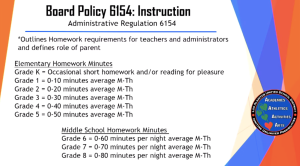
A slide shown during the June 14 Los Alamitos Unified School District Board of Education meeting outlines the district’s new homework policy that promotes “quality over quantity.”
Courtesy screenshot

“There is a lot of research that supports [that] if you overdo the amount of homework you actually see a negative impact on learning and so we really want to make sure that we’re addressing best practices and research and really making sure that our homework has a positive impact on students and student learning,” Deputy Superintendent Ondrea Reed said during her presentation on the revised homework policy at the June 14 Board of Education meeting.

The board adopted the policy in a unanimous vote at its June 28 meeting.

The shift to revise the homework policy was set in motion before Covid-19 appeared in 2020, according to Reed. Families were reporting students staying up past midnight to complete their homework as they juggled commitments to after school sports and activities.

The revised approach to homework has two parts: an update to the board policy and the addition of an administrative regulation which outlines how the policy will be implemented by staff.

The policy states elementary and middle school students will not be assigned homework on weekends. And for all grade levels, no homework would be given over school breaks.

“I think school breaks are very purposeful,” Reed said at the June 14 meeting. “The research really indicates that they’re set to give students an opportunity to recharge, also an opportunity for our staff to recharge.”

A slide shown during the June 14 Los Alamitos Unified School District Board of Education meeting outlines the district’s new homework policy that promotes “quality over quantity.”

The new policy includes specific guidelines on the amount of time students should be spending on homework every day creating consistency across campuses and classrooms.

For example, for elementary school, the guidelines are an average of zero to 10 minutes of daily homework for a first grader to an average of zero to 50 minutes per night for a fifth grader. Students can expect an increase of about ten minutes per day as they advance to the next grade level through middle school.

Reed said middle school teachers will create a “conflict calendar” so that students aren’t loaded up with projects or tests in different subjects at the same time.

Calculating the daily minutes of homework time for high school students depends on their courses. A student’s schedule could include college preparatory, honors and advanced placement (AP) courses, with AP courses having the biggest homework load.

Parents of high school students who enroll in multiple AP classes will be advised to review how the workload could impact their child’s overall schedule. In a phone interview, Reed said that parents can make sure that the lifestyle of their child can accommodate their academic load.

NEW POLICY BASED ON RESEARCH, MEETINGS, SURVEYS

Like many projects, the process to revise the homework policy slowed down during the pandemic but ramped back up last November. Reed said the policy is based on reviews of the latest research, input from dozens of meetings among staff, surveys of secondary school students as well as consulting from the Stanford-affiliated program Challenge Success.

An example of the research is a Stanford study that showed students in “high-achieving communities” who spend too much time on homework experience increased stress and physical health problems.

“Effective homework practices do not place an undue burden on students,” the district’s new homework policy reads. “The Board recognizes the value of extracurricular activities, unstructured time, and adequate sleep for a student’s success in school.”

“I think that this board has been very clear that our goal is to educate the whole child,” Board President Diana Hill said at the June 14 board meeting saying the new policy promotes academics, “but there’s also that balance of being able to give students that opportunity to do those other things that are their passion, that fulfill their lives as well.”

PARENT REACTION

Oliver Lee, a parent of a soon-to-be sixth grader at McAuliffe Middle School, said he welcomed change. Lee said his daughter was spending up to three hours every day on homework during her last years of elementary school.

“I noticed she had an obscene amount of homework. Some of her friends in other classrooms weren’t getting nearly as much as her,” Lee wrote in an email. “She’d have multiple breakdowns crying and stressing she would not finish in time and get benched for recess for not completing some of the work.” Lee said her teachers didn’t have an explanation for the disparity.

Most parents responded positively to the proposed homework policy in a June 16 post on a Facebook group for district parents.

Many commenters applauded less homework as a boost for students’ mental health. “I’m all for a lighter workload. It’s hard seeing your students burned out at the end of a semester,” one wrote.

Other parents had questions including how Jiji, an online math program, would factor into homework minutes and how average homework times would be calculated.

Others wondered if students might miss out on developing other skills with less work at home. “We do not need busy work but on some level we have to teach good study habits,” a parent wrote. Another parent of a student in elementary school commented: “I think homework is necessary and serves a purpose more than just getting an assignment done. It helps my child manage his time to get it done.”

Reed said, once the policy passed, the district planned to start communicating more with parents about how it would implement the new guidelines. She said meetings with families would likely take place in August.

Want more local education news? Sign up for the Spotlight Schools email newsletter at SpotlightSchools.com.


Two women, two decades as historical structure preserved for antiquity

It took more than two decades, divine help from the Pope himself and it was a challenge that required the grit and determination of two women who had never met. Yet on Saturday, because of the 22-year odyssey, a tiny chapel in Los Alamitos is now preserved forever.

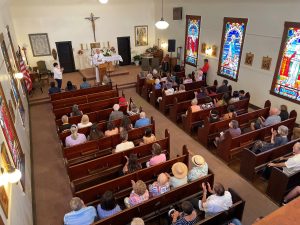
Former worshipers reunited at the chapel of St. Isidore Saturday to watch the unveiling of a bronze plaque that signifies its inclusion on the National Park Service’s National Register of Historic Places.

Tears flowed as freely then as they apparently did in 1999, at the last Catholic Mass ever said in this former church.

“I’m excited because so many people worked so hard,” said former mayor and local historian Marilyn Poe. “I get emotional about it,” said Poe, thinking about the two decades struggle to preserve the chapel, purchase the property and preserve the “last original community building in the city.”

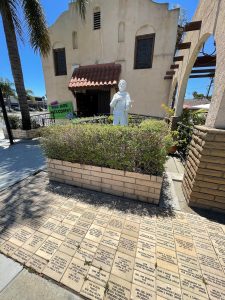
St. Isidore chapel, located on the grounds of the St. Isidore Historical Plaza in Los Alamitos.
dnyphoto

The tiny chapel still stands proudly at the corner of Reagan Street and Katella Ave. It has survived earthquakes, been closed twice, and emerged from a financial squeeze, yet the large group involved in its long rescue gathered to celebrate this new designation.

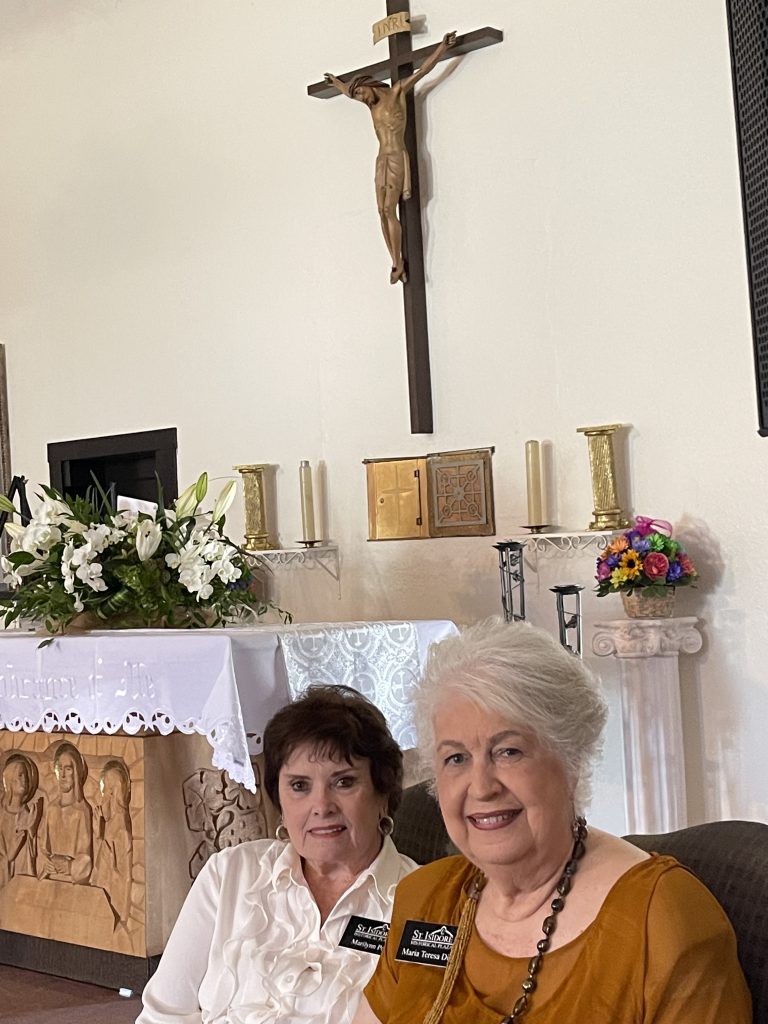
Shortly before the official ceremony, Poe, along with Rossmoor resident Maria Teresa Diaz, a retired singer, recounted their long fight to save the structure.

Diaz, who said escaped Communist Cuba to come to America, emotionally reminisced about how she and Poe faced down Catholic bishops, Poe revealing the advice of a banker that made the difference.

Poe was the elected Mayor of Los Alamitos when the Catholic diocese announced plans to close and deconsecrate the former Catholic Church.

Diaz, then heavily involved in St. Isidore, along with Pedro Brucoup, then the Chairman of the church committee, were stunned and did not know what to do, so they called the mayor. Pedro spoke Spanish, Poe spoke English and Maria was the translator.

Poe remembers it well. “It was more than a quarter-century ago,” said Poe, “when I was asked to get involved.” Many people thought she was “crazy,” said Poe, as the former mayor agreed to help. “I am not even a Catholic,” quipped Poe.

“We became fast friends,” said Poe, holding up two touching fingers on one hand, and holding Diaz with the other, saying “and we’ve been like this ever since.”
Poe said they had no blueprint in 1999.

“For me, it was personal,” said Diaz, whose emotions easily succumbs to tears as this devout Catholic remembers their struggle to save the St. Isidore Chapel.

In 1905, there were only 500 residents in Los Alamitos. Like many emerging communities in Orange County, Los Alamitos was rural and agriculture based. By 1920, a large sugar beet processing facility attracted new residents and produced a vibrant community.

There was no Catholic Church for the largely Catholic, Latino population.

“In the early 1900s, the Catholic contingent was meeting at either the Hormona Hotel or at the Scott’s Bros. grocery store, or wherever anyone would let them meet,” said Poe.
In 1922, Poe said a man named Michael Reagan stepped up. He was Irish Catholic, she said, “and the only one that had a phone in town.”

Reagan got the group of Catholic parishioners together, said Poe. He told them they should approach the town’s key developer, the Bixby Land Company, and ask for a property on which to build a church.

According to Poe, in 1924, the Bixby Land Company ultimately agreed to deed them two vacant lots for the church, where the St. Isidore Historical Plaza now stands, asking only for the group to pay a sale recording fee of $10.

According to historical information, the Archdiocese of Los Angeles agreed to establish a Catholic Parish, naming it after St. Isidore, the patron Saint of farming.

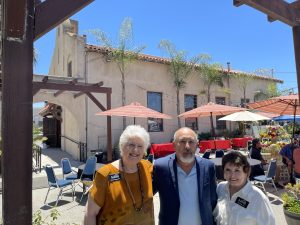
L-R Maria, Pedro and Marilyn stand in front of St. Isidore and celebrate mission accomplished after more than 20 years of effort.
dnyphoto

St. Isidore of Seville was born in Seville, Spain in 560 and died April 4, 630, according to Catholic records. He was a theologian and was the last of the Western Latin Fathers. Among St. Isidore’s more famous works is “Etymologies,” an encyclopedia of human and divine subjects.

According to the Archdiocese, when the St. Isidore Parish was formed, it consisted mostly of Belgian farmers, Irish guild members, Dutch and Portuguese dairymen, Mexican ranch hands, and sugar beet factory employees.

Hardy residents got to work building a church and after the construction of St. Isidore Catholic Church was complete, the parish began offering masses in March of 1926.

Father Miguel Santacane became St. Isidore’s first priest. Back then, St. Isidore was only the 5th Catholic Church constructed in Orange County.

Only seven years later, however, on May 10, 1933, parishioners faced a major setback, said Poe. The Long Beach earthquake destroyed the church, including its choir loft. The disaster left parishioners shaken, but not defeated.

Kelly Sutherlin McLeod, a Long Beach architect who specializes in historical preservation, said Saturday said, “the Long Beach earthquake caused severe damage to the seven-year-old building.”

Long time worshipers gather for dedication of the chapel onto the National Registry of Historic Places.
dnyphoto

Nonetheless, McLeod said women in the parish began to sell tamales to raise money for repairs. The Archdiocese of Los Angeles donated money for the reconstruction. Within three months of the earthquake, the community successfully rebuilt the church.

McLeod said it is the property’s rich heritage, the diverse history that gives it the special significance required to “meet the criteria” of the National Park Service.

“The property is associated with the early development of Los Alamitos as an agricultural community organized around a large sugar beet processing facility and a Latino community, including Mexican immigrants,” said McLeod.

St. Isidore “derives its primary significance as a religious property for its association with Latino ethnic heritage as well as the community development of Los Alamitos,” she said.

“Many community members collectively designed and built the church themselves,” said McLeod.

Poe said McLeod’s firm has guided St. Isidore Historical Plaza through the entire journey to becoming listed on the National Register of Historic Places.

Records indicate St. Isidore was a thriving church community from 1926 until 1960. St. Isidore was now in the Diocese of Orange but was shut down after St. Hedwig’s was constructed on Los Al Boulevard.

Only a decade later, however, due to the strong Latino contingent at St. Isidore, diocesan officials reopened St. Isidore in 1972 for Spanish language masses, and parishioners like Diaz were ecstatic.

Diaz, who had moved to Rossmoor in 1975 after escaping Castro’s Cuba, said on Saturday that, at that time, she was looking for a place to worship in her native language of Spanish.
“I was looking for a mass in Spanish and somebody told me there is one here (St. Isidore),” said Diaz. She came, said Diez, bringing her entire family, and said the church had become a big part of her life.

“I was a very big part of this church because I was the singer,” she said, “I was the soloist of the choir for many, many years,” said Diaz. “We had a Bible study here and I was very involved in that,” said Diaz.

The former singer’s soul was so centered in St. Isidore, she said, that when she tragically lost her 23-year-old son, Gustavo Diaz III, she insisted his service be held at the tiny chapel, reflecting how much it means for her to save this former church.

“All the people that have died in my family have had their goodbyes here,” said Diaz, “including my child. It was here,” she says proudly. “And I sang the whole mass. Yeah, and that is something that you just never forget. Gustavo, the third.”

Diaz said it didn’t matter that the funeral was packed in tiny St. Isidore’s chapel. Mourners were out the door onto Reagan Street, she said.

“The place was so full that they had to be outside. But I wanted it here. And I sang for the whole Mass. I did. Yes. I had the strength to do that,” said Diaz.

Diaz vividly remembers when, In 1999, crowds gathered and tears flowed as the parishioners celebrated what they knew was the last Mass their beloved church would ever see. The diocese had finally decided to close St. Isidore for good.

“I sang for the last Mass before they closed it,” said Diaz. “I was the singer there in front while I was crying. I mean, there was not a dry eye…no place, everybody was crying,” she said, “everybody.”

Diaz said that’s when they turned to Poe for help.

Poe picks up the story, saying St. Isidore Chapel “was the last remaining building of the original Main Street, so I was eager to help,” said Poe. “Our first goal was to get the diocese to keep it as a Catholic church.”

So they traveled to the Diocese to negotiate with Bishop Jaime Soto. After the first meeting, they knew the days of St. Isidore as a Catholic Church were over for good.

“After our first meeting with the diocese,” said Poe, “we knew that was not going to happen.”

Nevertheless, the two ladies, and their committee, committed to try and save the building, thus beginning a challenging journey that ended Saturday with the official U.S. historic designation.

“Our goal number two was to save the property,” said Poe. They began to investigate how to save the property and they learned they would have to own it to save and preserve it.
In 2000, they formed the Committee of Love, which became St. Isidore Historical Plaza, and voted to begin the work required to preserve the site. Although the St. Isidore Historical Plaza includes lots and buildings where the parish rectory once stood, only the chapel itself is considered historic, Poe said.

In 2001, they received their nonprofit designation and from 2005-2008, they worked on a business plan for the site.

In the meantime, Poe said a friendly banker whispered advice in her ear about how to maintain the property until they could afford to buy it. “He suggested offering the church to maintain the upkeep and paying them $500 per month until we could buy it,” said Poe.

Surprisingly, she said, the Catholic Diocese accepted the proposal. In 2009, they created the St. Isidore Historical Plaza brand and in 2010, formed a membership campaign. In 2012, the Los Al Museum recognized the building as the oldest remaining community building in the city.

They were gaining momentum.

By 2013, Diaz wrote a letter to Pope Francis I, which not only reached the Vatican but also, they believed played a divine role in the outcome. Diaz’ prayer must have been answered as the Diocese reversed course, said Poe, and agreed to sell the property in 2014.
With ownership of St. Isidore Historical Plaza, the group quickly began work to preserve it.

In 2018, the group hired McLeod’s architecture company to assist them and proceeded to seek the National Register of Historic Places designation that was celebrated on Saturday.

In 2019, while they sought the designation, Poe said the organization began to utilize the historical plaza and buildings for community meetings. She said St. Isidore is still paying a remaining mortgage on the property, using proceeds from site rentals, functions, fundraising and other events to pay the notes.

While the committee has achieved federal and state recognition, said Poe, there is much more to be done. She said restoration of each of the structure’s eight stained glass windows must be restored at a cost of $8000 each.

So far, said Poe, only one of the eight has been fully restored. Nevertheless, Poe said for her and Diaz, Saturday’s realization is a “dream come true.”

Los Alamitos Mayor Tanya Doby offered the SIHS congratulations, presenting a proclamation to Poe and David Ochoa, representing Sen. Thomas Umberg, saying “we love seeing parts of our history and our culture being preserved.”

The church has long been stripped of its relics, rails and other Catholic symbols that were removed after the church was de-consecrated. For Diaz, Poe, Pedro and the rest, it doesn’t matter. They’ve already built a new altar, restored the bell and choir loft, and for many, it will always remain St. Isidore.

“I’m excited because so many people worked so hard. I get emotional. They’re just wonderful. And we finally got the community to get behind us,” the former mayor said.

“A lot of people first said, oh, Marilyn, you’re crazy, why are you getting involved with that? But I think that’s extremely important. And everyone that’s been involved with this … some people have been here for a long time, some for a short time, but everybody has given their heart to it. So that’s what makes me excited,” she said.

For Diaz, too, the was emotional. Having within the walls of this tiny chapel having experienced both life and death, joy and heartbreak, she was overcome with joy at what they had achieved.

For Diaz, the event was moving and monumental. Even though the St. Isidore chapel had been deconsecrated, stripped of its railings, relics and gold, her heart will be in this place until her end.

“I go to the other churches,” said Diaz. “I go because I know that is where I get communion and all that, but this,” she said, “will be my church until I die.”

For more information, visit stisidorehistoricalplaza.org.


Los Al Unified implements solar strategy on campuses

The large metal structures started appearing on campuses just days after schools let out earlier this month.

Solar panel systems are currently being built at the Los Alamitos Unified School district’s six elementary schools, two middle schools and district office and will soon be constructed at Los Alamitos High School.

A revised design for the panels at LAHS was on the June 28 Board of Education meeting agenda. (The Event-News Enterprise publication deadline was prior to the meeting.) The design for the high school campus solar panel project was reworked based on community feedback, which was gathered at every site through meetings, according to C.J. Knowland, Director of Facilities, Maintenance, Operations, and Transportation for the district.

First approved in 2020, The solar panel project could translate to between $11-$17 million in savings over the next 30 years, according to the district. The installation will help cut power costs and also provide shade in parking lots and on campuses.

“That was one of the main things we discussed for the sites to figure out the locations that will provide the most benefit,” Knowland said in a phone interview this week.

He said that while the solar panel structures will likely be built before the school year resumes in August at the elementary and middle schools, they won’t start generating energy until weeks after school starts. Once up and running, Knowland said the structures will provide between up to 70% of the district’s electricity.

Cypress celebrates first-ever ‘Pride and Diversity’ community picnic

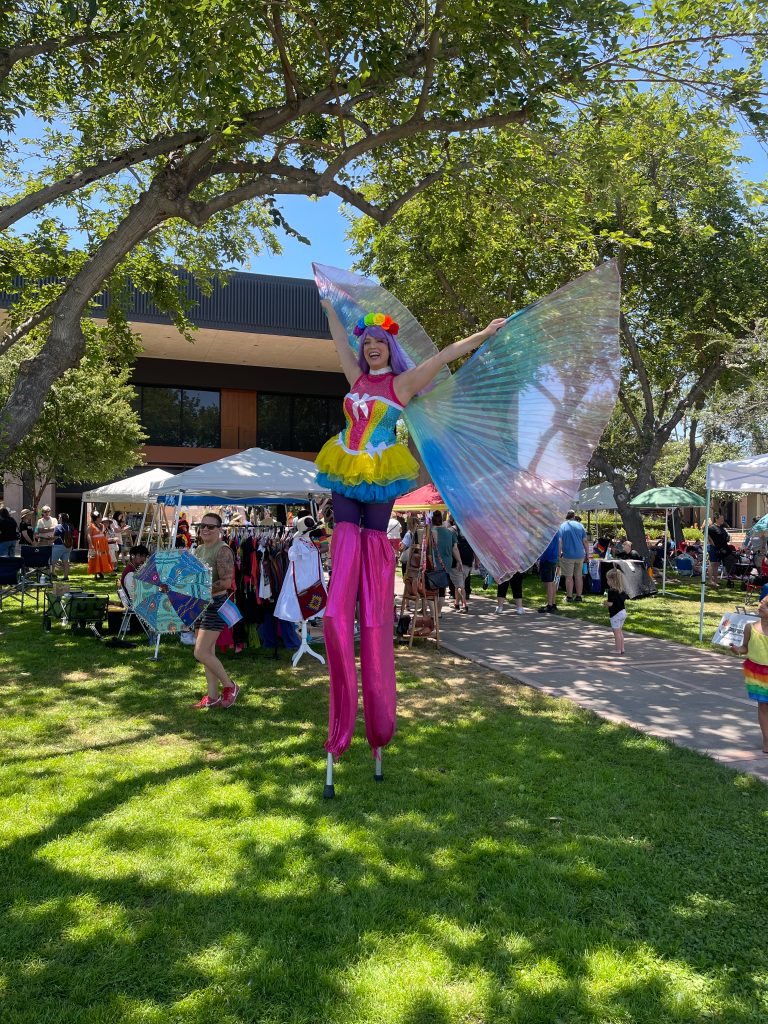
Organizers say the first-ever “Pride and Diversity” community-sponsored picnic was held Sunday on the Civic Center lawn bringing a rainbow of hope for Cypress residents longing to see the city’s diversity efforts materialized.

Inspired by the city’s May 9th proclamation in support of diversity and inclusion, residents amplified the council’s call to action by organizing the city’s first annual pride and diversity picnic.

“We might have started the most important movement in Cypress,” said event organizer Maria Campos-Krekos, in response to the positive ripple effect this event will bring towards future inclusionary efforts.

Citizens of all races, gender, colors, religions, sexes, ages, neurotypes and cultures were welcomed with open arms as the first public pride attendees. Despite being uncharted territory for the city, the picnic’s positive turnout and feedback reaffirm the demand for a more inclusive Cypress.

As residents enjoyed an afternoon of live music, food trucks, guest speakers, and family activities, the harmonious atmosphere created a safe space for attendees to listen, learn, and show support for marginalized groups.

Support booths including those representing neurodivergent, immigrant and LGBTQ+ groups bordered the civic lawn walkway offering free resources and education for anyone of interest.

Inclusive organizations from surrounding cities such as The Community Congregational United Church of Christ were also among the several booths stationed at the event.
Church organizations are one of the many institutions known to polarize diverse communities in the Orange County area, specifically members of LGBTQ+ groups.

Pastor Sam Pullen of the CCUCC, Los Alamitos’ “open and affirming” church, hopes people in the Cypress community know that his organization “offers a safe and welcoming place for people who have been rejected.”

Meanwhile, although the city is largely conservative, Carolyn Balagot believes Cypress has greater space for diversity than it alludes to.

“Our community is much more diverse than it appears,” said Balagot, who along with Campos-Krekos took the initiative to serve as event coordinator for the monumental occasion.

“And obviously we were right, because look at all the people that are here,” said Balagot, claiming the event quickly “snowballed” after being advertised on the city’s community forum.

Residents on social media were swift to show support, offering to bring items such as tables, chairs, and power cords to the community-run event.

Councilmember Scott Minikus–whose term will be up for the November 2022 election–also volunteered to help with community effort by donating funds for bouncy houses and Civic Center permits.

Amid the exponential growth in tension between Council members and residents, flyers for the event prompted attendees to only come with the agenda of an “open heart”, suggesting all matters of concern to be left away from the event’s positive energy.

(Cypress’ first Pride & Diversity Picnic flyer, advertised on Cypress Community Group Facebook page on Friday, June 10, 2022.)

Fortunately, it seemed everyone in attendance adhered to the sunshine and rainbows only policy— event organizers reported they were delightfully “surprised” to see no outside protesters.

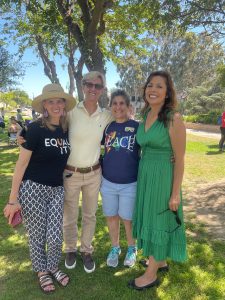
Councilmember Frances Marquez affirmed this, describing the event as a “loving day” while she engaged with citizens, parents and members of Cypress’ youth.

With the exception of Councilmember Jon Peat, Marquez was joined by the rest of Cypress council leaders to show the diverse community’s support.

Councilwoman Frances Marquez with residents at the Cypress Pride and Diversity Picnic.
Photo by Macy Meinhardt

Given three weeks to coordinate the entire event Campos-Krekos beamed with pride as she watched the blossoming event from a distance.

“I don’t know how we [Balagot and I] did it,” Campos-Krekos humbly remarked.
It takes a village indeed and based on feedback it seems that the city’s first annual Pride and Diversity Picnic only has room to grow from here.

“We’ve had a lot of people come up to us and say they want to be involved next time community involvement and participation, we’re excited,” said Balagot.
Until next summer, Campos-Krekos offers advice on how the community can community to support its diverse members.

“The community can start by listening. By sitting side by side with each other. By asking community members what can be changed for the better. By taking diversity training. Our goal is for all community members to feel seen and safe. Everyone.”

Adam Pascal shines as leading man in “Pretty Woman” at Segerstrom

A “Pretty Woman Walking Down the Street” is headed to the Segerstrom Center for the Arts. The musical “Pretty Woman,” based on the iconic 1990 movie of the same name is playing in Segerstrom Hall, July 5 -17.

Adam Pascal and Olivia Valli star in “Pretty Woman” now playing at Segerstrom Center for the Arts.
Photo by Matthew Murphy for MurphyMade.

Once upon a time in the 1980s, a boy meets a girl. This pretty much sums up the plot of “Pretty Woman.” The Rom/Com musical replicates the 1990 blockbuster film in style, story, and smoldering emotion. The girl is a hooker with a heart of gold; the boy is a wealthy entrepreneur who hires her as an escort for professional purposes. It’s a Cinderella fairytale in which star-crossed lovers following their hearts, change their lives.

Audiences will fall in love all over again with “Pretty Woman” and its stars Oliva Valli, playful and charming in the role of Vivian Ward and Adam Pascal whose lush musical tone compliments his role as Edward Lewis. The pair radiates star power, the choreography is lively, and the large ensemble is exciting.

Adam Pascal’s claim to Broadway fame was his breakout role as Roger in “Rent.” This led to a long career in theater, and television through he has a background based on making music. Pascal, a musician and actor, believes his greatest strength is his singing voice. He says “That’s what has been the dominant aspect of my career and what I’m known for. To a certain degree, I think it’s my voice that is so well suited to this Musical. The music definitely sits in my sweet spot. If there’s anything in particular that makes me uniquely cut out for this role, then it would be my voice.”

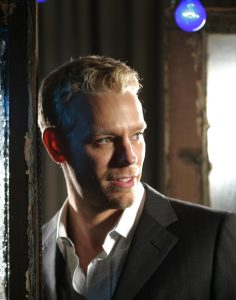
Adam Pascal starts in “Pretty Woman.”
Photo by Matthew Murphy for MurphyMade.

“Pretty Woman” Director and Choreographer Jerry Mitchell agreed, saying “Pascal’s voice is an incredible match to the romantic rock score. Bryan Adams score has a feel of late ’80’s and early ‘90’s rock which makes Adam Pascal pitch perfect for the part.”
Pascal was drawn to “Pretty Woman” because in his words, “The musical is a really beautiful, classic love story. I found that appealing. Obliviously, the film was a huge success, so it gave me an opportunity to play a character known from films and to do something different to make it my own.”

And yes, Pascal puts his own spin on the role of Edward Lewis, well-heeled businessman. He says “to be honest, I’m not the type of actor who grew up traditionally trained so my approach to playing Edward is a little different. So, to be Edward, I put on the costume and just become the guy. I don’t consciously step on a stage and think I’m a different person. I see the characters as people who exist within their own circumstances, and I insert myself into those circumstances. I put on the clothes/costumes and become them. It makes me honest and genuine in my part and into relating to my fellow characters.”

Pascal, the musician, doesn’t usually dress in high-end men’s wear but says “It’s great even though I’m not someone who usually wears suits. Actually, I try to avoid them in my personal life, so it took a little getting used to. The suits I wear in the show are props in and of themselves. I’m constantly fussing with clothes, taking jackets and ties off or rolling up the sleeves. Dressing in these suits has meaning and purpose. They are not just costumes; they are very important in revealing who Edward is.”

Rising star Oliva Villi plays opposite Pascal. As Vivian Ward, she is a charming, charismatic ‘lady of the night.’ The two stars shine bright separately and together as romantic leads the chemistry works. The sparks ignite between debonair, conventional Edward and the pretty prostitute, Vivian.

Pascal says “Olivia and I couldn’t have a better friendship and the chemistry is there. This is what makes this production so successful. We have become good friends, we have such a good time and we take that to the stage with us. Olivia and I have found something special with each other. That really sets the tone for the show.”

Amma Osei and The Company of Pretty Women.
Photo by Matthew Murphy for MurphyMade.

In Pretty Woman the entire show, script, setting, and costumes are reminiscent of the film. Expect to hum along to Roy Orbison’s “Pretty Woman,” because that is the only tune in the musical that was on the films soundtrack. The musicals’ songs are all new, all cool. Pascal explains “The movie was very 80’s specific so it wasn’t necessary to change place or setting. It belongs in the era in which it was created.”

He continues “Music works differently in musicals. In the movie the songs are there for atmospheric purposes and to set the tone, they don’t move the story along. Bryan Adams and Jim Valance wrote “Pretty Woman’s” songs in a specifically narrative way to tell the story, move it forward and to address specific moments.”

One of those very specific moments is the Opera scene; a favorite of Pascal’s which he describes as the “Wow” instant in “Pretty Woman.” He says “the scene in which Edward takes Vivian to the Opera to see La Traviata is so expertly crafted that it is the highlight of the show. Within the scene is a song called ‘You & I’ that Edward sings to Vivian while the Opera is going on. It’s interspersed into the actual opera itself and it segues in and out of the song that I’m singing.”

Love and Fairytale fun are the keys to why audiences are giving standing ovations to a girl in the world’s oldest profession and a boy who just wants to make a buck. It balances a fine line between prostitute and woman needing saving, as Happy Man sings “Damsel in distress or hero on a quest? You decide.”

‘The classic Fairytale love story doesn’t need a message,” says Pascal, it’s just about audiences laughing with pleasure. It’s a wonderful night of entertainment for fans of musical theater and its familiar fun for fans of the movie. People are ready to get back to the theater and just be normal.”

Fall in love all over again, “Pretty Woman” is at the Segerstrom Center for the Arts July 5 -17. For tickets, go online to SCFTA.org or call 714-556-2787. Box Office (600 Town Center Dr., Costa Mesa) Hours: Monday 10 a.m. to 2 p.m.; Tuesday through Friday, Noon to 5p.m. Closed Saturday and Sunday.

Rossmoor / Los Alamitos Library awards scholarships

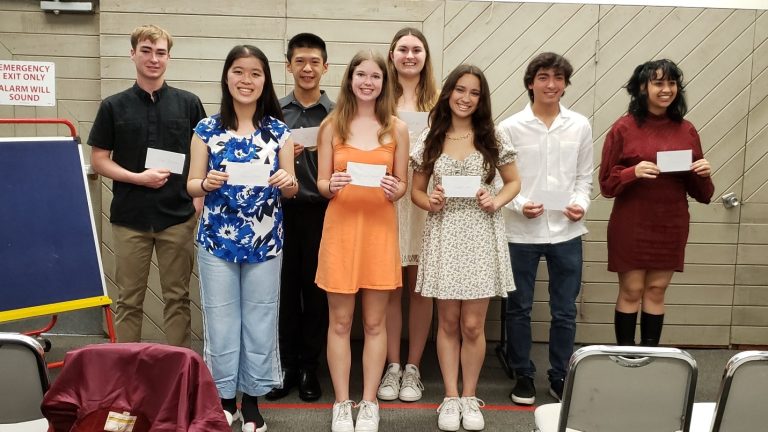
At the recent 2022-23 board installation, the board members of the Friends of the Los Alamitos-Rossmoor Library presented scholarship checks to eight outstanding Los Alamitos High School seniors. Pictured here are 2022 Friends of the Los Alamitos/Rossmoor Scholarship Recipients – Luke Goldade, Marina Zhao, Cody Tran, Fiona O’Farrell, Camille Harding, Kendall Villa, Diego Oliva, Andrea Murillo. The scholarships were for $1,000. The program is called the Los Alamitos-Rossmoor Friends of the Library Scholarship Program. The criteria for selection included the student’s activities and achievements and, in part, how libraries have assisted them in meeting their goals, said a library spokesperson.

Cash flow strategist to speak to Cypress Chamber July 12

The Cypress Chamber of Commerce will host George Brumis, a cash flow consultant with strategies to help businesses keep more of your hard-earned money, as our guest speaker at our July Networking Breakfast. Our breakfast event will be held Tuesday, July 12th at the Residence Inn by Marriott at 4931 Katella Avenue, Cypress/Los Alamitos starting at 7:30 a.m. An award-winning advertising copywriter by trade, and business development/pitch specialist, George Brumis has turned his focus in recent years to government programs and business strategies that are available to business owners to increase cash flow and decrease taxes.

George has been featured on Podcasts, has been a speaker at other area Chambers, and is the president of his BNI networking group.

Trained in Cost Segregation, the Research & Development Tax Credit, and the Employee Retention Credit (ERC), George will provide an overview of these valuable strategies/programs and explain who can qualify for them and how to get started. Armed with this information, he’ll share how to get back the money and savings we are entitled to through the federal and state government.

During the networking portion, each attendee will also have an opportunity to stand and introduce themselves and share a little about their business before the program begins.
Reservations are highly recommended to secure your spot for the monthly breakfasts and can be made here. Cost of the breakfast is $25.00. Early Bird Registration is $20.00.

Attendees are also encouraged to bring door prizes to promote their product or service. The program will include time for networking, self-introductions, breakfast, our speaker’s presentation and a Q & A session if time permits.

The Chamber breakfasts, which are open to the public, are held on the second Tuesday of every month. Space will be limited. To assure your seat, pre-register on the chamber website: cypresschamber.org.

Can Kindness Reunite America? Part II by Jessica Yang

For readers who may have not seen last week’s edition of the ENE, we are featuring for the next two weeks, essays written by high school students in which they assert how “kindness” can reunite America.

Given the incidents of the past week, the task of reunification seems a world away from where it was just last week. America’s growing political divide just seemingly gets worse.
Last week, Audrey Vinci made her case about how good Samaritans and acts of kindness can perhaps usher in new meaning and understanding among neighbors and fellow citizens.

This week, Jessica Yang explores a pandemic-fueled “empathy deficit” and how kindness is “always available for people willing to see it.”

As interesting as we may think the thoughts of these high school girls, should we not ponder what it says about us as a human race when girls yet old enough to drive cite “open warfare” among Americans and families “driven apart by political ideologies?”

Perhaps there are many ways to interpret such understanding at this tender age. Either it has been “normalized” and younger Americas are imprisoned to live in an age of rage, or, perhaps that they recognize it so early they will dedicate their lives to creating a different reality.

So, it is critically important, I think, that we listen closely to students; young people, who are living through an information explosion the likes of which could never have been pondered centuries ago.

The human experience is changing exponentially, while the various ecosystems, at all levels, that make up our worlds are seemingly unable to keep up. Thus, the many conflicts, and more sadly likely to come.

In listening to the voices of tomorrow, we can perhaps find hope for today. This week, Jessica Yang makes her case for the flexibility of normalcy and how kindness begins with us all.

Normalcy is flexible
Kindness starts with you

By Jessica Yang

It has been a roller coaster of a year, 3 years, wait when did the pandemic start. Between Corona, murder hornets, the world being on fire then not being on fire, and then being on fire again. I’ve begun to wonder if the Maya calendar got the date wrong on the end of the world, perhaps instead of 2012 they meant 2021.

But as a new year dawns and hope begins to emerge, I am left with one burning question. How can kindness reunite this country? Listen, when we can more easily flame people on Twitter than we can flame grill our own dinner (and we turn to Grubhub for BOTH problems) or we forget how to shake someone else’s hand? How do you smile underneath a mask? How much hand sanitizer is too much hand sanitizer? You know we have a problem.

The point is, during the pandemic between baking bread and checking the news, a phenomenon has emerged where we lost the ability to connect with other humans and at worst, the ability to empathize. We’ve forgotten how to be nice to each other.

Yes, the isolation away from awkward but polite coffee shop lines made us forget what our kindergarten teachers instilled into us so long ago; if you don’t have anything nice to say, don’t say it. So today, we’re going back to kindergarten and sharing how this problem evolved, next we’re going to take a buddy to the effects on our world, and finally hug it out in the most covid safe way possible to a few solutions.
So one of the first lessons you learn in kindergarten is that sharing is caring. So let’s first share the problem and cause of how the snick snack, frick frack did we get here and second, what the heckalrooney is an empathy deficit?

Well, first, when that fateful March came marching along into our lives, we had to come to a standstill as people were encouraged to stay in their homes. The Scientific American describes our decreased social interaction as incapable of fulfilling the quota for human empathy. The COVID-19 pandemic, tumultuous economics, the recent election, misinformation, horrifying accounts of racism, and overall general unrest that plagues our lives nowadays puts a lot of strain on peoples’ squishy brains.
Dr. Kristin Neff, helps explain why: The problem is that when we’re in the presence of suffering, or we see it on TV, or while scrolling down your Instagram feed, we feel it. It’s comparable to a sponge. If you soak up too much, you can overwhelm yourself, and suddenly you can’t take anymore.

As COVID-19 spread, researchers found that people were experiencing worse mental health problems than before the pandemic—high symptoms of stress, anxiety, depression, and post-traumatic stress disorder (PTSD). Up to half showed serious signs of depression, while up to 35 percent showed serious anxiety. Between dealing with burnout and self-isolation for the past few years during the pandemic, some people may struggle to have empathy for others while we continue to be in survival mode. But empathy is incredibly important to continue to have, both for ourselves and others.

So now that we know what an empathy deficit is, grab your buddy and let’s talk about some of the effects that the lack of kindness has had on society. This whole situation has made us forget how to be nice to each other. We’ve forgotten that every other person we encounter on the streets is stuck in the same world we’re all in and while we have to live with each other, it is the least we can do to just…be nice. Kindness has always been there. Kindness is always prevalent, through those in Berlin offering a bed, food, and a roof over people fleeing from the war in Ukraine.

Kindness is always prevalent, through extra hours made by kindergarten teachers so that even over zoom, class can be engaging. Kindness is always prevalent, through the eyes of someone willing to see it. It is there. And sometimes, it’s okay to look on the bright side. I understand we can’t really hug each other right now, as social distance is still very much a thing to keep us all safe, let’s look at some solutions that give us the same comfort we need.

So how do we fix this? How do we get rid of this empathy deficit and fix our country so we’re going to be better, brighter, and more empathetic towards each other? How are we going to whisk away the oodles and oodles of apathy that leaks out of the crevices of our society nowadays? I’m so very glad you asked!
The answer is, we’re not going to. That’s impossible.
You can’t force people to be nice, you can’t shove empathy down someone’s throat. It’s a learned skill, and can be forgotten as well. It’s simply far too much for a single person, even a small group of people, to take onto them. Like previously, I mentioned how your brain is a sponge for all things. You’ll overwhelm yourself, and then where would we be?

Back to square one. Apathetic and hopeless. Instead of trying to hold up the world, let’s see how we can integrate kindness, empathy, and respect into your own life, in the hopes we can achieve something smaller, in the communities around us.

A 2014 study from Stanford University finds that empathy is not a fixed point we can all achieve. But there are ways we can all empathize. First, actively listen, more than you speak. An empathetic person listens first; and only speaks after they’ve carefully heard.

‘Next, be vulnerable. We fear vulnerability because we worry that others may perceive us as foolish or weak. Brené Brown—a brilliant woman at the forefront of vulnerability research—says that vulnerability actually helps us connect with others.

Finally, learning to respect other peoples’ differences. While we do not need to like everyone or pay homage to people just because they are in a position of power, we should try to be respectful. Its due regard for the feelings, wishes, rights, or traditions of others that is true respect.

So basic human kindness is not something we’re allowed to take away or rescind if someone doesn’t agree on your opinions about your favorite anime character.
The second you claim you’ve lost that respect for someone is the second you don’t see them as an equal, another human, and that is the most dangerous thing humanity can do.

So while we can’t solve discrimination, create laws, or achieve world peace in ten minutes, we can find simple ways to integrate kindness, empathy and respect into our own lives. Because at the end of the day, you’re the only one who can change how you treat other folks. It has to start with you.

So today we went back to kindergarten. We shared some problems, grabbed a friend for the effect, and hugged our way to a few solutions. Today, we remembered the lessons that our teachers oh so long ago in a non-pandemic age taught us, and we’re applying it now, and in the future.

Normalcy is flexible. We will always change and fluctuate with this world. What shouldn’t change is how we continue to love, appreciate, and care for the people around us. You’re here, and now it’s your turn to do your part and just be nice to people. That’s it. Simple, cliche, cheesy– but still, it’s the best we can do.

Rotary honors several groups with grants

For more than 30 years, Precious Life Shelter has been accepting homeless pregnant women needing emergency housing in a safe environment. No state or federal funding is provided to the program.

Ladies accepted have rules and chores to file. Onsite licensed childcare is available. The women may stay up to two years after the birth of their child.

LAEF provides enrichment and educational opportunities throughout the year for students of Los Alamitos Unified School District. Recently they have been focusing on providing a Well Space at intermediate and high schools to support the emotional and mental health of students. They also provide five world language classes for free for elementary students.
The High School Foundation has been providing scholarships for two decades to graduating football players who otherwise may not be able to continue their education goals after graduation.

Courtesy Photo
Pictured, l-r, Sadie Sacks, Moms of OC; Theresa Murphy, Precious Life Shelter; Carrie Logue from LAEF and Bob Dominguez, Rotary President, Moms of OC serves pregnant women in need of medical assistance or help with domestic violence and assistance during childbirth. Their community outreach includes a fathering class and home visits for the women.

CASA provides emergency shelter for youth in the area that are in need of temporary Housing Counseling and mental health support is also available. The goal is reuniting these youngsters with their families and further support.
The Youth Center provides a safe, educational environment for youth after school and during the summer. The focus is currently a new facility on Los Alamitos Blvd. to provide field trips and summer programs.

Grateful Hearts serves the region by providing food, medicine, furniture and personal items for those in need; The jobless, working poor, disabled, elderly and veterans in crisis are welcome. In the first quarter this year, they served 12,000 meals.

Courtesy Photo
Pictured, l-r, Blair Pietrini, Grateful Hearts; Elizabeth Rubio, We Care and Bob Dominguez, Rotary Club President.

We Care is another agency helping between 20 and 30 families each week, meeting emergency needs of individuals with rental assistance, utility payments, therapy service, food and personal care items. Food Finders gathers surplus food and distributes it to local non-profit organizations that supply meals and groceries to those in need. The group provides food to support thousands of food insecure individuals every week.

Heart of the City also provides food and cheese to the hungry, and clothing, early mornings every 2nd and 3rd

Courtesy photo
Pictured, l-r, Lisa Hoffmaster, Food Finders; Dave Barnes, Heart of the City; Amy Payne, Summer Harvest and Bob Dominquez, Rotary President.

Saturday at the St. Isidore Plaza on Reagan Street and Katella Avenue.
And Summer Harvest provides lunches through local schools during the summer and school breaks. The quality food is offered at low or no cost. The group also provides school supplies and backpacks fof students in need at the start of each school year.

Los Al artist Francesca Brayton honored with display at John Wayne Airport

Francesca Brayton, a Los Alamitos artist has been honored with a personal display of her watercolor work at John Wayne Airport in Orange County.

According Brayton, “my watercolor paintings are derived from sketching on location and using photos I take to add additional details. I travel to Hawaii and Mexico yearly, and elsewhere, creating paintings reflecting my experiences there.”

“I enjoy the designing aspect of painting while filling dozens of sketchbooks with various themes. I sometimes use a border design to add related elements. Often I will add black ink lines over a painting for an impressionistic feel. Bright exaggerated color, line, and patterning are the signature features of my work,” she said.

In an email statement, Brayton said “I use quirky color combinations as in the Paradise Sealife painting series. Being of Hispanic heritage, I sometimes title paintings in Spanish and include Mexican tile patterns. I like painting local Southern California scenes with exaggerated color.”

She said spring is her favorite time of year “when everything has gone wild blooming. I always paint during the various holidays including their iconic symbols. I do love painting doggy portraits and including dogs in scenes. I painted 150 dogs during the pandemic year 2020,” she said.

For more info, www.francescabrayton.com. Contact: fr**************@***il.com.

Cypress resident asks authorities to take harrassment seriously

A woman who has repeatedly expressed opinions and later, signed on to a voting rights complaint against the city of Cypress said this week that she feels the city is not taking harassment against her seriously.

Cypress resident Katie Shapiro forwarded her email correspondence from city officials this week, suggesting with screenshots from harassing emails she claims were from a Cypress city employee, yet officers told her and a witness that it would have been “impossible” for a city employee to have done it.

Only after repeated attempts to have the city respond, including speaking directly to city manager Peter Grant during oral communications periods of city meetings, a series of emails, and two visits to the city’s police department, Katie Shapiro said the city has responded.

Further, Shapiro said City Manager Peter Grant sent a dismissive response only after being nudged by two emails from Mayor Pro-tem Anne Hertz Mallari.

Shapiro shared text messages from a self-identified “city employee” that she received on May 9, harassing her for speaking out at city council meetings regarding the trash contract.
The text message, which was delivered to her personal phone, suggested “city employees ignore” Shapiro and other “activists” in the city because they are “dishonest and lack integrity.”

When Shapiro inquired about the name, the texter said only, “I’m a city employee.” They also decline to give their name, saying “like I’m going to tell someone who publicly states me and my co-workers are corrupt.”
Shapiro says she has questioned the Council but has never accused anyone specifically of being “corrupt.”

Shapiro said she and Dr. Malini Nagpal visited the Cypress Police Station shortly thereafter seeking an investigation of the potential harassment from a city employee. She said officers told her it was simply “impossible” for city employees to have done that because they knew all of them.

Nevertheless, Shapiro said she still requests an investigation.

After a few days went by without hearing from Cypress Police, Shapiro said she went, this time asking to see Chief Mark Lauderback. “I was told to go through the chain of command,” she said.

The ENE has reached out to Cypress Police to confirm her meeting with the officers and we have requested a statement on the progress of the investigation itself. At press time, we had not received a response.

Screenshot courtesy of Katie Shapiro.

Frustrated by the lack of action, on June 3, Shapiro sent an email to the Mayor, Council, Police Chief and City Manager asking for help.

Only after Hertz-Mallari returned from vacation and again reached out, copying Grant and asking Shapiro if she’d heard from him, did the city manager finally respond.

“This email is a follow-up to your recent communications with Mayor Pro Tem Hertz in which you state a city employee ‘actively sought out my personal information with the intention to threaten and intimidate,’” responds Grant.

“I confirmed Cypress PD was investigating your report(s) and that any evidence a city employee was involved would be forwarded to me and our Human Resources team. Beyond that, city management does not intervene in PD investigations,” said Grant.

He told Shapiro that “If our PD finds evidence an employee is involved in the matter you reported, the city will conduct an administrative investigation (in addition to PD’s investigation) and respond appropriately.”

“If you would like to file a complaint with my office about the “‘self-identified’ city employee,” please provide all communications you have had with this person, including all information the city may use to identify them,” said Grant.

You would think the city is in a better position to identify a city employee than the recipient of a text message, Shapiro said.

She said Grant’s response “doesn’t surprise me, it’s still patronizing and is not taken seriously. The city manager sets the tone and narrative for the entire city.”

Since being a Council watcher, Shapiro said she thought Grant was providing “toxic” leadership. If Cypress Police and city hall do not provide a serious investigation of the incident, she said, Shapiro promised a claim against the city.

Four chicks now ‘Safe in the City’ of Los Al

Marlene Wagoner and her four ‘girls’ are finally back to living the good life on Cherry Street in Los Alamitos.

From a perch atop their well-appointed townhouse coupe, the girls are clucking a sigh of relief after the city has finally given them a new lease on life.

The four Wagoner ‘girls,’ Dixie Chick, Olive, Charlotte and Henrietta. dnyphoto

Three months ago, Wagoner’s chickens, Henrietta, Harriett, Olive, and Dixie Chick, faced what seemed to them like an eggsistential crisis.

Seriously, said Wagoner, they were mad as hens. Dixie Chick was so mad she was about to eggsplode, she said. They had never seen such ruffled feathers.

Their idyllic lives in the backyard of the Wagoner’s residence could be coming to an end. Apparently, a neighbor cried fowl, and the birds were suddenly clucking with worry.
According to Ron Noda, the city’s acting deputy city manager, the chicken odyssey began in February when an unnamed resident filed a complaint against the chicks. “I think it was a noise issue,” said Noda.

“I had no idea what to do,” said Wagoner, an educational administrator, at the time. Apparently, she learned, there was no provision in the city’s code of ordinances to support live fowl living in the city. Wagoner jumped into action, having only two choices.

Change the law or say goodbye to the girls. Wagoner put her paperwork in a henvelope and prepared for the hearing. It did not start well.

Planning Commission Chairman Art DeBolt said the city adopted a Long Beach ordinance years ago when Long Beach began providing animal control activities for Los Al.

“No person shall have, keep, maintain or have in possession or under control any live fowl in the city,” said the city’s ordinance. “Live fowl means, and includes male and female chicken, duck, goose, seafowl, peacock, turkey or pheasant.” Yikes, pretty bleak.

Marlene takes the four girls on a little “free range” walk through the yard as they dutifully follow.
dnyphoto

Wagoner, attending the meeting via Zoom, protested, saying her four girls deserved an eggsemption in the law.

As the debate wore on, the chicks’ fortunes began to change. Associate Planner Tom Oliver sudd-hen-ly seemed to side with Wagoner and her girls.

Oliver read a list of California cities where chickens, not roosters, are indeed permitted, including Garden Grove, Sacramento, Stanton, Cypress, and others, and reciting cities where chickens were not permitted, such as Seal Beach, La Palma and Fountain Valley.

DeBolt said he saw nothing wrong with the ordinances the way they were but was open to a discussion. He said his own experience was that when he once had neighbors with chickens decades ago, “the only thing I remember is the flies. We had a lot of flies,” he said.

“Do we really want a carve-out for chickens,” asked DeBolt, “no pun intended?”
Then came an uneggspected surge for the girls from commissioners.

“We probably have more chickens than we know about,” said Commissioner Larry Andrade, noting that “I get flies too.” Even dogs and cats can attract flies if not kept clean, he said.

“I can’t see that as an issue,” he said, “but no roosters crowing at 5 a.m. in the morning. No way.”

Now those hens began to some real eggscitement. Too early to crow about it though.
Commissioner Wendy Grose said her niece lives on a farm with chickens. “My niece has a farm out of state and watching her take care of her chickens [it] seems healthy,” she said.
Grose said it absolutely depends on the coupe, built in a special way, but given the proper housing, she could support it.

Lee, Marlene’s husband, has southern lineage from a long line of Arkansas chicken farmers, he said.

During the pandemic, when things were lonely, he and Marlene decided to get the four girls.

The ‘townhouse’ coop built by Lee during the pandemic gives them ample space. dnyphoto

Marlene said Lee built “an amazing coupe” for the girls, complete with an upper and lower floor, and they clean it every day. Lee loves those little peckers too, she said, even giving “Dixie Chick” her name. But their future was in doubt.

“If we limit the number [of chickens] they can have,” said Commissioner Mary Ann Cuilty, “I don’t think they would be smelly or loud.” Having “polled a few friends,” said Cuilty, she too could support a limited exemption.

“If we can figure it out without being a nuisance to neighbors, considering the smell and noise,” Commissioner John Reilly said, then the chickens could count on his vote as well. Commissioner Gary Loe voiced a similar sentiment.

For the chicks, this kind of talk was poultry in motion and Marlene went on the offensive.
Wagoner said chickens are “odorless pets, with no smell, we never had flies, and every bit of the waste is sealed in steel canisters.”

She suggested to the commission that compost piles from the local military base and dog poop attract way more flies than her girls. After all, the four girls have special cages and a duplex chicken coop.

“They don’t make a peep all night,” she said. “They are really sweet.”
As part of the coop townhouse, Lee built four special nesting boxes, she said, all locked, where the chickens “make polite announcements” every time they lay an egg. Wagoner said when they hear those announcements, they quietly retrieve the eggs, often sharing them with neighbors.

While most live fowl regulations call for three to five feet for each chicken, her chickens have 14 square feet each in the coop condo Lee built for them. “We believe in free-range,” she said.

The deluxe coop has nesting boxes on the side where the hens go to lay their eggs, then politely announce their arrival.
dnyphoto

At the hearing, Wagoner said most of her neighbors support her and that, if need be, she could likely fill the Council Chambers with supporters. She said an unnamed neighbor’s “yappy dog” and “loud music” were much greater threats to the neighborhood’s serenity than her four girls.

After a discussion, the Planning Commission agreed that any such chicken enclosures would have to be located at least 20 feet from any dwelling. They included other legal measures that would provide the city with some mechanisms for code enforcement to ensure compliance.

Though the planning commission had approved the measure, the City Council is the ultimate authority, and the ordinance carve-out still needed their approval. And, as with the planning commission, the Council simply could not resist the puns during the debate.

“Farmer John is now Farmer Ron,” said Council member Mark Chirco, referring to Ron Noda, who had shepherded the process. Chirco explained that the city had modeled the new ordinance after one in Sacramento, allowing four hens but no roosters. There will be no cock-a-doodle-doo in this town.

Chirco said his family had chickens growing up and thanked Wagoner for bringing the issue to the planning commission and ultimately, the Council. Her argument was impeckable, he said.

Each of the hens lay characteristically colored eggs, which are then shared with friends and neighbors.
dnyphoto

“She did a great job egging them on,” said Chirco, also praising the Planning Commission for showing plenty of “hendurance.”

“You know, they really evaluated it,” he said, and their talk is not cheep.” he said. Don’t’ pay attention to all the bad talk about chicks, said Chirco, “is not what it is cracked up to be.”

Mayor Shelley Hasselbrink also thanked “Farmer Ron,” and asked for a motion and a second. After a few more clarifications, the Council at its meeting in May voted unanimously to approve the new ordinance.

Marlene said the girls were so eggscited to find out that finally, they were safe in the city, and oh my, what a relief it was.

During a visit to her home, and the townhouse coop, Wagoner said “it would have been super sad to get rid of the girls. The four girls are part of the family,” she said.

“If my husband came out right now, they’d probably run up to him,” said Wagoner. Like other domesticated animals, they check visitors out. “They are very, very, very friendly animals,” she said.

Although her three boys are all grown up now, Wagoner said “I wish we would have done this when they were young. We decided to get them during COVID-19, when we were locked down,” she said.

Her husband Lee is an Arkansas native and getting the four birds was almost like being back home. “Lee comes from a family of chicken farmers,” said Marlene.

“It’s true,” said Lee.

Lee said while he’s no eggspert, his experiences with chickens growing up taught him they make “lovely pets.”

In fact, Marlene goes a step further, saying the four girls are “therapeutic, friendly and beneficial in many ways.”

With the threat removed, life is finally back to normal at the Wagoner household. The four girls on Cherry Street are enjoying life again. Even creating their own backyard chick flicks.

Now that these feathere fowl are famous, they have promised Marlene and Lee to always be a good eggsample for others.

And they are back to having fun. At a peck-nic the other day, Marlene said she overheard Henrietta, the quiet chick, ask Olive, ‘why did the cactus cross the road?’ “I don’t know,” said Olive, “because it was stuck to the chicken,” bellowed Henrietta.

Such comedi-hens, those girls. Even Dixie Chick had to chuckle.

Wagoner said the girls are now very happy and so is her family. “We’re eggstatic,” she said. It may not be eggsactly like life down on the farm, but for sure, it’s the next best thing.

Los Al Chamber sets date for upcoming “Heroes Appreciation Luncheon”

The Los Alamitos Chamber of Commerce has announced that the upcoming 3rd Annual Heroes Appreciation Luncheon has been set for September 22 at the Rush Park Community Center in Rossmoor.

According to information released this week, this year’s event will be co-sponsored by the Rossmoor Community Services District.

“We are very happy to co-host the event with the Los Al Chamber,” said RCSD General Manager Joe Mendoza. The sold-out event resumed at Rush Park in 2021 after a pandemic pause and is quickly becoming the Chamber’s hallmark event.

“Our RCSD Board of Directors is very proud to host the event,” said Mendoza, “to show support to all of our uniformed heroes. We’re happy the event brings all the heroes together,” he said.

“I think we all more appreciative of our public service heroes since the pandemic,” said Nesi Stewart, Chairperson of the Los Alamitos Chamber.

The Annual Heroes Appreciation Luncheon “is our way of saying thank you to the people in uniform that serve us every day,” said Stewart. “It’s good to recognize people that don’t always get recognized,” she said.

“Los Alamitos is a giving community,” she said and the Heroes Appreciation Luncheon simply amplifies “what our community is all about.”
In what has become a sold-out dinner each year, the Heroes Appreciation Luncheon pays homage to various community heroes from the public sector “for their bravery and courage.”

The event began in 2018 to honor military and public service men and women who serve in uniform. The Chamber voted to add medical heroes following the pandemic.
Currently, according to the Chamber, they present awards to military officials, California Highway Patrol, Orange County Sheriff’s Office, Los Alamitos Police Department, and Los Alamitos Medical Center.

“Bringing these men and women together is truly an honor for the chamber,” said Stewart.
According to Chamber official Toni Hauger, there are multiple sponsorships available for local businesses that want to express their appreciation and co-sponsor in some way.

There are multiple levels of sponsorship, she said. In addition, table sponsors are encouraged to invite men and women in uniform to sit with them at the event.
Seating is limited and tickets are $50, she said, and uniformed guests will get a complimentary lunch.

Hauger can be reached via email at to**@**********er.org.

Los Al Unified, teacher’s union, to implement innovative sick leave plan

The Los Alamitos Unified School District announced on Tuesday an agreement with its teacher’s union to begin a shared bank of accured sick leave hours that will offer teachers an opportuhity to share their sick leave with fellow employees who find themselves in a distressed or catastrophic situation.

“The Memorandum of Understanding allows employees to donate hours from their own sick time to a bank of hours where you can receive or request hours,” announced Dr. Joe Fraser, Assistant Superintendent for Human Resources, at the board’s most recent board meeting.
Fraser said the MOU was worked with the Los Alamitos Education Association during their most recent bargaining session. He thaanked outgoing LAEA head Stacy Smith, who was at the meeting for her final report, confirmed the move.

Fraser said in the case of “an accident to yourself, your family or children, employees can request to withdraw from the new hour bank of sick time hours. Fellow employees can donate portions of their own unused sick leave to assist fellow employees.

“A lot of work was put into this as we met as a committee the other day so we are happy to bring this forward to the board,” he said.

Los Al Unified Board member Marlys Davidson, who taught in the system for 25 years before being elected to the board, lost a daughter to cancer more than two decades ago. She applauded the move.

“I would just like to say something as a family member and as a former employee who spent 20 months fighting for my daughter’s life,” Davidson said.

In 1996, her daughter Stephanie, then a Griffin cheerleader, was discovered to have a rare form of soft muscle tissue cancer after having what was thought to be a cheering injury checked. Davidson’s daughter died twenty months later; a few days short of her high school graduation.

“To be able to lift the burden of how you’re going to be able to keep your home, or you know, pay your bills,” is an amazing gift to employees, she suggested.

“And to have it come from a team effort from all your friends and fellow employees is why Los Al Unified is such a great place,” said Davidson. Having gone through it, “you have no idea how terrifying it is to have to make decisions like that,” she said, again thanking the community for the support she and her family received.

“In the last few years we’ve had teachers who had these situations, and going forward what a huge difference this makes,” said Davidson, thanking Smith and Fraser for their work.

“It takes a burden off the heart of somebody who’s already really hurting,” she added.
Board member Meg Cutuli said “I think it shows such a reflection of compassion for one another and support,” adding that it further allows all of the school sites to become “like another family.”

The board voted unanimously to approve the measure, clearing the way for Fraser and the LAEA to implement the plan.

Rossmoor Woman’s Club installs new board, president

The Rossmoor Woman’s Club met at the Grand Event Center in Long Beach on Wednesday to honor their outgoing board and install a new president. Outgoing President Susan Denley expressed appreciation for the hard work done by board members during her two-year term, especially while dealing with Covid quarantines.

Among other things, the club broke its own fundraising record and won a commendation from the California Federation of Women’s Clubs during this difficult time. Incoming president Sue Goldberg, seated at right, was sworn in by Sandy Tessier, standing far right, who is an RWC board member and president of the California Federation of Women’s Club’s Orange District.

The RWC is a social and service non-profit volunteer group that was founded in Rossmoor in 1958. It now accepts members from all over northwest Orange County, Long Beach and beyond. It is best known for sponsoring the annual Rossmoor Holiday Home Tour in December and Spring Garden Tour in May and donating all net proceeds to local charities and scholarships for Los Alamitos High School and Youth Center students.

Can kindness reunite America, Part 1 by Audrey Vinci

As American politics emerges into a sea of ugliness, who would have the audacity to think that a simple act of kindness can reunite the citizens of our country?
Recently, when a colleague asked me to participate as a judge in the Buena Park Lions Club youth speaking contest, I jumped at the chance to hear what is on the minds of the next generation’s leaders.

David N. Young

Given today’s headlines and current events, I was even more curious when I learned the topic would be “How can kindness reunite America?” Given the harshness of our politics, and the intent of some to discredit the media, demonize those with opposing beliefs and generally seek to divide us, such a topic seemed curiously incongruent.

Yet I was prepared, in fact, eager, to listen. The three finalists, all young women, two of whom were too young to drive, were asked to deliver eight full minutes of narrative speaking, without notes.

For the next half hour, along with the other judges, we listened intently as each delivered their respective cases for how they believed the power of kindness could reunite America.
What I heard, in fact, moved me to the point that I resolved to write a column about “kindness” and announced it to the crowd of Lions and well-wishers.

As I began to write from my notes, however, I realized that, while I could do them justice, perhaps, by reporting on what they said, I thought it better to let them speak for themselves.

Therefore, I asked the young speakers and the Lions Club for permission to reprint their insightful work. For each of the next three weeks, the ENE will feature the youthful essays of the top three speakers.

Admittedly, however, the written word cannot fully capture the power of each girl’s individual style of delivery and cannot depict the way they engaged the audience or how they used intonation to make certain points.

Yet the words themselves do indeed have a message that I hope will be of interest to our readers.

Can kindness really reunite America? It is indeed worth considering.

Here is a reprint, in essay form, of the winner’s speech, delivered like a pro and delivering a powerful message from a generation to come.

Let kindness reunite America?
By Audrey Vinci, 10th-grade student

In February 2007, a campaign was launched to help thousands of people across America. A corporation worth nearly 50 billion dollars, devoted millions of its funds to improve people’s lives through small acts of kindness. From filling potholes in low-income community roads to donating to food banks, to paying for ramps to help the disabled, the Helpful Honda Person is a wildly successful representation of kindness and your modern good Samaritan.
Honda’s official purpose of its “Helpful Honda Person” campaign was to create a social movement to inspire others to come together and unite to do something helpful in their own community.

This is a microcosm of what we should all be doing as a country, society, and community of people. Helping each other through random acts of kindness – even if they are small.
The state of our country today is filled with loneliness, pain, suffering, and potentially more than anything else, division. While movements to fight social problems such as discrimination and systemic prejudices, have arisen, our country has never been more divided than it is today.

And we must ask ourselves, why?

If we are the UNITED States of America, “ONE nation, under God, INDIVISIBLE, with liberty and justice for all,” why is it that we have never been more divided and disconnected from one another than we are now?

At the surface, it seems that the central cause for such a divide is political disputes. Democrats versus Republicans, liberals versus conservatives, both creating severe presumptions about the other and deciding that the opinions of those who disagree are not just different from us, but ignorant.

And from this belief that those who oppose you are ignorant, stems the unkindness which divides our country further.

In the words of President John F Kennedy, “Let us not seek the Republican answer or the Democratic answer, but the right answer. Let us not seek to fix the blame for the past. Let us accept our own responsibility for the future.”

If we look at this issue from a more modern perspective, one of the main causes for their divide is the media. Whether it be CNN and FOX news, social media, or politically one-sided newspapers, the media is constantly putting divisive perspectives into the brains of millions.

The media creates two extremes of the political spectrum, Constructing a power struggle between two groups who should be united as one. Slicing our nation in two.

The media feeds us the belief that you can understand your neighbor based on 140 characters – the maximum amount of letters used in a comment or tweet, – a like on a post, or a share to their social media. We are told that everything there is to be understood about a person, can be found on the screens in front of us, rather than in the people themselves.

In order to heal our world with kindness, we need to fight the political divide that has been created in our country and stop the social media misinformation. We need to just accept everyone for who they are and come to a greater understanding of each other and finally become one under our country’s flag just as our founding fathers intended!

If only it were that easy.

The truth is, reuniting our country is a long-term process that will require our political leaders to take active steps to appeal to both political sides and stop the unnecessary divisive media stunts. And unfortunately, the decisions of our political leaders are something that we have less control over than we would like to admit.

But even if you are not a powerful political leader or some kind of heroic activist who makes the greatest change in American history and is remembered and written about in history textbooks, your small efforts to unite your own communities will not go unnoticed.
So what can we as individuals do to support unification in our own communities?

The first thing we can do to work towards a more kind and united society is unplug. Put down the screens, turn off the TV, and start looking around – because there are plenty of people who need you.

When we are absorbed in our screens, we are predisposed to plenty of divisive media that can feed the separation of our nation. Additionally, according to medical news today, social media is one of the causes of general negativity in our lives and increases self-absorption. Self- absorption is the preoccupation with one's own emotions, interests, or situation over all else.

One of the keys to reuniting our country is to be considerate of other people – remembering that our opinions are not universal and that everyone makes decisions based on personal experience.

In the words of Mother Teresa of Calcutta, “Only humility will lead us to unity, and unity will lead to peace.”

By limiting our time engrossed in the media, we can prevent severe self-absorption and take one step towards greater unity.

The second thing we must do is remember that it starts with us. One of the common misconceptions about change is that it must be national or incredibly large, and therefore those of us who are not in positions of power are simply not capable of making any change.
Too many people are under the impression that we are too small to make a change – “I am only one person. How could I possibly make a difference?”

This is an incredibly pessimistic way to view what we have to offer. If we can shift our view to a more optimistic perspective and acknowledge that “Even the small change I make is significant” then we can dedicate ourselves to being a change.

Once we make this realization and decision that small local actions can make a big difference, it’s time for us to MAKE THE CHANGE. There are so many opportunities to be kind and make change for the better in our communities.

Look specifically for things that support what you personally care about. By dedicating your time and efforts to altruism that is truly meaningful to you, you can find personal joy in your acts of kindness.

Is kindness towards animals important to you? Find a local animal shelter.

Do you feel called to help the poor and homeless? Volunteer at the homeless shelter.
Does the reunification of families matter to you? Support the child welfare cause.
I for one have hosted hygiene supply drives for the local women’s shelter in my school community as a way to support the women in my life who are less fortunate than myself.
If you yourself cannot create your own cause, look for projects hosted by your churches and neighborhood communities that you can contribute to. By actively supporting local causes that work towards the greater good, we can support kindness in our communities.
More so than this even, we should look for small ways in our daily lives to promote kindness towards those around us. In the words of Mister Fred Rogers, “there are three keys to success: the first way is to be kind, the second is to be kind, and the third way is to be kind.”

Random Acts of Kindness .org is a foundation that is dedicated to promoting small ways in which we can be kind in our daily lives. From buying locally sourced products to support your local community vendors, to simply making respectful eye contact with the people around you, the Random Acts of Kindness Foundation is a great source for any time you need an idea on how to do manageable good.

But, when we do these kind acts, we must remember that our kindness should extend to ALL people in our lives, not just those we agree with. Because we are not defined by our voting decisions, we are not the color of the party we support, we are not our political opinions: we are one nation united under a single flag.

You can be that “helpful Honda person” that modern-day good Samaritan, and ignite unity in your communities because small action can make a big difference. So let us put down the screens, consider how we can make a difference, and finally make the change and reunite our nation with kindness.