Imagine a beautiful underwater rainforest that can grow up to 2 feet daily, serves as a vital habitat for ocean life, and plays a key role in combating climate change.
Benefits to restoring the state’s bountiful kelp forests will be the subject of this month’s First Wednesday lecture presented by the Aquarium of the Pacific, according to aquarium officials.
Kelp forests are towering underwater algae that flourish along the coastline in cool, nutrient-rich waters. They provide food, nursery grounds and shelter for hundreds of marine species. They also protect shorelines from storm erosion, pollutants, and absorb significant amounts of carbon dioxide.
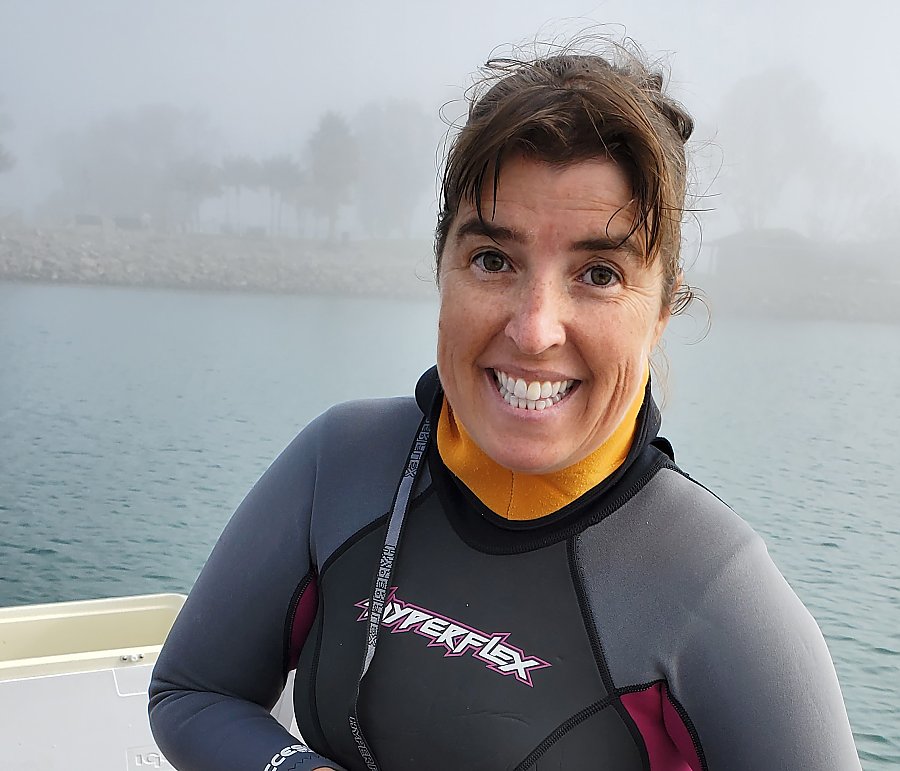
Nancy Caruso, Courtesy photo
Unfortunately, kelp forests are disappearing at alarming rates, with losses reaching up to 95% in Northern California. This once-lush underwater habitat is turning into barren seafloors.
Join us to discover the history of kelp restoration in Southern California and the current efforts to “Help the Kelp” on the north coast. While most people will never see a kelp forest, thousands of passionate individuals have been involved in restoring them over the last century.
It promises to be an inspiring evening presented by marine biologist Nancy Caruso. She will delve into the history of kelp restoration in Southern California and the ongoing initiatives aimed to “Help the Kelp” along the north coast. While many may never get a chance to experience a kelp forest firsthand, thousands of dedicated people have participated in their restoration over the past century.
Nancy Caruso is a marine biologist and the Executive Director of Get Inspired! Originally from Virginia, her fascination with ocean science sparked at the age of 10, which prompted her to obtain scuba certification by 16. She earned a Bachelor of Science in Marine Biology at the Florida Institute of Technology and began her professional career working in aquaculture, hydroponics and aquaponics.
In 2009 she founded Get Inspired!, a non-profit organization dedicated to the restoration of marine species. Between 2002 to 2012, she led the kelp restoration efforts in Orange County. She also founded KelpFest, an annual festival that celebrates the ecological importance of underwater kelp forests while promoting awareness for their conservation and restoration. Nancy has collaborated with over 6,000 students and volunteers to revitalize marine species, including abalone, white seabass, and pismo clams.
She teaches students how to grow species in their classrooms and has built a robust community of ocean stewards to assist in the ocean, on beaches, and in tidepools. Her work has been recognized globally, earning her a spot in the Women Divers Hall of Fame and featuring her in MY HERO Project documentaries.
Following the presentation, guests will have the opportunity to enjoy live music, crafts, cocktails (available for purchase) and conversations in our Art Gallery. The lecture will also be live-streamed.
This program is perfect for adults of all ages. Reservations are required.
Given the popularity of First Wednesdays, tickets tend to sell out quickly, so be sure to secure yours today, presented by Nancy Caruso at 7 p.m. on Wednesday, July 1.
Southern California’s premier theatre company, Musical Theatre West (MTW), is bringing a fresh new energy to one of Broadway’s most beloved family musicals as Joseph and the Amazing Technicolor Dreamcoat takes the stage this summer at the Carpenter Performing Arts Center for select dates between July 10 – July 26.
Starring Broadway performer and viral vocal sensation Brian Justin Crum in the title role, the production reimagines Andrew Lloyd Webber and Tim Rice’s classic musical through the lens of today’s pop culture, while remaining true to the heart of the timeless story.
“When Andrew Lloyd Webber wrote Joseph in 1968, he filled the score with references to the popular artists and sounds of that era,” said Larry Raben, Director of MTW’s Joseph and the Amazing Technicolor Dreamcoat. “We’re honoring that same spirit by moving those influences into this millennium while still telling the classic story of Joseph. Audiences may spot a few fun nods to some of today’s biggest music icons, but at its heart, it’s still the same timeless story about believing in your dreams.”
While audiences can expect all of the beloved songs, colorful storytelling, and uplifting themes that have made Joseph a favorite for generations, this production introduces a contemporary twist inspired by some of the biggest music icons of the last two decades. Director Larry Raben has embraced that same creative spirit, updating those influences for modern audiences through subtle references and performance styles inspired by artists such as Beyoncé, Bruno Mars, Adam Levine, and other contemporary superstars.
Leading the cast is Broadway performer and viral vocal sensation Brian Justin Crum as Joseph. Known for his powerhouse vocals, electrifying stage presence, and appearances on Broadway and national television, Crum brings a modern pop-star energy to the role. Inspired in part by performers like Adam Levine, his portrayal embodies the confidence of today’s biggest entertainers while maintaining the vulnerability of a young dreamer.
“Joseph is every kid who’s ever stood in front of a bedroom mirror imagining they were a superstar,” said Raben. “Brian captures both the charisma and heart of the character in a way that feels incredibly relevant to today’s audiences.”
Joining Broadway performer and viral vocal sensation Brian Justin Crum as Joseph is Daebreon Poiema as the Narrator, whose powerhouse vocals and commanding stage presence help guide audiences through Joseph’s remarkable journey. Kenneth Mosley takes on the dual role of Pharaoh and Simeon, expected to bring charisma, humor, and larger-than-life energy to some of the show’s most memorable moments, while Harrison White portrays both Jacob and Potiphar, delivering two distinctly different characters who play pivotal roles in Joseph’s story. Together with a talented cast portraying Joseph’s brothers and other featured roles, the company delivers a fresh, contemporary take on Andrew Lloyd Webber’s beloved musical while honoring the timeless spirit that has captivated audiences for generations.
Joseph and the Amazing Technicolor Dreamcoat will run July 10 – July 26 for select dates and times. Tickets are available for purchase by phone at 562-856-1999 or online at musical.org. Fees may apply. Student rush tickets for $15 are available at the Box Office one hour prior to showtime, with a valid student ID. More information, a full line-up of performances, and additional details can be found at https://musical.org.
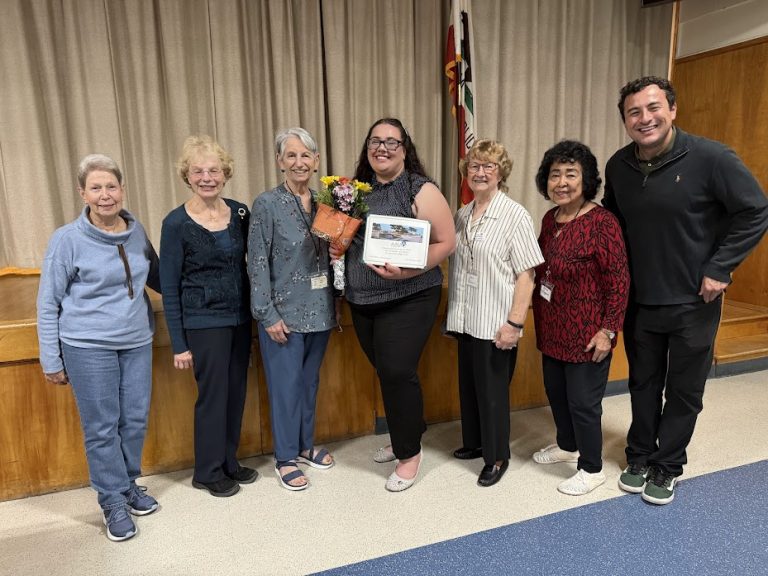
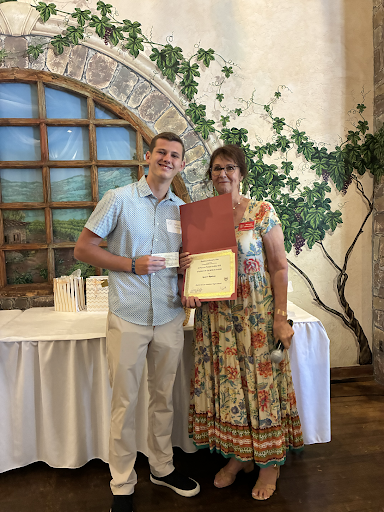
The La Palma-Cerritos Branch of the American Association of University Women (AAUW) honored two Cerritos College students with Academic Achievement Award (AAA) Certificates at their meeting on May 14, 2026, at the ABCUSD Adult School Auditorium.
Hospitality chairperson Ceci Borja-Van Zitter and her assistant Sue Carruthers had prepared a wide variety of refreshments for this special occasion, including fresh fruits, empanadas, tamales and other snacks that members and guests could enjoy from 6:30 to 7:00 p.m.
At 7:15 p.m. Administrator Celia Spitzer started a brief business meeting with approval of the April minutes, acceptance of the treasurer’s report, and committee reports from Public Policy, AAUW Fund, and Interest Groups.
Spitzer turned the meeting over to Joan Pylman, Chair of the Academic Achievement Awards Committee, who introduced AAA committee member Gail Ross. Ross read information about Meera J. Parikh, the winner of the Transfer Student Award for 2026.
She said that Meera is 20 years old and carries a 4.0 GPA while at Cerritos College. She is the STEM Club’s First Vice-President in charge of Communications which demands meeting deadlines and participation in campus activities. In addition, she has been tutoring students in Chemistry. Since she aspires to be a Physician’s Assistant, she has immersed herself in the world of healthcare by being a volunteer. In the community, Meera volunteered at events sponsored by Key Club.
She also was a research volunteer at the Lundquist Institute where she identified calcifications in the aorta and liver on CT scans and input patient data onto electronic records. Meera listed Biology and Pre-Med as her major and she will be attending UCLA in the Fall of 2026.
Since Meera was unable to attend this meeting in person, Eric Calderon, Scholarship Relation Specialist at Cerritos College, accepted the Academic Achievement Award Certificate and flowers for Meera. He also read a letter of thanks from Meera for her award.
Pylman introduced AAA committee member Christine Taxier, who read information about the winner of the Re-Entry Student Award for 2026. She said that Zaira is a 33-year- old and first-generation college student. She is also a first-generation American, and Spanish is her first language. She grew up in poverty as one of five children cared for by her mother. She was diagnosed with ADHD, bipolar disorder, and major depression five years ago and struggled with her mental health issues.
As she improved, she realized that to achieve her goal of functioning in the business world, she needed to go to college. Working at Sprouts Family Market sparked her interest in accounting and made her want to learn more about business. She entered Cerritos College in 2024 and used Student Accessibility Services (SAS) for disabled students to access accommodations and plan for her classes. In her first semester at Cerritos College, she had a 4.0 with 15 units with Accounting and Business as her major. Her GPA in 2026 is 3.84.
Zaira made the Dean’s List and Paresident’s List in her first semester. She became part of the Accounting Pathways invitation only program, Transfer Academy, P.R.I.D.E. Scholars, EOPS (Extended Opportunity Program & Services), and SAS. She is also President of the Academic Alpha Gamma Sigma Honor Society, and Treasurer of the Future Business Leaders of America-Phi Beta Lamda Business Club. She also volunteers for Special Olympics of California and helps organize athletes and community volunteers.
Zaira will graduate with six degrees in the Spring of 2026 from Cerritos College. The degrees include two Business Administration degrees, and one each in Economics, Language and Literature, Social and Behavior Science, and in Self Development. She has already been accepted at Cal State University Fullerton. Zaira plans to work for Bachelor’s and Master’s degrees in Accounting and become a Certified Public Accountant.
Zaira received a bouquet of flowers and the Academic Achievement Award Certificate for the Re-Enty Student of 2026 from AAA Committee Chair Joan Pylman. She thanked Pylman and the Academic Achievement Awards Committee of the La Palma-Cerritos AAUW Branch for her award. She said that the scholarship money would help pay for tuition, books, supplies and other necessities.
Both Zaira and Meera must notify AAA Committee Chair Joan Pylman when they are enrolled at the four-year college of their choice in the Fall of 2026 before they will be able to receive the funds that are part of their Academic Achievement Award. The meeting adjourned at 7:55 p.m. with a reminder for members to come to the Planning Meeting for programs for the 2026-2027 year on Monday, June 29, 2026, from 1:00 to 4:00 p.m. at the ABCUSD Adult School Auditorium.
When someone hands you a rope heading into a performance, your brain doesn’t know quite what to expect. Such was the case for the one-night performance of the Brisbane, Australia troupe Circa this week as they brought “Eternity” to Costa Mesa for a very limited run.
For the few hundred people who had the rare chance to see the performance, the “procession” into the theatre should have been a clue.
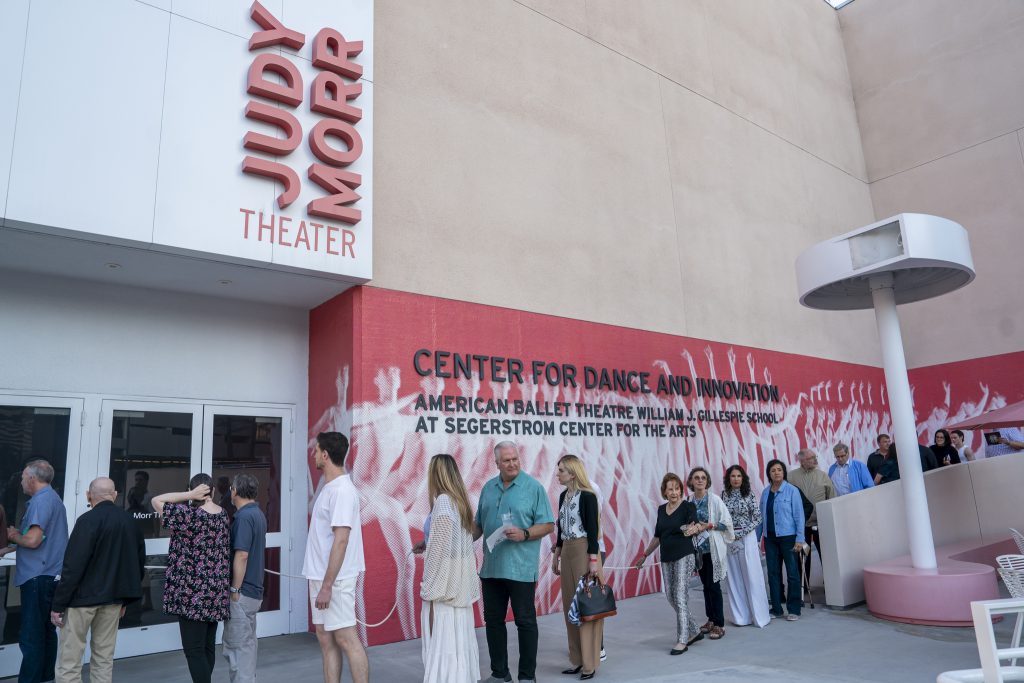
The circular entrance into the theatre was made artful as each of the guests, approximately 160, were only allowed to enter as the processional music played through loudspeakers and everyone grabbed their place on the rope of life and made their way into the darkened, theatre-style Judy Morr theatre.
Puzzled ticket holders grabbed onto the rope and were led into the darkened cathedral of catwalk for the “Eternity” performance. Photo by Stephanie Berger.
The cathedral-type structure looked more like a trendy dive barwhen darkened, as the entire performance took place on a catwalk so close to participants that one could easily hear the grunts of the acrobats as they twisted into shapes and did amazing acrobatics through the air.
The Judy Morr Theatre at mothership Segerstrom is set apart in a dark corner of the property, and although dark for years, it briefly returned to action this week
The Judy Morr has been dormant for public performances for more than a decade, and there was something quietly poetic about Circa being the company to wake it. They have a gift for resurrection: taking spaces, taking bodies, taking the oldest of human questions, and breathing something urgent and alive into them.
Segerstrom Center’s founding vice president of programming, Judy Morr, played a pivotal role in shaping the Center’s artistic vision.
Limor Tomer, Vice President of Programming, said: “As we gather in this newly reawakened theater, I can think of no better way to honor the legacy with a production that pushes artistic boundaries while celebrating our shared humanity.”
With a music score written especially for the 70-minute act, the performers said not a single word as they let their emotions, muscles and dynamic balance do all of the speaking for this performance. Photo by Stephanie Berger.
Around me, others were receiving theirs too, a quiet assembly of strangers each tethered to the same braided line, and then the performers began to move, and without quite deciding to, we followed.
That is how “Eternity” begins. Not with a curtain rising or a spotlight finding its mark, but with an act of surrender so gentle you almost don’t notice you’ve surrendered. You grab the rope. You walk. And somewhere in those first few steps, the show has already started doing what it came to do.
Circa, the Brisbane-based contemporary circus company that has spent two decades redefining what the human body can say, brought “Eternity” to the Judy Morr Theater at Segerstrom Center for the Arts in Costa Mesa for three nights in June which was the production’s first extended run in Southern California.
The space they revealed once we had followed the rope inside was spare and sacred. Not ornate in the way of the Brisbane cathedral where “Eternity” was born, but intimate in a way that felt deliberately chosen, close enough that you could see the tendons in a performer’s forearm, the tremor of effort held still, the exact moment when trust between two bodies becomes something indistinguishable from faith.
The music arrived before anything else made sense. Arvo Pärt’s Tabula Rasa and Fratres, recorded by the Australian Chamber Orchestra, filled the room the way water fills a vessel, completely and without negotiation.
The team of performers created scenes of “Eternity” as the audience was close we could literally hear the breathing and the sounds of the flesh synchronizing with each other as they moved up, down, together and then feats that lifted them 50 feet into the air. Photo by Stephanie Berger.
What remains, it turns out, is each other.
“Eternity” is a show about ten people who have decided to trust one another completely, and who make that decision visible. A performer climbs another’s shoulders in the dark and you feel the mathematics of it in your own chest, so close to the audience that the sounds of bodies slamming into each other, and the mat, brings realism and gravity to the performance.
The weight, the balance, the quiet catastrophe that hovers just at the edge of every moment and never quite arrives. There is no net. There is no safety in the theatrical sense of the word. What there is instead is preparation so thorough it becomes something else, something that looks from the outside like grace.
Director Yaron Lifschitz, who has led Circa since its founding and who shaped “Eternity” from its earliest commission for the Brisbane Festival, works in a mode that refuses easy categorization. This is not circus as spectacle. It is not dance as decoration. It is physical theater in the oldest and most serious sense, the body as the instrument through which we examine what it means to be mortal, to be connected, to be briefly and improbably alive in the same room as other people.
The themes, though sometimes harder to discern, fully explored various aspects of life, including love, death, loss, hope, wonder; all using mere music, and bodily expression.
Perhaps these words can feel hollow in the wrong hands. In Circa’s hands they become weight-bearing. You feel them the way you feel the rope: as something real pressed into your palm, something that connects you to a line of other people moving through darkness toward something they cannot yet see.
Circa’s reputation precedes them across six continents and forty-five countries and while it took a while for the small crowd to get engaged, they eventually became so engrossed it ended with a standing ovation.
It was different for sure, at times inviting humans to bridge the comfortable distances we keep between ourselves and our most difficult feelings. Orange County is not always thought of as a place that reaches for the transcendent. But when we grabbed onto Circa’s rope, we had somehow accepted a challenge to go or not go where the mysterious rope wanted to lead us. Most of us did.
We live in an unsettled time. The future is always uncertain. And our day-to-day lives go by so fast it seems we can hardly make sense of our place in it. Yet, there is one relatively constant timeline we can count on to mark the passage of time and hopefully our place in it – the past.
Our collective histories, the stories and events we gather, recollect and document, are the shoulders we stand on to peer over the horizon and prepare us for what is coming. As Shakespeare put it, “past IS prologue” to the future. No matter what we become, we will always be from where we came.
That is why history, especially the history closest to us, is so vital to preserve, to cherish, and most importantly to carry forward with us into that uncertain future. It’s the ground we stand on that gives us the confidence to confront the future.
One of the only known photos of the Chapel when it was made of brick before the earthquake of 1933. Courtesy photo
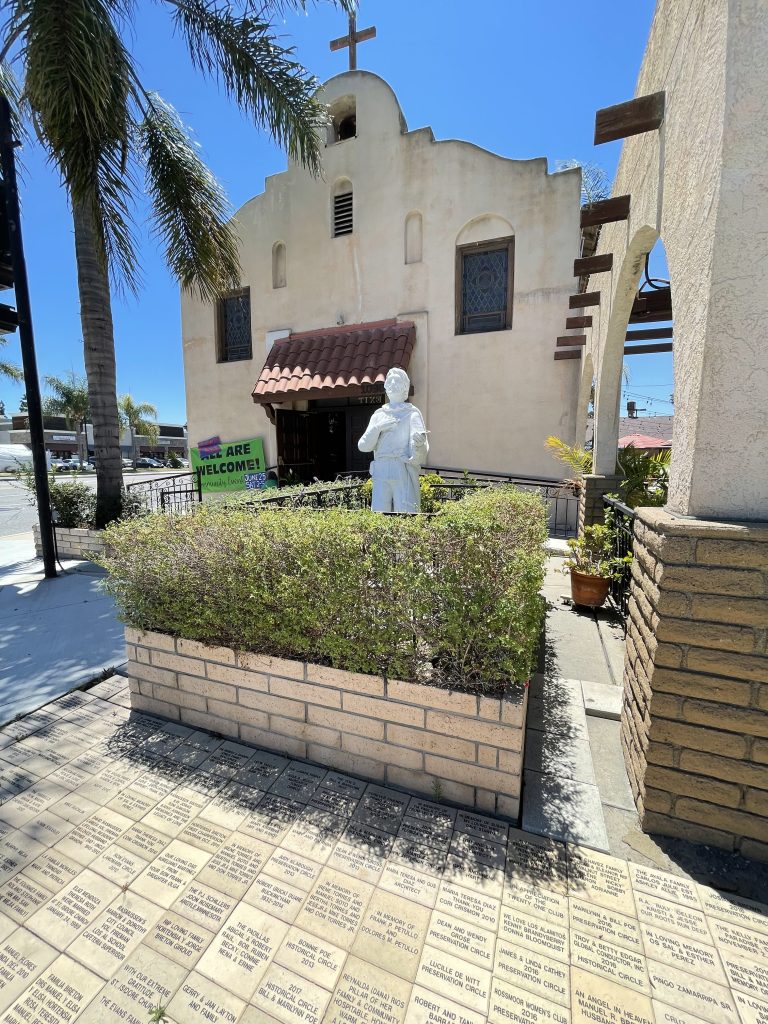
For many in Los Alamitos that ground is St. Isidore Historical Plaza and Chapel. The oldest public building in the city and the crossroads for many cultural influences that have left their mark on this town. “It is the jewel of Los Alamitos that has been cut into a gem by the hands of many from many backgrounds over the last 100 years,” says St. Isidore docent and co-producer of the Plaza’s upcoming 100th Centennial Festival, Maria Teresa Diaz. “We want to invite the community that knows us and the community that doesn’t know us to come and help us celebrate our 100 years in Los Alamitos.”
In the long and tightly woven story of Los Alamitos, no history is more closely tied to our origins, to the place from where we came, than St. Isidore’s Chapel and the plaza that surrounds and sustains the property just off Katella Avenue and the former main street of old Los Alamitos, Reagan. This little chapel and its plaza have marked the passage of time with many festivals and fiestas, with music and dance, art and cultural events that have connected this community together for the past 100 years.
And the community’s connections to St. Isidore is as alive today and as vital to its supporters and patrons as it was to its earliest parishoners and supporters who built the modest chapel in 1925-26, and then rebuilt it again after the great earthquake of 1933, this time in the California Mission style. The “hands of many” coming together as early as 1923 to plan and build a chapel.
Following the earthquake of 1933, the chapel was rebuilt into the Spanish Missionary Revival style. Courtesy photo
First it was the old Mexican families, some of whose names go back to the Spanish land grant days and later worked for the Bixbys as ranch hands, farmers and foremen of the Bixby Ranch. Then it was the Belgian and Portuguese farmers and Dutch dairymen who came to the area in successive waves, each adding their own skills and backgrounds to the mix of cultures that sustained the chapel and its plaza as a gathering place for all under the one roof of St. Isidore.
Those connections to historic St. Isidore run deep for many families in and around Los Alamitos. None deeper than for those in the Mejia family. Eva Mejia Hilts is one of four children to the Mendoza family whose precedents span five generations of family that grew up in and around the little chapel. Like her sisters Eva was baptized at St. Isidore, married there, and has returned there to do her part to preserve the chapel and plaza for her own descendants. Born before WWII she remembers Los Alamitos as a small town that began and ended at either end of the old main street, Reagan.
“I recall walking south down the main street of Los Alamitos, just a dirt and gravel road all the way to 7th Street through the shade of the eucalyptus trees on both sides all the way. On weekends dad would drive us up the hill to the Bixby Ranch. Along the way we gathered gunny sacks from the fields. We would use them as sleds to slide down the long hill from the Ranch. I only remember the exhilaration of sliding down that hill over and over. I don’t ever remember the long walks back up.”
Photo from inside the chapel from the early years. Courtesy photo
The Bixby Ranch in those days, along with the sugar beet factory Bixby’s beet farmers supplied, was the center of the universe for the community that would become Los Alamitos. It provided the work and a sense of community that allowed the local families to prosper. It was in fact Fred Bixby who in 1924 donated the property at the corner of Katella “Road” and Reagan Street for the express purpose of providing land to build a Catholic church. That church stands today as St Isidore, and is the center of the universe now for many of the old Los Al families.
Built in 1925-26 the little chapel and its open air plaza soon became a center of spiritual and cultural life for a wide region around it, drawing parishoneArs and patrons from Stanton, Buena Park, Garden Grove, Westminister, Hawaiian Gardens and beyond. They were farmers, field workers, dairymen and carpenters who worked on the Bixby’s Rancho California, and later for the sugar beet industry centered in Los Alamitos. Eva’s own great grandfather, Luis Mendoza, was a supervisor of the sugar beet factory.
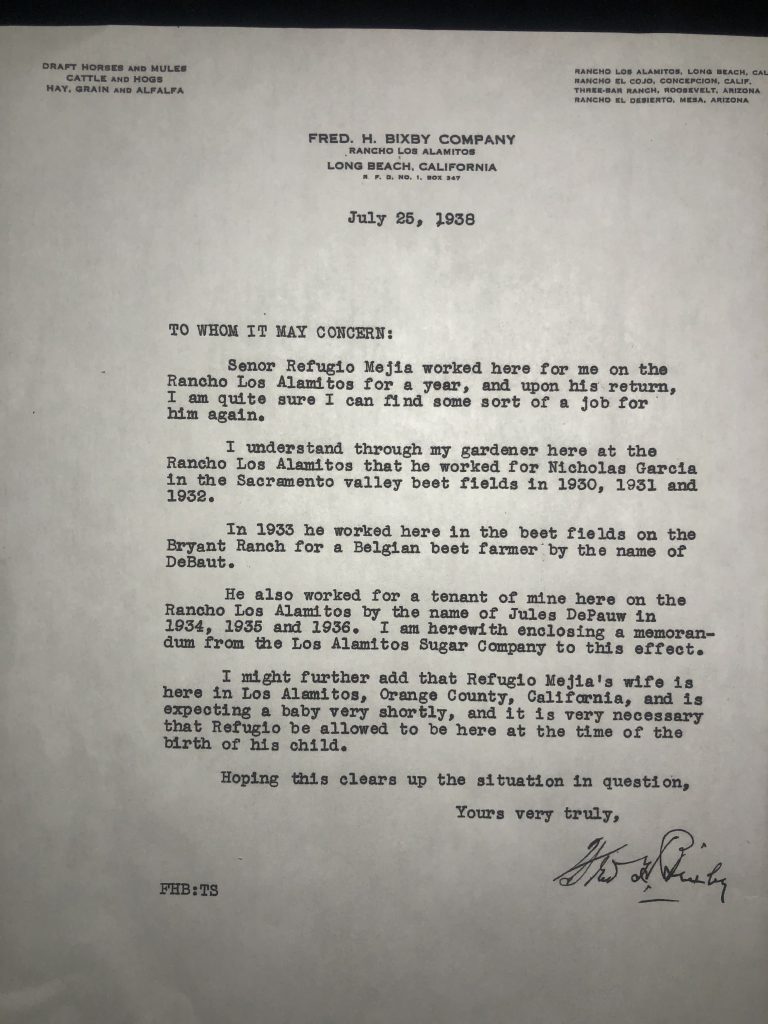
Fred Bixby by all accounts was a thoughtful and compassionate landowner who, in addition to donating the land where the chapel stands today, opened his hill top hacienda to many gatherings and fiestas for his workers and their families. Eva recalls among the family stories passed down to her was when her father, Refugio Mejia, had to return to Mexico to attend to a family medical crisis there. Returning to the US would have been almost impossible at the time, if not for a letter Fred Bixby penned personally to immigration authorities requesting an expedited repatriation of Eva’s father back into the country on the grounds that he was an exemplary worker citing many work-related experiences he had held here in California.
Courtesy photo (L-R) Refugio “Ray” Mejia, his wife Esther and four daughters, Victoria, Eva, Madeline and Esther, one family that enjoyed five generations of life centered around the tiny chapel. Eva was baptized at St. Isidore, married there, and has returned there to do her part to preserve the chapel and plaza for her own descendants.
Preserved letter from Fred Bixby requesting expedited repatriation of Eva’s father. Courtesy illustration
There were many local Hispanic families like Eva’s who can trace their lineage back to the early Bixby days and the boom years of the sugar beet industry in the early 20th Century. Families of many cultural backgrounds who gave of their time and treasure to eventually create a chapel and social life around its plaza. There were Portuguese, Belgian and Dutch immigrants who came to the area for the same economic reasons as the Mexicans, who also participated in the building and the restorations of St. Isidore Chapel and its plaza. Most of the spectacular stain glass windows that adorn the walls of the chapel were paid for by donations from these local families.
They saw the chapel and the plaza as a cultural center of the community. And when the brick edifice of the first St. Isidores church was decimated by the ‘33 earthquake, it was by the hands of these same immigrant families that the chapel was rebuilt and rededicated to the greater Los Alamitos community.
“It took many hands over many years to build St. Isidore’s,” says Marilynn Poe, long time advocate and board member of the historical plaza and member of one of the early Los Alamitos families, the Poes. “And a lot of angels along the way.” Some, like Marilynn herself, not even Catholic. “I knew the history of the chapel and the many immigrant families that had a role in its creation,” she remembered recently. “So when some of these families came to me in 1999 when I was mayor, with their urgent request to save the chapel once again from closure and possible demolition, I couldn’t say no.”
The running battles to save St. Isidore’s chapel and plaza have been ongoing. Its future uncertain at many points in its 100 year history. But thanks to timely interventions by some of the more recent “angels along the way,” the land under the buildings is now owned free and clear by the St. Isidore Historical Plaza’s own nonprofit, and the chapel itself is now officially recognized as a state and federal historical site.
St. Isidore will soon celebrate 100 years in the City of Los Alamitos. Courtesy photo
Still, much work remains to be done. Retrofit and restoration work is constant and ongoing. The glorious stain glass windows, the center pieces of the chapel, are currently being restored one at a time at great expense. But the work is essential to the legacy of St. Isidore because each window was funded by and dedicated to a particular Mexican, Portuguese, Dutch or Belgian family who financed the original fabrication of each and every one. Names of families like Van Demaele, Kuppen, Baraldi and Aguilar identify donors from many cultural backgrounds. These windows alone tell the story of a collaboration between cultures that has been the hallmark of St Isidore’s survival for the past 100 years.
St. Isidore remains today a crossroads of many cultures reflected in the varied arts, dance and musical performances it presents to the public throughout the year, while at the same time facilitating the important day to day work by hosting many other nonprofit and service organizations that provide everything from food donation to blood banks, family relief and support, to substance abuse recovery programs, as well as partnering with the City of Los Alamitos on many of its events.
Maria Theresa, Eva Mejia Hilts and Marilynn Poe are just a few of many who have carried forward the struggle to preserve the historic chapel and plaza from decay, from insolvency, and from the wrecking ball. But the future, as we said earlier, is never certain. There are those who believe there is no future in preserving the past. For those supporters of history who understand the value in capturing the past, no explanation of why is necessary. One of those supporters of St. Isidore’s little chapel and plaza was Mildred Jones, founder and matriarch of one of the first nonprofits in Los Alamitos, Casa Youth Shelter. About St. Isidore she said, “St. Isidore’s is very precious to me. They helped me when I was struggling so hard to start Casa. Please help us save St. Isidore’s, it is the heart of this community.”
Thanks to the perseverance of all of these “angels along the way,” St. Isidore Historical Chapel and Plaza will continue its mission of serving and preserving at its original plaza site. So today there is much to celebrate in its 100th year of serving the spiritual needs of its patrons and the secular needs of the greater community around it. The celebration will begin on June 27 with St. Isidore’s Centennial Festival. Billed as an “Open House for all,” the day’s events will include live musical performance, crafts, vendor booths, food and drink, and even an escape room for kids and adults, all on the plaza grounds, and of course, ongoing presentations by Plaza docents about the chapel’s 100 year history, including a special area history presentation by the docents of the Bixby’s Rancho Los Alamitos, conducted in the chapel itself.
One of the many stained glass windows of the St. Isidore Chapel in Los Alamitos, every one of which was funded by family donations dedicated to a family member. Courtesy photo
Then, on August 29, the Centennial Celebration continues with a Gala Dinner that will include a pre-dinner cocktail hour out on the plaza with music. The open-air sit- down dinner will be accompanied by ongoing auction activities, and after-dinner entertainment will include a live band and dancing. And of course, just off the plaza in the Floriza Martinez Hall ( another “angel along the way”) there will be running displays of St. Isidore’s historic past, eventful present, and hopeful future for the curious to take in.
These upcoming events are designed to celebrate and to educate the public about the curious little chapel off Katella Ave., the “hidden jewel of Los Alamitos” that has been the center of life for so many over the past 100 years. Take in one or both of these events and become part of an illustrious Los Alamitos family that honors its past, and faces its future with the dignity of knowing from whence it came.
Happy birthday St. Isidore at 100!
The June 27 Centennial Festival Open House is free to the public from 2-7 p.m. (small fee for escape room)
The August 29 Gala Dinner from 5-10 p.m. ( or until the dancing stops) is by reservation only. Please contact the St. Isidore office at 562-596-9918, or go to StIsidoreHistoricalPlaza.org for more info on either of these events.
The President and CEO of the Aquarium of the Pacific made it clear this week that he views the role of this internationally recognized center as not only a place to put the ocean on display, but also a forum for environmental knowledge to protect it for years to come.
“The Aquarium already does amazing education and conservation work,” CEO Jeff Flocken acknowledged at a major press conference this week, but said he wanted to expand the institution’s role in the knowledge economy.
“My goal is to have us double down on that while continuing to expand in those directions,” he said.
To that end, Flocken this week invited the nation’s top weather experts into the Honda Vision Center at the Aquarium to explain how hotter weather associated with a growing “El Niño” could have severe implications for the world’s oceans, especially for the oceans and the blue economy.”
“We’re (AofP) already known as a fantastic entertainment facility,” Flocken told ENE after the event, saying, “people come here with their families to be inspired,” he said, while noting that the Aquarium has expanded its existing conservation work and educational resources.
Jeff Flocken, President & CEO of the Aquarium of the Pacific. Courtesy photo
“I would like us to continue doing that and be a voice beyond Long Beach and Southern California,” said Flocken. “I want people to understand more about our oceans and what’s going on in them.”Earlier, inside the Vision Center, he introduced experts from the National Oceanic and Atmospheric Administration (NOAA), a scientist from NOAA’s Southwest Fisheries Science Center, and two Aquarium staff members to discuss a developing El Niño and the “anticipated effects of warming water on ocean life.”
In addition, Flocken introduced the Ocean Science Center within the Aquarium, where satellite data from NOAA and the National Aeronautics and Space Administration are beamed directly into an elevated globe called Science on a Sphere® to reflect real-time warming of the earth’s oceans.Flocken also explained how the Aquarium is in training to study “the health impacts of marine animals” caused by the warming oceans.
“As a non-profit organization committed to ocean conservation and education, the Aquarium of the Pacific is focused on programs that help marine life as well as those that make science accessible to the public,” he said.
Flocken said as impacts of the heat ramp up, the Aquarium is preparing to “serve a pivotal role in directly responding to aid wildlife in need of rescue, as well as providing rehabilitation care and sanctuary for impacted animals when needed.”
“We have staff on the water each day recording sightings of marine life so we can track population calculations and anomalies,” the Aquarium CEO said.
Dr. Ariel Cohen, a meteorologist who runs the Los Angeles Bureau of the National Weather Service, explained what El Niño looked like, which is a giant red ‘ blob ‘ gathering over the Pacific Ocean.
Photo by David N. Young National Weather Service Meterologist Dr. Ariel Cohen points out a huge red blob gathering in the Pacific Ocean, warming the oceans and preparing for El Nino.
“I’m going to show how warm water temperatures over the equatorial Pacific can play a huge role in the types of weather patterns that we will see across California,” said Cohen.
Under normal conditions, an area of warm waters is blown westward by naturally occurring trade winds, followed by an area of cooler waters just off the coast of Central and South America.
Cohen used the Vision Center’s huge 130-foot video screen to show diagrams to illustrate the formation of El Niño weather patterns and how they indicate warming waters.
“We are already seeing the conditions favoring this El Niño pattern coming to light,” said Cohen.
He said El Niño forms when trade winds slacken, causing warm waters to extend farther east, right off the coast of Mexico and northern South America, which causes jet stream energy in the atmosphere to bring disturbed weather southward across the southern U.S.
“We are already seeing these warm temperatures lining up,” said Cohen, and when we look at the anomalies, or the departure from normal conditions, these reds and even darker colors are showing several degrees above normal in waters pooling over equatorial waters of the Pacific.”
Dr. Andrew Leising, a research oceanographer at the NOAA Southwest Fisheries Science Center, spoke directly about how the warming waters of El Nino affect the world’s oceans, specifically the Pacific Ocean.
Leising demonstrated government software modeling via satellite data, designed to predict ocean temperatures using external conditions. Scientists must take into consideration that some ocean heat waves “last for years,” he said.
El Niño, said Leising, “tends to cause green heat waves, indicating very warm conditions all along the coast. If indeed it continues to form, the conditions would be like the El Niño in 1998 and the one in 1978, which puts these conditions in spans of 20 to 30 years.
The researcher pointed out, however, that this year’s marine heat wave is mostly restricted to Southern California. In addition, he said it is located “far offshore,” and it is only about a third the size of the big one in 2015.
Nevertheless, the scientist said, the impacts are still hard to predict. “The impacts of El Niño are always different on different years,” said Leising.
Brett Long, Aquarium of the Pacific vice president of animal care, birds, and marine mammals, said the Aquarium supports disaster responses affecting birds and marine mammals using organized volunteers who monitor beaches and key ocean indicators.
“We work with local organizations to respond to crises, assist with wildlife surveys in search and recovery efforts, and collect impacted wildlife for them to receive the care they need,” said Long.
Nate Jaros, the Aquarium’s VP of animal care, fish, and invertebrates, said the warming waters could bring “an increase in tropical or warm subtropical species, which could include increased shark sightings.”
“We may see rare visitors like yellow-fin tuna, mahimahi, yellow-bellied sea snakes, seahorses, pelagic red crabs, and in very rare cases, even whale sharks,” said Jaros.
The group also heard from Dr. Felix G. Castro, from NOAA.Flocken thanked the experts for sharing their understanding of what’s happening to our oceans. “We understand there’s so much more we need to know about what’s currently there, and we will continue to grow in our knowledge of what we should know about.”
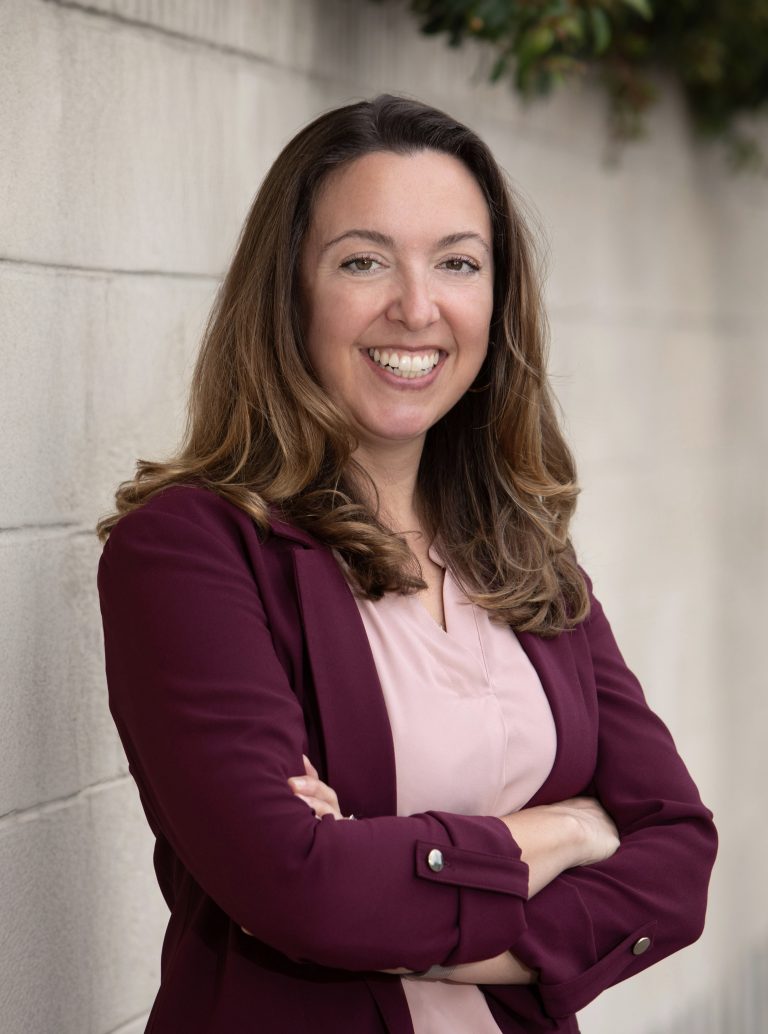
The Cypress Chamber of Commerce will welcome Shannon DeLong, City Manager of the City of Cypress as our guest speaker at our July Networking Breakfast on July 14th at the Residence Inn by Marriott at 4931 Katella Avenue, Cypress/Los Alamitos, beginning at 7:30 a.m. At our breakfast event, Shannon will share her municipal background and discuss her ideas for continuing to make Cypress business-friendly and successful. She will also take questions as time permits.
Earlier this year Shannon was hired as City Manager for the City of Cypress and is the first woman and 10th City Manager in the City’s history. With more than 20 years of executive leadership experience, DeLong is known for her people-first approach to local government and dedication to building strong community relationships.
Prior to joining Cypress, she served as Assistant City Manager and Interim City Manager for the City of Whittier, where she helped oversee major initiatives including the establishment of the Whittier Navigation Center, expansion of the historic Central Library, remodel of the Uptown Senior Center, and improvements to parks and public facilities throughout Whittier.
Earlier in her career, DeLong advanced through several leadership positions with the City of Downey where she served as the Director of the Downey City Library, Interim Executive Director of the Columbia Memorial Space Center and led the City’s first Innovation Team. After college graduation, Shannon worked for The Aerospace Corporation, a Federally Funded Research and Development Center, and as an undergraduate she assisted in the Hubbell Lab in the UCLA Jules Stein Eye Institute.
DeLong holds a Bachelor of Science in biology from UCLA and a Master of Business Administration from California State University, Dominguez Hills. Beyond City Hall, she is also the proud mother of three children and values creating connected communities where families can thrive.
Each Chamber breakfast guest will also have an opportunity to stand to introduce themselves and share a little about their business before the program begins.
Reservations are highly recommended to secure your spot for the monthly breakfasts and can be made online. Cost of the breakfast is $25.00. Attendees are urged to also bring along a door prize to help promote their product or service.
The Chamber networking breakfasts, which are open to the public, are held on the second Tuesday of every month. Space will be limited. To assure your seat, pre-register on the chamber website: https://www.cypresschamber.org/events/details/2026-july-networking-breakfast-2819
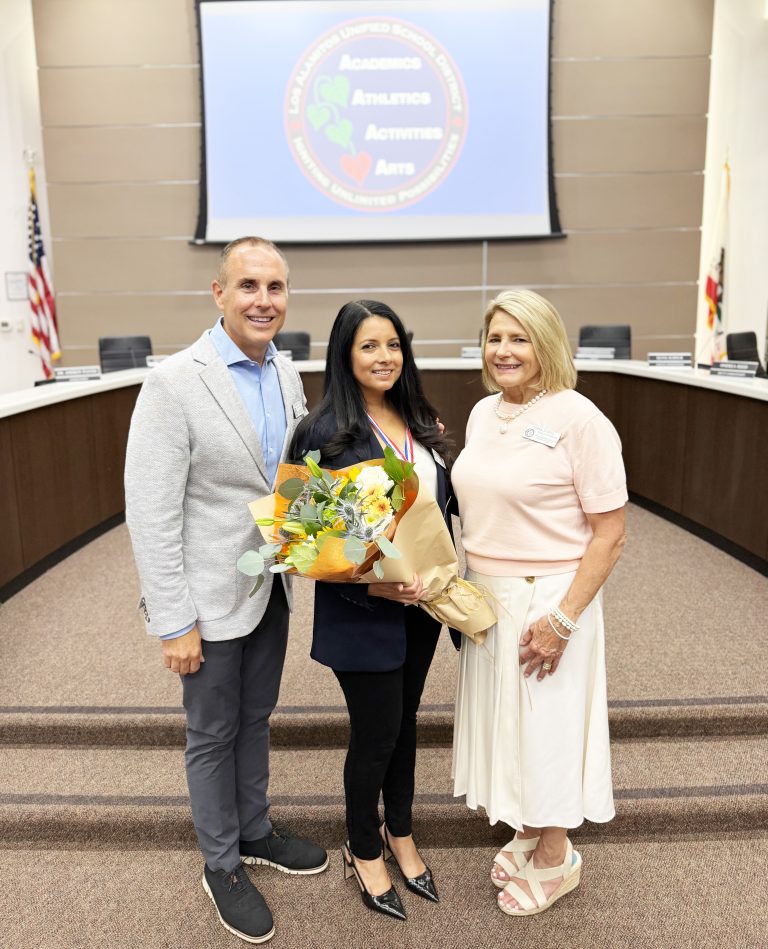
The Los Alamitos Unified School District is pleased to announce the appointment of Tatiana Garcia as the District’s new Director of Fiscal Services following a comprehensive selection process. At its June 9, 2026, Board of Education meeting, the Board officially welcomed Garcia to Team Los Al USD as she prepares to join the District in mid-June.
Garcia brings more than a decade of experience in school business operations and financial leadership, with an extensive background in budget development, accounting, payroll, benefits, purchasing, and systems support.
She currently serves as the Director of Budget and Accounting for Santa Ana Unified School District. She has previously held key business services positions with Huntington Beach Union High School District, Westminster School District, the Orange County Department of Education, and Huntington Beach City School District.
Throughout her career, Garcia has demonstrated a strong commitment to operational excellence and continuous improvement. Her experience includes hands-on work in payroll and benefits administration, as well as leadership oversight of budget, payroll, and purchasing functions. During her tenure at the Orange County Department of Education, she supported school districts throughout the county by providing expertise in financial, human resources, and payroll systems. At Huntington Beach Union High School District, she also led the implementation of digital payroll systems and forms to streamline processes and improve efficiency.
Garcia recently completed the Fiscal Crisis and Management Assistance Team (FCMAT) Chief Business Official Mentor Program and holds the California Association of School Business Officials (CASBO) Chief Business Official Certification.
As Los Alamitos USD welcomes Garcia, the District also recognizes an important transition within its Business Services Department. As previously announced, Tim Golden will assume the role of Assistant Superintendent, Business Services, while longtime Director of Fiscal Services Elvia Schnur will retire in June after years of dedicated service to the District.
The Cypress School District Board of Trustees is pleased to announce the appointment of two outstanding educational leaders to serve as elementary school principals beginning with the 2026/27 school year.
At its meeting on June 11, 2026, the Board of Trustees approved Audrey Jeans to serve as Principal of Frank Vessels Elementary School and Niccole Petersen to serve as Principal of A.E. Arnold Elementary School.
These appointments reflect the district’s ongoing commitment to inspiring and empowering every student, every moment, for every opportunity through exceptional instructional leadership, strong school-community partnerships, and a positive culture that supports student success.
Audrey Jeans, courtesy photo
Audrey Jeans Appointed Principal of Frank Vessels Elementary School
The Board of Trustees has appointed Audrey Jeans as Principal of Frank Vessels Elementary School for the 2026/27 school year.
Mrs. Jeans brings 28 years of dedicated service to the Cypress School District and a deep understanding of the district’s mission, values, and commitment to student achievement.
Throughout her career, she has demonstrated a passion for teaching and learning, a commitment to mentoring colleagues, and a steadfast focus on building meaningful relationships with students, staff, and families. Currently serving at Morris Elementary School, Mrs. Jeans has made a lasting impact on the district through her concurrent role as the district’s BTSA Support Provider Mentor.
Since 2002, she has mentored dozens of new teachers and has served as the district’s lead mentor, collaborating with the Orange County Department of Education and overseeing new teacher induction activities. Her leadership has helped develop and support generations of Cypress educators.
In addition, Mrs. Jeans has served as an Interim Principal during various assignments over the past four years, demonstrating her ability to lead school communities, support staff, and maintain a strong focus on student learning.
Mrs. Jeans holds master’s degrees in curriculum and administration and is recognized as a collaborative educational leader who is skilled at building lasting partnerships and helping students and staff achieve their goals.
“Audrey’s dedication to Cypress students and staff spans nearly three decades,” said Board President Dr. Lydia Sondhi. “Her commitment to instructional excellence, teacher development, and relationship-building reflects the very best of our district. We are excited to see her lead the Frank Vessels Elementary School community.”
Niccole Peterson, courtesy photo
Niccole Petersen Appointed Principal of A.E. Arnold Elementary School The Board of Trustees has appointed Niccole Petersen as Principal of A.E. Arnold Elementary School for the 2026/27 school year.
Mrs. Petersen brings 26 years of experience in public education and a distinguished record of educational leadership. For the past six years, she has served as a principal in the Adelanto Elementary School District, where she has focused on fostering collaborative school cultures, supporting student achievement, and partnering closely with staff and families.
Prior to becoming a principal, Mrs. Petersen spent 16 years as an elementary classroom teacher, teaching students at all grade levels, grades one through six. Her broad instructional experience provides her with a strong understanding of teaching and learning and the diverse needs of elementary students.
In addition to her classroom and site leadership experience, Mrs. Petersen served as the English Learner (EL) Coordinator for Lucerne Valley Unified School District from 2008 to 2018. In this role, she supported programs and services designed to meet the needs of multilingual learners and worked to ensure equitable access to high-quality instruction for all students.
Mrs. Petersen has also demonstrated a longstanding commitment to collaborative leadership and employee engagement. From 2005 to 2010, she served as President and Co-President of the teachers’ association, where she worked closely with educators and district leaders to support students, staff, and school communities.
Her leadership experience extends beyond the school site. She served for eight years as a member of the Hesperia Unified School District Board of Education, including service as Board President.
This unique combination of classroom, administrative, governance, and association leadership experience has shaped her collaborative approach to leadership and her commitment to serving students, staff, and the broader community.
A highly motivated and dedicated educational leader, Mrs. Petersen is known for working collectively with teachers, staff, students, and families to create positive learning environments where all students can thrive.
“Niccole brings a wealth of experience as a teacher, principal, and educational leader,” said Interim Superintendent Dr. Tim McLellan. “Her collaborative leadership style, commitment to student success, and ability to build strong relationships will be tremendous assets to the A.E. Arnold Elementary School community.”
Continuing the Cypress Tradition of Excellence As instructional leaders, both principals will play a vital role in advancing the district’s vision of engaging in dynamic learning for success in an ever-changing world. They will work alongside staff, students, and families to ensure high-quality teaching and learning, foster inclusive and supportive school cultures, and uphold the district’s core values of respect, integrity, innovation, diversity, compassion, resilience, and perseverance.
The Cypress School District welcomes Mrs. Jeans and Mrs. Petersen to their new leadership roles and looks forward to the positive impact they will make in supporting students, staff, and families in the years ahead.
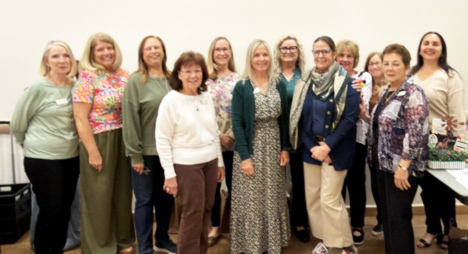
Courtesy photo Pictured is the GFWC Woman’s Club of Cypress Incoming New Executive Board 2026-2027. Back Row Left to Right: Linda Hines-Parliamentarian, Cheri Summers-2nd VP Membership, Mary Kamhi-Publicity, Mary Button-Communications Secretary, Shirley Bradley-Recording Secretary, Ginger Osman-1st VP Dean, Sue Goodman-Treasurer, Michele Pourtemour-President. Front Row Left to Right: Renee Snyder-Programs, Laura Price-2nd VP Membership, Sharla Staab-1st VP Dean, Maria Sterk-Financial Secretary.
This Spring the Rossmoor Woman’s Club awarded three Los Alamitos High School (LAHS) Seniors with $1,000 checks to use towards their college expenses.
The selection process for Seniors of the Month is designed to recognize students who exemplify academic excellence and outstanding citizenship. To be considered, students must maintain a high GPA and demonstrate strong moral character, respect, and involvement in school and community activities.
Candidates who meet these criteria are then voted on by teachers, counselors and the administration. This process ensures that the chosen Seniors of the Month are not only high achievers academically but also positive role models who contribute to the school’s culture and spirit.
Ella Pardasani, right, with RWC member Michelle Wittenberg. Courtesy photo
LAHS Senior of the Month for March – Ella Pardasani Ella Pardasani, a past senior at Los Alamitos High School, has a passion for leadership and business. On campus, she served as ASB President, competed on the Varsity Girls Tennis team, and founded the Small Business Club. She was also a proud member of Spanish Honor Society, California Scholarship Federation, the Kindness Collective, and National Honor Society. Her interest in business went beyond the classroom — she completed programs outside of school at UCLA and Berkeley, and created her own leadership and business workshops which she taught to elementary students last summer through Los Alamitos Education Foundation (LAEF) and the Youth Center. Off campus, you’ll find Ella cheering on students, exploring new places, or heading to the beach with friends. This fall she will be attending USC Marshall School of Business where she’ll study Business Administration with minors in Organizational Leadership & Management and Social Entrepreneurship.
Sarina Forsyte, left, with RWC member Michelle Wittenberg. Courtesy photo
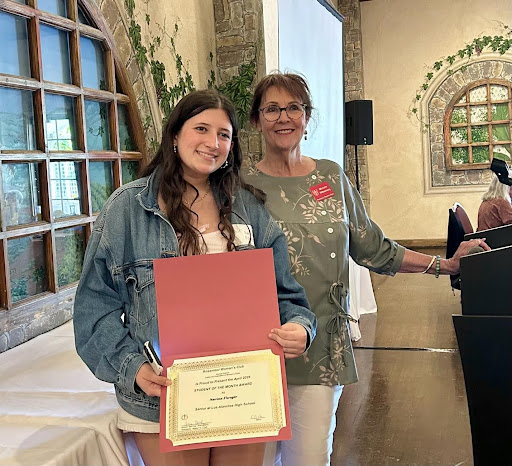
LAHS Senior of the Month for April – Sarina Forsyte Sarina Forsyte was a senior at Los Alamitos High School this year where she served as a member of ASB and the senior class co-president. She was also a member of French Honor Society and the outreach commissioner for National Honor Society. Outside of school, Sarina also worked a part time job at a local candy store where she enjoyed helping customers and hosting birthday parties. In her free time, Sarina enjoys spending time with friends and family, going to the beach, and traveling. Although Sarina is unsure of where she will be attending college next year, she hopes to pursue a career in business and sociology.
Spencer Byström with RWC member Michelle Wittenberg. Courtesy photo
LAHS Senior of the Month for May – Spencer Byström Spencer Byström is a past senior at Los Alamitos High School that has no shortage of ambition. Now that he has graduated he will be serving a 2 year mission for the Church of Jesus Christ of Latter Day Saints. He is super excited to be able to live in Brazil for a few years and teach people about Jesus! When he returns, he will be going to Brigham Young University where he plans to major in Chemical Engineering. After he earns his Bachelor’s degree, he plans to work as a chemical engineer for a few years while working on his Master’s degree. Then he hopes to become an astronaut. He also is looking forward to one day marrying an amazing woman and being
He might be a little late for the Norman Rockwell era, yet the life of Dr. Robert A. Kaplan does indeed sound like a painting from a wonderful life.
And in a world sometimes full of gloomy news, this is a story of humble glory, reminding us all that, yes, the American Dream does still exist.
As a pediatrician for more than half a century, the physical and mental health of his patients is the testament of his life’s work.
Hard to imagine, but for 52 of America’s 250 years, he has made kids and their families feel better.
Even so, a khaki-dressed “Dr. Bob” bobblehead, a gift from an office mate, Dr. Vivi Tran, on his 80th birthday, is the highlight of his sparse Los Alamitos office.
“I’ve always loved kids,” he told ENE this week. “I’ve always enjoyed doing this kind of stuff and being around children. It’s been a very happy practice for me, and I retired at the right time.”
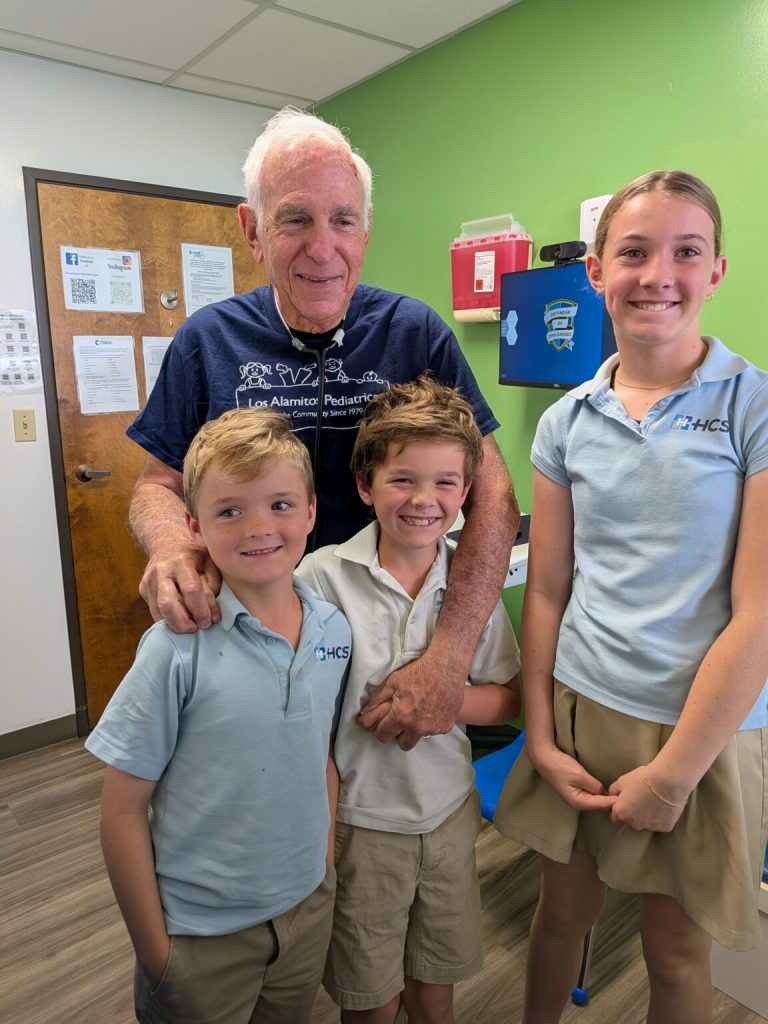
Dr. Kaplan with Traci Aaron’s three children, among his last patients before retirement. “I’ve always loved kids,” says Dr. Kaplan.
The baseball aficionado used a Willie Mays fable to explain that he knew it was time to go (Mays, he said, dropped the last fly ball before his retirement). “I wanted to go out catching the last fly ball,” he said.
Dr. Bob, as old-school a doctor as you’ll ever meet, took his final at bat in May, with an office party and patient tours, and a sendoff with his large circle of colleagues, friends, and loved ones at a waterfront restaurant in Long Beach, his office said in a statement.
After treating kids, grandkids, and great-grandkids in over 40,000 local families, which experts say translates to about 100,000 patients during his career, but who’s counting?
“It feels embarrassing, heartwarming, and it feels rewarding,” he said, yet “it also feels like validation.”
Kaplan grew up in New York, attended Penn State University for his undergraduate degree, and graduated from NY Medical College in 1971. He completed his Pediatric Internship in New York.
In 1972, he and his wife, Ronni, moved to California, where he completed his Pediatric Residency at the University of California, Irvine. He became Board Certified in Pediatrics in 1976 and remained board certified throughout his career.
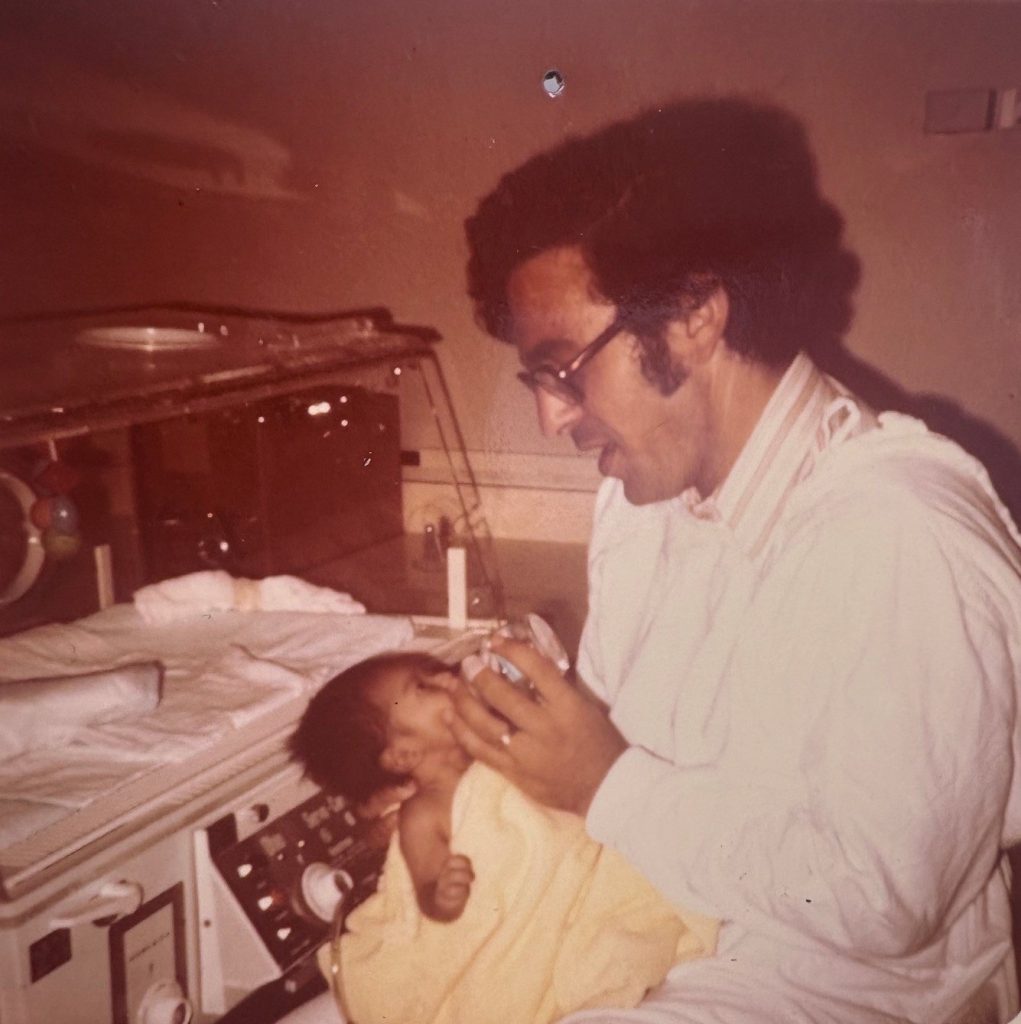
A very young Dr. Kaplan with newborn. Courtesy photo
Kaplan and his long-time collaborator and friend, Dr. Joel Widelitz, founded their practice in Cerritos in 1979 and later moved to Los Alamitos in 1997. He served as a Clinical Professor of Pediatrics at the University of California, Irvine, and he taught medical students and Pediatric Residents both in his office and at Miller Children’s Hospital in Long Beach.
Back in the day, he said, running a private pediatrics practice was vastly different from what it is now.
“Those early years were incredibly nerve-racking and busy,” said Kaplan. “Besides seeing patients from all over, we had to find staff and make sure that they had our philosophy and work ethic,” Kaplan remembered.
“Our clinic was too far away from a hospital to send sick patients to without first stabilizing them. We needed to have supplies and a place to handle any emergency for any child,” he said.
“We had a room in the office dedicated to emergencies for critically ill children,” said Kaplan.
He said it was before many vaccines, “so we regularly diagnosed, tapped, started IVs, intubated, and treated children with meningitis, sepsis, and illnesses, and then would have one of our staff call the children’s hospitals to come pick up the child to be admitted to either CHOC or Miller’s Children’s Hospital.”
Dr. Kaplan, a lifelong athlete, still says in shape. Courtesy photo
“I’m so thankful that we don’t see those illnesses anymore, all due to immunizations.”
“We were on staff at four hospitals caring for newborns, seeing consults throughout the area, and admitting sick children to Miller Children’s Hospital, where one of us visited them every single day.”
For Kaplan, however, it’s been a lifetime labor of love.
“I fell in love early with pediatrics,” he said, “and had a great teacher and mentor.” I have never second-guessed my career choice,” he added. “I guess I’m pretty lucky.”
Luck, it seems, belonged to the tens of thousands of children who received his care over the past half-century.
To his staff, his patients, and to other doctors, Kaplan has emerged as an excellent example of medical ethics and professionalism.
He remembers the thousands of success stories, including his groundbreaking treatment of a neurodivergent child, now 20 and enrolled in Cal State University.
Life and medicine have not always been sunny side up for Dr. Kaplan.
“I remember the parents brought in a four-month-old baby that looked pale, so we sent them to the hospital. He died that night,” says Kaplan. “We decided then and there that if a baby were that sick, we would begin treatment, start antibiotics, then send them to the hospital,” he said.
Also, he remembers a teen who died of a heroin overdose. “I still wonder what I could have done differently.”
It is, however, with that personal and individual concern for every patient that observers say Dr. Kaplan successfully treated more than 100,000 patients over his illustrious career.
Dr. Robert A. Kaplan. He is a pioneer at Children’s Hospital of Orange County, he developed many new policies and procedures in the areas of mental health and addiction treatments. Courtesy photo
Kaplan became a pioneer in mental health and addiction treatment for kids and teens, two standard areas that yet remain in huge demand at pediatric healthcare systems today.
Other physicians have noticed.
“Bob has made a lasting impact through not just his work but also through the people like me that he’s guided, supported, and inspired,” says Dr. Andrea Kallah, a colleague in Dr. Kaplan’s clinic.
Another associate, Dr. Anjalee Galion, a pediatric neurologist, said it is obvious that the “mindset” of the community is within him.
“He came in with the mindset that he’s an extension of the community. That’s a deep core value for him,” she said. “He’s a very mission-oriented physician. For him, it’s not just about making money; he’s embedded in the fabric of Los Alamitos.”
Dr. Michael Weiss, VP of Population Health and the Clavis Foundation Chair for Wellness at RCH, said in a statement that he has known about Dr. Kaplan’s reputation for decades.
“Dr. Kaplan was a pioneer in mental health and addiction treatment for kids and teens – two areas that are standard at pediatric healthcare systems today. And he has mentored scores of residents,” said Weiss.
Kaplan has endured and overcome personal loss along the way. “I was shocked,” he said,” when his long-time partner, Dr. Widelitz died, somewhat unexpectedly, following a hospital procedure in 2012.
“His loss was emotionally and operationally difficult for me,” said Kaplan, admitting a low ebb during this period. “The staff was devastated, yet the office stayed open.”
He and Widelitz were best friends and shared the duties of running the office, said Kaplan. “Luckily, we were great friends, and we knew what each other did,” he said.
“I sought additional support,” said Kaplan, which landed him an affiliation with Children’s Hospital of Orange County (now Rady Children’s Health).
In addition to spending part of his residency at CHOC in 1972-74, Dr. Kaplan’s longtime practice, Los Alamitos Pediatric Medical Group, has since 2018 been part of the primary care network at CHOC.
Kaplan refused “buckets of money” to avoid a path taken by other firms, many of whom sold their practices to larger firms. The move allowed Dr. Kaplan’s office to remain open.
Thus began an association with CHOC that “has allowed me to continue practicing pediatrics the way I always wanted to, surrounded by people who truly care about children and families,” said Kaplan.
Kaplan’s longevity has been matched by the loyalty of his dedicated staff.
“I was a little intimidated by him at first,” says Registered Nurse Laurie Moffitt. She has worked with Dr. Kaplan for more than 35 years.
“I learned so much from him that impacted me as a nurse and as a mom. Even after all these years, he still manages to teach me something new. He is one-of-a-kind and irreplaceable, and he will truly be missed,” said Moffitt.
Traci Aaron, a Cerritos native whose parents took her to see Dr. Kaplan, said she had a rough time saying goodbye to him at her recent appointment. Now, it seems, the pediatrician is taking care of her three children, two boys and a girl.
“I remember him being so easy to talk to when I was a child; he’s so kind, caring, and attentive,” she said. “And I love the way he speaks to my kids. He’ll ask my boys, ‘Are you having big poops?’ They think he is hilarious.”
Kaplan said his long career has taught him that, in many cases, a pediatrician treats the parent as much as the kids.
“A lot of what I did is more taking care of the parent than the kids,” he said. “I mean, you have to be able to listen to children, listen to the parents, believe them,” he said.
Vaccines have eliminated most of the diseases that he once discussed with parents, said Kaplan, and now issues most faced by pediatricians are psychosocial issues and the behavioral stuff,” said Kaplan.
“That is much more difficult,” he adds, “as you can imagine.”
Kaplan, now 81, bemoaned the loss of traditions long gone, like paper charts, when you could write stuff down. “Now,” he said, “it is all automated. It takes a long time to do a chart when it’s electronic, rather than just writing things down,” said Dr. Kaplan.
He admits, however, that technology has been a two-way street. “As a doctor, there have been some great technological changes as well. We have better dictation systems, some with artificial intelligence in them, which made my notes a lot better,” he said.
“Once the door is closed,” he said, “technology is not that important,” he said. “It can be helpful.”
A pediatrician’s office, said Kaplan, was almost like a confession booth. “Good people tell you stuff that they would normally not tell you, which is very nice,” he said.
His parents’ stories are hilarious, even though the kids he treated now have kids, even grandkids, and a few great-grandkids of their own.
“I would have to tell some parents, ‘your child is my patient, not you, so you have to quit picking on them and yelling at them to eat their vegetables and don’t make them eat fruit,’” he says.
“They’re going to grow,” he remembers telling many of them.
“You have to learn to pick your battles,” said Kaplan, “understanding full well in your heart that you’re not going to win every one of them, and that’s fine with me.”
Kaplan and his wife Ronni have lived in Rossmoor, College Park East, and now reside in Cypress. His wife is a retired special education teacher from the Long Beach School District.
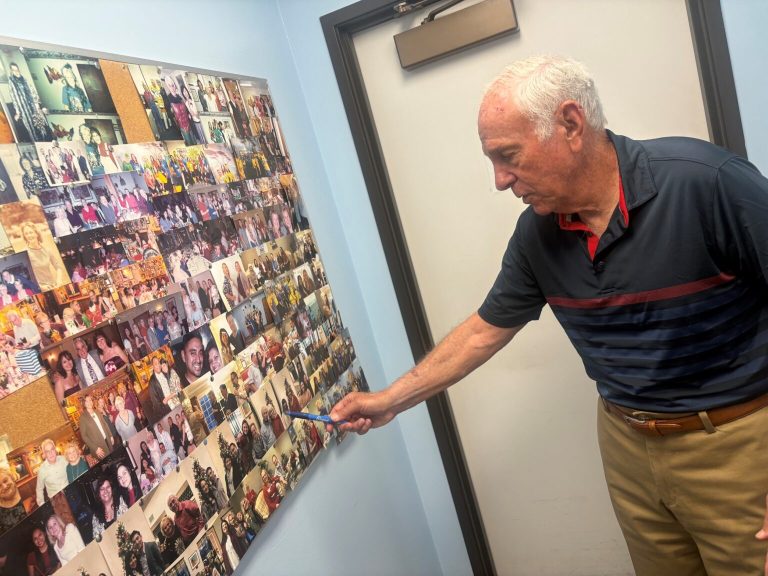
Now, wherever he goes, he inevitably runs into families eager to show Dr. Kaplan photos of the kids he once treated that are now, all grown-up, healthy, and with families of their own.
“I’ve been pretty lucky,” he admits, “and lived a pretty good life. We still have a lot of the friends here from when we first came here to practice,” said Kaplan.
Kaplan obviously has never been the subject of any famous painting, but given his history and well-earned success, his story does paint its own picture of a well-lived life.
An initiative launched in 2020 within the Los Alamitos Unified School District to teach filmmaking to high school students has grown into a district-wide effort that has inspired students throughout the system to express their own vision through film.
So much so that many parents, students, teachers, administrators, and board members from Los Al Unified filled the Bay Theatre in Seal Beach twice on May 30 to enjoy the 2nd annual Los Al High School Film Festival.
The demand for tickets was so great that organizers said they scheduled showings at 4:00 p.m. and another at 7:30 p.m.
“We sold out the 4 p.m. show,” said an excited Conner Brown, Los Al Unified School District’s Film and TV instructor, and by the time the 7:30 p.m. showing came around, the Bay Theatre was filled again.
Film and TV Director at Los Al Unified Conner Brown announces winners. Courtesy photo
“This community is so unlike any other community,” said Brown before the second show.
“It is so different because it so enthusiastically supports the school system and the school district,” he said.
“Los Al and Seal Beach are such school-first communities,” said Brown.
Brown moderated the show, introducing the videos with the enthusiasm of a parent or teacher who had grown anything from a tiny idea into what this film festival now represents.
“If you’re in the audience right now and you’re in elementary school, or if you’re in middle school,” the instructor said, “look at what you have to look forward to,” Brown said to the attending students.
Only in its second year, the Los Al Student Film Festival seems to be a smashing hit. The students and parents were laughing, clapping, and cheering each other on as Brown went through the films and students began to recognize their fellow students on screen.
Brown thanked all of the students for making films, apparently in such supply that only the top three from each category could be shown. Following the showing in each category during the 4 p.m. event, Brown announced the filmmakers and presented them with a trophy.
Full house twice at Los Alamitos High School Film Festival. Courtesy photo
The golden trophies, resembling a miniature Oscar Award, were presented to the winning filmmakers at the 4 p.m. show. This is the 2nd such film festival since students decided to utilize the recently renovated Bay Theatre on Main Street in Seal Beach. With the smell of fresh popcorn wafting throughout the 300-seat venue, student filmmakers within the Los Alamitos Unified School District crowded into the 21st-century iteration of the 1940s-era facility.
During the event, Brown ran through an impressive list of “wins” for the filmmaking program this school year. “It has been an amazing year for us,” said Brown, noting the various Los Al Film students winning county, state, and national competitions.
In addition, said Brown, “the county’s top film schools like NYU and USC are taking notice of the Los Al Unified filmmaking program.” Several of this year’s graduating seniors have been accepted at top film-related programs around the nation, he said.
Interest is also growing within the system.
Brown said 80 films made by students throughout the Los Al system were submitted for consideration for this year’s festival. Only thirty made the final cut.
Film festival attendees had the chance to see all 30 of them. Some, such as those from elementary school, were short but funny. Brown described them, with obvious affection, as “adorable” and “really, really funny and cute.”
The kindergartners through fifth-graders had been handed a challenge with literally zero formal film training and produced miniature narratives full of earnest drama and accidental comedy.
The winner, a short called “No Bread,” played to delighted laughter from every corner of the theater.
Then came the middle schoolers and their view of the world through film.
Brown said viewers could almost see the difference, “a shift in the way they work” as middle schoolers, imperfect still, but intentional.
“Camera angles were considered. Film cuts had a logic to them. One group made a commercial that made you want to buy the thing,” exclaimed Brown.Another made a music video that, despite the technical wobbles, had a genuine emotional pulse, he said.
And then came the high school films.
Brown had spent most of the evening warming up the room, but he got noticeably quieter when the high school reels began. The freshman and sophomore submissions, strong for intro-level coursework, gave way to the advanced students’ pieces. By the time the category reached the senior students, the audience had grown almost silent in its respect.
The statistics Brown dropped into his remarks told a more ambitious story still.
His students had entered a contest called Directing Change, a 60-second commercial promoting mental health awareness, and out of more than 1,300 submissions from across California, Los Al took second place.
In a safe driving PSA competition with 500 entries, they won first. That video, made by high schoolers in a classroom in Seal Beach, now plays in every DMV in California and on gas station screens across the country.
Two of his students’ commercials are currently running on television during Los Angeles Angels games.And then there was Chris Blocher, a Los Al student who entered OC Artist of the Year, a county-wide competition “typically dominated by private schools and arts academies,” but not this year.
“We won,” he said. It was the first time in the school’s history.
“This is your guys’ night,” Brown said to every student in the theatre. “You should be so proud of yourselves for all the hard work you put in to get here. Even just being here tonight is a special thing,” said Brown.
Three years ago, Brown started allowing his students to make a short film.
Students made the film entirely, from ideation to casting to directing, etc. The first one was all students and just one 15-20-minute film, a modest celebration of his students’ work at the end of the year.
It was good. His students loved it. The families who showed up were proud. But Brown kept thinking bigger. The first few were shown at the Los Al High Performing Arts Theatre.
“Then we decided, let’s take it up a notch. Let’s invite the middle schools to participate. Let’s invite the elementary schools to participate,” Brown recounted the decision.
Brown said he made some calls, talked to teachers across grade levels, brought in judges, organized nominees, and found the perfect venue, the recently renovated Bay Theatre in Seal Beach, which was willing to partner with a public school on a two-show event.
This year, for the first time, the Seal Beach Student Film Festival opened its doors, and its trophy cases, to filmmakers from kindergarten through senior year.
Filmmakers deserve a showcase just like football, basketball, orchestra, etc. said Brown, and the LAHS Film Festival seems like a smashing hit.
“We want this event to become a fixture of this community,” Brown said, “something people circle on their calendar the way they do the Car Show or the Christmas Parade,” he said.
“We want it to become a local institution,” said Brown.Based on the last two shows, he may already be closer to it than he thinks.
###
LAHS Film Festival Winners:
The Bay Theatre in Seal Beach. Courtesy photo
Elementary Short film Winner: No Bread by Sabrina Nunez and Miley Antunez Middle School Commercial Winner: Uber Eats by Noah Yoon and Owen Chua Middle School Music Video Winner: The Man by Brea Berani, Solyana Girum, Jaxon Price, Isaac Davalos, Camila Real, Cerys Burns, Ryan Vu, Eric Ang-y, and Aila Nickloff Middle School Short Film Winner: When Nobody is Watching by Jack Standlea, Presley Markle, Levi Shockley, Silas Wille, and Charlie Dodson Beginning High School Commercial Winner: Sprite by Whitney Rupp Beginning High School Music Video Winner: Punk Rocky by Andrew Tellez, Ian Huh, Connor Kubit, and Colt Carroll Advanced High School PSA Winner: Superhero by Joseph Ito, Davis Taylor, Chris Blocher, Audrey Romo, Mason Potter, and Ash Fragoso Advanced High School Music Video Winner: Satellite by Chris Blocher, Zach Blocher, & Jayden Villa Advanced High School Short Film Winner: Updawg by Joey Ito, Davis Taylor, Leonard Rosa, Audrey Romo, Milo Gih, Ryan Quinn, Jayden Villa, and Fiona Cole.
U.S. Representative Derek Tran (D-CA-45) introduced bipartisan legislation alongside Representatives Morgan Luttrell (R-TX-08) and Jeff Crank (R-CO-05) to prevent the deactivation of certain U.S. Army Reserve aviation units.
The Prohibit Deactivation of the ECABs Act of 2026 would protect the Expeditionary Combat Aviation Brigade (ECAB), including a medical evacuation unit stationed at Joint Forces Training Base-Los Alamitos (JFTB-LA). This unit is critical to California’s military and disaster relief preparedness.
Representative Tran represents JFTB-LA in Congress and completed a portion of his training there as a member of the U.S. Army Reserves.
U.S. Congressman Derek Tran Courtesy photo
The legislation would limit the use of certain funds for the deactivation of Expeditionary Combat Aviation Brigades (ECABs) that provide capabilities like air assault and medical evacuation (MEDEVAC) to support our armed forces’ readiness. The U.S. Army plans to deactivate the ECABs on September 15, 2026, despite replacement capability not being available until 2030. The proposed deactivation of a medical evacuation unit at Joint Forces Training Base Los Alamitos would impact the livelihoods of 150 soldiers and 34 civilians while leaving a gap in the region’s disaster relief capabilities.
“The medical evacuation unit at Joint Forces Training Base Los Alamitos is a critical asset for emergency and disaster relief missions, serving communities across Southern California. Deactivating these flying units without a clear plan for how the service intends to fill the capability gap will hurt our communities at home and diminish our readiness to respond to global conflicts,” said Representative Tran.
“The soldiers and civilians impacted by this drawdown have not been given meaningful options to continue their service. Trained pilots and experienced personnel are leaving the force because they have not been given a clear plan for their futures. We have invested so much in training and equipping highly qualified service members, and now we are letting them walk away. I am proud to introduce the bipartisan Prohibit Deactivation of the ECABs Act to ensure that the Department of Defense presents a credible plan to recapitalize these capabilities, retain this expertise, and ensure that our military readiness remains at its peak,” he said.
“Our Army Reserve units are doing critical work and deserve certainty as they execute their missions,” said Representative Luttrell. “Deactivating the ECABs before a replacement capability is set creates an unacceptable gap in our force structure and gambles with our nation’s readiness. This legislation ensures our posture doesn’t waver throughout this transition while mitigating operational risk.”
“The 11th Expeditionary Combat Aviation Brigade headquartered at Fort Carson is vital to the mission and support for local search and rescue operations in conjunction with the El Paso County Sheriff’s Office,” said Representative Crank. “Deactivating the Brigade would weaken the Army’s ability to surge capabilities in conflict and leave Colorado’s Fifth Congressional District’s emergency responders shorthanded.
By introducing the Prohibit Deactivation of the ECABs Act, we are ensuring that the Department of War has a plan to recapitalize capabilities, resources, and personnel of the Brigades to support warfighters, preserve expertise, and protect Coloradans.”
Representative Tran serves on the powerful House Armed Services Committee, overseeing the Department of Defense. In a May 15 House Armed Services Committee hearing, Tran questioned Army Secretary Daniel Driscoll and Acting Army Chief of Staff General Christopher LaNeve about the department’s decision to deactivate ECABs at Joint Forces Training Base Los Alamitos.
An Army Veteran, Representative Tran is dedicated to expanding protections and benefits for Veterans and service members in Washington.
The first bill Tran introduced in Congress was H.R. 1637, the Protect Veteran Jobs Act, to restore the livelihoods of Veterans wrongfully fired from their civil service positions. He recently joined Representatives Chrissy Houlahan (PA-06) and Maggie Goodlander (NH-01) in introducing the WARRIOR Act to protect women’s ability to serve all roles across the military, including in combat. Courtesy of Rep. Trans’s office
Integrity Newspapers, Inc. has announced the appointment of Alan Moskal as Publisher of Seal Beach Sun and Group Publisher of the company’s Orange County newspaper publications.
Moskal brings nearly two decades of experience with Integrity Newspapers, having advanced through the organization from advertising sales into senior leadership positions. Throughout his tenure, he has played an instrumental role in business development, community engagement, circulation growth, operational oversight, and the continued success of the company’s local publications.
His appointment follows the retirement of longtime Seal Beach Senior Account Manager Donna Leedy, whose 21 years of dedicated service helped shape the success of the Seal Beach Sun and its sister publications. Leedy’s commitment to community journalism, customer relationships, and operational excellence leaves a lasting legacy throughout the organization.
Moskal will work closely with Leedy during the transition to ensure continuity for readers, advertisers, and community partners. In his new role, Moskal will provide leadership and strategic direction for Integrity Newspapers’ Orange County publications while continuing to support the broader organization.
“I’m excited to have the opportunity to work more closely with the Orange County communities,” Moskal said. “My wife and I have spent a great deal of time in the area over the years and have come to appreciate the unique character of these communities. Having worked in community newspapers throughout my career, I feel this is an ideal fit and look forward to building relationships with our readers, advertisers, and community partners.”
Moskal’s newspaper career spans more than 30 years and includes leadership in advertising sales, publishing, editorial collaboration, distribution management, and community relations. He began his newspaper career in the Midwest and has extensive experience in newspaper and magazine publishing throughout Michigan and California. His commitment to local journalism and community involvement has helped strengthen the connection between Integrity Newspapers and the communities it serves.
“Alan is a rock-solid community newspaper man,” said Linda Rosas, Senior Vice President of Integrity Newspapers, Inc. “He understands that local newspapers are more than just publications; they are part of the fabric of the communities they serve. His passion for community journalism, coupled with his experience and leadership, make him the perfect person to lead the Sun and our Orange County publications.”
Fresh off the release of their first album, “In the Spotlight,” a local rock group was proclaimed the winner of the prestigious “Echo Sessions” Battle of the Bands showcase, earning a spot in the upcoming Echo Sessions festival.
Nonso Ikeji on bass, photo by Sara Naccarato
The band, Familiar Faces, is an explosive, Long Beach-based pop-rock and indie band. They captured the attention of the music community by winning the Echo Sessions Battle of the Bands, earning a highly coveted spot to perform at Echo Fest, according to the event sponsor.
Chad Bierman, photo by Sara NaccaratoSean Bierman, photo by Sara Naccarato
They earned the coveted title after winning a showcase presented by the Guitar Center Music Foundation, the Wherever You Go Foundation, and Fab Factory Studios.
Their energetic sound is led by captivating guitar arrangements that resonate deeply with fans of modern alt-rock.
The competition featured several hand-selected emerging artists on May 29 in East Hollywood at the Gold-Diggers venue.
The band’s founding duo, identical twin brothers Sean (guitar/vocals) and Chad Bierman (guitar/vocals), grew up busking in the streets of Seal Beach and Los Alamitos starting in middle school.
For many years, the duo performed locally as “The Bierman Brothers.”
While attending Cypress College, however, the brothers met Nonso Ikeji, who became their bass player, and the group settled on “Familiar Faces” as the band’s new name, which reflected on the twins’ identity while expanding it to encompass a more professional appeal.
Now college graduates, the duo continues to pursue their dreams of music with Nonso and, currently, with Brennan Murray on drums.
Their music blends indie and psychedelic rock, drawing heavy inspiration from acts like Led Zeppelin and Tame Impala.
“Renowned for their high-voltage live shows, Familiar Faces has electrified audiences along the California coast, gracing the stages of iconic venues such as The Troubador, The Whisky, Viper Room, The Mint, Catalina Island, and much more. In November 2023, their original song, “Don’t Stop Us” debuted nationally on SiriusXM Deep Tracks by the legendary, iconic DJ, Jim Ladd. And in December 2023, Familiar Faces won The Jam In The Van and Battle of The Bands L.A.
The Aquarium of the Pacific is home to one of the most diverse collections of sea jellies in the United States. Due to the ground-breaking work of its staff, the Aquarium propagates and raises over forty species in unique spaces specially designed for each stage in the jelly life cycle. Staff members also culture or grow the nutritious food that the sea jellies need to thrive in each of their life stages.
These efforts are all part of the Aquarium’s commitment to sustainable aquaculture or the cultivation of aquatic species and providing state-of-the-art care to all of its animals.
Jellies are housed in special aquariums designed to meet their specific needs. In addition to the curved shape of their home, jellies also need just the right water flow—not too strong to injure their delicate bodies and not too weak to ensure they are allowed to naturally drift. Aquarium staff members also carefully monitor other habitat parameters, including lighting, water temperature, salinity, pH, and more. Achieving the right conditions for jellies to thrive takes a team—animal care, veterinary services, water quality, and life support. The animal care staff monitor the health of the jellies daily.
The sea jellies are also part of the Aquarium’s overall animal welfare assessment program, where each jelly is assessed based on a five-point scale on body condition, feeding response, growth, water parameters, and more. This data is recorded and discussed with the animal welfare committee.
As an Association of Zoos and Aquariums (AZA) accredited organization, the Aquarium of the Pacific meets and exceeds the rigorous standards of care set for sea jellies. The Aquarium participates in AZA’s Aquatic Invertebrate Taxon Advisory Group to help further knowledge about these gelatinous creatures and other invertebrates (animals without backbones).
Sea jellies have no heart, brains, or lungs and existed on Earth before the time of dinosaurs. They have been around for more than 500 million years and have adapted to every ocean environment on Earth. Sea jellies are not fish, but invertebrates – animals without backbones. There are approximately 200 species of true jellies, and they are relatives of sea anemones and corals. Jellies range in size from those not much larger than a pencil eraser, to those longer than a blue whale. Sea jellies also come in many different colors, including green, blue, purple, and orange. A group of sea jellies is called a smack.
Jellies are composed of protein, mineral salts, and ninety-five percent water. Jellies have three main parts: the round, umbrella-like bodies or bells with a network of nerve cells, which propel the animals with a pulsating motion; tentacles equipped with nematocysts that sting and immobilize prey; and oral arms or flaps that are used to transport their prey to feed on it and to brood their young. Sea jellies mostly eat zooplankton, small crustaceans, fish, or other sea jellies depending on their species. Depending on the species, a sea jelly may have up to 1,200 tentacles. Some jellies wield a potent sting, but you can safely touch others at the Aquarium of the Pacific on its Harbor Terrace. Some jellies are also indicator species whose presence can inform on if ocean water is clean or polluted.
The life span of a sea jelly varies depending on the species. Some only live a few months and others live several years. The average life span of a sea jelly is about one year.
Jellies clone themselves to reproduce. The Aquarium’s aquarists have successfully cultured numerous species of jellies. Below is a list of some of the species you may see throughout the opening year of Jelly Dreamscapes. This will be a dynamic exhibit where guests can see different species depending on when they are visiting the Aquarium.
Moon jelly (Aurelia coerulea) The Asian moon jelly is one of the most widely distributed species of sea jellies found in our World Ocean. This species can quickly populate areas and reduce the amount of zooplankton by consuming it. They are believed to be originally from the northwest region of the Pacific Ocean and that humans unintentionally introduced them to Europe via maritime or shellfish transport. This species can be white to brownish pink. Its bell can reach over ten inches in diameter. This jelly reaches around two inches in length. They produce an antioxidant compound that scientists are studying for its beneficial properties. GeoRange: Northwest Pacific Ocean and introduced to Europe
Blue lion’s mane jelly (Cyanea lamarckii) When they are young, this sea jelly is typically white to pale yellow. As they grow, they develop more of a color, which can range from grey to blue to purple. They use their up to 800 stinging tentacles to capture phytoplankton, zooplankton, and even other jellies to feed on and also for protection from predators. The bell of the blue lion’s mane jelly can grow to nearly twelve inches in diameter. They have oral arms that can reach the same length as their diameter. They are regularly observed in coastal waters off the British Isles. Geographic range: Mainly in the Northeast Atlantic Ocean, primarily near European coasts
Brownbanded moon jelly (Aurelia limbata). This cold-water species of jelly is most commonly found in the Northern Pacific and Arctic Oceans but can sometimes be found in nearby temperate seas. They inhabit coastal and open ocean waters. The Brownbanded moon jelly tends to be translucent to off-white in color with a brown edge around its bell, which differentiates it from other species of moon jellies. It can grow up to twelve inches in diameter and since they are not known for their length, it is not commonly reported on. Their food sources include larval crustaceans called decapods. At the Aquarium, they have a varied diet, including krill, artemia, and more. Geographic region: Mainly the northern Pacific Ocean and Arctic Ocean California sea gooseberry (Hormiphora californiensis) This species of comb jelly or ctenophore has tiny hairlike structures called cilia that run down its sides. When light refracts on their cilia, it can resemble strings of glowing lights. Comb jellies are believed to be among the earliest animals on Earth. They are not true jellies and are instead planktonic animals, which feed on other planktonic animals such as copepods and other plankton. The California sea gooseberry has an oval-shaped gelatinous body that can reach up to an inch in length and is translucent. Geographic Range: Common off the California coast, including the coast of Long Beach
Marbled jelly (Lychnorhiza lucerna) As this jelly grows, its bell becomes flat like a dish that can grow up to nearly twelve inches in diameter, but the average is approximately nine inches. They are translucent with a dark edging around the base of their bell and can sometimes have a pale brownish marbling on the bell. Young crabs use the inside of their bell as a nursery. They lack long marginal tentacles and instead have complex oral arm structures. The marbled jelly has eight oral arms, with those reaching five to nine inches in length. Marbled jellies feed on zooplankton and larger ones may eat shrimp and even other jellies. They can be found in shallow waters off the east coasts of South America and in estuaries in that region. This species of sea jelly often becomes stranded on beaches. Geographic range: Tropical and subtropical waters of the western Atlantic Ocean (native to Atlantic coasts of South America)
South American sea nettle (Chrysaora plocamia) As with most other jellies, the tentacles on this jelly have small, barbed stingers called nematocysts that release a toxin to immobilize their prey. They feed on zooplankton, larval fishes, and even other jellies. The bell of this jelly can grow up to around twelve inches or more in diameter and six feet or more.
The Warland Investment company from the Cypress Business Park has stepped up this week and donated $25,000 for the families from Cypress caught in the mandatory evacuation zone during last week’s Garden Grove Incident, according to District 5 Council member Rachel Strong Carnahan.
When emergency planners from the Orange County Fire Authority drew up concentric rings to be included in a potential blast impact area during the Garden Grove GKN chemical scare last week, streets in nearby Cypress that housed about 2,500 households were included in the mandatory evacuation area.
According to Strong, most of the residents affected by the incident and forced under a mandatory evacuation order to leave due to the city’s proximity to the Garden Grove incident were from District 5.
In addition, she said the Cypress Business Park is also located in District 5.
Council member Rachel Strong Carnahan Courtesy photo
Strong was recently appointed to fill the vacant Council seat representing District 5 upon the resignation of former Mayor and Council member Scott Minikus.
“Hope Warschaw and Chip Robertson, the co-managing directors of Warland Investments, reached out to me to begin investigating with city staff how to provide immediate relief,” said Strong in an interview with ENE.
“Warland and I initially talked when the hazmat situation was unfolding,” said Strong.
“They decided to donate $25k in funds directly to the community and just needed a way to distribute that,” she said. “It is just such a genius idea,” she said, “they’ve been very consistent with donating to the community, being present and being part of things,” said Strong.
“This is just one more phase of that but incredibly generous,” said Strong.
“I contacted our city staff to find a means to do so. Jason Machado at City Hall under the direction of our City Manager Shannon DeLong was key in connecting us all with United Way as a means to distribute that money as well as gather and distribute other relief funds,” she said.
“I know the hotels were very expensive for some, while others left town to stay with relatives, and overall, this will give a chance to many of those evacuees who endured a financial burden to get reimbursed,” said Strong.
“I think the Garden Grove evacuation really made life complicated for so many people,” said Strong, noting that it affected people with pets “and we had people in shelters and all kinds of stuff going on, so I think this is a beautiful, magnanimous gesture to just show that they’re really partners with our community,” she said.
“I will be walking through the affected neighborhoods, about 2,500 households in the southern most part of the city, to ensure people are aware this is available,” the District 5 Council member said.
Cypress residents can donate now and call in to a hotline – 211 – to apply for relief. She said the link is live and ready for resident’s interaction.
“There are resources on the city webpage as well as their social media feed. I also have a feed for my district, which is available at @racheloncypresscitycouncil,” Strong said.
The role nonprofit organizations play in our community again took center stage at a joint meeting of the Los Alamitos and Seal Beach Chambers of Commerce held this week inside the Epson America meeting hall.
Los Al Chamber President Richard Barnes thanked the audience of business leaders, community members, and nonprofit professionals from across the Los Alamitos, Seal Beach, and Cypress areas for their participation.
The panel featured four nonprofit executives representing a cross-section of the region’s service sector, from emergency youth shelter to food rescue to international civic service, each making the case that strong boards are not a luxury but a lifeline. The four nonprofit panelists included Diana Lara, Executive Director of Food Finders.
Food Finders operates as a food rescue organization, collecting perishable donations from grocers, manufacturers, growers, and food service providers and delivering them directly to nonprofit partners across LA, Orange, San Bernardino, and Riverside counties for same-day or next-day distribution. The organization also runs a Food for Kids program.
Lupita Gutierrez, Executive Director of CASA Youth Shelter, brought more than 15 years of connection to an organization she described as “very near and dear to my heart.”
Courtesy photo (L-R) Kevin Young, Seal Beach Lions Club, Michelle Byerly, Executive Director, The Nonprofit Partnership, Lupita Gutierrez, Executive Director, Casa Youth Shelter, Diana Lara, Food Finders and Tiffany Roberts, F&M Bank Foundation, the moderator.
CASA Youth Shelter serves young women in crisis, she said, describing them as “the most vulnerable population,” caught between adolescence and adulthood.
Michelle Byerly, Executive Director of The Nonprofit Partnership (TNP), leads an organization founded 34 years ago by a group of executive directors who recognized that nonprofits themselves needed support to be effective.
She said the Partnership serves approximately 1,000 nonprofits annually across Southern California through workshops, consulting, grant administration, and convening.
Kevin Young, President of the Seal Beach Lions Club, said their organization represented a different model entirely, a service organization rather than a traditional nonprofit, but one with formidable reach.
The Seal Beach club counts over 400 members, making it the largest Lions Club in the Western Hemisphere, with members ranging in age from 19 to their 90s and a membership that is 51 percent women.
Tiffany Roberts, Director of the Farmers and Merchants Bank Foundation, served as moderator of the Los Alamitos Chamber’s Nonprofit Board Leadership Forum.
Roberts directed much of the discussion around the various boards and directors of these nonprofit organizations, comparing them to “steering wheels” in autos.
“When we look at cars, we think about engine power, interior design, exterior design,” she said, noting that “in the nonprofit world, the board is like the steering wheel. It doesn’t power the engine day-to-day; that’s what the executives and their staff are doing. But without the steering wheel, the organization can drift, stall, or even head straight into a ditch.”
Roberts steered the executives into a discussion about the roles played by board members of each organization. Byerly was direct: “The board’s job is governance, not management. They set the direction, they ensure accountability, they protect the mission. They are not there to run the programs,” she said.
What boards are expected to provide, across all four organizations, fell into recognizable categories: strategic guidance, financial oversight, fundraising, and access.
“The board is your connector,” Lara said. “They open doors that staff can’t open on their own.” Gutierrez described the board’s role at Casa Youth Shelter in terms of what the young women served by the organization see in board members.
“When our board members come to an event and interact with the young people, those kids see that there are adults in the community who care about them. That matters more than any program we can design,” she said.
Young said his club represented a different model entirely, a service organization rather than a traditional nonprofit, but one with formidable reach. He said the club manages roughly 150 to 160 projects annually, from vision screenings and graffiti removal to beach wheelchairs, rescue drones, and the restoration of a World War II submarine memorial on Seal Beach Boulevard.
“We have everything from just going and cooking hamburgers and hot dogs,” Young said, “to some big fundraising projects.” The Seal Beach Lions Club’s board has 21 members, drawn from across the community, he said.
The panelists also described in some detail what board members do for the organizations they serve.
Byerly reinforced the accountability dimension. “The board holds the executive director accountable. And the executive director, in turn, is the one resource the board directly manages. Everything else flows from there.”
Roberts wondered if some boards have a “Give, get or get off,” board strategy, asking each panelist about what board service actually requires.Young offered the Lions Club perspective, saying a dues structure had replaced traditional board members’ giving expectations, and where the real currency is time and active participation in Lions Club projects.
“We want people who show up,” he said.
Gutierrez was candid about what that looks like in practice: “I’m going to be honest with you. If you join our board, I’m going to need you. Not just at meetings. I’m going to need you to answer a text sometimes. I’m going to need you to make a call.”
Lara described Food Finders’ current board as focused primarily on connections and strategic thinking during its rebuilding phase, with financial contribution expectations that are meaningful but tiered.
Gutierrez noted that Casa Youth Shelter asks board members to participate in its annual gala — one of the organization’s primary fundraising events — both as attendees and as ambassadors who bring others.
The panelists all agreed that not everyone who is asked to join a nonprofit organization board accepts the challenge. The most common reasons people decline board service, they said, are time, perceived lack of expertise, and the fear of fiduciary responsibility.
Roberts addressed the last fear directly, noting that “when some people hear ‘fiduciary,’ they think it means they’re personally liable for everything. It doesn’t mean that. It means you have a duty to act in good faith, in the organization’s best interest, with the information you have. That’s a standard any reasonable person can meet,” she suggested.
On the time involvement concern, Byerly offered an interesting observation.
“Most people spend more time scrolling their phone in a week than a board commitment would require. This is about priorities, not availability,” she suggested.
Lara said serving on a nonprofit board does make board members “feel like they’re a part of a connected community.”
Young spoke to the depth of engagement that board service creates.
“When you’re a member, and you just go to the meetings and go to a project, sometimes you don’t understand what’s going on. But if you take that step and get involved in the board, it’s a deeper commitment, you learn more, you get more out of it,” he said.
Despite the challenge of serving on a board, all of the executives agreed that it has been their experience that personal fulfillment was always the result.
“When our board members come to our community marketplace and actually see the distribution (of food) in person, they just come away with such fulfillment. They’re like, ‘We know what you do, but to actually be a part of it makes a huge difference.’
That whole fulfillment is a big part of what board service is,” said Lara.
Gutierrez pointed to what that fulfillment looks like at Casa Youth Shelter. Board members are seeing their dollars and their effort in action with the young people the organization serves, she suggested.
“It’s nice to get excited about something,” she said. “Find something that you’re passionate about, then it feels like you get to be a part of something instead of feeling like you have to go do something.”
“If you want fulfillment, connection, impact, and joy, it sounds like you might want to join a (nonprofit) board,” Roberts said with a closing summary.
Barnes thanked the panelists, the moderator, and the title sponsors, including CIU Networks and Landon HR Consulting, thanking also the executives of Epson America for its relationship with the business community and their participation in it.
The Los Alamitos Chamber of Commerce hosts regular forums, luncheons, and community events throughout the year. For more information on upcoming events or board service opportunities with the organizations featured in this story, contact the Chamber directly, or reach out to Food Finders, Casa Youth Shelter, The Nonprofit Partnership, or the Seal Beach Lions Club.
This event was jointly hosted by the Los Alamitos and Seal Beach Chambers of Commerce.
There have been times of real tension in the past between Rossmoor’s two largest organizations, the Rossmoor Homeowners Association and the Board of Directors for the Rossmoor Community Service District.
Over the past few years, however, the RHA has engaged with the RCSD on various projects, and, in fact, Jo Shade, a longtime RHA executive, now serves as President of the RCSD Board, having run for and been elected to the board of RCSD.
“I find this so incredible,” said Shade this week, “it’s such an incredible and generous gift from the RHA. I am proud to say that I served with you guys, and like, this is insane,” she said.
“They (RHA) are so amazing and incredible to me, so I thank you,” the Board President said.
At their most recent board meeting, General Manager Sharon Landers said Art Remnet, President of RHA, had reached out to the district.
“On their own volition, they came to me and indicated they were aware of the conversation that had been taking place related to the possibility of purchasing an electric golf cart vehicle,” said Landers.
“They said RHA was interested in making a donation of $25,000 for that electric vehicle,” said Landers. Remnet, who spoke on behalf of the RHA board, said the donation, in essence, is what good neighbors are supposed to do.
“It’s really our pleasure,” Remnet told the board.
“This is how a community works together,” he said. “We happen to have some money that we could afford to give you, and you have a need,” he said.
Remnet said RHA understands the electric vehicle will greatly assist the administration in keeping up the trees and parks, which he said, behind the school district, is the top reason people choose to live in Rossmoor.
“If we can help the district do that, and be more effective and more efficient, it just makes sense for us to do that,” said Rement.
“We are one community working for Rossmoor, so it’s our pleasure to make this donation,” he told the board.