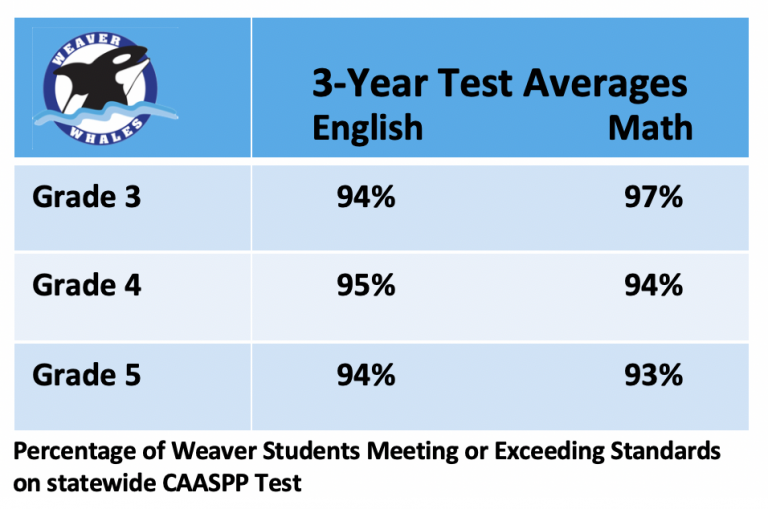
Weaver Elementary School in Rossmoor is the top performing school in Orange County based on statewide testing in English language arts and mathematics. More than 93 percent of Weaver students met or exceeded state standards in both subject areas of the California Assessment of Student Performance and Progress (CAASPP), which is administered in third through fifth grades.
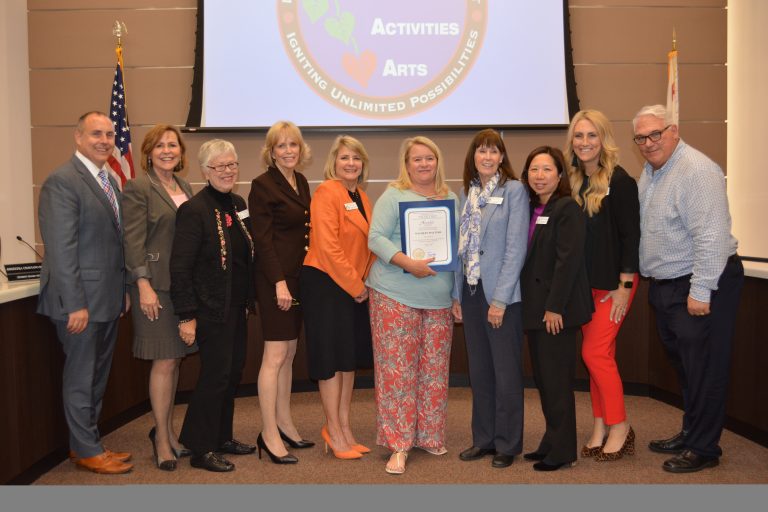
In his report to the Los Alamitos Unified School District board, Weaver’s interim Principal Rick Larson called the results “absolutely spectacular.”
“Weaver’s achievement in academics is a collaborative effort between teachers, students, and parents coming together under a unified vision that all students can thrive when they have unlimited possibilities,”
The community gardens at Stanton Park are sprouting with the help of some additional green thumbs from UnitedHealthcare employees. A team of 10 employee volunteers from UnitedHealthcare spent the afternoon planting and maintaining the Stanton Community Garden, Volunteers helped disassemble garden beds to be moved to the bigger and more open site at Stanton Park, where the garden was recently relocated to. Together, the team was able to relocate 25 garden beds that will be re-used at the new garden, which is open to any resident of Stanton who is interested in gardening.
Community Gardens enhance the quality of life in Orange County by eliminating and preventing the causes and effects of poverty by mobilizing and directing resources to programs that assist, educate and promote self-sufficiency. Part of that initiative has been to create community gardens in low-income neighborhoods to promote and educate residents about the benefits of healthy living in a fun and rewarding way.
The local writing duo of Janet Elizabeth Lynn and Will Zeilinger recently announced the release of “Gametown,” their latest and final in their Skylar Drake Mystery series. The couple lives in Long Beach. Will grew up in the area, having attended high school in Huntington Beach.
The book is the latest from the married authors and it follows private investigator Skylar Drake, who is hired as a bodyguard for two young starlets. He delivers them home after the 1957 Emmy Awards ceremony, but stumbles onto the murder of Silver Brovor-Smith, the mother of one of his charges. He wonders why the FBI is on-scene for a simple murder.
Drake and his partner are now on the case as suspicion shifts between the victim’s husband and her three brothers.
Drake and Dolan are misled while kidnapping and mysterious deaths take them into the world of Hollywood backroom deals.
They must keep the high-profile family from becoming front page news.
Drake meets the perfect woman to help him move on, but is she a suspect?
The letters P-E-G-O seem to appear everywhere. He thinks they may be connected to the crimes. Follow Skylar Drake to Hollywood parties where the forbidden is accepted and games played are for keeps.
These published authors say they wrote individually until they got together and created the Skylar Drake Mystery Series. These hard-boiled tales are based in old Hollywood of 1956-57. Janet has published seven mystery novels and Will has three plus a couple of short stories. Their world travels have sparked several ideas for murder and crime stories. This creative couple is married and live in Southern Californi
Maureen Wauters has done so much to help out in schools that Los Alamitos High Principal Dr. Gregg Stone had to write an epic, 13-stanza poem to praise her two decades of volunteer work and honor her as the high school’s 2019 Hero of the Heart.
Speaking to the Los Alamitos Unified School Board, Stone said Wauters began volunteering at Hopkinson Elementary in Rossmoor even before her sons had entered school and served in many capacities including president of the school’s fund-raising group.
She moved on to Oak Middle School with her sons and helped out with school events such as Pi Day, 6th Grade Social, Back to School luncheons, and eighth-grade promotion ceremony. She served as PTSA treasurer and vice-president and is a recipient of that organization’s Honorary Service Award.
At Los Alamitos High School, Wauters was instrumental in organizing Grad Nights, fall class registration and the cross-country team banquet among many events. She moved up to executive vice-president of PTSA and president of the golf team boosters.
Stone said Wauters is a regular at athletic contests and drama, band, and choir performances. “Maureen supports all students; that is all she knows.”
When not helping out at the high school, he added, Wauters is active in Pony Baseball, Scouts and We Care.
“Over many years Maureen has helped so many and gone the extra mile,” Stone wrote in concluding his poem. “She does this with humility, care, and dedication, and always with a smile.”
In accepting the honor, Wauters said, “I really do it for the kids. So, if you know any kindergarten or first grade parents, tell them to get involved. They won’t regret it.”
The California Jazz Conservatory (CJC) is offering a full-tuition, four-year scholarship to “the most successful jazz education startup in the United States” (as noted by jazz historian and critic Ted Gioia in a recently published article in New York’s City Journal magazine). The scholarship will allow the winner to work their way towards a Bachelor of Music in Jazz Studies at the only music school in America completely devoted to jazz.
Los Alamitos High School Jazz 1, led by Los Alamitos High School Band Director Justin Padilla, will be participating in the Next Generation Jazz Festival (presented by the Monterey Jazz Festival), April 5 – 7 in Monterey, California. Groups from across the country and around the world will be playing in the prestigious event, the majority of those groups having performed at the highest levels in order to qualify for participation in the Festival.
The full-tuition, four-year scholarship to the California Jazz Conservatory is for the upcoming Fall semester. Applications are available only at CJC’s Next Gen booth.
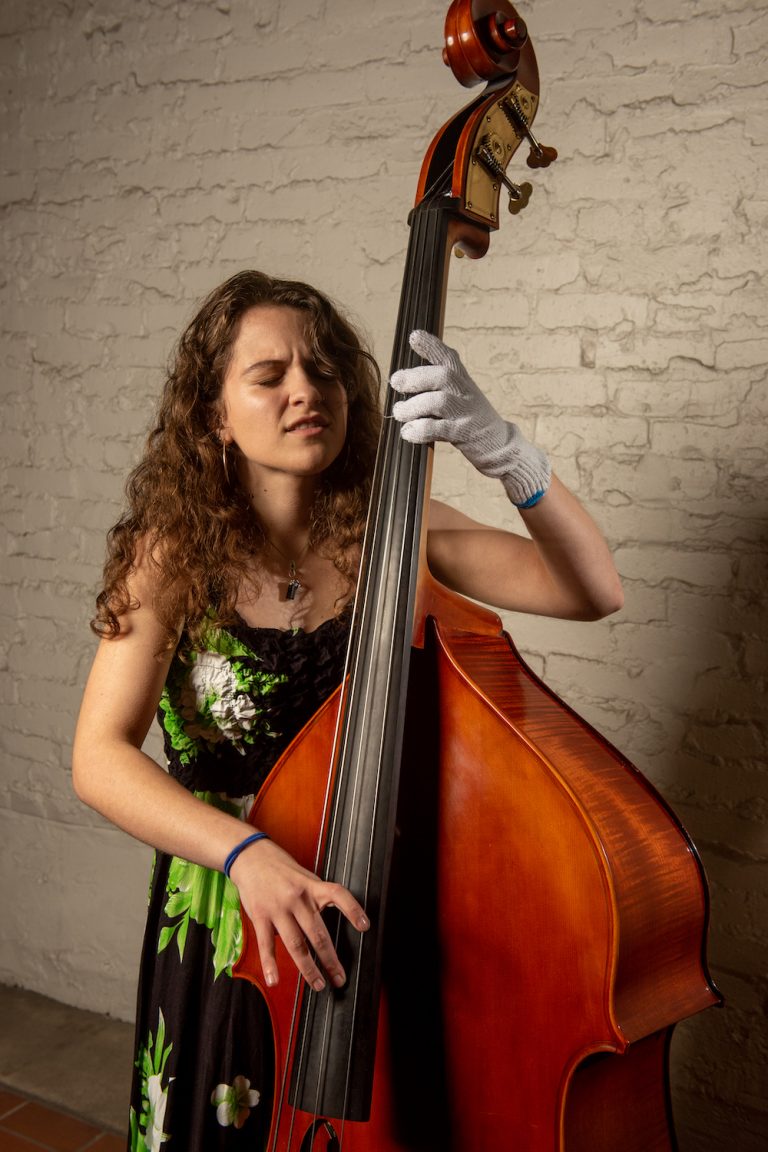
CJC awarded a similar scholarship last year at the El Cerrito Jazz Festival. Winner, bassist Autumn Salvo, is now a first-year student at the Conservatory.
About The California Jazz Conservatory: The California Jazz Conservatory (CJC) is the only independent, accredited music school in the country completely devoted to the study and performance of jazz. CJC offers a Bachelor of Music degree in Jazz Studies and an Associate of Arts degree in Jazz Studies. CJC’s non degree-granting Jazz school offers over 100 classes and workshops on a quarterly basis. CJC also presents concerts year-round in two intimate venues, featuring visiting artists, students and faculty. For more information about CJC, visit www.cjc.edu.
Courtesy Photo
Caption: 2018 scholarship winner Autumn Salvo, a first-year CJC student.
The Cypress City Council is pleased to announce its annual Commissioner recruitment. Registered voters residing in Cypress who are interested in serving on the Recreation and Community Services Commission, Senior Citizens Commission or Traffic Commission are encouraged to apply by April 30, 2019.
Applications are available on the City’s website (www.cypressca.org) or from the City Clerk’s office. Resumes that include information on civic involvement and reason for wanting to serve on a City commission will also be accepted. Applicant interviews will be conducted by the City Council and appointments will be made in June. Commissioners serve a four-year term that begins July 1, 2019.
“Serving on a commission is a great way to become more involved in the city. As a former Senior Citizens Commissioner, I encourage all residents interested in serving our community to apply,” stated Mayor Berry.
The Recreation and Community Services Commission currently has three openings. The Recreation and Community Services Commission advises the City Council on parks acquisition, development, and maintenance. The Commission meets once a month, on the third Tuesday, at 7:00 p.m. at the Cypress Community Center.
The Senior Citizens Commission currently has three openings. The Senior Citizens Commission advises the City Council on the concerns of senior citizens, including recreational opportunities, social services and affordable housing. The Commission meets once a month, on the second Wednesday, at 3:30 p.m. at the Cypress Senior Citizens Center.
The Traffic Commission currently has three openings. The Traffic Commission recommends ways and means of improving traffic conditions and traffic regulations. The Commission meets once a month, on the third Tuesday, at 3:00 p.m. at Cypress City Hall.
The City of Cypress Boards, Commissions and Committees Policy Manual is also available on the City’s website. For more information, please contact the City Clerk’s Office at 714-229-6683.
Author Kristine Wood will be the guest speaker at the Cypress Chamber of Commerce Networking Breakfast Tuesday, April 9th at the Residence Inn by Marriott (4931 Katella Avenue, Los Alamitos) at 7:30 a.m.
Kristine Wood and her husband, longtime Cypress Dentist Don Wood, are a part of a group of motorcycle riders who travel each year, as part of an organized group, to the Vietnam Memorial in Washington DC to honor the veterans who served. Hundreds of bikers across the United States arrive in DC over Memorial Day weekend to take part in the Run for the Wall event.
Kristine joined with a professional photographer and compiled a book of her experiences over the past 3-4 years doing this Run for the Wall ride and will share her many stories that went into her book. The book, Run for the Wall – A Journey to the Vietnam Memorial, explains the purpose of the event, the message and the patriotism demonstrated through photos and brief narration.
Kristine’s book will also be available for sale at the breakfast.
Reservations are suggested for the monthly breakfasts and can be made directly on the Cypress Chamber website at cypresschamber.org. For more information call 714-484-6015. Cost of the breakfast is $20 in advance or $25 for nonmembers or those who do not register in advance. Attendees are encouraged to bring door prizes to promote their product or service. The programs include a meet and greet time, self-introductions, breakfast, speaker and a question and answer session if time permits.
The Chamber breakfasts, which are open to the public, are held on the second Tuesday of every month.
Married in 1962, the Caldwells bought their first home together in Los Alamitos in August of 1963. They quickly became much more than mere neighbors to the folks living in the Dutch Haven community. Tex and Lorraine were surrounded by a wide circle of kids and adults alike who came to know and love them more as parental figures, best friends, mentors, confidents, and most gracious hosts, to name a few.
Both Tex and Lorraine had been raised in small towns, she in Central City Iowa, he in Aransas Pass, Texas. And after they decided to make Los Alamitos their home, they wanted nothing more than to recreate the kind of small town charm they grew up with and so appreciated. And they did… in this brand-new neighborhood, full of hopeful young families who immediately took to their warmth, generosity and kindness. They fostered trust – so much so that eventually they possessed the keys to almost everyone else’s homes, watched their animals and watered their plants. They were literally the hub of this up-and-coming Dutch Haven neighborhood.
And some might say they were “kid magnets” as they became surrogate parents and grandparents to many of the neighborhood kids and young adults. In fact, on most days, a few of the neighbor boys would carefully listen for the curb feelers on Tex’s car to scratch the pavement as he arrived home, then quickly follow him into the house, lunch box in hand. Once inside, they would each get a warm greeting and a piece of candy from “Miss Lorraine”. Priceless memories were created in such moments, and thankfully, there were many.
In the early years, they hosted countless dinner parties as Lorraine especially loved to cook and play host to friends, neighbors and loved ones. They even helped arrange having the street officially blocked off for their annual 4th of July block party, where everyone would merrily eat, drink, and be social. Later, they’d all watch as the fireworks erupted over the naval air base, an exciting ending to another memorable day.
Tex and Lorraine had many hobbies, many of which, like gardening and baking, they enjoyed together. At Christmastime, it became a ritual for Tex to make his favorite fruit cake and Lorraine her famous cookies – which they happily shared with everyone. They had no local family, and on holidays were known to invite friends and acquaintances who were alone to join them, sometimes as many as a dozen or so. Their home was always open to neighbors – for a meal, a shoulder to cry on, or – on occasion – a stern talking to.
They loved to walk the neighborhood, doing so regularly while stopping and talking to all who crossed their path – a habit that made them known by the entire neighborhood, if not by their names, surely by their faces. Tex and Lorraine were the most gracious, warm and loving people you could ever imagine, always focusing on building relationships. They helped anyone in need.
The Caldwells, while financially conservative, contributed regularly to causes close to their hearts. But it wasn’t until 1993 that, together, they determined who would be gifted their estate once they passed. It was a neighbor, Dorothy Blan, who initially introduced Lorraine to Casa Youth Shelter. Upon touring the facility, she quickly became very impressed with the work they did for local children in trouble, something very dear to both she and Tex. Ultimately, they endowed the organization with a significant portion of their estate, a gift they knew would undoubtedly touch the lives of many youths for years to come. And how right they were.
In a world of shock jocks and performers seemingly no longer restrained by the limits of profanity, Comedian Brian Regan’s career is a testament that clean comedy can not only be funny, but in fact can propel a performer to a vaulted position indeed.
He returns to southern California for a one-night special event at the Segerstrom Center for the Arts April 5.
Critics, fans and fellow comedians agree: Brian Regan is one of the most respected comedians in the country with Vanity Fair calling Brian, “The funniest stand-up alive,” and Entertainment Weekly calling him, “Your favorite comedian’s favorite comedian.”
Having built his 30-plus year career on the strength of his material alone, Brian’s non-stop theater tour continuously fills the most beautiful venues across North America, visiting close to 100 cities each year.
As he takes the stage, Regan is somewhat noted for zoning out most of the audience to focus on “a few faces near the front. I want to know there are humans out there,” he said, but prefers to engage directly with people close to stage while feeling the pulse of the larger audience move “like a flock of birds in flight.”
His deep wit comes from a wholesome place as he finds incongruencies to illustrate the funny side of life. What makes Regan different is that he does not use profanity in his standup act.
“I never did it for career reasons,” said Regan in an interview this week, “I just find it beneficial for myself.” According to Regan, clean comedy is just another brand of comedy.
He compares it to music, saying there are different genres of entertainment. “There is rock and there is acid rock. There is clean comedy and saltier comedy. Everyone is entitled to their own style, he said, and he is not offended by those who incorporate a bit more salt into their work. “I just gravitate to own vision,” he said.
Regan’s onstage demeanor is a lot like his Vegan lifestyle where he is known to rigorously project an off-screen image of a doting father and neighbor next door. Regan has said he does not want his children to know him as a comedian star, only as “dad.’
For Regan, his focus of living and projecting the good life has worked and worked well for his career. He credits David Letterman with giving him a platform, appearing a record 28 times on the Letterman show. Regan can be seen whispering “thank you” in Letterman’s ear on the famous comedian’s last show.
On stage for more than 30 years now, Regan’s career is still red hot.
Brian premiered his seventh hour of comedy, the Netflix special, Brian Regan: Nunchucks And Flamethrowers, on November 21, 2017. This is the first special in a two-special deal with Netflix, joining Brian with Dave Chappelle, Chris Rock, Jerry Seinfeld and others in multi-special deals with the leader in worldwide streaming. Brian’s second Netflix special is planned for release in 2019.
Given the political divisions that currently divide the country, Regan says he navigates carefully.
“Many comedians wade into those waters,” said Regan, but “I largely stay away from it.” Though lately, Regan said he is trying some new material with a slight “foreign” element. “I’m putting my big toe in the water,” said Regan, but will still only do material that “both sides can laugh at.”
Regan has also become a regular on The Tonight Show with Jimmy Fallon, where he appeared recently to promote his upcoming Netflix special series produced by Jerry Seinfeld.
His new Netflix series Stand Up and Away! With Brian Regan, which is currently streaming and Executive Produced by Jerry Seinfeld. Brian’s first of his two upcoming Netflix special’s “Nunchucks and Flamethrowers” is also currently streaming. Regan joins an illustrious group of legendary standups with a 2-special deal for the platform including Chris Rock, Dave Chappelle, and Seinfeld.
Taking a leap into the acting world, director Peter Farrelly personally cast Brian in his new TV series, Loudermilk, on The Audience Network. Loudermilk premiered to rave reviews in 2017, with Brian earning accolades in the role of “Mugsy,” a recovering addict who is estranged from his family. The second season was shot this past summer.
Brian appeared at Carnegie Hall, also in 2017, following years of performances in New York City’s finest theaters, including Lincoln Center’s Avery Fisher Hall, The Beacon Theater and Radio City Music Hall. Brian’s tour has included visits to Denver’s legendary 8,600 seat Red Rocks Amphitheater and the 12,500 seat EnergySolutions Arena in Salt Lake City. Regan made history in 2015 with his special Brian Regan, Live from Radio City Music Hall – the first live broadcast of a stand-up special in Comedy Central’s history.
Regan says he “loves the process of comedy,” taping every show and going back later to analyze what worked and what didn’t. Regan finely tunes his act. “Comedy is really subjective,” he said, and he understands the fact that every audience is a case of “group psychology.” What makes them laugh, said Regan, “well,” he said a bit tongue-in-cheek, “I’m still trying to figure that out.”
Single tickets start at $54.50 and are available now at www.SCFTA.org, at the Box Office at 600 Town Center Drive in Costa Mesa or by calling (714) 556-2787. For inquiries about group ticket savings of 10 or more, please call the Group Services office at (714) 755-0236.
Before the break of dawn on St. Patrick’s Day, as most people enjoy the quiet wonder of early Sunday morning, the crew at Spaghettini is already stirring.
In a few hours, the first of 400 guests will begin arriving from all corners of the nation for brunch, just as they have each Sunday for the past 18 years.
And, although they are enjoying their 32nd successful year in business, owners Laurie Sisneros and Cary Hardwick are up early too, working alongside the staff.
In a world where the average restaurant lasts a mere five years, and in a system where businesses are told “greed is good,” this unassuming enterprise in Seal Beach has, by every measure, defied the odds, invested in its employees and is today a booming enterprise with more than 50,000 happy customers.
“We take nothing for granted,” says Cary.
In fact, the local eatery comparably annually serves as many meals as the nation’s top establishments.
As Chef Victor Avila sears fish on the grill, each member of the staff performs their magic with the artful precision of a backstage crew preparing for a command performance. Better yet, like a very close family awaiting relatives on a holiday morning. Avila “always tries to bring new ideas to the table,” yet loves the fact that the staff “works like a family, both in the front and back of the house.”
At its core, Spaghettini is a family enterprise, founded on principles of honesty and trust. Founded by Cary and Laurie with only a dream, they were fiercely determined to uphold their values.
In the beginning, said Laurie, while they were not sure what would become of the business, she said they knew one thing for sure that would NOT happen. “We did not want to maximize profits. We have poured ourselves into our people,” said Laurie.
Server Theresa Herria, who calls herself a “newbie,” with only twenty years at the company, said “this place is really like a family.” Behind the scenes, she said, the owners are even more generous and as authentic as they appear to the public.
Many staffers have been with Laurie and Cary even longer, some for the entire 31 years since they opened. These unusual owners take pride in the fact that their employees make enough to live good lives, send kids to college, buy houses, etc.
According to Cary, “we know that Laurie and I cannot greet each customer, as hard as we try, so we want our customers to get a sense of who we are through our employees.”
Jayme Young-Eke, a sales representative of KTWV (94.7), a powerful radio station that is now referred to as “The Wave,” remembers approaching Laurie and Cary with the seed of an idea for a Sunday Brunch two decades ago. Popular “Wave” personality Talaya says she is proud to have been there since the beginning, adding that “we have built this event from scratch.”
Herria remembers the day Laurie and Cary called employees together to ASK THEM, the staff, if they thought it was a good idea to start a Sunday Brunch? “They wanted our opinion,” she said, somewhat incredulously.
“Back then, we really couldn’t afford to pay what the radio station was asking,” remembers Cary, but he and Jayme negotiated and reached a shared compromise. Until launching the brunch, Spaghettini had been closed on Sundays (first 12 years), but the staff gave the idea a big thumbs up and 18 years later, the event remains sold out, sometimes months in advance.
On this Sunday, the preparations go like clockwork. Chef Victor and his team lay out a wonderous buffet with, literally, dozens of choices, and of course, corned beef and cabbage for St. Paddy’s Day. The house band, DW3, is tuning up. The “Wave” takes its place, as it has for nearly two decades. For Spaghettini it is never just another Sunday.
By noon, there are more than 400 people representing various groups celebrating retirement, anniversaries, birthdays, divorces inside, and for a few hours, they are simply happy to be part of the family in the House of Spaghettini.
As the band played, the champagne flowed, and the immaculate preparation was worth it.
“This is an unbelievable place for special occasions,” claims Donna Ciancio, of Fort Lauderdale Florida, who has been coming “for many years.” Rodney Jameson, her husband, was celebrating his birthday. “There is nothing else like it,” he said. “It’s fabulous.”
Lisa Lang, from Washington state, was enjoying herself as well. “I’ve been coming off and on for more than 10 years. If I am anywhere near, I am going to be here. The staff treats me like family and the ambiance is amazing.”
For Michelle Duckworth, a Mississippi native who moved to California years ago, it was her first visit to Spaghettini’s Brunch. Her reaction was clear. “Immaculate. Superb. Everything I imagined it would be.”
Oakland native Joellyn Johnson, who now lives in Cerritos, said she was amazed at the attentiveness of the staff. “They are always filling our glasses. We don’t feel rushed. I’m so happy I came.”
Early investors Jerry and Marilyn Kruse are there. Approached by Laurie and Cary with only an idea three decades ago, they (along with many other local investors) believed in them then and even more today. “It’s all been good,” said Kruse.
According to John “Q” Quigley, Spaghettini’s music director and brunch manager, “you simply can’t come here and NOT have a good time because there are so many things going on.” Quigley wisely suggests the brunch, in many ways, becomes a “microcosm” of America.
He has been with the company for two decades and has helped Cary and Laurie develop an incredible music and entertainment side of the business. After learning the value music could add to the overall experience, Spaghettini added a main stage years ago to its complex network of five dining rooms of various sizes and a covered patio.
To Spaghettini’s good fortune, jazz great Dave Koz was a morning personality at “The Wave” when they began the brunch. Koz, a multiple Grammy winning artist, would then both take the stage and when n ot performing, work the DJ booth at the radio station’s perch within Spaghettini.
Laurie and Cary became great friends with Koz, who eventually led them to friendships and performances from artists like Smokey Robinson, Kenny Rogers, Christopher Cross and many more music A-listers.
Greg Adams, a Grammy and Emmy nominated artist, and arranger, known for his role in the Tower of Power (called by some the funkiest sound ever to exist), was in the house, having played the night before.
“I’ve been playing Spaghettini for 25 years,” said Adams, remembering his first appearance “on a stage (then) the size of a postage stamp. We had to put the horn players on the floor.”
Always on tour, Adams said his current group, East Bay Soul, carves out time to play Spaghettini three times a year. “Honesty is here,” he said, “everybody is happy.” Adams said Spaghettini is the only place his band will play without “an advance.” After a quarter of a century friendship, Adams says he knows his artists will be treated with the greatest respect.
L-R Cary Hardwick, Joy Hardwick, Dave Koz, Laurie Sisneros and Music Director John “Q” Quigley.
In the House of Spaghettini, celebrities and guests are treated the same, as they all seem to leave their cares of a chaotic world behind and emerge from the brunch fulfilled not only with a great meal, but also fed with the renewed vigor of understanding that a common purpose does exist.
Over the years, even the so-called Godfather of British Blues, John Mayall, played Spaghettini. Like everyone else, great artists also want to belong to families that believe in values bigger than themselves.
Koz led Spaghettini to some really big names in Beverly Hills, and they even tried for a while to expand the franchise there in a Koz-Spaghettini partnership.
Cary and Laurie quickly realized, however, that home is where they’d rather be, but they have continued the Koz partnership and have made a major reinvestment in Seal beach. That said, the Beverly Hills partnership awarded them with valuable lessons and an incredible rolodex.
Patrons come from far and wide to attend Sunday Brunch at Spaghettini.
In fact, Laurie and Cary will be cruising with 2,000 people in Australia next week on a Dave Koz jazz cruise, promoting “Spaghettini at Sea.” Moreover, Quigley will act as the cruise music director as together, they will nightly promote their brand with food, wine and music. He also manages a Grammy laden lineup for Spaghettini guests throughout the week, not just during Sunday brunch.
“It’s been a magical career,” recalls Laurie, trying to make sense of the immense set of circumstances that have positioned Spaghettini at the pinnacle of success.
They are as proud of their friendships and customer loyalty as their financial success. “We are very rich in terms of relationships,” says Cary.
Having now secured a long-term lease for their current location, Laurie and Cary have made a major reinvestment into their facility, including custom colors on the wall and coordinated art, including a massive, 3-D relief depicting the city of Florence, Italy in 1847.
“We both love northern Italy,” they say, and Spaghettini has become indicative of those values, creating a family atmosphere of which any Italian family could be proud.
“Every family has a story. Welcome to ours,” reads a sign that welcomes everyone to Spaghettini. Thirty-one years later, those words are more prophetic today than the day the restaurant opened.
It all goes back to those early values and the unique combination of Laurie and Cary. These two entrepreneurs, like many, had a dream. Unlike many, they took a risk and made it a reality. And in many ways, by dedicated adherence to those early values, they have defied all logic and created their own amazing brand with a collaborative appeal found few other places in America.
With more than three decades behind them, Spaghettini is still hotter than hot, using a homemade recipe for success that, like the most perfectly seasoned dish, always seems to leave its legions of customers wanting more.
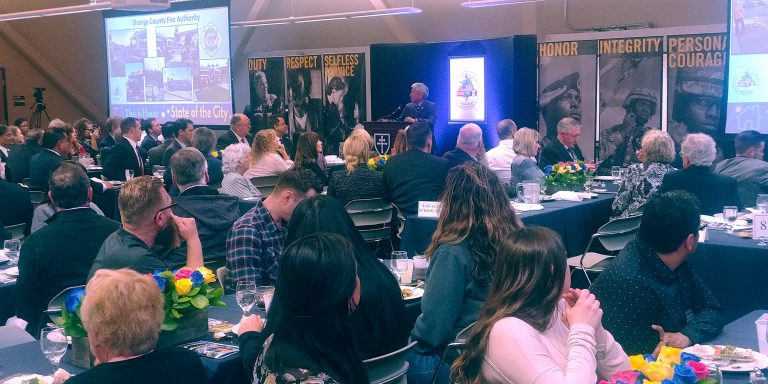
Although this Warren Kusumoto’s second term as mayor, it was his first time to ever “have the honor” of delivering the “State of the City” address.
Kusumoto delivered his address to a packed house in the main banquet hall of the 79th Theatre Sustainment Command on the Joint Forces Training Base in Los Alamitos on Wednesday. This year’s theme was Los Alamitos, “this is home” and it included a video featuring citizens, businesses and comments from local elected officials.
“We are the biggest little city in Orange County,” said Kusumoto. “We do have significant challenges ahead,” he added, referring to current projections that projects that if the current financial trajectory is left unchanged, the city could be broke by 2024.
Nevertheless, Kusumoto told a room jammed packed with area leaders, business groups along with state and federal officials that the city does “have a plan to create long-term fiscal sustainability.”
The mayor’s keynote address included graphs of city revenues which indicate the three main drivers of city revenues were strong. Kusumoto said more than $9 million of the annual $13 million budget is collected from property taxes, sales and use taxes and utility taxes.
All three show upward trends, he said, and incoming projects will only drive additional revenues in the future. Among the projects, Kusumoto said the Marriott Fairfield Inn now under construction will become the first major hotel project to locate in Los Alamitos in quite a while.
Also, he said additions to the Los Al Medical Center, a 107-unit luxury apartment project and other multi-family projects will generate new revenue for the city.
In addition, Kusumoto said the city’s AAA credit rating keeps the city’s borrowing costs low and he noted that the Government Finance Officers Association has presented the city with a “Certificate of Achievement for Financial Reporting.”
The mayor also noted major strategic partnerships and cooperation with local municipalities as representatives from state and local offices looked on. Also attending were and other local officials from Stanton, Seal Beach, Cypress, Stanton, Orange County Fire Authority, West Cities Communications District and the Los Alamitos Unified School District.
Representatives of many city contractors and local nonprofits also attended the event.
Major General Eugene LeBeouf, in command of the 79th TSC, briefly expressed the desire of JFTB to remain an integrated partner with the community as he provided a warm welcome to the large crowd.
City Manager Bret Plumlee acted as Master of Ceremonies for the event began with a moving rendition of the national anthem by Raivyn Hearne of the 40th ID and a JFTB color guard presented the colors.
A Los Alamitos man has been killed in a snowboarding accident after apparently snowboarding in the mountains on a back-country trail near Mammoth Mountain ski resort, according to the Mono County Sheriff’s Department.
Officials say Justin Khoshnevis, 32, was apparently snowboarding in a remote area at the time of the accident. Reports also say eyewitnesses saw the snowboarder falling from the cliffs above Twin Lakes, Mono County Sheriff’s Office reported. He was alone at the time of his death.
“On March 19, 2019, at approximately 3:50 p.m., Mono County Sheriff’s Office received a 9-1-1 call reporting that a person was seen falling from the cliffs above Twin Lakes, across from Tamarack Lodge and north of “Hole in the Wall,” according to the department’s Facebook post.
“Our dispatch immediately sent personnel from Mono County Paramedics, Mammoth Lakes Fire Department and Mammoth Lakes Police Department,” they said.
Fire responders reportedly hiked up to the area and determined that Khoshnevis the died as a result of injuries sustained in the fall. His snowboard was found along the path of his descent.
Officials said it appeared as though Khoshnevis came across the ridge-line from “Dragon’s Tail, a remote area outside the Mammoth Mountain Ski Area. Apparently, the Los Al snowboarder could have been making an attempt to ride a favorite chute called ‘Hole in the Wall’ when the accident occurred, they said in the statement.
“This tragic incident is a reminder that ski area boundaries are established for your safety. Anything outside the ski area boundary is considered backcountry, and the decision to enter the backcountry should be made with great care. Always ride with a partner; have a plan; know your route; and carry the proper equipment,” they concluded.
Nicholas Nygryn stands under the canopy of his family’s picnic tent March 16 and turns to his mother.
“Since when have I ever been a ‘pleasure in class’?” Nygryn asks with an expression and delivery that is equal parts excitement and surprise.
Moments earlier, the Buena Park teenager introduced one of his teachers from Sunburst Youth Challenge Academy to the twenty-or-so family members who joined him at Joint Forces Training Base, Los Alamitos, California, for the academy’s Class 23 Family Day.
His mother, Angie Bonilla, shakes her head and gives her son a bear hug.
“That was a first,” she says to her son, who is a high school junior and is carrying straight A’s for the first time he can remember.
Nygryn turned 17 about a week and a half earlier and is surrounded with birthday decorations. His family surprised him with an impromptu party at their tent, which is one of a couple hundred neatly arranged in rows across the academy campus.
“We’ve missed him so much,” Bonilla said. “I was so excited that I couldn’t sleep all night.”
Family Day marks the first time Nygryn has seen his family in ten weeks.
In early January, he and more than 200 other teens arrived at the base to begin personal transformations courtesy of the academy’s eighteen-month para-military program of residential and post-residential curriculum and mentoring. The program focuses on eight core components: leadership and followership, service to community, job skills, academic excellence, responsible citizenship, life coping skills, health and hygiene, and physical fitness.
Nygryn was mad, he said, when his mother dropped him off on intake day. But now he’s glad she did.
“I didn’t want to come,” he said of the voluntary program, “but now I realize she just wanted the best for me, and it’s making me better as the days progress. I’m happy here.”
Nygryn and his classmates are almost halfway through the academy’s five-and-a-half-month residential phase. Tonight, they’ll go back to their dorm rooms, tidy up the campus, hit the books and maybe write another letter home.
The cadets will each earn 65 high school credits – about a year’s worth of units — before they leave in June and many will receive their high school diplomas or equivalencies during the class’ graduation ceremony.
June is in the future. It’s not far away, but Nygryn says he never would’ve thought about it before.
“The present and the past is what I used to think of,” Nygryn said, “but now it’s success and the future,” Nygryn said.
Sunburst Youth Challenge Academy is one of three National Guard Youth ChalleNGe programs in California and is facilitated by the California Military Department’s Youth and Community Programs Task Force in partnership with the Orange County Department of Education. Sunburst, which is in its 11th year, has helped more than 3,500 at-risk Southern California teens reclaim their lives.
March 11 through 15 the Boys & Girls Club of Cypress hosted its Pop! Fizz! Splat! Spring Break Camp. This explosively fun weeklong program provided over 150 attendees with fun, hands-on science explorations and messy experiments, such as baking soda and vinegar eruptions, making fizzy lemonade and slime, and coding with real robots.
Spring Break kicked off on Monday when all members were treated to free chicken wings and fries compliments of Buffalo Wild Wings in Cerritos. On Wednesday, March 13, Officer Julie Marquez from the Cypress Police Department brought in her robot police car, Donut, and together they answered the children’s questions. Optional field trips were offered throughout the week to John’s Incredible Pizza, the Microsoft Store in Cerritos for video game design labs, and Laser Quest. On Friday, March 15 all members walked to Veteran’s Park for a field day led by staff from Planet Fitness Cerritos, and enjoyed ice cream sundaes when they returned to the Club.
The Boys & Girls Club of Cypress’ nine week Summer Program begins on Monday, June 3. Registration materials will be available starting April 8. Each week will feature a different theme and group-wide STEAM learning projects, fun field trips and a variety of indoor and outdoor games and activities. The Club will be open Monday through Friday from 7 a.m.-6:30 p.m. for all children entering first grade through twelfth grade for the 2019-2020 school year. Specialized teen programming will be available for members going into grades 7-12 in the brand new Teen Center onsite. For more information, call the Boys & Girls Club of Cypress at 714-527-2697, visit www.BGCCypress.org or stop by the Main Clubhouse located at 10161 Moody St.
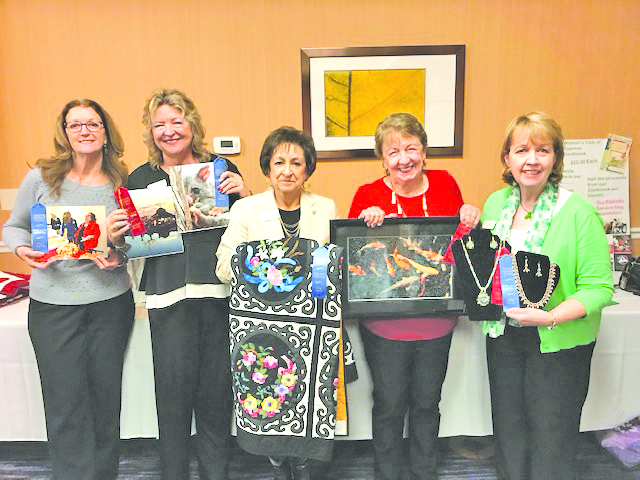
Members of the Woman’s Club of Cypress participated in the Orange District Fine Arts & Photography Festival held at the Woman’s Club of Orange. Five Club members won awards in several categories.
Winners included Carole Stone, 1st place—Photography; Carole Shaw, 2nd place—Cross-stitch; Mariellen Yarc, 1st & 2nd place—Photography; Donna Holder, 1st & 2nd place—Jewelry; and Stephanie Chagollan, 1st place and Members’ Choice—Quilting.
Club President Colleen Janssen expressed her pride at the recognition of the winners’ efforts.
“Each year, our members enter this county-wide contest, and each year, many are selected as winners,” she said. “This year was an exceptional example of the talents of local women in both the arts and photography. We are proud of the work our club members have done, and the recognition each received.”
The Woman’s Club of Cypress is a local nonprofit service organization of women actively involved in various volunteer and charitable works in the community. For more information about the Woman’s Club of Cypress, visit www.wccypress.org. New members are always welcomed.
The Youth Center in Los Alamitos, which transforms lives one family and child at a time, announced today that it was awarded a $5,000 Community Impact Grant from New York Life through local agent Jeffrey Blancq who represents the company’s Orange Coast General Office located in Irvine.
The grant will support their various programs including their After-School Programs and Tutoring Program, Elementary Music Program, Camp SHARK and Teen Camp, Leadership Academy, and others which enrich local children’s lives through social, educational and recreational activities.
“We are grateful for New York Life’s investment in our organization, which will change many lives for the better,” said Youth Center Executive Director Lina Lumme. “Without the support from New York Life, we wouldn’t be able to keep growing our programs.”
“I’m proud to work for a company that encourages its agents and employees to devote their time, energy and talents to support the needs and priorities of their local community,” said New York Life agent Jeffrey Blancq, who also serves on The Youth Center’s Board of Directors. “We are pleased that our partnership will have a long-lasting impact on The Youth Center and the population they serve.”
The Community Impact Grant program awards grants of up to $25,000 to local nonprofit organizations which are championed by New York Life agents and employees to serve the needs of their local communities. Since the program’s inception in 2008, more than 500 grants totaling nearly $7 million have been awarded to nonprofits across the country.
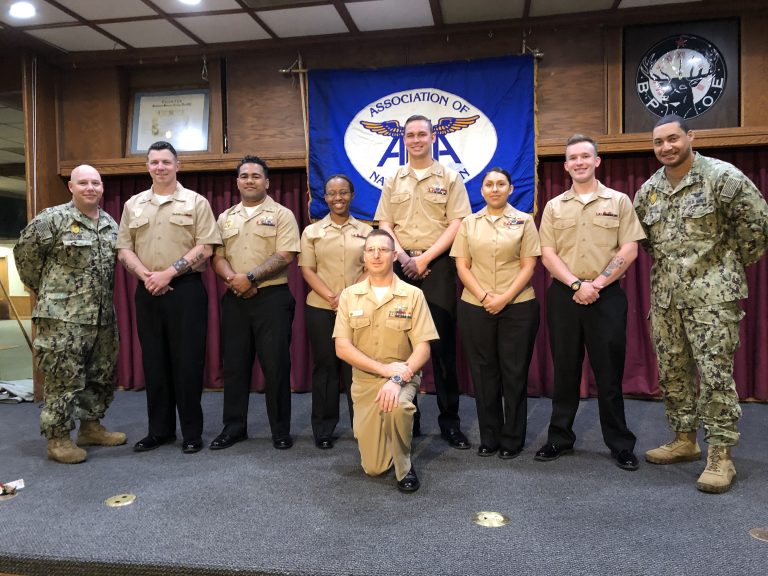
The Sailors of the Quarter (October thru December) from the Naval Weapons Station., Seal Beach, were special guests at the March meeting of the Grampaw Pettibone Squadron. When Certificates of Appreciation were presented to the honorees by the Squadron, they were assisted by Chief Petty Officers from the base: Senior Chief William Lyons, GMC Jeff Vance, and MAC Chris DeLawrence.
The persons recognized from the Naval Weapons Station were: Senior Sailor of the Quarter–MA1 Zachary Goldman; Junior Sailor of the Quarter–MA2 Maa Taliu; and Bluejacket of the Quarter—MA3 Ivory Scott. From the Munitions Command Pacific West Division at Seal Beach were: Senior Sailor of the Quarter—MN1 Matthew Wilson; Junior Sailor of the Quarter—YN2 Joanna Carbajalmendiola; and MN3 Tim Parker
Certificates of Appreciation were presented to each of these outstanding sailors. Local restaurants contributed various coupons to the honorees.
Contributing restaurants were in Seal Beach: Avila’s El Ranchito Mexican Restaurant, Bistro St. Germain, Coaches Sports Grill, CreamaCafe, Finbar’s Italian Restaurant, Glory Days Beachside Grill, Hennessey’s Tavern, Mahe Restaurant, Old Town Café, Seal Beach Grill, Thai on Main, The Abbey, Yucatan Grill, 320 MAIN, California Pizza, Chick-fil-A, Islands, Romano’s Macaroni Grill, Santa Fe Importers. In Long Beach were: Corner Bakery Café, Mimi’s, Ruby’s Diner, The Crab Pot. In Sunset Beach were: Fish Camp, Harry’s Rooftop Patio Grill, Romano Cucina, and in Huntington Beach: Buon Gusto Italian Restaurant, and in Tustin: The Crab Cooker.
Attractive plaques were presented by the USAA Insurance Company to each Sailor of the Quarter. Grampaw Pettibone Squadron, affiliated with the Association of Naval Aviation, meets each month at the Elks Lodge in Garden Grove.
The Segestrom Center for the Arts has announced that the acclaimed Israeli performance troupe MAYUMANA will make their West Coast debut at the Center this April 6. The group’s style can perhaps can best be described as mixing the electrifying energy and percussion of STOMP with the dazzling stagecraft and playfulness of Blue Man Group – plus the pure athleticism of Pilobolus dancers.
The troupe heavily combines song, dance and percussion for immersive and visually striking performances. They’ll be performing their new show Currents which takes inspiration from the “Battle of Currents” between Thomas Edison and Nikola Tesla in their quest for finding energy sources for the world.
“While not a part of our Dance Series, the Center is thrilled to welcome an international performance troupe of this caliber for an immersive evening and a unique complement to all of the other dance programming we offer,” according to Segerstrom spokesperson Hanya Bruner.
Currents is a spectacular show that was inspired by the historical Battle of Currents between Thomas Edison and Nikola Tesla in their quest for finding energy sources for the world. Audience members will be taken on a journey between two troops, each representing a different view of the essence of light and electricity and each inspired by a different esthetic and artistic approach, all of which are presented as a dialogue, through unique sounds, lights and visual effects.
The show combines a variety of elements: specially made musical instruments, massive video art projections including video mapping on the walls of the Old City of Jerusalem and eleven skilled performers in constant movement, playing on different instruments and musically juggling between different sounds.
Currents overcomes age and language barriers, bringing incredible energy that enables the audience to take a pause from their daily routine and enjoy a fascinating, breathtaking experience filled with color, music and movement that come together in an extraordinary fashion.
Driven by their deep love for percussion and music, Artistic Director Boaz Berman and Eylon Nuphar created the first Mayumana show in 1996. From around the world, Berman and Nuphar gathered a group of gifted performers, each with diverse talents and contrasting backgrounds. Sparked by their shared passion for rhythm and coordination, and fueled by their unique sense of humor and mischief, the group’s dynamic on stage was inexhaustible and infectious. Enriched by working with a multicultural cast, they inspired each other to fulfill the individual’s prowess in his or her area of expertise, while developing in all players the versatility to master other skills. This befits the name Mayumana, which comes from the Hebrew word for skill – Meyumanut.
Every show produced by Mayumana endeavors to “visualize the music” with its audience. In
addition, the power of each Mayumana creation comes from the strong emphasis placed on the
unity and synchronization of the group. Simultaneously, the unique talent of each performer is
highlighted and celebrated. Mayumana’s playfulness extends beyond the stage, reaching out to
engage in direct interactions with its audiences of all ages and cultures.
Since its conception, Mayumana has produced many shows including Mayumana, BE, Momentum, Bejuntos, Malabi, Rumba! and Currents. Mayumana has also collaborated with many artists around the world including Bobby McFerrin, David Broza, Mati Caspi, Estopa, Infected Mushroom and Tiesto. Today, the artistic team of Mayumana is led by Boaz and Geri Berman/
Tickets to Mayumana start at $39 and are on sale now at www.SCFTA.org, at the Box Office at 600 Town Center Drive in Costa Mesa or by calling (714) 556-2787. For inquiries about group ticket savings of 10 or more, please call the Group Services office at (714) 755-0236.
The Los Alamitos High School varsity cheerleading squad was honored by the district school board for winning a Division 1A championship in the first year that the California Interscholastic Federation established cheerleading as a competitive sport. Back row (L-R): Advisor Jennifer Ramirez, Kaylyn Wilson, Erin Schmitt, Zoe Rubio, Alyssa Perez, Kaylyn Lunsford, Abbie Ledterman, Emily Colmenares, Makena Carrion, Kaya Cannady, Principal Dr. Gregg Stone, Board President Diana Hill. Front row (L-R): Natalie Walker, Caylin Cannady, Chandler Giunchini, Haley Litt, Zoey Litt. Not pictured: Coach Cheryl Vuong.
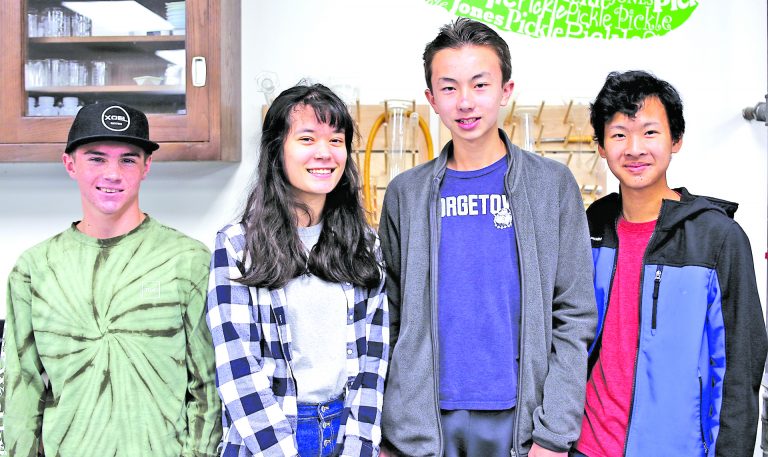
A team of four Los Alamitos High School AP Chemistry students has placed 6th out of 45 Orange county schools participating in the annual American Chemical Society exam competition. That is Los Alamitos High’s best performance in many years, said AP Chemistry teacher Tim Jones. In addition, one of the team members, sophomore Andy Fong, ranked 10th among all students in the county who took the special, rigorous exam. He will go on to compete nationally next month. He and his teammates—Lucas Torgerson, Katherine Kubiatko, and Vincent Ngo—also will be honored at an awards dinner in May. Fong was nonchalant about his stellar performance: “Chemistry just makes sense to me.” Pictured, (L-R), are Lucas Torgerson, Katherine Kubiatko, Andy Fong, and Vincent Ngo.