

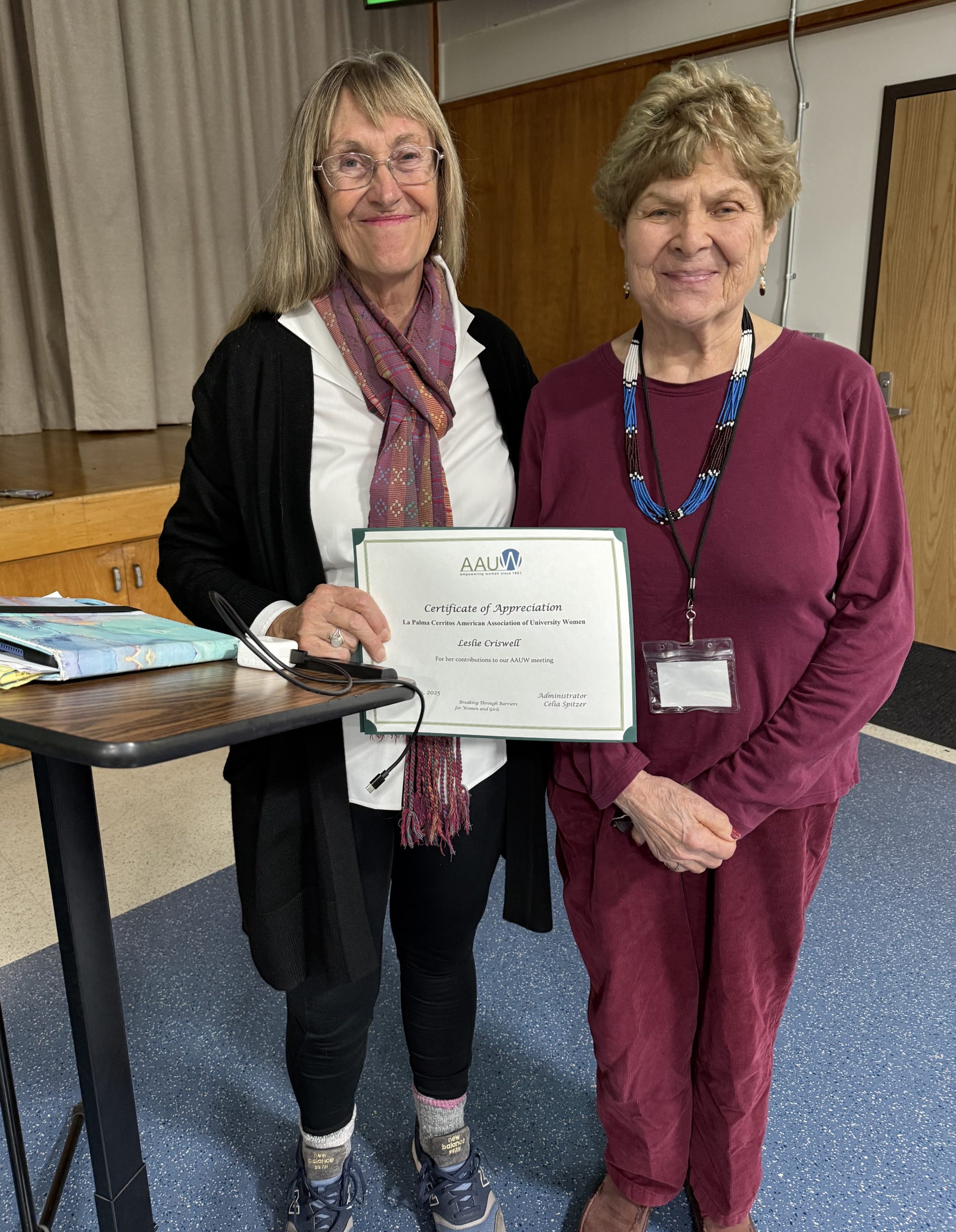
Members of the La Palma-Cerritos Branch of the American Association of University Women learned about Book Banning in the United States from guest speaker Leslie Criswell at their meeting on November 20, 2025, at the ABCUSD Adult School Auditorium in Cerritos. Administrator (President) Celia Spitzer welcomed members and guests and introduced Program Facilitator Faith Herschler.
Herschler then introduced Leslie Criswell, who is a retired trial attorney who spent 35 years trying civil jury cases, who volunteered as an L.A. Superior Court mediator and Small Claims Court judge, and is an active member of the American Board of Trial Advocates. She is a member of the Palos Verdes and Beach Cities AAUW branches.
Criswell prepared a Power Point presentation with information about book banning in America that showed that it has been a persistent issue in our history and is driven by political, religious, and social factors. An early example of book banning was in 1637 when the Puritans banned Thomas Morton’s The New English Canaan because it was critical of the Puritans and their treatment of indigenous people. During Colonial and Revolutionary times in the 18th century, pamphlets and books were banned for their political content against British rule. In later years, there were many traditional challenges for banning books because of pornography, sexual content, political content, or violence. Some of the books that were listed included Canterbury Tales, To Kill a Mockingbird, and Charlotte’s Web.
According to Criswell, the role of the U.S. Constitution was brought into the discussion of book banning in 1957 with the ruling in Roth vs. U.S., where a magazine seller was banned for mailing magazines that were pornographic with no redeeming social importance. Other current challenges include the U.S. Education Code in 1978 that said that the government must protect students’ privacy and obtain written parental consent before giving students surveys regarding political, religious, sexual beliefs, etc. In 1982, the American Library Association began celebrating Banned Book Week and can provide a list of banned books.
Criswell said that the states are responding to the issue of Book Banning in different ways. In Florida, Governor DeSantis backs the, Don’t Say Gay bill, HB1557, where parents can opt out of activities such as Black History Month, diversity, critical race theory, and ethnic studies. In Utah, if three school districts agree to remove a book, all school libraries must remove the book. In California, she said that Governor Newsom would not ban books. California State Superintendent Tony Thurmond sponsored legislation to halt Book Banning with AB 1078. It was signed into law by Governor Newsom on September 25, 2023.
Criswell ended her presentation with some good news. More people are starting to protest book banning because they wanted to keep their right to freedom to read. With the ruling from Troxley vs. Granville, parents retained their fundamental right by the 14th Amendment to direct the upbringing of their children. She said that activism by PEN (Poets, Essayists, Novelists) America, led to Toni Morrison’s book, The Bluest Eye, to be taken off the banned book list. (PEN America is a non-profit organization protecting free speech in literature and human rights.)
Book banning continues to be a growing issue that affects education, intellectual freedom, and democracy, as books centering on race, gender, and diverse perspectives are being removed from library shelves. According to PEN America, 10,046 books were banned in 2023-2024, in the United States. AAUW members are encouraged to go to their city council meetings and contact their state’s representatives if they are concerned about books that are being banned that they disagree with and want to protect their right to freedom to read books.
At the conclusion of the program, Administrator Spitzer then conducted the branch business meeting with acceptance of the secretary’s minutes, the treasurer’s report, and a request by Joan Pylman for gift card donations for Falcon’s Nest for Cerritos College students and donations for Academic Achievement Awards. Edna Ethington presented Spitzer with Certificates of Recognition from California State Senator Tony Strickland, 36th District, for the La Palma-Cerritos AAUW Branch and Edna, for “dedication to advancing education, leadership, and opportunity for women and girls in our community.” The Certificate was received on October 18, 2025, during Community Recognition Month.
At the end of the business meeting, members were reminded to come to the Branch holiday gathering at the home of Cathy and Charles Niederman at 7:00 p.m. on December 20, 2025.
Members and guests are invited to come to the next meeting of the La Palma-Cerritos AAUW Branch on Thursday, January 15, 2026, at the ABC Unified School District Adult School Auditorium at 20122 Cabrillo Lane in Cerritos. There will be a social time starting at 6:30 p.m. and a program on Artificial Intelligence and Our Schools at 7:00 p.m. For more information, contact 562-924-5227 or the branch website at http://lapalma-cerritos-ca.aauw.net.