

Following the discovery that the city records to the positive an abstention by a member of the City Council voting on an item under consideration, the Cypress City Council voted unanimously to ask for staff and the legal advisor to create options for change.
Change to what, however, was explored in an extended discussion by the Council during their meeting on March 24.
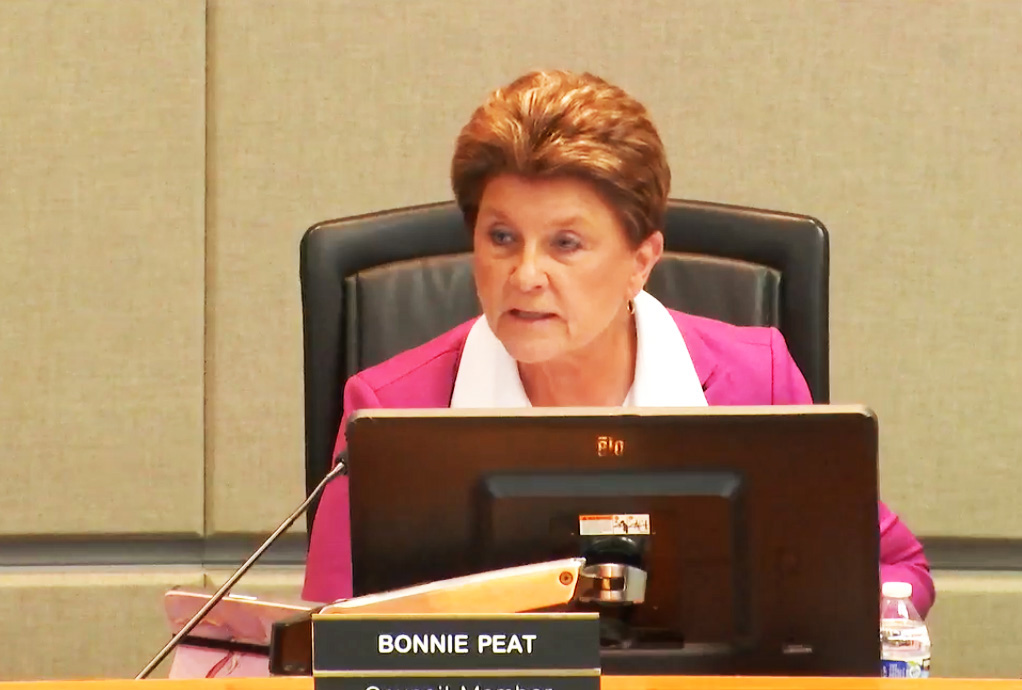
During a recent meeting, a motion by Council member Bonnie Peat failed by a vote of 3-2, even though the actual vote was a tie.
Mayor Pro-tem Leo Medrano abstained from voting on the issue, which currently, according to the city code, counts in the affirmative. Under most rules of order, elected council members here, and in most communities, are allowed to abstain from voting on any issue.
Since that meeting a few weeks ago, Peat has obviously been doing research to determine how other cities handle members who abstain from voting on an issue.
“I did a little bit of homework after we’ve had a couple of abstain votes, which I thought were somewhat unique, and I kind of went back and wanted to really look at what’s the best practice that other cities have put into place,” Peat told the Council.
“I asked the city clerk and the city manager to do a bit of a survey, and this is one of the attachments, and they had 14 cities that responded. And there’s a variety of different things that people do,” she said.
Of the 14, four cities counted an abstention as a “yes” vote while 10 of them counted it as a “no.” Most cities use Roberts Rules of Order or Rosenberg’s Rules of Order, she said.
In addition, Peat said city staff were sufficiently proficient to find minutes from 1965, suggesting the city’s code “is a bit dated.”
“I would propose that it be something different,” she said, offering several options for the handling and meaning of an abstention.
Elected members of city council have an option to “recuse” themselves from a vote or simply abstain from voting on any issue. City officials said these are different options than “disqualification,” which is a situation where members must leave the chamber during debate on an issue.
Peat didn’t like the fact that the city code, as currently written, counts an abstention as a “yes,” and she also thought about new rules that would tighten the criteria that would allow members to “abstain” from voting.
One idea proposed by Peat was to have Council members, who have a conflict of issue, first get approval of sorts from the city’s legal counsel to confirm the conflict before they would be allowed to abstain from voting.
She suggested the city’s code could “prohibit abstentions unless a council member has established a legal justification for abstentions.”
It was an idea that Fred Galante, the city’s legal counsel, waved off, saying it would be better to simply have the city’s code deal with the problem.
“I have a point of clarification, as far as asking the city attorney on the appropriateness of an abstention,” said Galante. “What I suspect those particular cities have language in their municipal code…to the extent they count abstentions as a yes vote.”
“They do that for the purpose of assuring that if there are abstentions due to conflict issues, there’s an opportunity to have items passed so that they vote actually counts, short of just confirming whether there’s a conflict,” Galante explained.
“And in the context of a code that requires an abstention to be counted as a yes, I’m not quite sure how adding these two components of asking the city attorney… I’m not trying to avoid any obligation but I’m not sure how asking the city attorney to opine on the abstentions can also follow Robert’s Rules of Order.”
Peat explained her rationale for the suggestion, thinking the city attorney might be able to help members sort of issues that could underlie a conflict of interest that triggers a member to abstain.
Mayor David Burke said having the city attorney “give permission” to a member to abstain would, he thought, be better considered as “disqualification.” “Are you proposing that you can only abstain from a vote if you’re legal disqualified from voting on the matter?”
“Good question,” answered Peat, “I would recommend that, especially in a situation where we have a 2-2 vote. I’m just saying that, as a city council, we’re elected to make decisions on behalf of the city and every vote counts.”
“I would say you can abstain only if you really have a legal reason to abstain,” she said.
Council member Scott Minikus said “I think a abstentions should be allowed if there’s a legal conflict, moral or ethical conflict. That’s pretty standard, right?”
“I think what we’re driving to is that a yes is a yes, and no is a no, and abstention just counts as an abstention and doesn’t count as a vote.”
Galante said Robert’s Rules of Order essentially says an abstention it counts neither as a yes or a no vote. It is as if the vote is excluded and there’s only, let’s say one person abstain, there’s only four members of the Council voting.
“Thank you for clarifying that,” said Peat, adding that “I wasn’t saying somebody couldn’t abstain. I’m just saying that if you do abstain, it doesn’t count toward a yes vote.”
Council member Kyle Chang suggested Minikus was actually proposing a measure going farther than what Peat was proposing, “that you can abstain only abstain when there’s a legal conflict of interest or ethical conflict of interest,” while Peat was proposing voting abstentions only with permission.
“I think we’re all saying the same thing,” said Minikus.
The discussion then went deep into the weeds after Mayor Burke asked city staff explain ways the Council could change the city code whereas a member “could conceivably say during the meeting…I want to reconsider this right now.”
Medrano, whose earlier abstention set off this past week’s discussion, said little except for asking to hear staff’s perspective on the issue.
Following a lively discussion with Galante and City Manager Peter Grant describing the various and potential ways motions could be brought back up following a vote, the Council unanimously agreed to allow staff some time to research various ways to deal with abstentions and how measures can be reconsidered during meetings.
The vote was 4-0. Chang abstained from voting.