

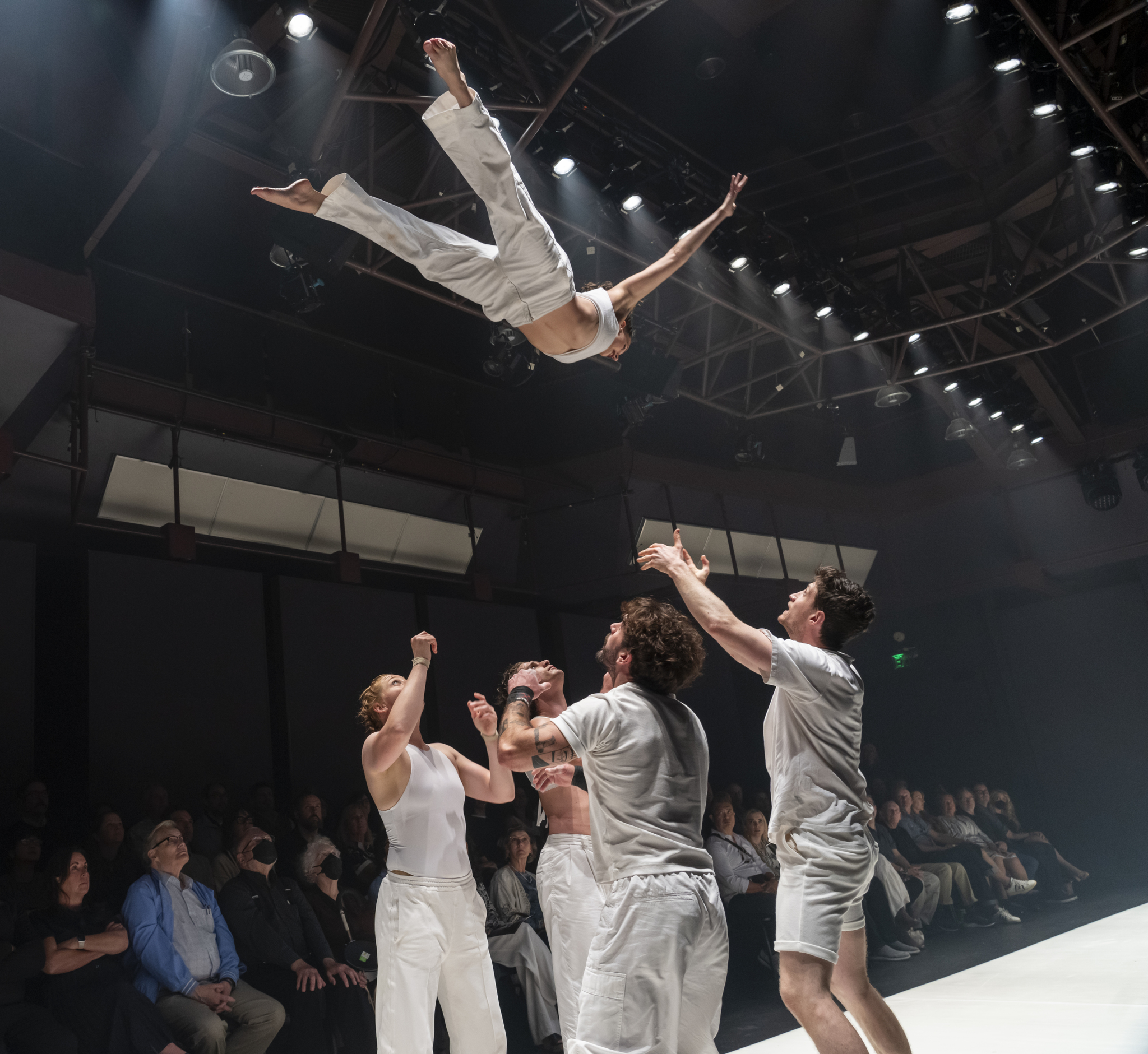
When someone hands you a rope heading into a performance, your brain doesn’t know quite what to expect.
Such was the case for the one-night performance of the Brisbane, Australia troupe Circa this week as they brought “Eternity” to Costa Mesa for a very limited run.
For the few hundred people who had the rare chance to see the performance, the “procession” into the theatre should have been a clue.
The circular entrance into the theatre was made artful as each of the guests, approximately 160, were only allowed to enter as the processional music played through loudspeakers and everyone grabbed their place on the rope of life and made their way into the darkened, theatre-style Judy Morr theatre.
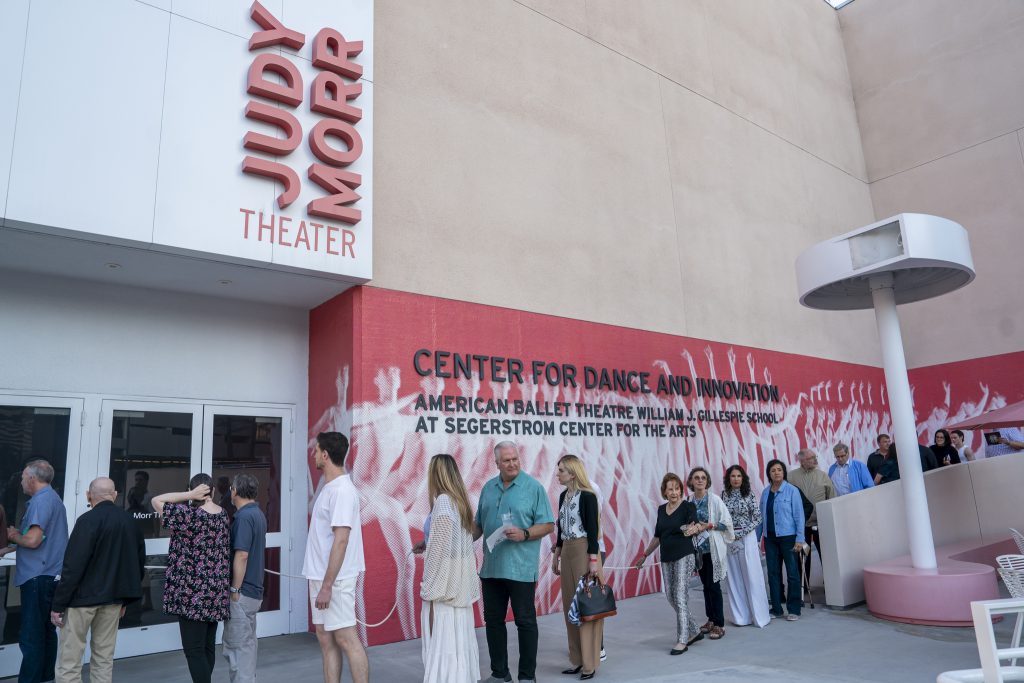
The cathedral-type structure looked more like a trendy dive barwhen darkened, as the entire performance took place on a catwalk so close to participants that one could easily hear the grunts of the acrobats as they twisted into shapes and did amazing acrobatics through the air.
The Judy Morr Theatre at mothership Segerstrom is set apart in a dark corner of the property, and although dark for years, it briefly returned to action this week
The Judy Morr has been dormant for public performances for more than a decade, and there was something quietly poetic about Circa being the company to wake it. They have a gift for resurrection: taking spaces, taking bodies, taking the oldest of human questions, and breathing something urgent and alive into them.
Segerstrom Center’s founding vice president of programming, Judy Morr, played a pivotal role in shaping the Center’s artistic vision.
Limor Tomer, Vice President of Programming, said: “As we gather in this newly reawakened theater, I can think of no better way to honor the legacy with a production that pushes artistic boundaries while celebrating our shared humanity.”
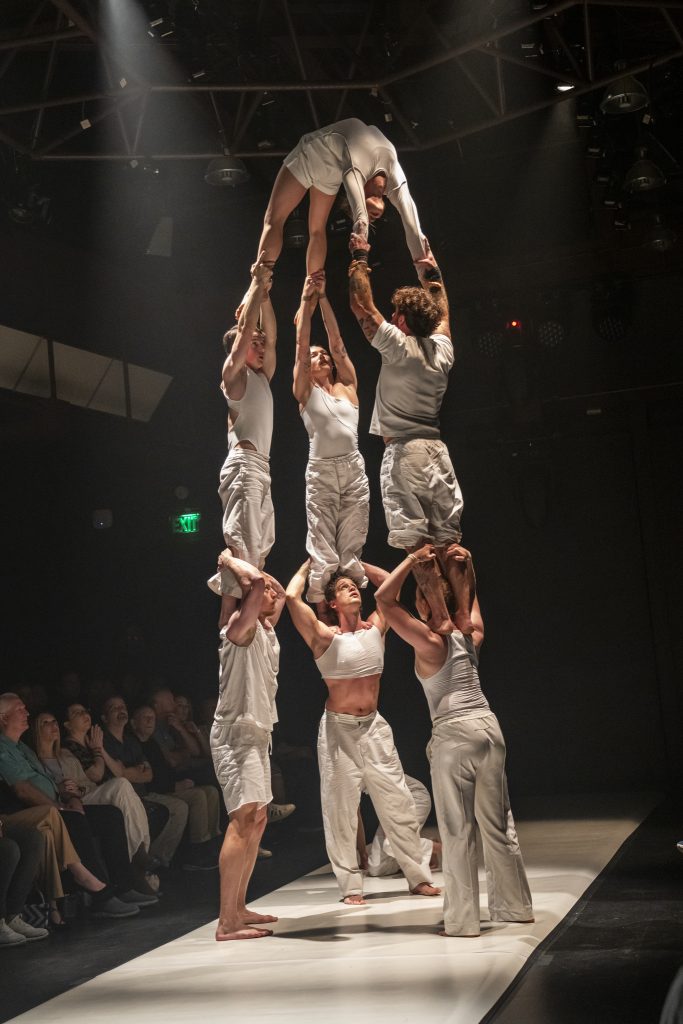
Photo by Stephanie Berger.
Around me, others were receiving theirs too, a quiet assembly of strangers each tethered to the same braided line, and then the performers began to move, and without quite deciding to, we followed.
That is how “Eternity” begins. Not with a curtain rising or a spotlight finding its mark, but with an act of surrender so gentle you almost don’t notice you’ve surrendered. You grab the rope. You walk. And somewhere in those first few steps, the show has already started doing what it came to do.
Circa, the Brisbane-based contemporary circus company that has spent two decades redefining what the human body can say, brought “Eternity” to the Judy Morr Theater at Segerstrom Center for the Arts in Costa Mesa for three nights in June which was the production’s first extended run in Southern California.
The space they revealed once we had followed the rope inside was spare and sacred. Not ornate in the way of the Brisbane cathedral where “Eternity” was born, but intimate in a way that felt deliberately chosen, close enough that you could see the tendons in a performer’s forearm, the tremor of effort held still, the exact moment when trust between two bodies becomes something indistinguishable from faith.
The music arrived before anything else made sense. Arvo Pärt’s Tabula Rasa and Fratres, recorded by the Australian Chamber Orchestra, filled the room the way water fills a vessel, completely and without negotiation.
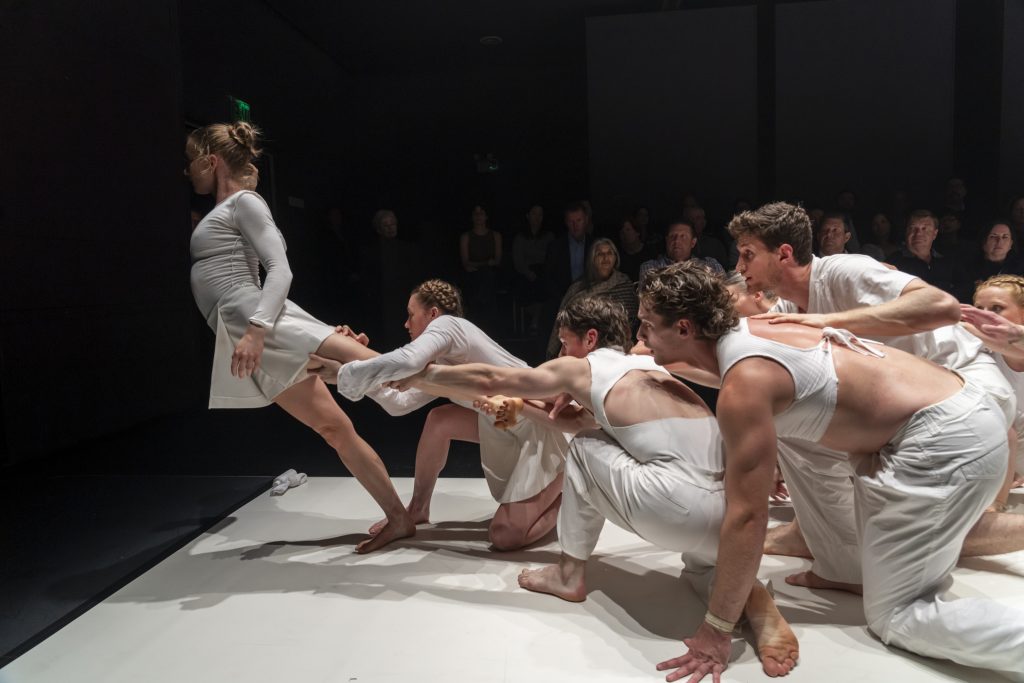
Photo by Stephanie Berger.
What remains, it turns out, is each other.
“Eternity” is a show about ten people who have decided to trust one another completely, and who make that decision visible. A performer climbs another’s shoulders in the dark and you feel the mathematics of it in your own chest, so close to the audience that the sounds of bodies slamming into each other, and the mat, brings realism and gravity to the performance.
The weight, the balance, the quiet catastrophe that hovers just at the edge of every moment and never quite arrives. There is no net. There is no safety in the theatrical sense of the word. What there is instead is preparation so thorough it becomes something else, something that looks from the outside like grace.
Director Yaron Lifschitz, who has led Circa since its founding and who shaped “Eternity” from its earliest commission for the Brisbane Festival, works in a mode that refuses easy categorization. This is not circus as spectacle. It is not dance as decoration. It is physical theater in the oldest and most serious sense, the body as the instrument through which we examine what it means to be mortal, to be connected, to be briefly and improbably alive in the same room as other people.
The themes, though sometimes harder to discern, fully explored various aspects of life, including love, death, loss, hope, wonder; all using mere music, and bodily expression.
Perhaps these words can feel hollow in the wrong hands. In Circa’s hands they become weight-bearing. You feel them the way you feel the rope: as something real pressed into your palm, something that connects you to a line of other people moving through darkness toward something they cannot yet see.
Circa’s reputation precedes them across six continents and forty-five countries and while it took a while for the small crowd to get engaged, they eventually became so engrossed it ended with a standing ovation.
It was different for sure, at times inviting humans to bridge the comfortable distances we keep between ourselves and our most difficult feelings. Orange County is not always thought of as a place that reaches for the transcendent. But when we grabbed onto Circa’s rope, we had somehow accepted a challenge to go or not go where the mysterious rope wanted to lead us. Most of us did.