


The innovation-minded CEO of the Aquarium of the Pacific unveiled yet another swirl in the ocean of ideas on Sunday, Nov. 8 as the institution hosted its first-ever film festival to bring new attention to the “underdogs of the ocean.”
Since arriving at the Aquarium two years ago, Jeff Flocken, the institution’s president and CEO, has not only beefed up the traditional tourist fare but has also sought to build greater understanding and awareness of the plight of the world’s oceans.
Long before the Super El Niño began to devastate the state’s unparalleled coast, Flocken brought government experts to the institution to warn residents, sent environmental first responders to rescue rare turtle eggs, and premiered the institution’s first-ever film festival this weekend.
Two months ago, the Aquarium announced the opening of the “Holo Theater,” an immersive experience inside the new Ocean Theatre, and now it has brought a film about its conservation work to the super-large screen in the Honda Vision Center.

“This could have been a very straightforward film about a catastrophic ecosystem collapse,” said Flocken about the award-winning Aquarium-produced film, “Before the Forest Falls,” screened at the Aquarium’s Honda Vision Center.
The Aquarium produced the film, along with two others: “Between Breaths,” a short documentary about a polar bear by Florian Ledoux, and “WASAWASA, Beyond the Reef’s Edge,” a glorious explosion of ocean color produced by Scott Ressler of National Geographic’s ‘Pristine Seas’ series, which were shown as part of the Aquarium’s inaugural film festival.
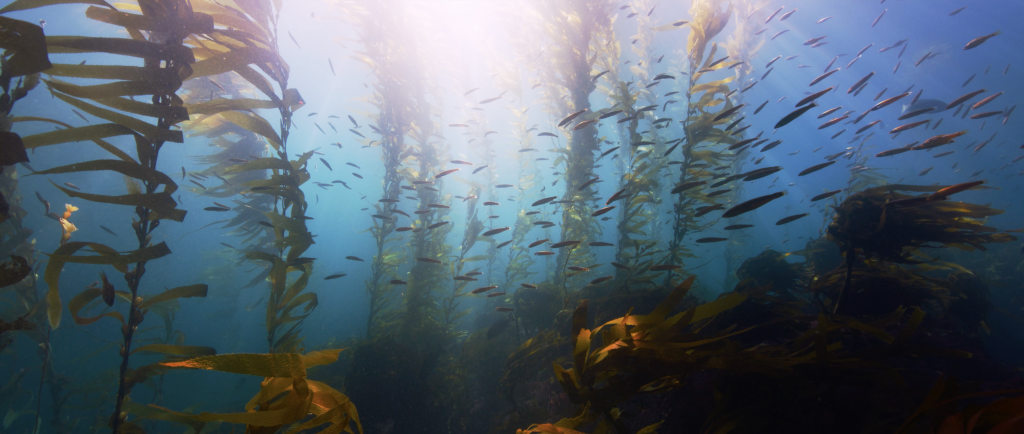
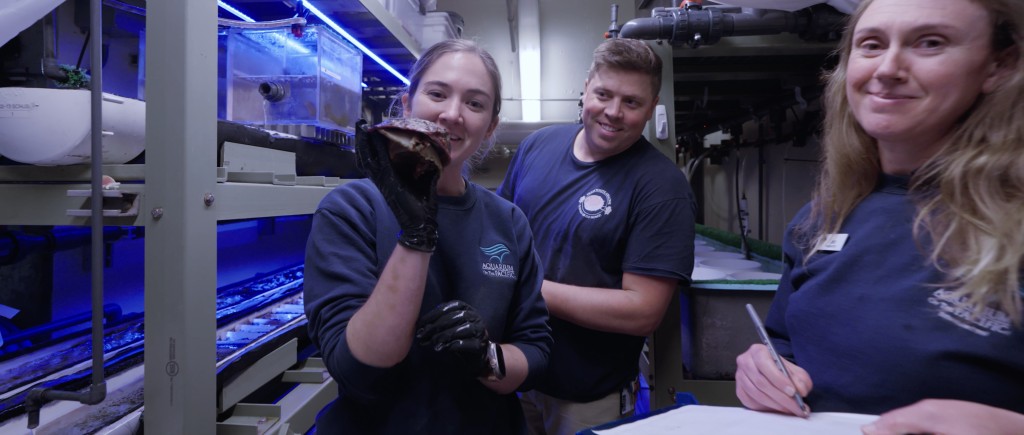
The film debuts as undersea kelp forests across southern California disappear at an alarming rate. It follows four young Aquarium staffers and documents their work in five-gallon buckets as they urgently hatch sea organisms known to fight the bacteria experts have determined are killing the kelp.
“Before the Forest Falls” takes audiences across Washington and California, introducing a close-up look behind the scenes at the Aquarium where staff is doing this critical work.
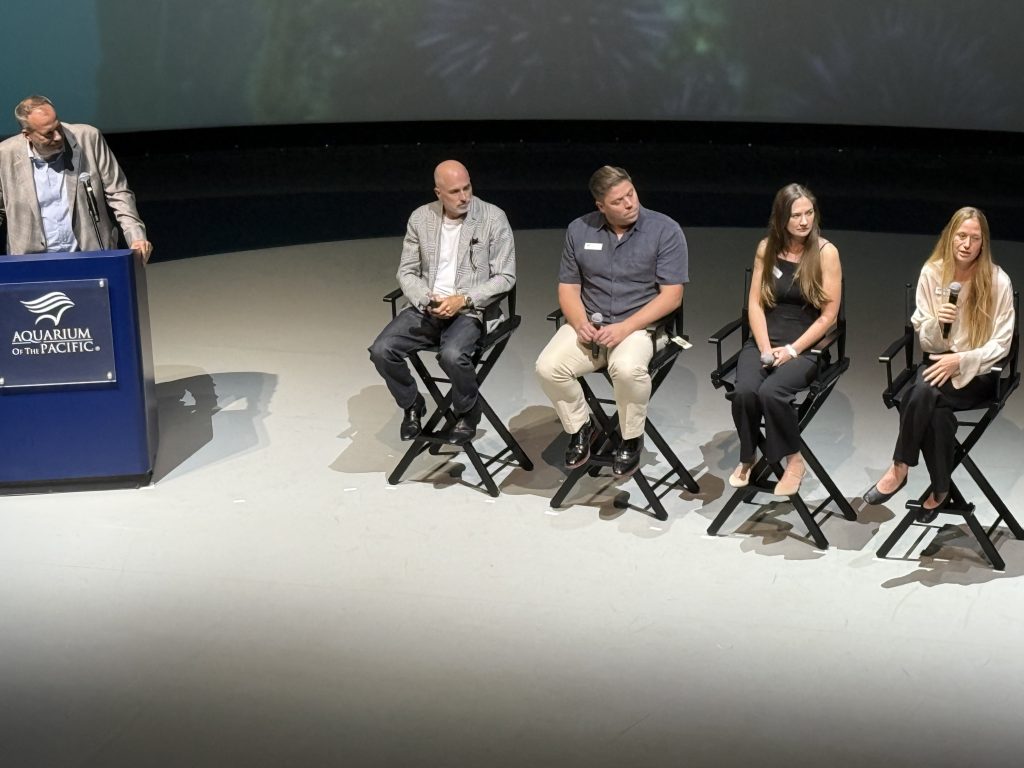
Left to right, Jeff Flocken, President & CEO of the Aquarium of the Pacific, filmaker Chris Stanford, A quarium Curator of Fish and Vertebrates Jonathan Casey, Melissa Fisher and Johanna Hultberg speak in a Q&A after the film.
“These are the people that get up every day with finite resources who are just genuinely passionate about leaving this world a little better than they found it,” said Flocken.
Documentary filmmaker Chris Stanford, who directed the film, said in essence, “it is a film about possibility and the people who chose action over despair.”
“It is a reminder,” he said, “that often meaningful change in our world begins quietly, long before the rest of the world notices.”
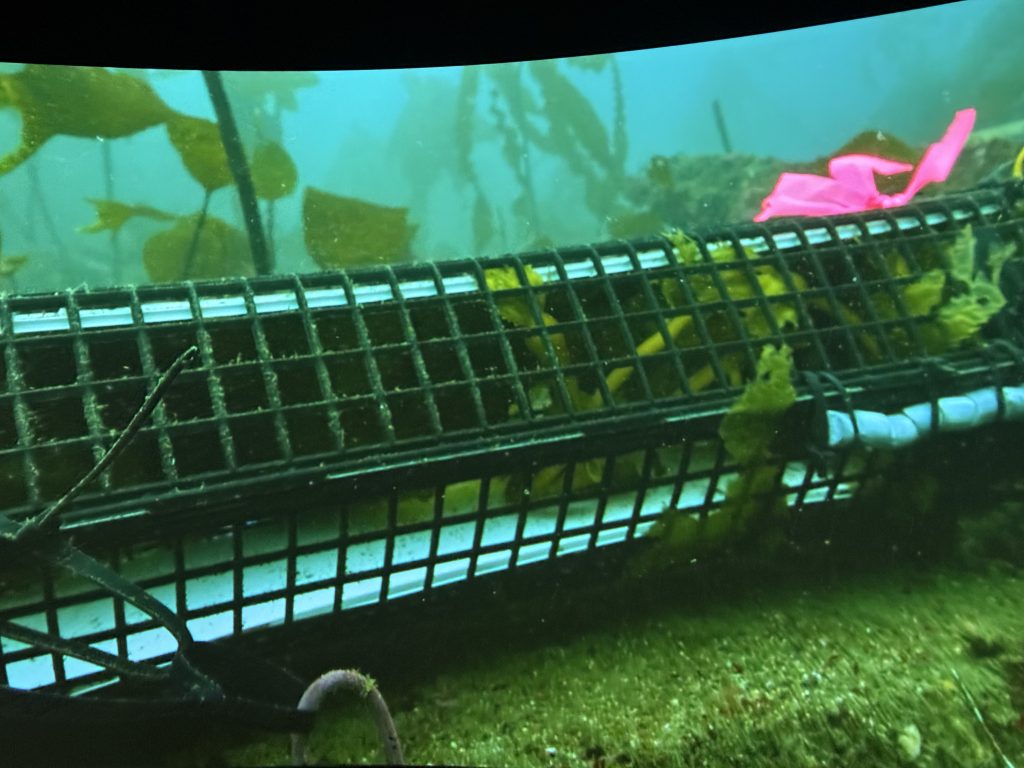
“You took a species rarely talked about, the underdogs of the ocean, and made them exciting,” Flocken told Stanford. “You took heroes, and their work behind the scenes, and made the invisible visible,” he said.
Though the entire division behind the Aquarium’s behind-the-scenes work is credited, the film features three dedicated staffers: Jonathan Casey, Johana Hultberg, and Melissa Fisher.
In their stories, the younger staffers remembered being bonded to the ocean by their families, like many kids in Southern California, but unlike the others, they spoke urgently about their hidden work to save the beauty of undersea California, especially the kelp forests off the Catalina Island coast.
Casey, the Aquarium’s Curator of Fish and Invertebrates, spoke passionately and emotionally about his team’s captive breeding program.
“As of today, we have outplanted 32,000 white abalone and are raising thousands more juveniles for future release,” he said to applause. White abalone have been proven to eat the bacteria that kills the kelp.
Hultberg also spoke passionately about how climate change and warm oceans have decimated the once-thriving Sunflower Sea Stars, and how excited she is that the Aquarium’s captive breeding program is showing promise.
Fisher, who began her career at the Aquarium as a volunteer, then an intern, talked about her path into conservation and the challenges of breeding white abalone. Fisher also explained how they discovered that protective outplanting pods help small abalone survive after release into the ocean.
Warming oceans, invasive sea urchins, and other factors are leading to an ecological imbalance in the world’s oceans, pushing kelp forests toward collapse, and Aquarium officials say the film documents one small part of the institution’s fight to make a difference in this struggle to restore the ocean’s kelp.
The 35-minute film has already racked up several film festival awards, according to the Aquarium, including best short documentary at the Marina del Rey Film Festival, feature film runner-up at the Changing Tides Ocean Film Festival in Roswell, GA, and was named “Best of the Fest” at the Catalina Film Festival.
Moreover, guests & visitors can watch a 10-minute version of the film at the Honda Vision Center, which features a whopping 130-foot curved screen that truly brings any film to life. Public screenings begin Nov. 11, the Aquarium officials said.