

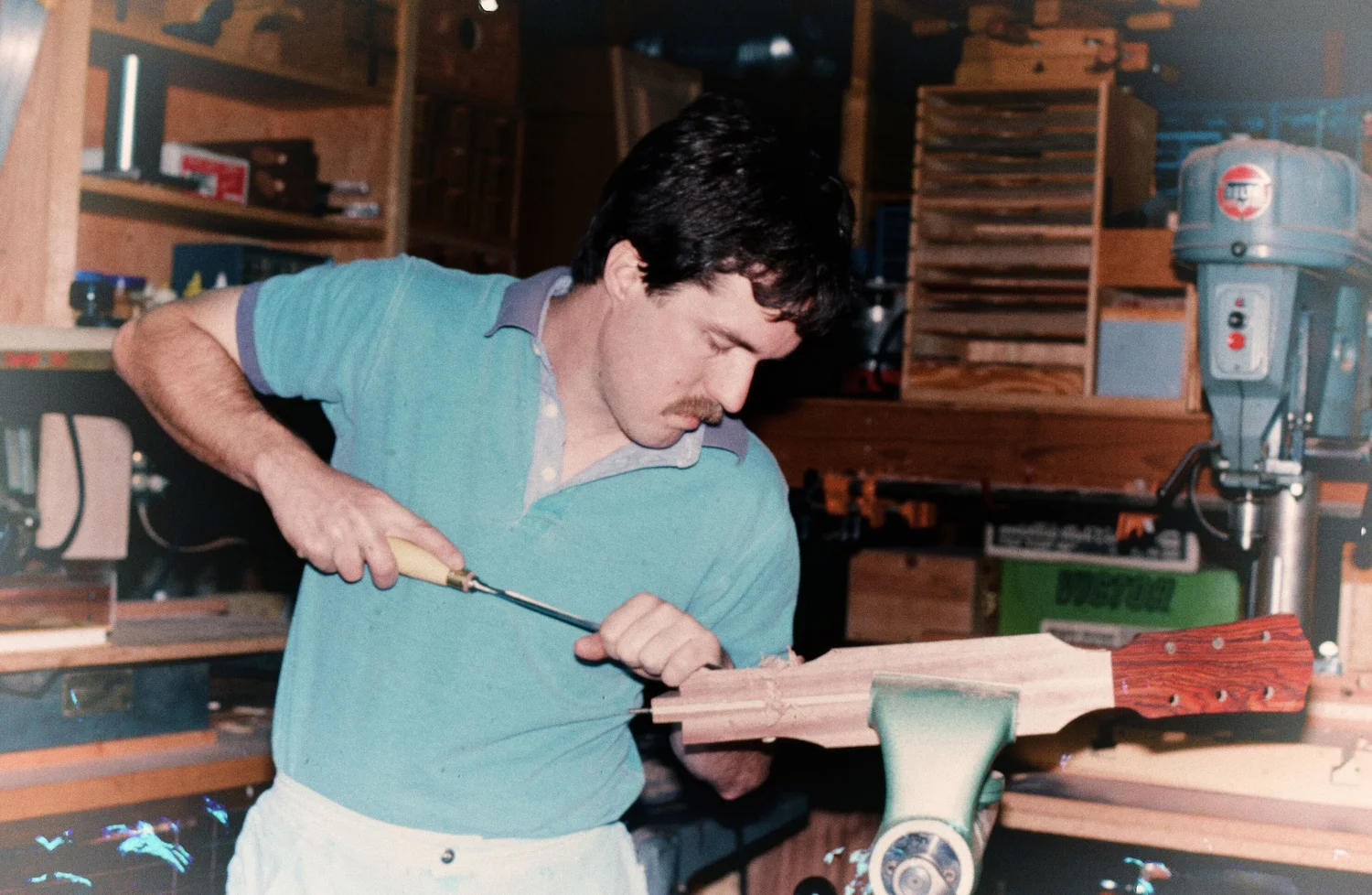
Kevin Ryan’s long odyssey from aerospace to inner space has been a remarkable journey to witness.
He’s traveled from the lab precision of experimental aircraft to the brave frontier of acoustic guitar craftsmanship in a single lifetime.
Such is the fabled story of this Ohio native and his wife Barbara, who tumbled into Southern California forty or so years ago.
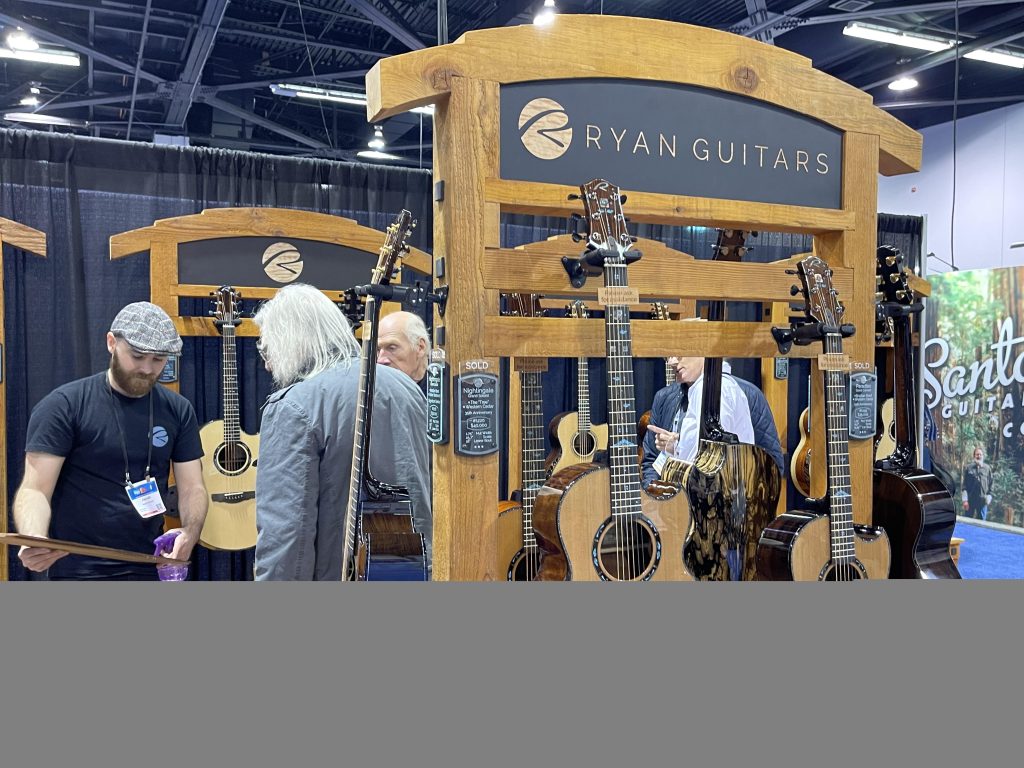
When the National Association of Music Manufacturers opens its show in Anaheim next week, Ryan’s company, Ryan Guitars, will be featured in one of the largest booths, with his hand-crafted guitars on sale for as much as $50,000 – and likely sold out.
Decades ago, Ryan was a cabinet maker and a home builder in Ohio when his dad found him a job in the engineering department of Northrop, the predecessor of the aerospace giant Northrop here in Southern California.
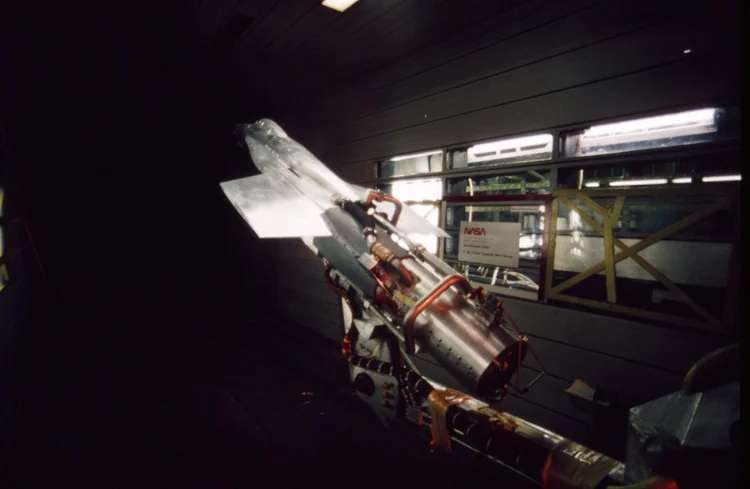
Ryan, and his wife Barbara, left Ohio and settled in Westminster, California, not far from the Seal Beach Naval Weapons Station. They found a home not far from Kevin’s parents and Kevin soon traded his outdoor tools to build model aircraft for wind-tunnel testing.
The son of a self-professed “nutty professor” dad (also an aerospace engineer) and a “zany” musical artist mom, Ryan says he’s happy to have inherited a bit from both.
Ryan said, at first, he was stunned by the “microscopic tolerances” used by the engineers in the development lab at Northrop.
“As a cabinetmaker, I was accustomed to working with tolerances of up to 1/16th of an inch,” he said. Working in aerospace, Ryan said he was suddenly faced with building complex engineering test aircraft “with tolerances of no more than 1/1000th of an inch.”
Ryan worked on the B-2 bomber, building scale models to withstand insane tolerances while being wind-tunnel tested. There was little room for error. “We worked on the B-2 and other aircraft,” said Ryan, “but some that are still classified that I’m not allowed to talk about.”
Ryan could hardly have known then that his name would one day become well known for groundbreaking guitar craftsmanship
“I worked in aerospace for 10 years and I loved that job,” said Ryan in an interview at the recent NAMM show. “There’s a bunch that I learned that I could translate directly into the process of making guitars,” he said.
Although he loved his model-building work in aerospace, Ryan began to reveal a fascination for making guitars, according to his wife Barb.
Even back in Ohio, Barb said her husband was quite the guitar player. Nothing professional, but he loved to play. Fatefully, Barbara said in the mid-80s, she and Kevin went to a concert where she saw someone playing a guitar played by Jim Olsen that she liked.
“I fell in love with that guitar,” said Barb, so after the concert, she found an Olsen guitar that she wanted to purchase for her husband.
“I wanted to find out more about it so I called Jim Olsen to see if I could place an order,” said Barb. “This was 40 years ago, and Jim told me it cost $1200 and there was a three-year backlog on the guitar.
“We couldn’t afford it back then,” said Barb, saying the Olsen guitar was out of financial reach. However, it made Barb think that it may be time for her husband to perhaps build his own.
Barb said the next Christmas, she gifted her husband with the book, William Campano’s Guitar Making: Tradition and Technology.”
Ryan set up a small workshop in the garage of his parents and acquired the materials and tools to build a guitar.
“I started to build guitars, so I was working 100 hours a week,” said Ryan. “I would work all day in aerospace, then come home and work in the shop until midnight and then get up at 3:30 a.m. the morning,” he said.
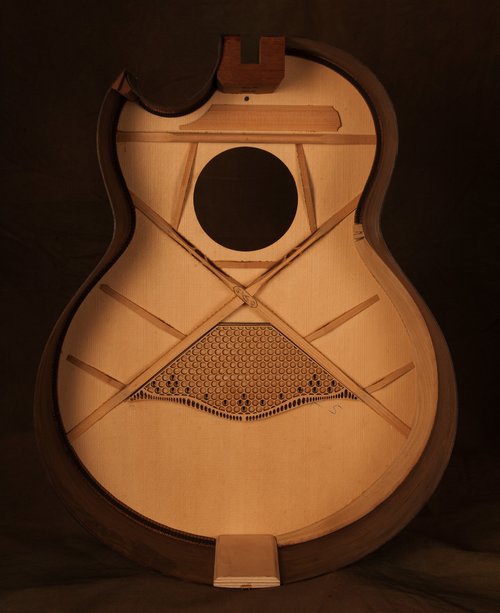
“I did that for 10 years and it was the only way to start the company,” said Ryan. Through trial and error, Ryan quickly discovered new ways to craft the “inner space” of a guitar body to create a smoother sound.
While still at Northrop, Ryan finally managed to create his first “Mission” guitar, which he gave to his devoted mom. It didn’t take long, however, for Ryan, he says, to realize that he could not both work at Northrop and create a successful guitar company.
Ryan said he gave in to the “irrational insanity” to follow his dreams.
He soon resigned from Northrop and set up a manufacturing facility in Westminster. “Okay, if I’m ever going to do this,” Ryan said he told himself, “and that’s my dream career, you know, now’s the time.”
“That was just about the time we adopted our son, so we went from two incomes and no kids to one kid and no incomes,” said Ryan.
Though of concern to Ryan, his wife Barb said she never worried.
“The thing that is unique about Kevin is that he’s so driven. He must be learning something new every day. Once he’s decided, you couldn’t tear him away from it.”
Ryan left Northrop, but taking with him incredible insights from the model building and wind tunnel tests that would jumpstart his process.
“I knew from aerospace that weight was the enemy, even in a guitar,” said Ryan. With time, he debuted more instruments and more models, with industry-first design features like the Ryan bevel, acoustic floutes and using lasers for styling.
Ryan’s aerospace experience helped him develop innovations that showed up in his first series of guitars, including exciting new approaches to design. His long nights alone in the workshop led to breakthroughs in guitar making that included the Ryan bevel and acoustic flouts, an acoustic honeycomb framework and laser sculpting tolerance that produced precision sounds from the strings.
Ryan’s fascination with tools led him to increasingly high-tech approaches, and he credits Bob Taylor for helping him in his developments. Before long he acquired a CNC (computer numerical control) machine, a complex tool that allows Ryan to develop designs in a computer CAD program, which then directs the machine to perform precise cutting and routing operations. With the CNC machine, Ryan was able to introduce more precise and intricate details, including his MicroPearl inlay around the headstock and rosette, as well as blind fret slots where the binding is integrated
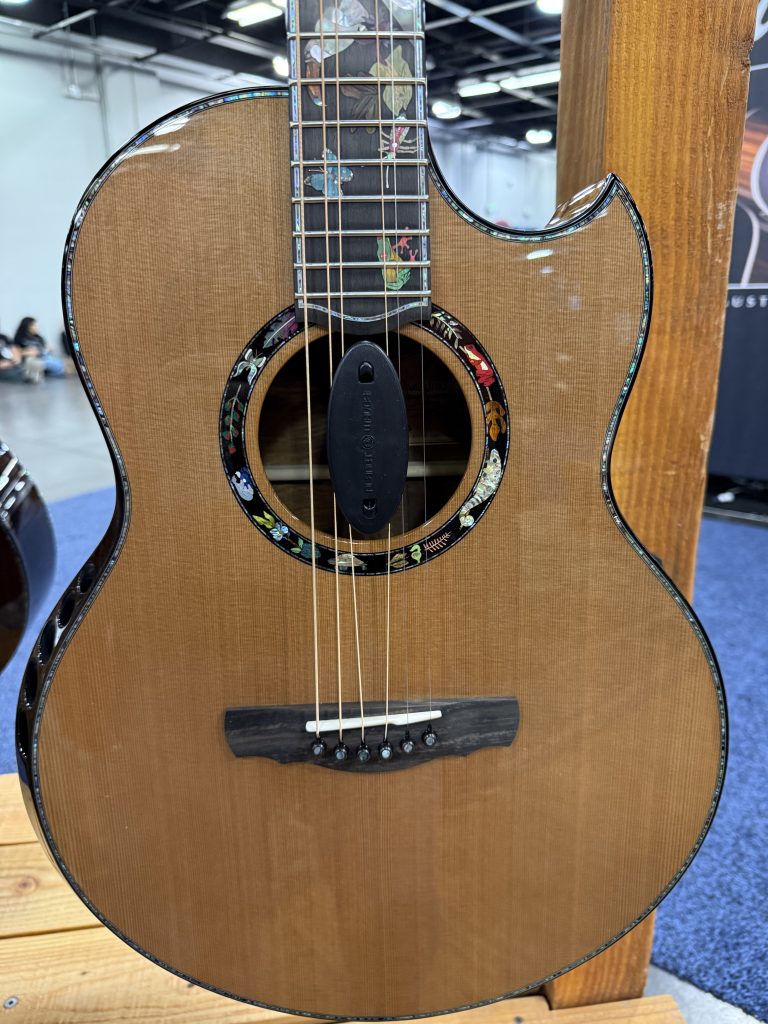
Ryan Guitars remains dedicated to crafting instruments of unparalleled beauty, comfort, innovation and performance, which honor the planet’s natural resources and delight the world’s finest players.
“Weight is the enemy,” Ryan says. “That has been a guiding principle to me.” As a former carpenter, he was familiar with wood, so he began testing all kinds of configurations and structures.
According to Ryan, seeking a “top” for the guitar was a challenge. He wanted it lighter, yet shaped with an ability to create and softly amplify sounds that resonated louder from the instrument.
When challenges like this cropped up, Ryan said he had an advantage. “I have a steel trap mind that works in my favor,” he said. “I’m dysfunctional in that while I’m working on something involved in the building process, it suddenly becomes the most important thing in my life,” said Ryan. “My brain knows this is not the case, but every other part of my brain thinks this is the most important thing I have ever done in my life,” he said.
“The more I did, the better I liked my guitars,” said Ryan.
Moreover, Ryan’s manufacturing plant in Westminster became an everyday Santa’s workshop for music, especially the sounds of acoustic guitars.
Ryan encouraged ideas from his team and even today, there are no bad ideas.
“I want our team to feel comfortable to push me, and others to do our best work,” he said.
“I love it when they have an idea, even if it doesn’t work,” said Ryan. “We always learn something and have fun doing it.” “We do things that nobody else in the world does. We invented things no one else can figure out and I wanted to create an environment where an incredibly talented team can flourish,” says Ryan.
Ryan’s “endless experimenting” and unique work environment paid off.
His guitar company, founded in 1987, today attracts national attention and has been adopted by some of the finest acoustic guitar players like Al Stewart, Laurence Juber (Paul McCartney’s “Wings” guitarist), Peter Finger, Tim Sparks, Woody Mann, Isato Nakagawa and others.
Acoustic Guitar Magazine crowned Kevin Ryan one of the most influential makers of the previous thirty years and his guitars “A blueprint for scores of other builders” and “a modern classic”.
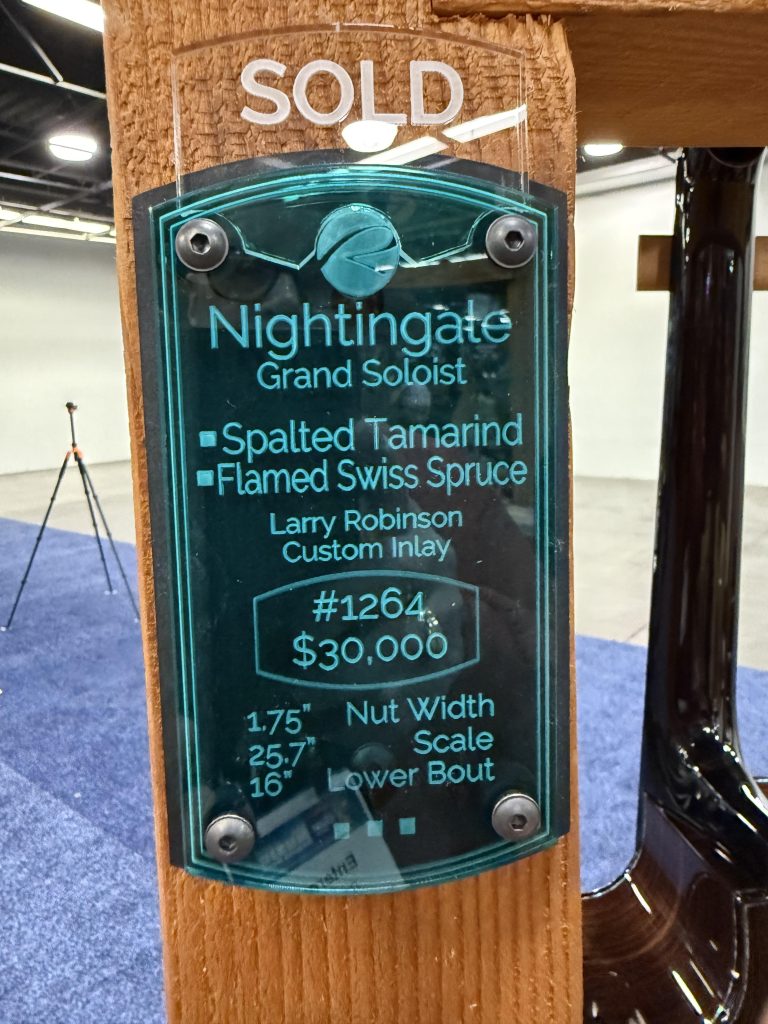
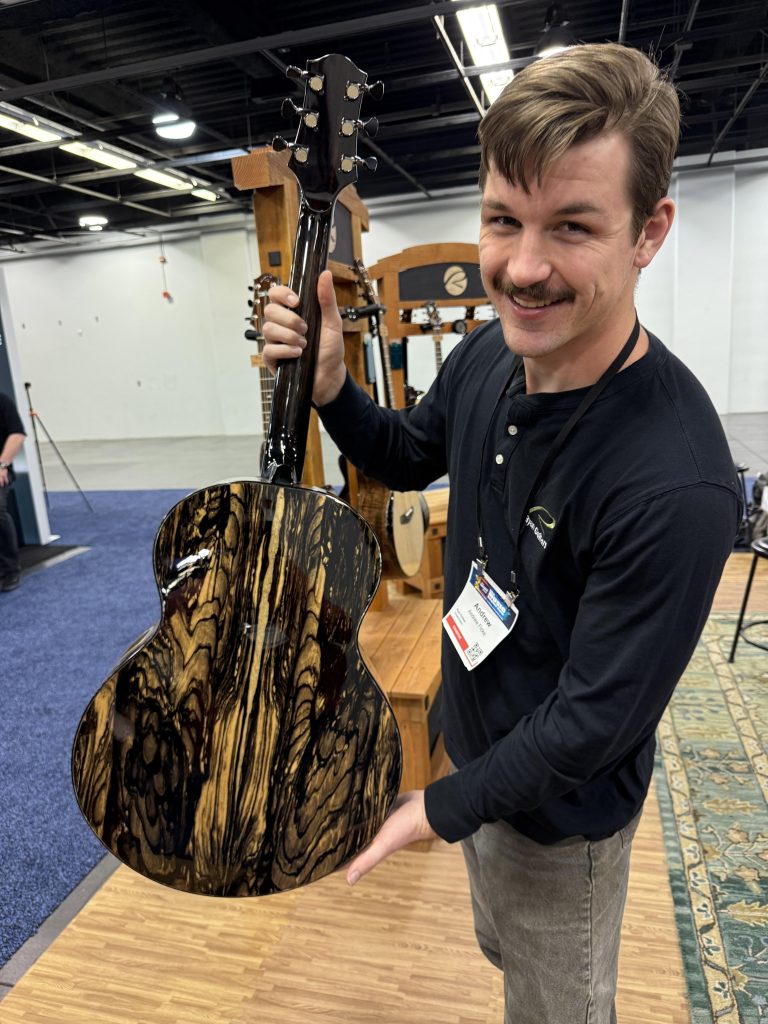
The Westminster guitar maker now offers several lines of guitars as its priceless instruments continue to attract attention and the dedication of an industry that has only grown over time. Ryan now purchases rare wood, like rare trees, some thousands of years old, to further refine his never-ending quest for a better sound.
“We build guitars, not because it is easy but because we thought it was going to be extremely difficult. We flourish not only as craftsmen, but I mean, we really love each other,” he said, “and I guess that is what really matters.”
Ryan said that until he launched his company, guitar building had changed little in the past 150 years. Perhaps 150 years from now, they will be studying Kevin Ryan. While his journey from aerospace to inner space is not yet complete, Ryan and his brand of guitars have indeed reached an orbit all their own.