

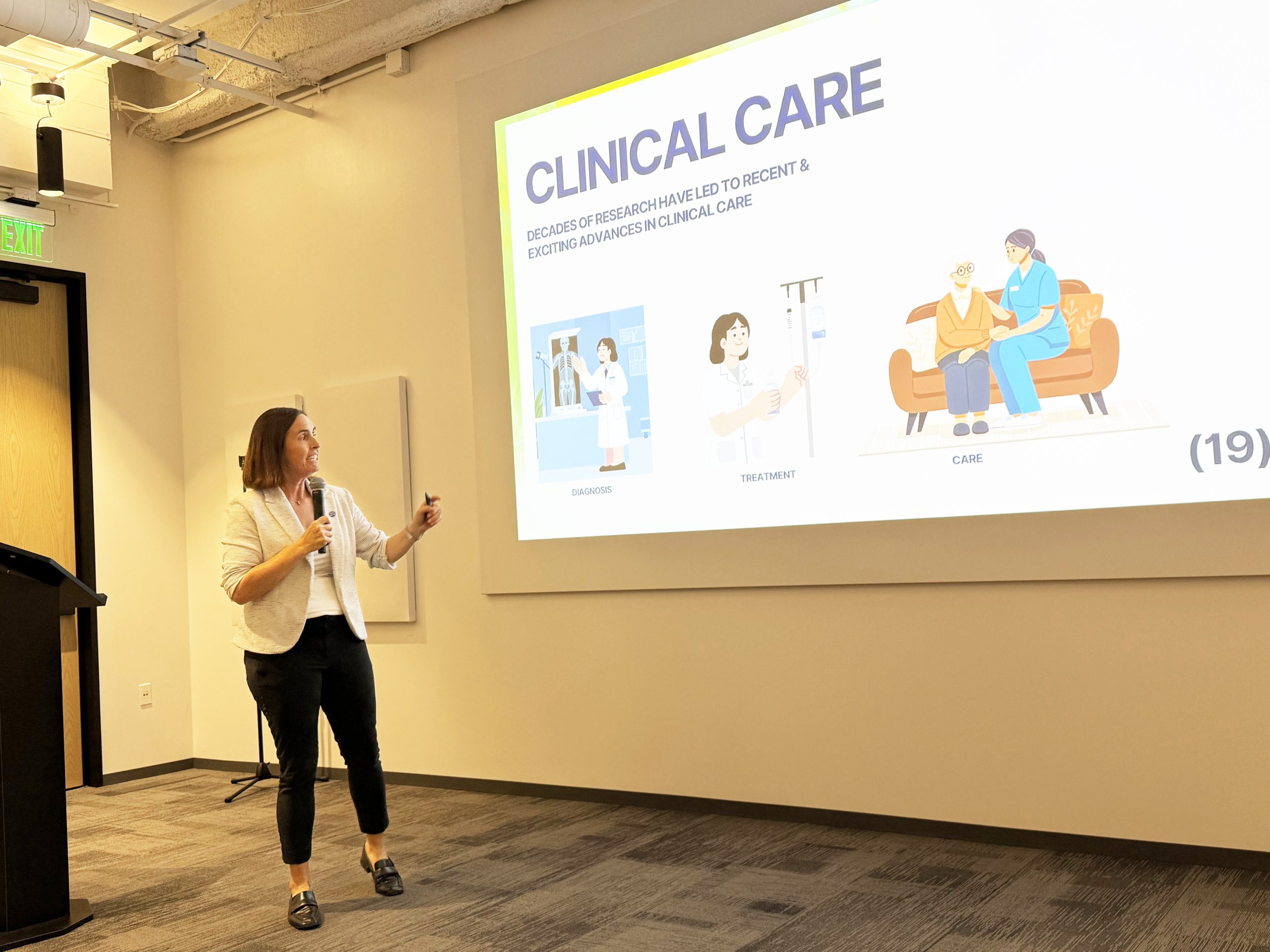
The Los Alamitos Chamber tackled a popular, yet indirect commercial issue at its November networking luncheon, inviting a leading doctor from the UCI Mind Initiative to explain the complexities of a topic of increasing interest to an aging demographic.
“I’m excited,” said Susan Morales, co-Chair of the Los Al Chamber, “because our speaker today is one of the most sought-after speakers from the University of California at Irvine’s Institute for Memory Impairment.”
Morales, a UCI Health executive, said many people within the city, the school system, and others had requested that she find a speaker within their organization to educate members about neurologic diseases.
“I’m happy to see so many of you here today,” she said. So many Chamber members and members of the public had signed up that the event was held in the large conference room at the Epson America auditorium in Los Alamitos.
Morales introduced Megan Witbracht, Ph.D., representing the UCI MIND (.Institute for Memory Impairments and Neurological Disorders). She then led the group on a journey through the human mind while sharing the institute’s latest neuroscience research at UCI.
The innovative and collaborative program at the University of California, Irvine, supports interdisciplinary brain and neuroscience research. It is closely linked to and builds upon the work of established centers like the Center for the Neurobiology of Learning and Memory (CNLM), she said.
Accordingly, UCI MIND “aims to advance brain science through collaborative research, graduate education, and by creating a digital hub, focusing on themes such as learning, memory, and brain health.”
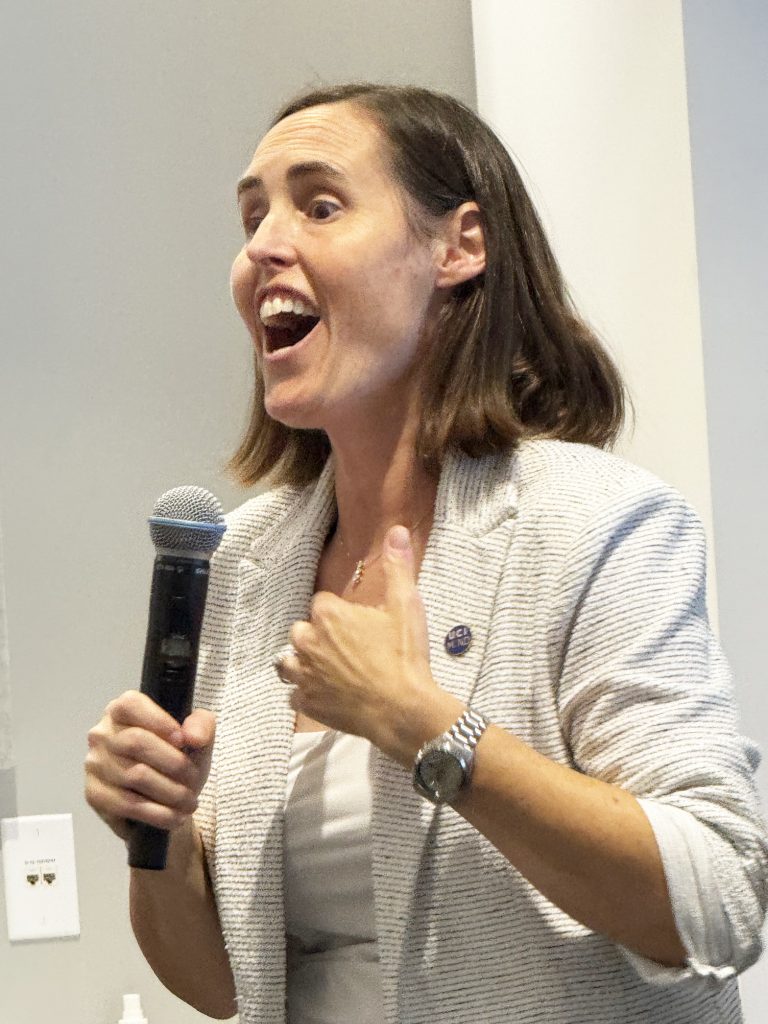
First of all, Dr. Witbracht clarified the issues surrounding many of the well-known neurological diseases and defined “dementia” as an “umbrella term.”
“Dementia simply means cognitive impairment, or a problem with memory and thinking severe enough to impair the way you live,” she said.
Moreover, Dr. Witbracht respectfully discussed when and how average citizens can determine routine “forgetfulness” issues vs. serious brain impairment.
“If it happens occasionally, or if it’s happening and not affecting your daily life, it is normal,” she said. “But when you start getting the lights turned off, or if you decide it’s a good idea to run a red light because you’re going to miss your appointment with the doctor, that’s when it becomes a problem,” Witbracht said.
She said Alzheimer’s Disease dates back to the 20th century when a German neuropsychiatrist named Alva Alzheimer noticed something in the brain of a female patient that he did not see in the brains of other people.
Today, Alzheimer’s initial findings have been developed into an infinite science of the brain disease that carries his name. Without getting overly technical, Dr. Witbracht said Alzheimer’s occurs when there is amyloid plaque buildup in the brain.
“We know that there are 7.2 million people with Alzheimer’s disease and about 12 million unpaid caregivers. This costs $413 billion and it’s the seventh leading cause of death,” she said.
“For every five years a person lives past the age of 65, their risk for developing Alzheimer’s disease doubles. In fact, when we turn 85, our risk of developing dementia is about one in three.”
She said scientists and technicians have not identified exactly what causes our brains to develop these neurological diseases.
“Typically,” said Dr. Witbracht, 99 out of 100 cases of Alzheimer’s disease are sporadic, meaning it’s a combination of genetics and environment. We think about 50% contribution of each one in 100 cases is purely genetic.”
Another puzzling fact is that 75 percent of Alzheimer’s patients are women, she said, as researchers and scientists’ study why this happens.
“Two-thirds of Alzheimer’s cases are in women. At age 45, the lifetime risk for women is 20%, and that of men is 10%. We’re not entirely sure why… We know that women go through a huge change at about 45-50 called menopause, which may have something to do with it,” said Dr. Witbracht, though research continues.
UCI, in its collaboration with other major institutes and organizations, are studying prevention methods for Alzheimer’s and other major brain diseases.
“We know that getting plenty of aerobic exercise lowers your risk for Alzheimer’s disease. We don’t know why it hasn’t panned out in randomized, controlled trials, but we know there’s a strong association in epidemiological studies between aerobic exercises like walking, running, gardening, and lowered risk for Alzheimer’s disease,” she said.
While research is underway, there is a growing demand for more people from the broader public to volunteer to participate in the program.
“The single most common reason that clinical studies fail is that we don’t get enough people to participate… It’s possible we could have found cures to certain diseases years ago, but it’s often the case that we can’t complete a study, or it takes us five to 10 years longer to complete a study because we don’t get enough people to participate,” Dr. Witbracht said.
Even so, Witbracht said treatments are emerging. Though there are currently only two treatments for Alzheimer’s, the existing treatments show promise.
“In 2023, we had our first disease-modifying treatment. In 2024, we had our second disease-modifying treatment… These are treatments, monoclonal antibodies that target amyloid plaques and remove them from the brain. And in people with early Alzheimer’s disease, they’ve been shown to slow cognitive and functional decline compared to people on a placebo,” Witbracht said.
“While Alzheimer’s disease remains a complex challenge, we are making unprecedented strides. With new blood tests, disease-modifying treatments that can slow cognitive decline and a growing understanding of prevention strategies, we can more effectively manage and potentially mitigate the impacts of this devastating disease,” she told the group.
“The latest research offers a beacon of hope: by focusing on risk factors and maintaining a healthy lifestyle, we have more tools than ever to protect our cognitive health,” Dr. Witbracht said.
In other action, the Chamber recognized Courtyard by Marriott in Cypress as the Business of the Month. Officials thanked Hotel manager Christine Dieu and Events Manager Pamela Konneker for their assistance and Co-Chair Dr. Andrew Pulver thanked Mike Prencavage from The Family Plumber in Los Alamitos for sponsoring the event.