

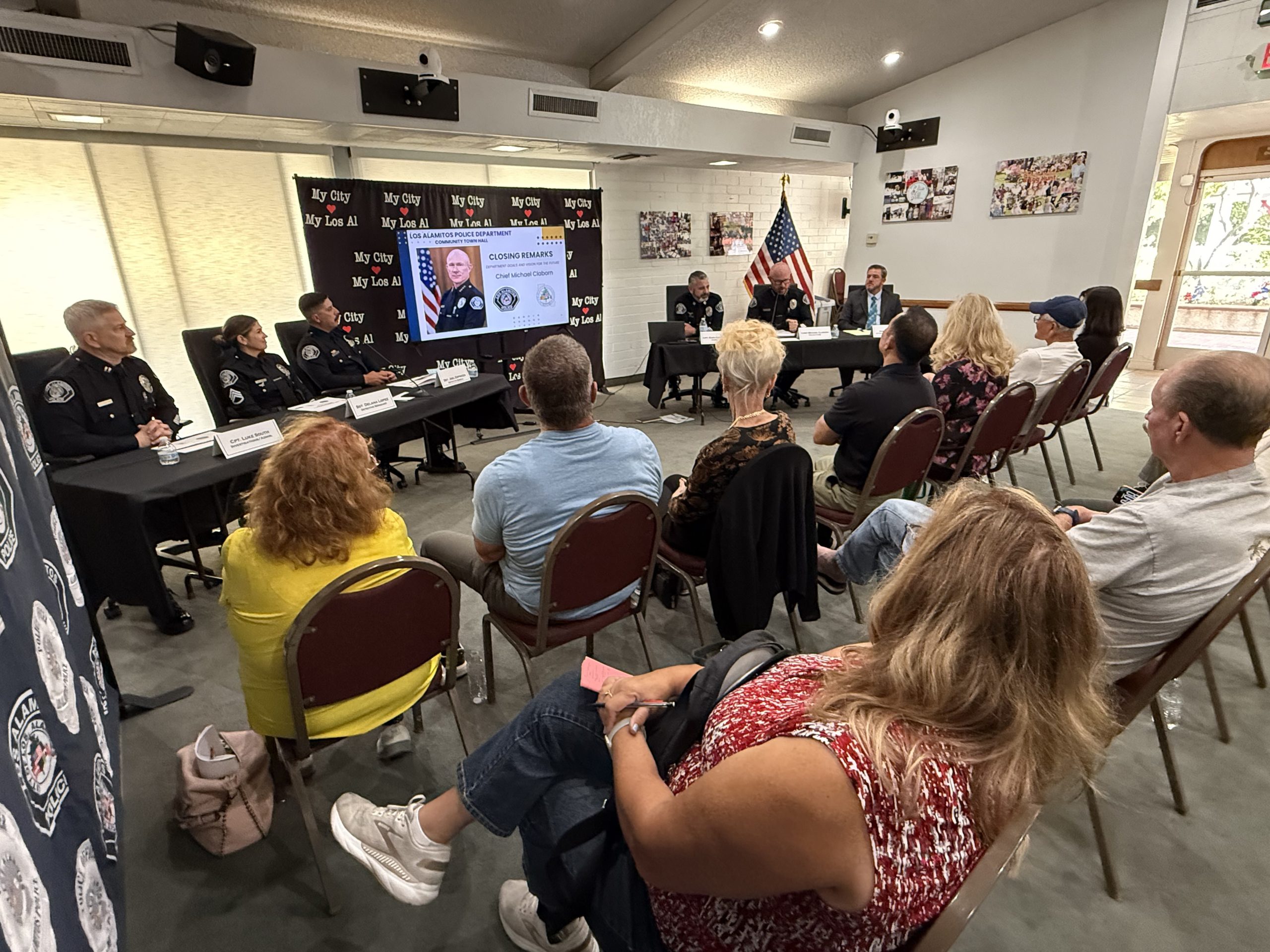
Although the Los Alamitos City Council approved body-worn cameras for police in December of 2025, police officials explained at a town hall on June 30 why the city’s police officers are still not wearing the devices.
Los Alamitos remains the only police department in Orange County to not utilize body-worn cameras in the field, though police officials acknowledge they are working out the details to deploy them soon.
In addition to body-worn cameras, Los Al Police Chief Michael Claborn had his department heads explain other top crime patterns in the city, hoping to prevent additional crimes of opportunity.
In addition to the body-worn camera discussion, Claborn said, “I’m going to cover some crime patterns to help prevent burglary, theft, fraud, and some of the best schemes.”
Claborn introduced Detective Luke South, who introduced Det. Sgt. Delana Lopez and Det. Joel Espinoza. Espinoza then explained two “crimes of opportunity” perpetrated on senior citizens in the community that robbed them of $100,000 in cash.
South and Ezpinoza said they also work with Det. Oscar Perez, who was not present at the forum.
First, he said residents should always keep their residences locked to prevent themselves from “becoming easy victims” of property crimes.
“So as you guys can see, property claims, fraud scams, and fraud related crimes are on the rise, as well as crimes of opportunity like shoplifting, mail theft, bicycle theft, and things like that. Fraud and scam related claims continue to increase statewide, as you guys can see, and that you guys probably get tons of messages and calls a day as we all do,” said Espinoza.
He went through a series of crimes but said fraud and identity type thefts are on the rise.
“You guys can really take quick, easy steps by locking your residences, make sure you lock your vehicles, make sure you don’t leave things in plain sight for individuals to take,” the detective said.
Also, he said, residents should certainly not leave their property out in plain sight for criminals “committing these crimes and affecting our communities.”
Moreover, Espinoza said residents, especially seniors, should be especially vigilant of phone calls from scammers seeking information and/or money. “It’s called the government impersonation scam,” he said.
Espinoza told the story of a resident who “got a call” from someone impersonating a police officer who would give them a call to arrange the payment,” Espinoza said.
“The defense attorney called back and gave him a number that kind of resembled a case number,” the detective said, and advised them to go to the bank. “So, he went and got $16,000 from the bank,” Espinoza said.
Then, the detective said, the couple was told the “woman driving the other car was pregnant, and her unborn child,” had both died in the accident so they would need an additional $35,000.
The Los Al man, said Espinoza, did as instructed, went to another bank to withdraw an additional $35,000, and the same thing, someone came to his house and he handed it over.
“He was out $50,000 in a span of a few hours,” the police detective said, urging residents to take a series of steps to protect themselves.
“And the best practice is always to hang up on suspicious callers, don’t even give them your voice if it’s a pending urgent matter,” he said.
In addition, said Espinoza, criminals are using digital recording devices to sample people’s voices over the phone to create fake recordings that can sound convincing. In addition, he said, scammers also claim to be from the Social Security Administration, Publisher’s Clearing House and others.
Police officials said residents should hang up and check with the police department.
“This is a community partnership,” he said, and “the sooner we get this information the sooner we can act on it,” he said.
Regarding the body-worn cameras, Capt. Kain Gallaugher, a 20-year veteran of the department and currently the department’s longest-serving officer, gave a detailed overview of the technology and the rights demanded by its use.
With a degree in computer science, Gallaugher said he became a natural to investigate the body-worn cameras for the department and tried to explain to the attending residents what body-worn cameras are and what they are not.
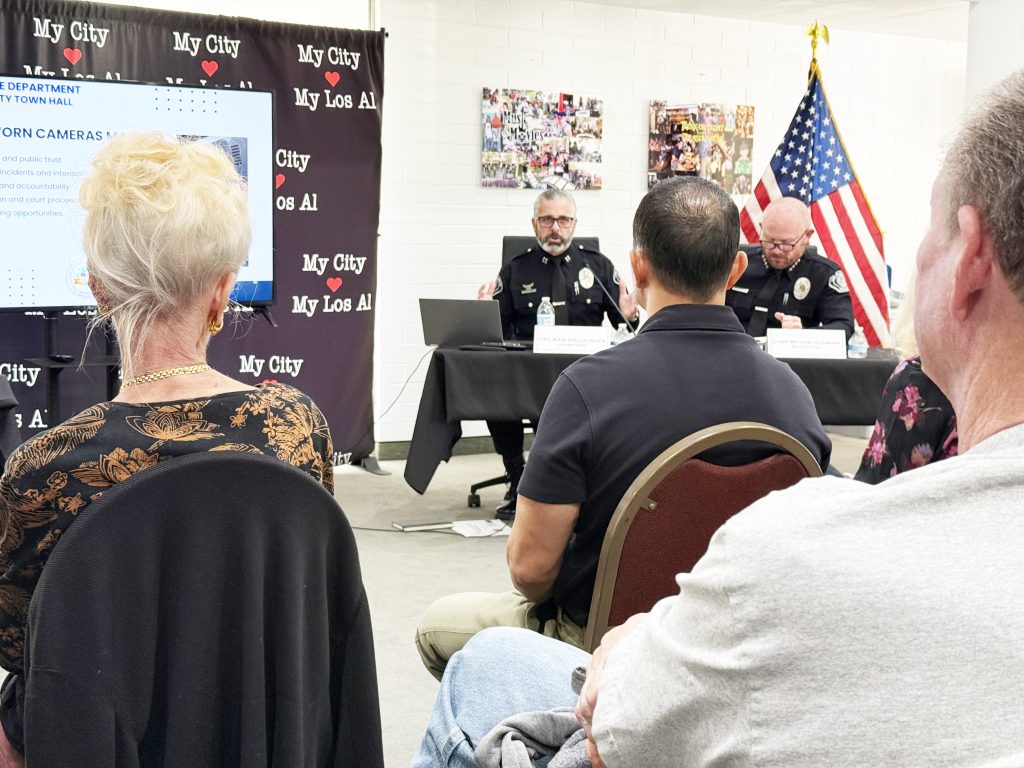
Photo by David N. Young
“When people hear the word ‘body-worn camera,’ they often think it simply means strapping the camera on your chest and it is so much more than that,” said Gallaugher.
Citizens have no idea how much more is involved by the implications of a public recording technology.
“The reality is that implementing our camera program is a major undertaking involving technology, police policy, developmental evidence management, cyber security, privacy protections, training, public records acts compliance and accountability systems,” the veteran police captain said.
After extensive evaluation, he said, the Los Al Police Department has decided to go with the Axon body-worn devices, which, said Gallaugher, is widely recognized as the leader in the industry.
Actually, he said the camera itself worn by officers is only a small part of a massive system of interconnected internet platforms that will be automatically integrated with the Orange County District Attorney’s office.
“This will allow us to very safely streamline and save the evidence that is created or captured by this camera system that maintains a good chain of command,” said Gallaugher.
Today’s sophisticated cameras start rolling automatically when a taser is activated, and body-worn cameras have a 30-second pre-roll feature that starts recording before an incident to ensure nothing valuable is lost.
The cameras roll on their own, and the recording system uses a proprietary judicial platform that protects the recordings from any tampering.
Any actions on any previous videos are instantly recorded and double-checked, so that every action taken on a recorded video must be defensible and stand up to evidentiary scrutiny in court, said Gallaugher.
Moreover, he said body-worn cameras have a history of promoting field compliance among citizens, and the evidence they record “will protect the citizens as well as the police.”
“One of the most common misconceptions regarding body cameras is that the recording exists and everyone can get it.
California law is much more complex than people think. That’s why we have this wonderful attorney here to my left. While it is incredibly important to be transparent to the community and share with you guys the things we can, what is equally as important to us is your privacy. If you end up on one of the cameras, I’m sure you probably don’t want everyone seeing it,” he told the citizens.
“Actually, we live in a day and age,” said Gallaugher, “where this technology is so readily available that simply telling somebody what happens sometimes just isn’t enough,” said Gallaugher. “People want to see it. They want to hear it,” he said.
“The goal is transparency, not secrecy,” he said.
Part of the delay in implementing the cameras is developing a social use policy that encompasses every one of these protections, he said, and then that document must, by law, be ratified by the City Council.
Claborn said the department is hoping to be done by August, while Gallaugher said he hoped so, but that might be a bit optimistic.
According to Gallaugher, the wait is simply to get it right with a technology that is changing literally by the day. Deploying body-worn cameras implies much more than just fighting crime.
“It is about strengthening confidence between the Police Department and the community that we serve, as both a police captain and a parent whose family is deeply connected to this community, I believe this program represents a positive step forward for the department and the residents we proudly serve,” he said.
Editor’s Note: The police and residents also discussed a growing electric bike concern, but we will cover that in an upcoming issue.