

This is the first such incident. Perhaps it won’t be the last.
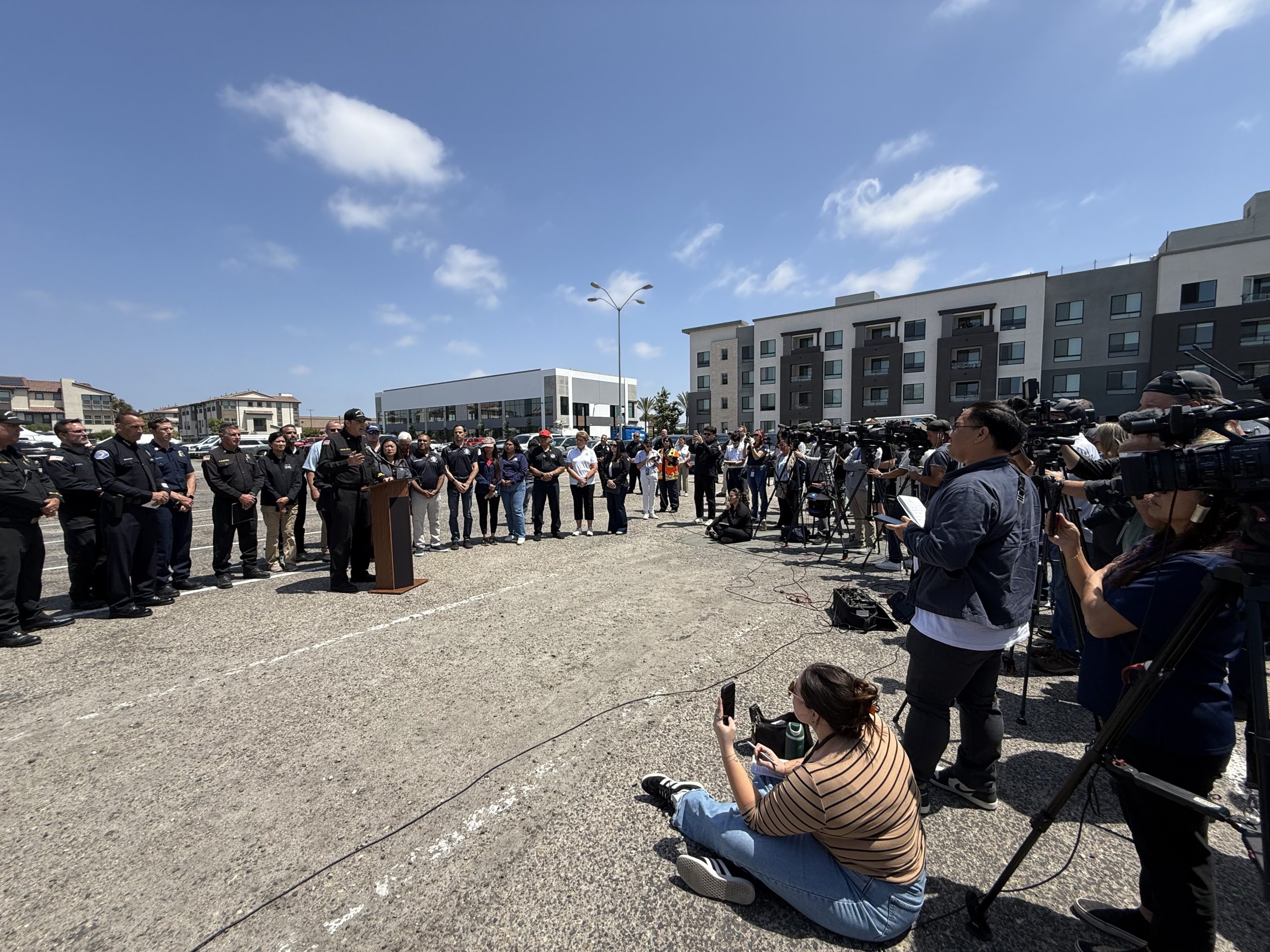
Following a leak in a chemical tank in southern California this week, more than 50,000 displaced residents were, in some cases, literally pulled away from their homes with little or no notice.
Ripping them away from everyday lives this week was like ripping off a Band-Aid to expose something deeper and more ominous underneath. Smoldering beneath the surface for decades, unearthed only by the leaking MMA.
Believe it or not, it appears as though that in this state, there is no minimum distance required by law between a tank full of explosive industrial chemicals and the bedroom window of a child.
This situation didn’t happen overnight, and this column should not be considered an effort to point fingers or assign blame. Consider it an issue that deserves attention before this happens again.Let us be precise about what is at stake beyond the immediate evacuation. The GKN facility manufactures the F-35 fighter jet canopy. It sits on Western Avenue in Garden Grove, flanked on multiple sides by residential streets.

Those streets, and many more, appeared on an official Orange County Fire Authority blast zone map this week. An elementary school sits within the projected damage radius. There is no moat. There is no green belt. There is, in most cases, a fence.
As it turns out, this may not be unique to Garden Grove, as no zoning laws have been broken.
Over the years, GKN has had to deal with OSHA violations, paid hundreds of thousands in fines, though, in fairness, none were apparently connected to this week’s incident.
Within a twenty-mile radius of Long Beach, there are an estimated 150 to 200 aerospace and defense manufacturing facilities. Of those, perhaps 80 to 120 file Hazardous Materials Business Plans with the state. Companies that store regulated quantities of chemicals capable of causing mass casualties if released must file HMBPs.
A conservative analysis of land use records, regulatory filings, and a study by the Bay Area Air Quality Management District on proximity suggests that somewhere between 60 and 75 percent of those filers operate with less than 1,000 feet of separation between their hazardous materials storage and the nearest residential parcel.
As we saw in Garden Grove, it is even less.
The governing law is California Health and Safety Code, and a program that requires businesses to disclose the location, type, quantity, and health risks of hazardous materials, and to file emergency response plans with the state.
It seems also from a simple reading of the statute, that it appears not to contains any setback provision, no minimum distance requirement, and no prohibition on locating regulated facilities adjacent to residential zones.
There is no minimum distance required by California law between a tank full of explosive industrial chemicals and the bedroom window of a child.
The Hazardous Materials Business Plan program, which has governed chemical disclosure since 1986, requires paperwork. It requires emergency response plans. It does not require distance. It recommends but apparently, does not mandate buffers.
In some cases, there may be good reasons for it. In some cases, however, as this community has experienced, the measure offers little when things go wrong.
The aerospace and defense industry came to Southern California in the 1940s, drawn by open land, year-round flying weather, proximity to the ports of Los Angeles and Long Beach, and the gravitational pull of wartime federal contracts.
I’ve written extensively about how fortunate the area has been and is currently, to have such a strong aerospace technology base. It is the future and offers much to our community.
But those high-tech firms require hazardous materials to produce this amazing technology that makes our military what it is today.
That original proximity was a function of necessity. Workers walked to work. Transit was sparse. The calculus made a kind of economic sense. What happened next did not. As the Cold War deepened and the defense industry expanded, California’s booming postwar population filled every available parcel around the plants.
Zoning laws, written to manage uses rather than separate them, drew lines between industrial and residential that existed on paper but not in physical space. The fence at the back of the cul-de-sac was the only buffer.
Lost wages, lost business revenue, hotel and shelter costs, and emergency response expenditures are running into the millions. Garden Grove Unified School District is closed. The Garden Grove Strawberry Festival parade has been canceled. The voting center shut. The 22 freeway was partially closed. The ripple effect extends across the regional supply chain.
But the opportunity cost is higher and less visible.
Every dollar a local government spends responding to an industrial emergency is a dollar not spent on roads, schools, or public health infrastructure. Every family that experiences a forced evacuation loses trust in the proposition that their neighborhood is safe.
There is also the cost of foregone regulatory action. California has had the tools to address industrial-residential proximity for decades. The CalARP (California Accidental Release Prevention Plan) program, which governs the most dangerous chemicals, has required facilities to acknowledge proximity to sensitive receptors since 1997. Apparently, it never required them to do anything about it.
GKN is the crisis of the moment. It may not be the last. Area aerospace firms utilize hazardous materials like liquid oxygen, rocket fuel, perchlorates and hydrazine, beryllium and more.
Castellon, a missile manufacturer in Torrance, describes its own operations in job postings as a “high-hazard manufacturing environment.”
None of these facilities are necessarily operating irresponsibly. Many are among the most sophisticated engineering organizations on earth. The problem is not competence. These are all very competent companies with among our best and brightest.The problem is proximity.
When a facility that handles catastrophically dangerous materials has no physical buffer between its operations and a residential neighborhood, competence is the only thing standing between a Thursday afternoon and a BLEVE. Competence is not a land use policy.
If there is a lesson here, it is that government still matters.
Legislators would be wise to second look at the proximity issue and although it is a bit late in the game, with residences built to within feet of many, but not all, facilities. Public interest is vital to safeguard our future, so we must restore it, both right and left.
All of the first responders in this incident are indeed heroes. If only those elected can now sit together and determine what regulatory changes might make sense in the wake of this incident, it may be necessary to restore the confidence and fear that leaked with the chemicals.
At the very least, every resident should know every chemical within 2,000 feet of their homes and what to do the next time something like this occurs. The data likely already exists.
The cost of this tragedy is impossible to gauge. The physical, emotional, social, and legal damages are extensive, to say the least.
Though this was the first incident of its kind, we can only think that, with millions of residents exposed to so many facilities, it likely will not be the last. Residents have no place to go, and the aerospace industry is critical to the future.
There is a way to balance the best interests of both.
If we can’t solve the proximity issue, however, at least let residents and local businesses know what lies beneath or among their corporate neighbors next door.
After all, this is only the first such incident. It could indeed happen again.