

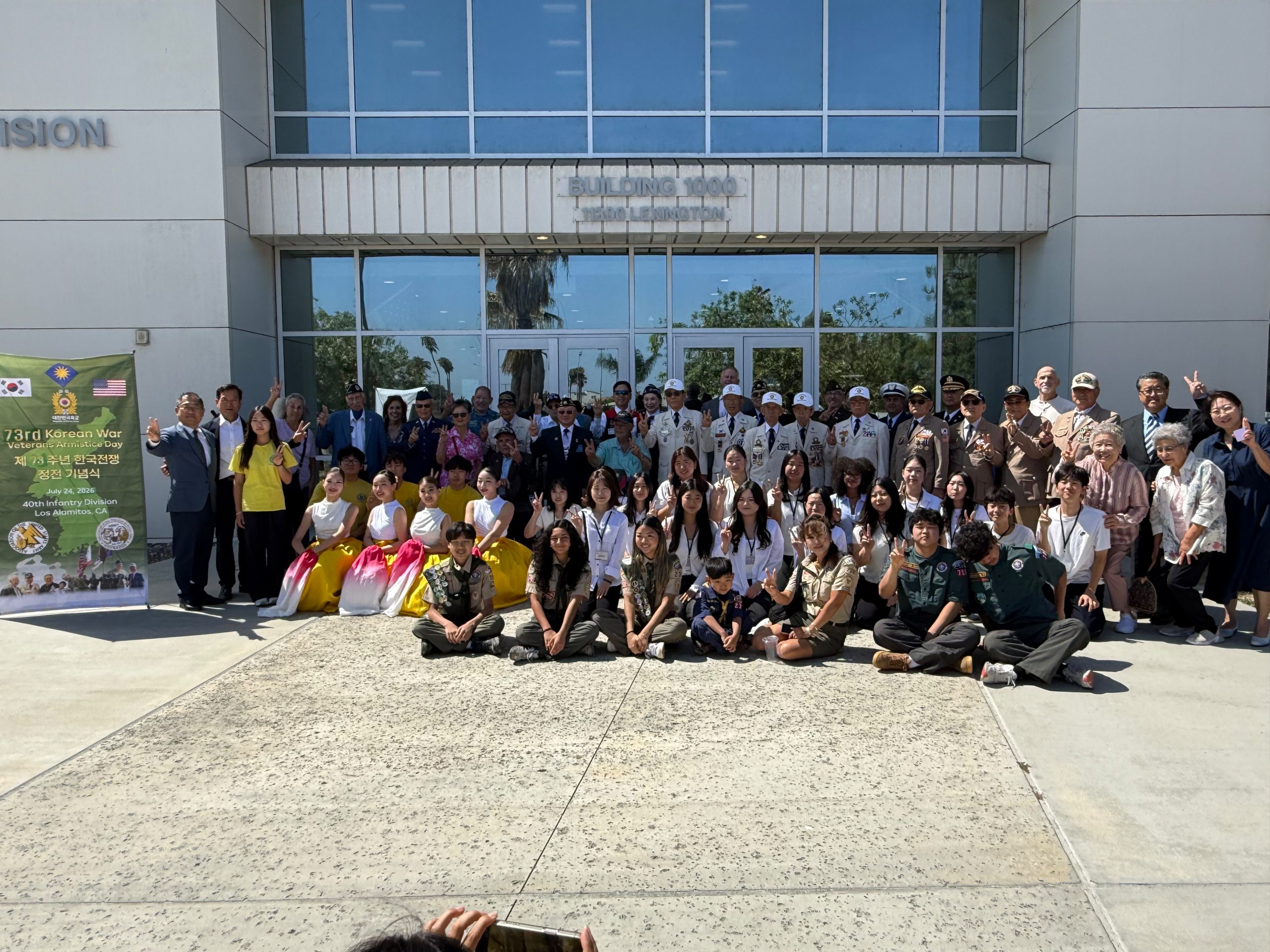
Although time is beginning to take its toll on aging veterans, several American and Korean War veterans old enough to fight in the early 1950s returned to uniform July 24 to jointly celebrate the 73rd Anniversary of the Korean War Armistice.
For the 40th Infantry Division, stationed at the Joint Forces Training Base in Los Alamitos, it was perhaps one of their most glorious campaigns, fighting in the so-called “Punchbowl,” along Heartbreak Ridge and Sandbag Castle to heroically halt the North Korean advance.
In fact, a large marble statue stands proudly in the lobby of the 40th Infantry Division headquarters, along with many other weapons and armor used in the successful effort.
“On behalf of the soldiers of the 40th Infantry Division and Commanding General William J. Pendergrass IV, we welcome all of our guests, veterans and friends to the 73rd anniversary of the Korean War Armistice,” said 40th Infantry Division Chief of Staff Juan M. Mora.
Mora says the 40th Infantry Division was deployed to the Korean War to halt the breakout and push back the North Koreans to establish the so-called 34th parallel, the dividing line between North and South Korea that remains to this day.
On Friday, small groups of U.S. and Korean War veterans were honored at the Joint Forces Training Base for their service to the cause that ended with an Armistice on July 27, 1953.
The Koreans and Americans both added pageantry to the event with decorative dancers and representatives of younger generations who plan to keep the tradition alive, according to Man K. (Martin) Choi, President of the Republic of Korea Army Association.
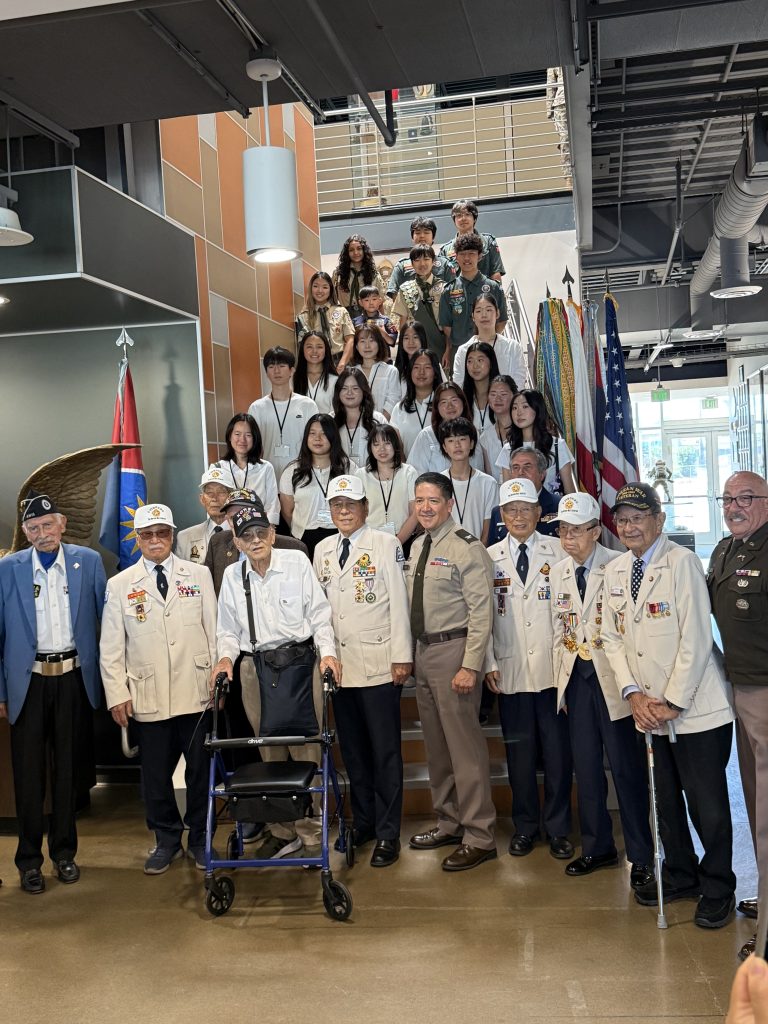
Over the past few years, the massive lobby of the 40th Infantry Division has been turned into a mini-museum, with significant displays of battlefield armor, weapons, medals and documents.
Currently, a Japanese-era tank awaits visitors as they walk through the front door and base officials said the public is invited to visit.
During the 40th Infantry Division’s 342 days of campaign combat, nearly 400 Americans from its ranks were killed in action, while nearly 1,500 were wounded in action. Three of its service members were awarded the Purple Heart, a purple ribbon and medal bearing the likeness of George Washington were awarded for acts of bravery to honor those who shed blood or sacrificed their lives in the line of duty.
Historical accounts say during the Korean War, the storied 40th Infantry Division Commander, Maj. General Joseph P. Cleland noticed more than 150 Korean children attending classes in a tent dangerously close to the booming artillery fire.
Under his military leadership, each service member put up $2 while the division’s architects and engineers designed a new school near the area of Gapyeong, northeast of Seoul.
The division subsequently helped fund Gwanin Middle School and High School near Pocheon in 1955, together with hospitals and other community facilities in an area called “Sunburst Village.”
In addition to the school, the “Sunburst” is another tradition carried on by the Division, with an award-winning special “Sunburst” school on the base and the 40th Infantry Division itself called the “Sunburst Division.”
Moreover, Mora said the school is still supported by Korean and American veterans. “We still raise money for scholarships each year for the school in Korea,” said Mora before this year’s event.
The school was named Kenneth Kaiser School, honoring Sgt. 1st Class Kenneth Kaiser Jr., a 19-year-old Los Angeles soldier who was the division’s first Korean War combat fatality. Korean residents pronounced Kaiser as “Gaisa,” so it was also known locally as the Gaisa School. It later developed into what is now Gapyeong Middle School and Gapyeong High School.
The 40th Division has maintained its relationship with Gapyeong for more than seven decades through visits, scholarships and the Kaiser Hall Museum, according to U.S. Army accounts and National Guard history.
Following the event, the military veterans from Korea and the 40th Infantry Division were treated to lunch and celebratory remarks and events.
Ironically, Orange County resident Michelle Steel, recently appointed by President Donald J. Trump as U.S. Ambassador to Korea, also honored the anniversary; however, this time did so at the U.S. Forces Korea (USFK) ceremonies in Seoul.
Leading up to the anniversary, Ambassador Steel aligned diplomatic and military efforts with Acting Secretary of the Navy Hung Cao. In statements issued alongside the Department of the Navy and U.S. Forces Korea, she reiterated an “ironclad” commitment to a free and open Indo-Pacific. According to reports, she highlighted the enduring strength of the U.S.–Republic of Korea naval partnership.
Steel often tells the story of her lineage to the Korean War, as her parents were forced to flee North Korea, ended up in South Korea, then Japan before immigrating to the USA in 1975.