

So far, it’s been nonstop for the relatively new President and CEO of the Aquarium of the Pacific, Jeff Flocken, since he arrived in 2025, and this week was no different.
Flocken brought together NOAA weather experts in January who predicted significant impacts from this year’s El Niño, which has brought hurricanes, humidity, and heat to the Southern California Coast.
Little did he know that his staff would be called out on a rescue mission for rare sea turtles because of those impacts, but indeed it happened this week.
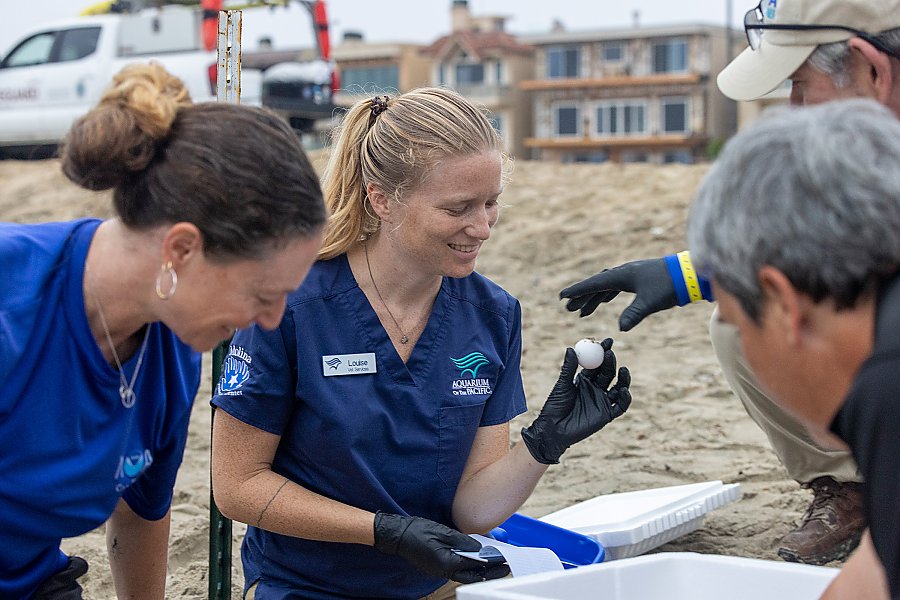
Biologists were called to the sandy beaches of Seal Beach where an olive ridley sea turtle was seen nesting for the first time ever. With another hurricane in the Pacific now threatening coastal flooding, Flocken authorized biologists on his staff to jump into action and rescue the sea turtle eggs.
Olive ridleys are also among the smallest sea turtles and are found in the tropical and warm waters of the Pacific, Atlantic and Indian oceans. Their closest known nesting locations were 700 miles south in Mexico before the most recent discoveries.
Flocken said this was the first recorded occurrence of an olive ridley sea turtle nesting on a southern California beach.
In addition, the aquarium said later it found yet another olive ridley sea turtle nest farther south near Huntington Beach.
Both nests have now been moved, along with about 200 Ridley sea turtle eggs, to the Aquarium
The Aquarium of the Pacific has been authorized by U.S. Fish and Wildlife to rescue sea turtle nests when they are threatened, as well as ill or injured sea turtles, said Flocken.
The organization announced that it moved olive ridley sea turtle nests on Southern California beaches.
“As animals adapt in unexpected ways to changes in their natural world, humans will need to adapt and make space to ensure endangered and threatened species are given a fighting chance,” said Flocken.
“If they successfully hatch, these baby turtles may one day return to nest to carry on future generations on these very same beaches, giving us a remarkable opportunity to help a species expand its range and thrive,” he added.
Biologists from U.S. wildlife agencies say Aquarium staff will care for the eggs during their forty-five-to-sixty-day incubation period. If the eggs successfully hatch, the young turtles will be released on the beaches where the eggs were laid to make their journey across the sand to the ocean.
Hazardous surfing conditions, beach erosion, and flooding could destroy or wash away the nests as Hurricane Polo approaches.
Biologists from U.S. wildlife agencies overseeing the eggs’ protection believe the option with the highest chance of survival is to collect them and hatch them under human care.
They are being held in sand-filled containers in a quiet, private area at the Molina Animal Care Center, where staff will carefully monitor and maintain temperature and humidity during incubation.
“This is an unprecedented situation, and we’re proud to provide a temporary home for these eggs as they incubate,” said Dr. Lance Adams, veterinarian at the Aquarium of the Pacific. “We’re hopeful that this will lead to a successful hatching in the near future and a successful release back to the wild.”
These nests were the first-ever recorded nesting of olive ridley sea turtles in California. It is not known why these turtles chose Southern California beaches as nesting sites, but it may indicate an important historical change with long-term implications for the species and for local sea turtle management and protection.
Olive ridleys are one of the smallest sea turtles, found in the tropical and warm waters of the Pacific, Atlantic, and Indian Oceans. Mexico’s Pacific coast arribada breeding populations are listed as endangered under the Endangered Species Act, and all others are listed as threatened. We are at the peak of the nesting season for olive ridleys in Mexico, which runs from July to December.
Additional turtles may nest or have already nested on Southern California beaches. The public should watch for sea turtle tracks in the sand. If the public sees a sea turtle nesting, in distress, or suspects they have found a nest, they should call the 24/7 West Coast Sea Turtle Stranding Hotline: 562-506-4315. Keep a safe distance from wildlife.