

The launch of the Artemis II rocket from Cape Kennedy this week reminded many of a time in America when our political divisions were contained, and our ambitions were greater than our fears.
According to NASA, the moon-bound launch of the towering rocket was the American space program’s most-watched event in modern history.
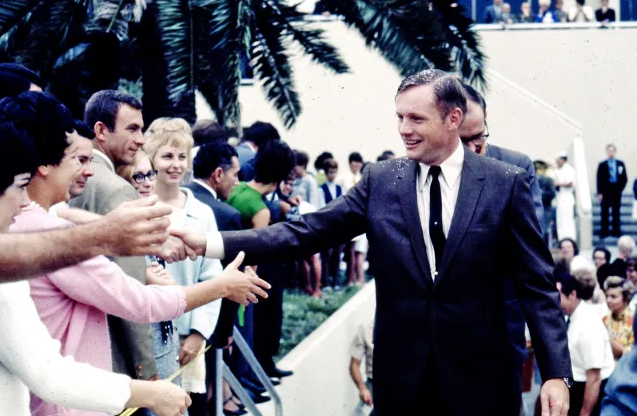
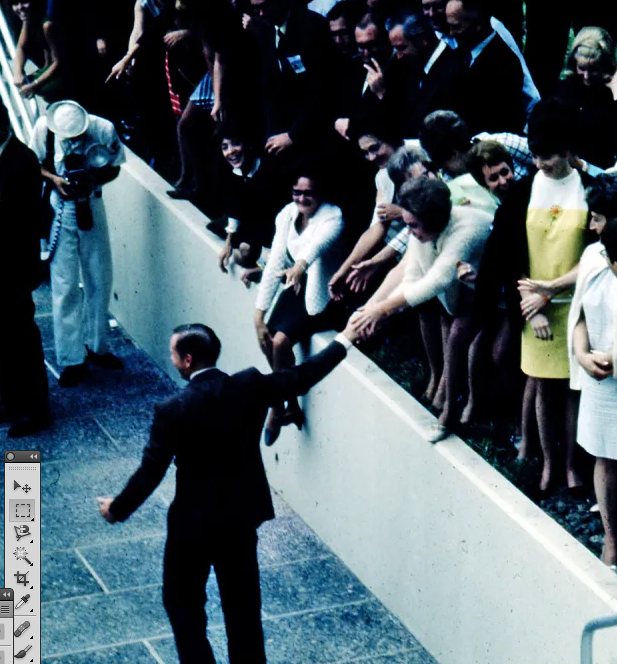
It’s hard to believe that almost 60 years ago, Seal Beach was so central to the program that the first man who walked on the moon, Neil Armstrong, and his fellow astronaut Michael Collins, were given rock-star welcomes to a rock-star welcome in September of 1969.
Astronaut “Buzz” Aldrin, another member of the crew, did not attend the international “Goodwill Tour,” according to NASA records.
Just months earlier, on July 20, at 7:56 p.m. PDT, Armstrong had slowly backed down the ladder of the lunar module before carefully stepping onto the moon. Once there, he uttered what factinate.com calls the most famous one-liner in history, “one small step for man, one giant leap for mankind.”
What is less remembered, however, is that much of the technology, including the awesome second stage of the Saturn rocket booster that took them there, was engineered and built in a highly secure building on Seal Beach Boulevard that no longer exists.
The astronauts splashed down in the Pacific Ocean about 900 miles west of Hawaii on July 24 and spent almost a month in quarantine before launching the goodwill tour, according to NASA.Each of the astronauts has been treated to a hometown parade in their honor, spoke before a joint session of Congress and finally attended a State Department briefing on Sept. 17 where they were briefed on the upcoming tour.
“We thank you, on behalf of all the men of Apollo, for giving us the privilege of joining you in serving – for all mankind,” Armstrong reportedly told the Congress.
President Richard M. Nixon dispatched an aircraft from the Presidential fleet to carry the astronauts and their wives around the world for the tour.
One of the more interesting stops before they arrived in Seal Beach was the Johnson Space Center, where they delivered 18 pounds of the rocks to be divided and studied by a convention of 142 “principled investigators,” including those from eight countries outside the U.S.
By Sept. 26, their U.S. Air Force V-137B landed in California for their visits to Seal Beach, then Downey.
The Boeing building on Seal Beach Boulevard was then owned by North American Rockwell (NAR), Space Division, just across the Boulevard from the ten-story tower where the Saturn second stage was being constructed.
Rockwell was a key contractor in the Apollo program as executives recall watching over projects in Seal Beach, Huntington Beach and nearby Long Beach from the massive windows on the top floors of the building.
Armstrong and Collins visited two North American Rockwell (NAR) Space Division facilities in California that built parts of the Saturn V rocket and Apollo 11 spacecraft.
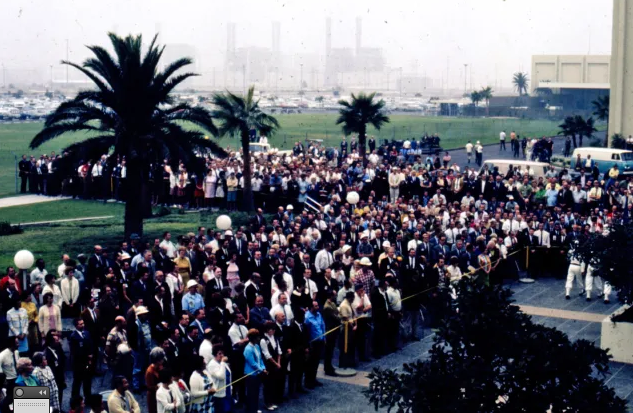
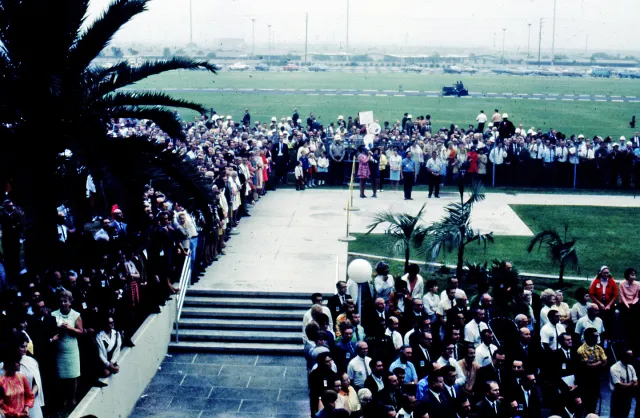
First, they stopped at the Seal Beach plant that built the S-II second stage of the rocket, where 3,000 employees turned out to welcome them.
According to NASA, Armstrong commented to the assembled crowd that during the July 16, 1969, liftoff, “the S-II (booster built in Seal Beach gave us the smoothest ride ever.”
Collins, when he spoke, added that despite earlier misgivings about using liquid hydrogen as a rocket fuel, “after the ride you people gave us, I sure don’t have doubts any longer.”
For the hundreds of technicians, engineers, scientists, and administrative personnel from around the U.S. who had migrated to Seal Beach and the area to work in the program, it was a stunning achievement.
According to a post left by Michael Dobkins on a Seal Beach history blog, Armstrong “was already looking to the future” by seeing the day when larger spacecraft would become “good mediums” for cooperation between nations.
Artemis II includes the largest capsule ever built and includes an international team of astronauts.
Following the ceremonies in Seal Beach, the two Apollo 11 astronauts drove to Downey, where the command module was built, and thousands more were waiting to celebrate their monumental achievement.