

The Aquarium of the Pacific is home to one of the most diverse collections of sea jellies in the United States.
Due to the ground-breaking work of its staff, the Aquarium propagates and raises over forty species in unique spaces specially designed for each stage in the jelly life cycle. Staff members also culture or grow the nutritious food that the sea jellies need to thrive in each of their life stages.
These efforts are all part of the Aquarium’s commitment to sustainable aquaculture or the cultivation of aquatic species and providing state-of-the-art care to all of its animals.
Jellies are housed in special aquariums designed to meet their specific needs. In addition to the curved shape of their home, jellies also need just the right water flow—not too strong to injure their delicate bodies and not too weak to ensure they are allowed to naturally drift. Aquarium staff members also carefully monitor other habitat parameters, including lighting, water temperature, salinity, pH, and more. Achieving the right conditions for jellies to thrive takes a team—animal care, veterinary services, water quality, and life support. The animal care staff monitor the health of the jellies daily.
The sea jellies are also part of the Aquarium’s overall animal welfare assessment program, where each jelly is assessed based on a five-point scale on body condition, feeding response, growth, water parameters, and more. This data is recorded and discussed with the animal welfare committee.
As an Association of Zoos and Aquariums (AZA) accredited organization, the Aquarium of the Pacific meets and exceeds the rigorous standards of care set for sea jellies. The Aquarium participates in AZA’s Aquatic Invertebrate Taxon Advisory Group to help further knowledge about these gelatinous creatures and other invertebrates (animals without backbones).
Sea jellies have no heart, brains, or lungs and existed on Earth before the time of dinosaurs. They have been around for more than 500 million years and have adapted to every ocean environment on Earth. Sea jellies are not fish, but invertebrates – animals without backbones. There are approximately 200 species of true jellies, and they are relatives of sea anemones and corals. Jellies range in size from those not much larger than a pencil eraser, to those longer than a blue whale. Sea jellies also come in many different colors, including green, blue, purple, and orange. A group of sea jellies is called a smack.
Jellies are composed of protein, mineral salts, and ninety-five percent water. Jellies have three main parts: the round, umbrella-like bodies or bells with a network of nerve cells, which propel the animals with a pulsating motion; tentacles equipped with nematocysts that sting and immobilize prey; and oral arms or flaps that are used to transport their prey to feed on it and to brood their young. Sea jellies mostly eat zooplankton, small crustaceans, fish, or other sea jellies depending on their species.
Depending on the species, a sea jelly may have up to 1,200 tentacles. Some jellies wield a potent sting, but you can safely touch others at the Aquarium of the Pacific on its Harbor Terrace. Some jellies are also indicator species whose presence can inform on if ocean water is clean or polluted.
The life span of a sea jelly varies depending on the species. Some only live a few months and others live several years. The average life span of a sea jelly is about one year.
Jellies clone themselves to reproduce. The Aquarium’s aquarists have successfully cultured numerous species of jellies.
Below is a list of some of the species you may see throughout the opening year of Jelly Dreamscapes. This will be a dynamic exhibit where guests can see different species depending on when they are visiting the Aquarium.
Moon jelly (Aurelia coerulea)
The Asian moon jelly is one of the most widely distributed species of sea jellies found in our World Ocean. This species can quickly populate areas and reduce the amount of zooplankton by consuming it. They are believed to be originally from the northwest region of the Pacific Ocean and that humans unintentionally introduced them to Europe via maritime or shellfish transport. This species can be white to brownish pink. Its bell can reach over ten inches in diameter. This jelly reaches around two inches in length. They produce an antioxidant compound that scientists are studying for its beneficial properties.
GeoRange: Northwest Pacific Ocean and introduced to Europe
Blue lion’s mane jelly (Cyanea lamarckii)
When they are young, this sea jelly is typically white to pale yellow. As they grow, they develop more of a color, which can range from grey to blue to purple. They use their up to 800 stinging tentacles to capture phytoplankton, zooplankton, and even other jellies to feed on and also for protection from predators. The bell of the blue lion’s mane jelly can grow to nearly twelve inches in diameter. They have oral arms that can reach the same length as their diameter. They are regularly observed in coastal waters off the British Isles.
Geographic range: Mainly in the Northeast Atlantic Ocean, primarily near European coasts
Brownbanded moon jelly (Aurelia limbata).
This cold-water species of jelly is most commonly found in the Northern Pacific and Arctic Oceans but can sometimes be found in nearby temperate seas. They inhabit coastal and open ocean waters. The Brownbanded moon jelly tends to be translucent to off-white in color with a brown edge around its bell, which differentiates it from other species of moon jellies. It can grow up to twelve inches in diameter and since they are not known for their length, it is not commonly reported on. Their food sources include larval crustaceans called decapods. At the Aquarium, they have a varied diet, including krill, artemia, and more.
Geographic region: Mainly the northern Pacific Ocean and Arctic Ocean
California sea gooseberry (Hormiphora californiensis)
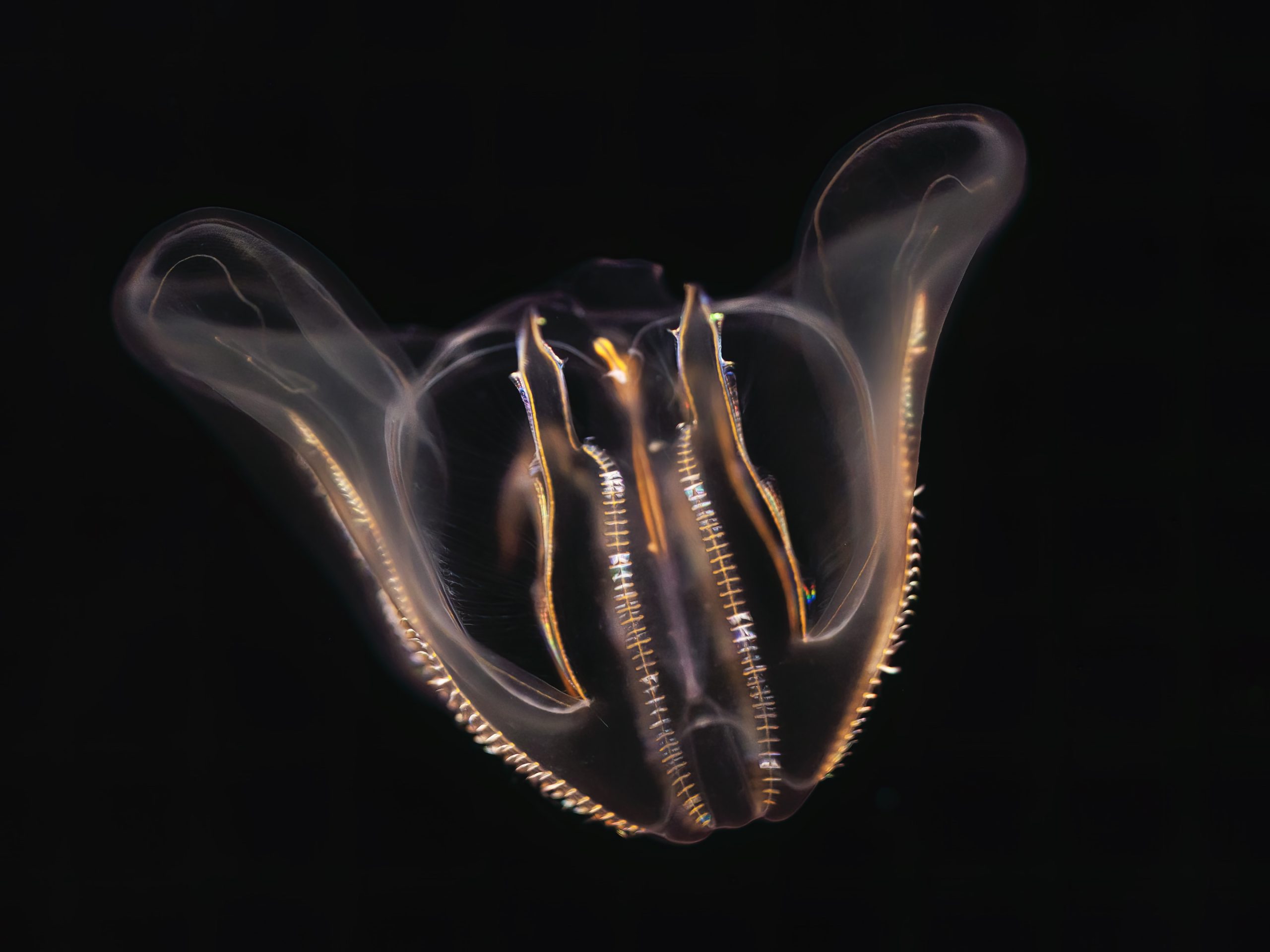
This species of comb jelly or ctenophore has tiny hairlike structures called cilia that run down its sides. When light refracts on their cilia, it can resemble strings of glowing lights. Comb jellies are believed to be among the earliest animals on Earth. They are not true jellies and are instead planktonic animals, which feed on other planktonic animals such as copepods and other plankton.
The California sea gooseberry has an oval-shaped gelatinous body that can reach up to an inch in length and is translucent.
Geographic Range: Common off the California coast, including the coast of Long Beach
Marbled jelly (Lychnorhiza lucerna)
As this jelly grows, its bell becomes flat like a dish that can grow up to nearly twelve inches in diameter, but the average is approximately nine inches. They are translucent with a dark edging around the base of their bell and can sometimes have a pale brownish marbling on the bell. Young crabs use the inside of their bell as a nursery. They lack long marginal tentacles and instead have complex oral arm structures. The marbled jelly has eight oral arms, with those reaching five to nine inches in length. Marbled jellies feed on zooplankton and larger ones may eat shrimp and even other jellies. They can be found in shallow waters off the east coasts of South America and in estuaries in that region. This species of sea jelly often becomes stranded on beaches.
Geographic range: Tropical and subtropical waters of the western Atlantic Ocean (native to Atlantic coasts of South America)
South American sea nettle (Chrysaora plocamia)
As with most other jellies, the tentacles on this jelly have small, barbed stingers called nematocysts that release a toxin to immobilize their prey. They feed on zooplankton, larval fishes, and even other jellies. The bell of this jelly can grow up to around twelve inches or more in diameter and six feet or more.