

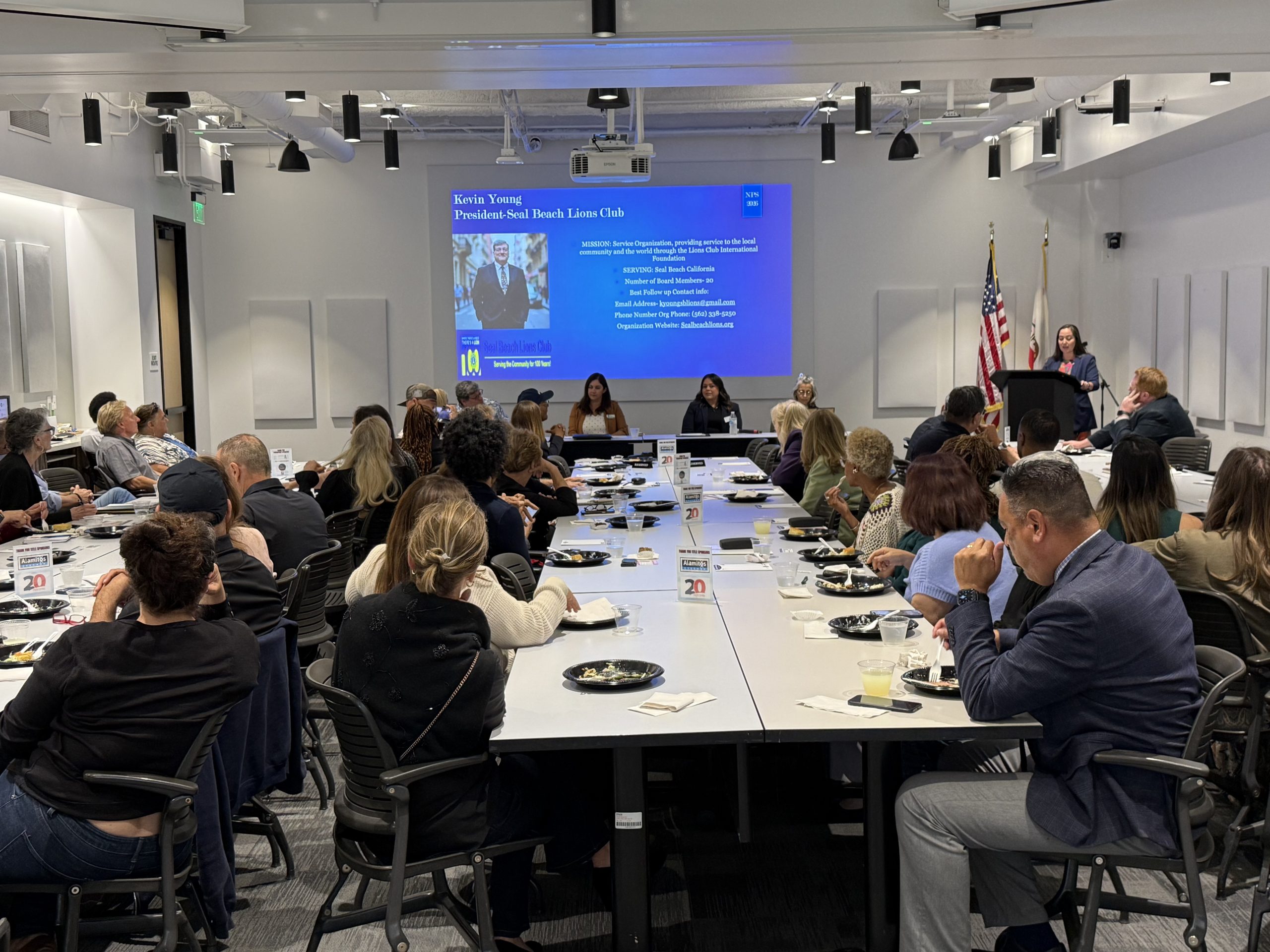
The role nonprofit organizations play in our community again took center stage at a joint meeting of the Los Alamitos and Seal Beach Chambers of Commerce held this week inside the Epson America meeting hall.
Los Al Chamber President Richard Barnes thanked the audience of business leaders, community members, and nonprofit professionals from across the Los Alamitos, Seal Beach, and Cypress areas for their participation.
The panel featured four nonprofit executives representing a cross-section of the region’s service sector, from emergency youth shelter to food rescue to international civic service, each making the case that strong boards are not a luxury but a lifeline.
The four nonprofit panelists included Diana Lara, Executive Director of Food Finders.
Food Finders operates as a food rescue organization, collecting perishable donations from grocers, manufacturers, growers, and food service providers and delivering them directly to nonprofit partners across LA, Orange, San Bernardino, and Riverside counties for same-day or next-day distribution. The organization also runs a Food for Kids program.
Lupita Gutierrez, Executive Director of CASA Youth Shelter, brought more than 15 years of connection to an organization she described as “very near and dear to my heart.”
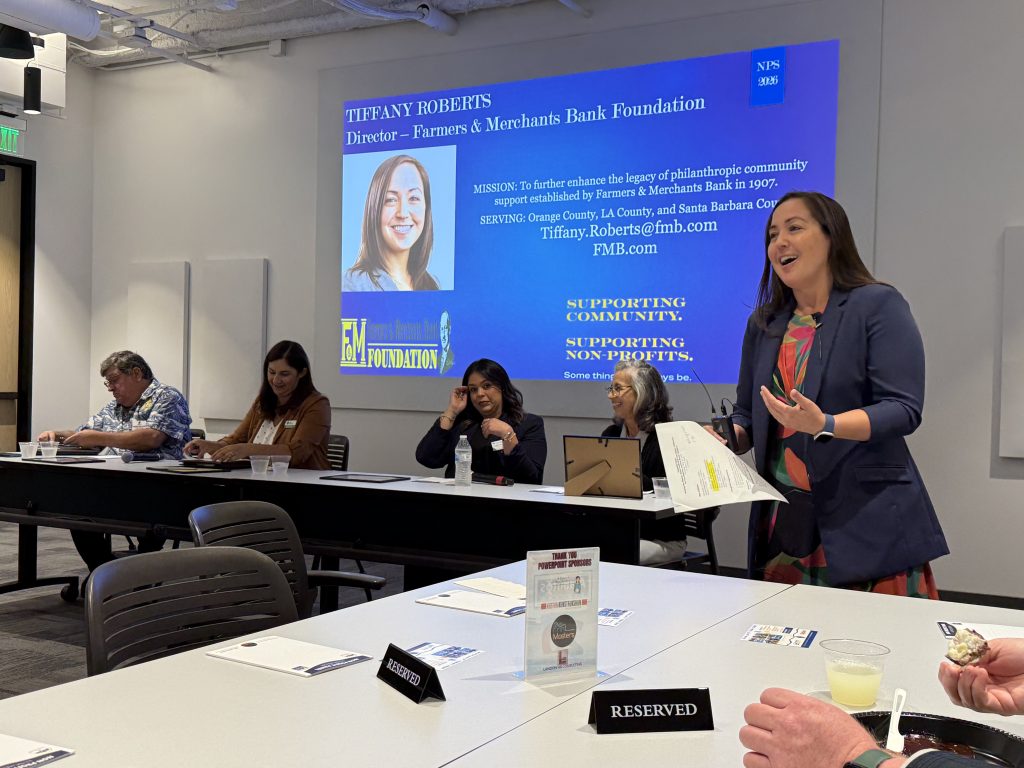
(L-R) Kevin Young, Seal Beach Lions Club, Michelle Byerly, Executive Director, The Nonprofit Partnership, Lupita Gutierrez, Executive Director, Casa Youth Shelter, Diana Lara, Food Finders and Tiffany Roberts, F&M Bank Foundation, the moderator.
CASA Youth Shelter serves young women in crisis, she said, describing them as “the most vulnerable population,” caught between adolescence and adulthood.
Michelle Byerly, Executive Director of The Nonprofit Partnership (TNP), leads an organization founded 34 years ago by a group of executive directors who recognized that nonprofits themselves needed support to be effective.
She said the Partnership serves approximately 1,000 nonprofits annually across Southern California through workshops, consulting, grant administration, and convening.
Kevin Young, President of the Seal Beach Lions Club, said their organization represented a different model entirely, a service organization rather than a traditional nonprofit, but one with formidable reach.
The Seal Beach club counts over 400 members, making it the largest Lions Club in the Western Hemisphere, with members ranging in age from 19 to their 90s and a membership that is 51 percent women.
Tiffany Roberts, Director of the Farmers and Merchants Bank Foundation, served as moderator of the Los Alamitos Chamber’s Nonprofit Board Leadership Forum.
Roberts directed much of the discussion around the various boards and directors of these nonprofit organizations, comparing them to “steering wheels” in autos.
“When we look at cars, we think about engine power, interior design, exterior design,” she said, noting that “in the nonprofit world, the board is like the steering wheel. It doesn’t power the engine day-to-day; that’s what the executives and their staff are doing. But without the steering wheel, the organization can drift, stall, or even head straight into a ditch.”
Roberts steered the executives into a discussion about the roles played by board members of each organization.
Byerly was direct: “The board’s job is governance, not management. They set the direction, they ensure accountability, they protect the mission. They are not there to run the programs,” she said.
What boards are expected to provide, across all four organizations, fell into recognizable categories: strategic guidance, financial oversight, fundraising, and access.
“The board is your connector,” Lara said. “They open doors that staff can’t open on their own.”
Gutierrez described the board’s role at Casa Youth Shelter in terms of what the young women served by the organization see in board members.
“When our board members come to an event and interact with the young people, those kids see that there are adults in the community who care about them. That matters more than any program we can design,” she said.
Young said his club represented a different model entirely, a service organization rather than a traditional nonprofit, but one with formidable reach. He said the club manages roughly 150 to 160 projects annually, from vision screenings and graffiti removal to beach wheelchairs, rescue drones, and the restoration of a World War II submarine memorial on Seal Beach Boulevard.
“We have everything from just going and cooking hamburgers and hot dogs,” Young said, “to some big fundraising projects.”
The Seal Beach Lions Club’s board has 21 members, drawn from across the community, he said.
The panelists also described in some detail what board members do for the organizations they serve.
Byerly reinforced the accountability dimension. “The board holds the executive director accountable. And the executive director, in turn, is the one resource the board directly manages. Everything else flows from there.”
Roberts wondered if some boards have a “Give, get or get off,” board strategy, asking each panelist about what board service actually requires.Young offered the Lions Club perspective, saying a dues structure had replaced traditional board members’ giving expectations, and where the real currency is time and active participation in Lions Club projects.
“We want people who show up,” he said.
Gutierrez was candid about what that looks like in practice: “I’m going to be honest with you. If you join our board, I’m going to need you. Not just at meetings. I’m going to need you to answer a text sometimes. I’m going to need you to make a call.”
Lara described Food Finders’ current board as focused primarily on connections and strategic thinking during its rebuilding phase, with financial contribution expectations that are meaningful but tiered.
Gutierrez noted that Casa Youth Shelter asks board members to participate in its annual gala — one of the organization’s primary fundraising events — both as attendees and as ambassadors who bring others.
The panelists all agreed that not everyone who is asked to join a nonprofit organization board accepts the challenge.
The most common reasons people decline board service, they said, are time, perceived lack of expertise, and the fear of fiduciary responsibility.
Roberts addressed the last fear directly, noting that “when some people hear ‘fiduciary,’ they think it means they’re personally liable for everything. It doesn’t mean that. It means you have a duty to act in good faith, in the organization’s best interest, with the information you have. That’s a standard any reasonable person can meet,” she suggested.
On the time involvement concern, Byerly offered an interesting observation.
“Most people spend more time scrolling their phone in a week than a board commitment would require. This is about priorities, not availability,” she suggested.
Lara said serving on a nonprofit board does make board members “feel like they’re a part of a connected community.”
Young spoke to the depth of engagement that board service creates.
“When you’re a member, and you just go to the meetings and go to a project, sometimes you don’t understand what’s going on. But if you take that step and get involved in the board, it’s a deeper commitment, you learn more, you get more out of it,” he said.
Despite the challenge of serving on a board, all of the executives agreed that it has been their experience that personal fulfillment was always the result.
“When our board members come to our community marketplace and actually see the distribution (of food) in person, they just come away with such fulfillment. They’re like, ‘We know what you do, but to actually be a part of it makes a huge difference.’
That whole fulfillment is a big part of what board service is,” said Lara.
Gutierrez pointed to what that fulfillment looks like at Casa Youth Shelter.
Board members are seeing their dollars and their effort in action with the young people the organization serves, she suggested.
“It’s nice to get excited about something,” she said. “Find something that you’re passionate about, then it feels like you get to be a part of something instead of feeling like you have to go do something.”
“If you want fulfillment, connection, impact, and joy, it sounds like you might want to join a (nonprofit) board,” Roberts said with a closing summary.
Barnes thanked the panelists, the moderator, and the title sponsors, including CIU Networks and Landon HR Consulting, thanking also the executives of Epson America for its relationship with the business community and their participation in it.
The Los Alamitos Chamber of Commerce hosts regular forums, luncheons, and community events throughout the year. For more information on upcoming events or board service opportunities with the organizations featured in this story, contact the Chamber directly, or reach out to Food Finders, Casa Youth Shelter, The Nonprofit Partnership, or the Seal Beach Lions Club.
This event was jointly hosted by the Los Alamitos and Seal Beach Chambers of Commerce.